Editorial responsibility for this article rests with Wuhan Ooi Photoelectric Technology Co., Ltd. Written and reviewed by the Ooitech editorial team. See our editorial policy for how we write, where AI tools are used, and how to request a correction.
Encapsulant by Cell Type: PERC, TOPCon, HJT, BC
Table of Contents
Quick answer: The encapsulant is the one layer whose job changes every time the cell does. PERC asked the film to fight PID with a transparent front and a white back. Bifacial asked the back film to go transparent and hold back water. TOPCon moved the test from PID to UV and added acetic acid corrosion. HJT, the most delicate cell, asked for the cleanest, most water-tight film. BC put both electrodes on the back and asked the rear film to insulate and resist corrosion. CPIA figures put TOPCon at about 87 percent of the market in 2025, easing to about 69 percent by 2030 as BC climbs toward 23 percent. Every route is a different exam for the same material. A UNSW study adds one twist: damp heat failure often comes from contamination left on the cell during handling, not from the film, so a clean cell with plain EVA can beat a dirty cell with premium POE.
Choosing an encapsulant by a single film spec is a trap. The right film depends on the cell generation, and the cell generation keeps moving. Here is each technology mapped to the film it actually needs.
One film, many different exams
An encapsulant is not one product that behaves the same everywhere. It is a moving target whose job is set by the cell underneath it. Over the past decade the industry has run through several cell tracks, and each one handed the film a new set of questions. PERC asked about PID. Bifacial asked about transparency and water. TOPCon asked about UV and acid. HJT asked about cleanliness and water. BC asked about backside insulation. Film makers answer with EVA, POE and EPE in different mixes, and the answer that was right one generation ago is not automatically right for the next. Reading the roadmap before you read the film data sheet is the fastest way to buy the right material.
A market that has already turned N-type
The shift from P-type PERC to N-type cells is no longer a forecast, it is the installed base. CPIA figures collected by TaiyangNews put TOPCon at about 87 percent of the market in 2025, with BC at about 7 percent and HJT at about 2.6 percent. By 2030 the mix shifts again: TOPCon eases to about 69 percent, BC climbs toward 23 percent, and HJT reaches about 7.5 percent. For a film buyer the point is that the dominant technology sets what the film must survive, and the mix is still moving toward the routes that ask the most of the encapsulant.
| Technology | 2025 share | 2030 forecast |
|---|---|---|
| TOPCon | 87% | 69% |
| BC | 7% | 23% |
| HJT | 2.6% | 7.5% |
Why the film follows the cell share
The film that ships in volume is the film the leading cell technology can tolerate. When TOPCon crossed half the market, demand shifted away from plain single-glass EVA toward EPE and POE, because those are the films a TOPCon line can run without an acetic acid corrosion problem. A film buyer reads the cell share before the price list, because the share decides which films are stocked, quoted and supported.
PERC and the single-glass era
In the single-glass, single-sided PERC years the layup was simple: a transparent EVA on the front and a white EVA on the back, over a backsheet, sealed in one lamination step. The front film had to transmit light and protect the cell, and the white back film reflected light back toward the cell. The headline test was PID, potential induced degradation, driven by system voltages of 1000 V or 1500 V in hot and humid conditions. The fix was an anti-PID EVA built on higher volume resistivity, which slows the ion migration behind PID. In this era the film job was mostly about electrical isolation under voltage, and UV was a secondary concern. The single-glass build placed fewer demands on the film, and the water and UV questions that later came to dominate had not yet arrived.
Bifacial makes the back film see light
Bifacial changed the back of the module completely. Once the cell also generates from the rear, the white back film is no longer allowed, because it would block the light the rear side is meant to collect. The back film must be transparent, and the module moves to a glass-glass build. That brings a new problem: moisture that seeps in from the edges of a double-glass module has nowhere to escape, so the film needs a higher water barrier and higher anti-PID performance than before. POE stepped in on its high water barrier, high volume resistivity and acid-free chemistry, and EPE, an extruded sandwich of EVA skins over a POE core, later took the middle ground to balance cost against those properties.
Why EPE took the middle ground
The POE answer was technically clean but expensive, and the EVA cost edge did not buy enough water and resistivity margin for a glass-glass module. EPE splits the difference: the co-extruded POE core supplies the water barrier and resistivity where they matter, while the cheaper EVA skins keep the stack economical and bond well to the glass and the cell. It is now the default for a large share of bifacial N-type modules.
When running glass-glass stacks with EPE or POE films, we regulate vacuum dwell times and platen heating curves to eliminate bubbles while preventing core resin displacement.
TOPCon moves the test from PID to UV
TOPCon changed the failure the film has to prevent. The cell is no longer as PID-limited, but it is sensitive to ultraviolet light, and the industry now watches for UVID, ultraviolet-induced degradation. The test conditions at Kiwa PVEL use a front UV dose of 120 kWh per square meter at 60 degrees C, roughly one to two years of outdoor exposure. Some PERC cells show UVID too, so it is not exclusive to TOPCon. On top of UV, TOPCon metallization is sensitive to the acetic acid that EVA can release, which corrodes the metal, so TOPCon lines have largely standardized on EPE or POE rather than plain EVA.
Three ways to handle UV
There are three basic routes. Transmit the UV to keep every photon for generation, which maximizes output but leaves the cell exposed, the highest-risk choice. Cut the UV to protect the cell, which loses the power the UV band would have contributed. Or convert it, using a downshifting agent to turn UV into a longer wavelength the cell can use, which aims for both but depends on the converter staying stable over the module life. Most formulas lean toward cut or convert, because transmitting raw UV to a UV-sensitive cell is a risk few module makers will take. The film spec has to state which route the formula takes.
HJT is the most delicate cell
Heterojunction cells put an amorphous silicon passivation layer, a transparent conductive oxide and a low-temperature silver paste on a wafer that never sees a high-temperature step. The whole process runs cold, and the finished cell is sensitive to water, acid and UV all at once. That pushes the film toward the POE class, which offers the water barrier and acid-free chemistry the cell needs. HJT is the route where cutting corners on the encapsulant shows up fastest, because there is no forgiving high-temperature step to burn off a mistake. The cold process is the root of that sensitivity: a conventional cell passes through a furnace that can drive off residue, but HJT is assembled cold, so anything the film releases, or anything left on the wafer, stays there.
To protect low-temperature heterojunction cells during encapsulation, we configure reduced thermal setpoints and uniform heat transfer across both chambers to cure the film without degrading temperature-sensitive layers.
The film is not the only culprit
A UNSW study from 2024, led by Sen and colleagues, found something that changes how to read HJT and TOPCon damp heat failures. When cells failed badly in damp heat, the main cause was often not the film grade but contamination left on the cell during production, sodium, calcium, chlorine and sulfur ions picked up from gloves and suction cups. Contaminated cells kept losing about 10 to 16 percent of relative power after 1000 hours of damp heat even when a high-quality POE was used. Cleaned cells, by contrast, degraded very little whether the film was EVA or POE.
Hidden fingerprints
The finding is awkward because the contamination is invisible. A cell can pass its electrical tests and still carry ions that a damp heat test will later mobilize. This is why two lines running the same cell and the same film can show very different results, and why film choice alone cannot explain a damp heat failure. N-type cells are sensitive to contamination all along the line, from the soldering flux to the gloves that handle the wafer. The lesson is to treat cell cleanliness as part of the encapsulant decision, not as a separate hygiene question.
BC keeps a clean front and a crowded back
Back-contact cells move both electrodes to the rear, which leaves the front free of the busbar and the grid lines, higher in efficiency and clean in appearance. The price is paid on the back: the positive and negative electrodes interleave at a fine pitch, so the rear film has to provide long-term electrical insulation between closely spaced polarities and resist damp heat corrosion. Some BC modules are all-black, which adds a color and covering requirement to the rear film so the module looks uniform from the front.
The all-black requirement
An all-black module hides the rear of the cell and the ribbon, so the back film has to do more than insulate, it has to cover. That means opacity and color fastness enter the spec alongside insulation and corrosion resistance, and the film has to hold all of them over the module life.
The roadmap in one table
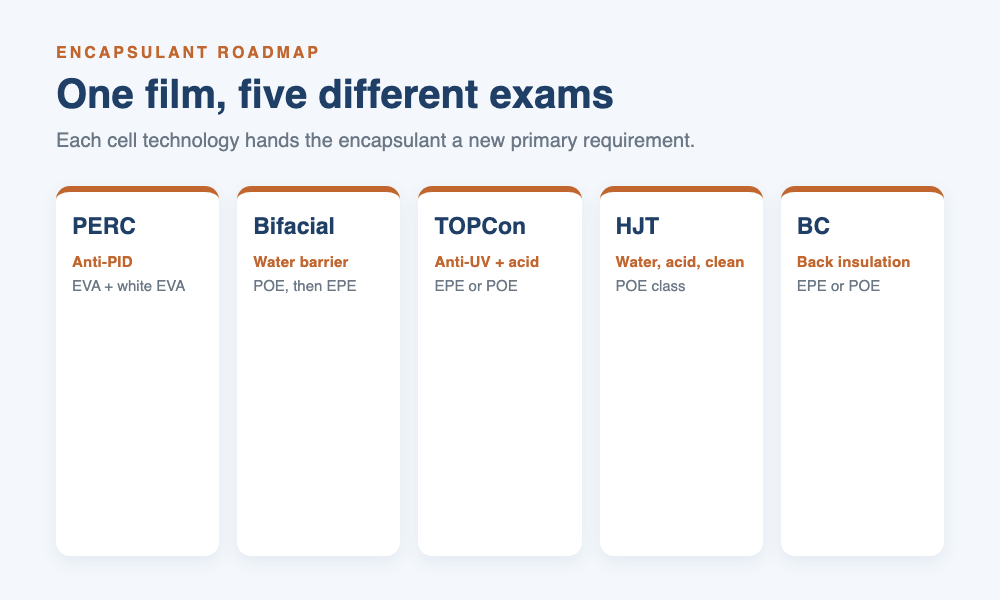
The pattern is simple once it is laid out. Each cell technology hands the film a primary question, and the industry has settled on a matching film answer. The table summarizes the roadmap.
| Cell route | Primary requirement | Typical film |
|---|---|---|
| PERC single glass | Anti-PID | Transparent EVA + white EVA |
| Bifacial glass-glass | Transparent back, water barrier | POE, then EPE |
| TOPCon | Anti-UV plus acid resistance | EPE or POE |
| HJT | Water, acid and cleanliness | POE class |
| BC | Backside insulation and looks | EPE or POE with covering |
The encapsulant roadmap. Each cell technology hands the film a new primary requirement, from PERC PID to BC backside insulation.
Beyond silicon, the tandem question
Perovskite tandem cells point to the next exam. They run at low temperature, need a strong water barrier and are sensitive to heat, so the industry is exploring thermoplastic encapsulants and edge sealing rather than the standard peroxide-cured films. This is still exploratory, but it shows the pattern holding: the cell changes, and the film has to learn a new answer. The film that wins the tandem era will be the one that answers the water and heat question cleanly, just as POE answered the bifacial question.
Where these numbers come from
The market shares, about 87, 7 and 2.6 percent for TOPCon, BC and HJT in 2025 and about 69, 23 and 7.5 percent in 2030, are CPIA figures collected by TaiyangNews and quoted in the source article. The Kiwa PVEL UV test of 120 kWh per square meter at 60 degrees C is the stated test condition. The UNSW damp heat finding, the 10 to 16 percent relative power loss and the 1000 hour duration, comes from the 2024 study by Sen and colleagues. These are figures from the source article and its references, not measurements from this site. The UV handling routes and film choices are qualitative industry practice, not a single specification.
Q: Does every cell technology need a different film?
Not a fully different chemistry every time, but a different spec. The core choices stay EVA, POE and EPE. What changes is which property the film has to lead on: PID for PERC, water barrier for bifacial, UV and acid for TOPCon, cleanliness and water for HJT, and backside insulation for BC. The same film family can serve several routes once the grade is matched.
Q: Why did the back film have to change for bifacial?
Because a bifacial cell also generates from the rear, the old white back film would block the light the rear side is meant to collect. The back film has to be transparent, and a transparent film in a glass-glass module also has to hold back moisture that seeps in from the edges, which is why POE and EPE replaced plain white EVA on the back.
Q: Why does TOPCon care about UV?
TOPCon is sensitive to ultraviolet-induced degradation, UVID. The Kiwa PVEL test exposes the front to 120 kWh per square meter at 60 degrees C, roughly one to two years of outdoor dose. The film has to either transmit, cut or convert that UV, and the choice changes both cell protection and power output.
Q: Why is POE preferred for HJT?
HJT is built in a low-temperature process and is sensitive to water, acid and UV at once. POE offers the high water barrier, high volume resistivity and acid-free chemistry the cell needs, with no high-temperature step to burn off a film mistake. That makes POE the safer default for HJT.
Q: Does a better film fix damp heat failure?
Not always. The UNSW study found that contamination left on the cell during handling was often the real cause, and contaminated cells still lost about 10 to 16 percent after 1000 hours of damp heat even with a high-quality POE. Clean cells degraded very little with either EVA or POE.
Q: Why did EPE replace POE on many lines?
POE is technically clean but expensive, and plain EVA does not buy enough water and resistivity margin for a glass-glass module. EPE puts the POE core where the barrier is needed and wraps it in cheaper EVA skins, which keeps cost down while holding the water and resistivity performance.
Q: What does BC ask of the back film?
BC puts both electrodes on the back at a fine pitch, so the rear film has to insulate closely spaced polarities for the long term and resist damp heat corrosion. All-black BC modules add a covering requirement, so the film also has to hide the rear of the cell and stay color-fast.
Q: Is EVA dead for N-type modules?
No. EVA is still the workhorse for the front side of many modules and for single-glass builds where UV and PID are manageable. It loses ground where water barrier, acid resistance or UV protection are the deciding factors, which is where POE and EPE take over.
Final thoughts
The encapsulant follows the cell, and the cell keeps moving. A film spec written for PERC will not survive a TOPCon or HJT line unchanged. Before you compare EVA, POE and EPE on price, work out which exam the cell is asking the film to sit, and check that the cell itself is clean before you blame the film for a damp heat failure.
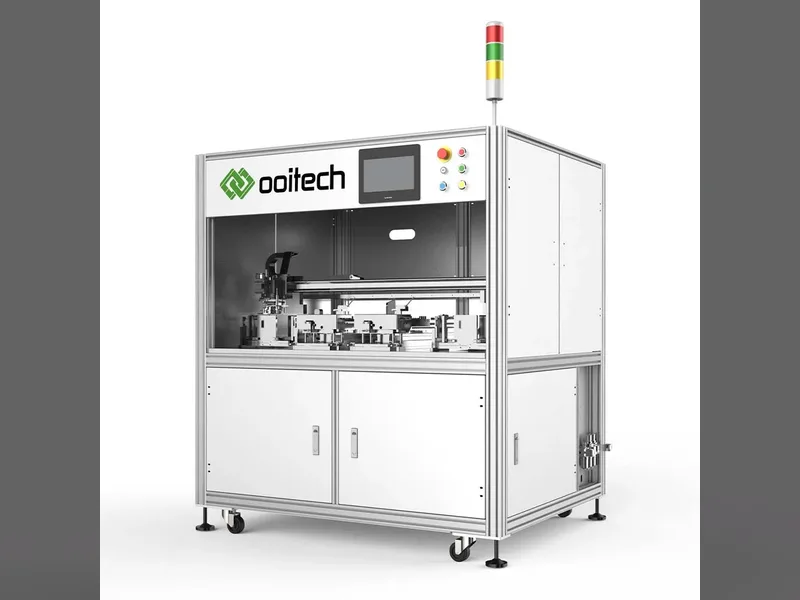
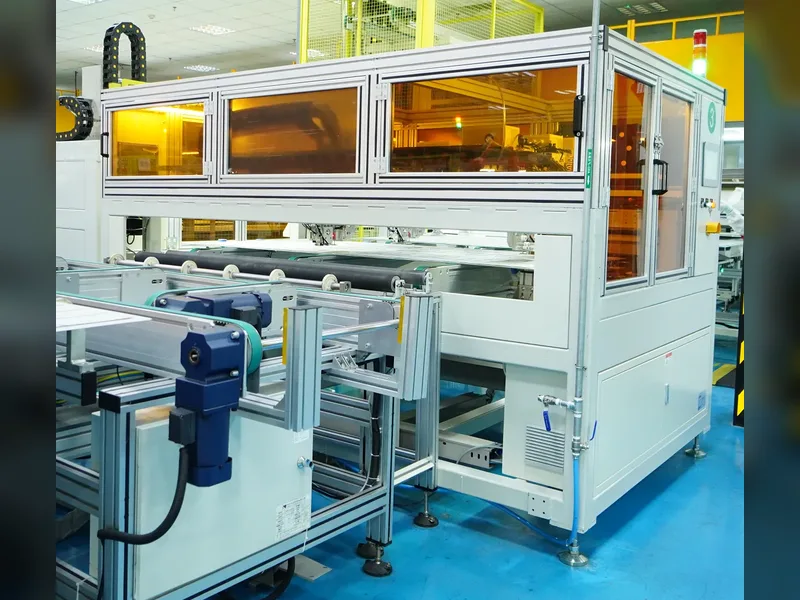
OOITech manufactures single and double chamber solar panel laminator machines with oil-heated or electric heating options to handle PERC, TOPCon, HJT, and BC module recipes. Send your drawings, module stack specifications, or test samples to our engineering team for cycle evaluation and parameter validation.