Editorial responsibility for this article rests with Wuhan Ooi Photoelectric Technology Co., Ltd. Written and reviewed by the Ooitech editorial team. See our editorial policy for how we write, where AI tools are used, and how to request a correction.
0BB Dispensing Glue Can Poison Encapsulant Crosslinking
Table of Contents
Quick answer: On a 0BB line the ribbon is pinned down before lamination by a row of tiny glue dots, each a fraction of a milligram. At the 145 to 155 degrees C lamination step the small molecules inside those dots migrate into the molten POE or EVA, and if any is an amine, a thiol or a phenolic inhibitor it interrupts the peroxide radical relay that builds the crosslink network. The result is a soft, under-cured ring around each dot, exactly where the ribbon needs the film to grip. The film passes its own incoming test, the glue passes its own test, and the module still fails later in thermal cycling or damp heat. The signature to look for is a gradient: gel content low at the dot and normal a few millimeters away. POE drops below its line first because it crosslinks about four times slower than EVA.
You see a soft ring around the ribbon and reach for the film batch. The film is usually fine. The more likely culprit is the glue dot that was meant to hold the ribbon still.
The soft ring around the ribbon
0BB removes the busbar and lays many thin ribbons straight onto the fine grid fingers, so the ribbon has nothing to hold it in place until the film cures. On most lines the ribbon is tacked down with a row of tiny glue dots, a UV or thermoset adhesive, so it does not drift while the string is stacked, moved and pulled into vacuum. Each dot weighs a fraction of a milligram, next to nothing against a film that weighs several hundred grams.
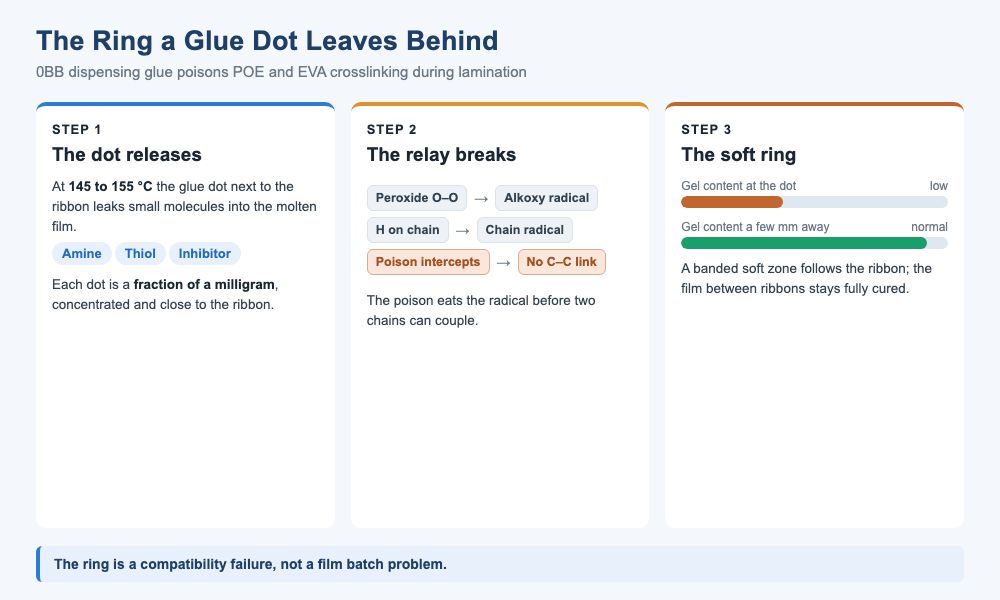
At lamination the plate runs near 145 to 155 degrees C, and the small molecules in the dot become mobile and diffuse into the film that has melted around the ribbon. If those molecules attack the peroxide that is trying to crosslink the film, the ribbon ends up sitting inside a ring of film that never finished curing. The signature is easy to miss because it is local: a few millimeters away the film looks and tests normal, which is why the first instinct is to blame the film batch rather than the glue.
We hold the platen between 145 and 155 degrees C with circulating thermal oil to maintain a steady temperature profile that prevents uneven diffusion while the film crosslinks.
How the film crosslinks, one relay
POE and EVA are thermoplastic. Uncrosslinked, they soften and flow at temperature, and uncrosslinked EVA begins to melt near 70 degrees C, a temperature a module backsheet reaches on a summer day. The film formula carries an organic peroxide, a peroxycarbonate such as TBEC, plus a co-agent such as TAIC. During lamination the crosslink reaction runs like a relay. Heat splits the peroxide oxygen-oxygen bond into an alkoxy radical. That radical abstracts a hydrogen from a polymer chain and hands the radical to the chain. Two chain radicals then couple into a carbon-carbon crosslink, and the co-agent helps pass the baton to more chains.
Crosslink level is read as gel content: the uncured part is extracted with a solvent such as xylene, and the insoluble share that remains is the gel content, measured to IEC 62788-1-6 or GB/T 29848. The industry rule of thumb is at least 75 percent for EVA and at least 60 percent for POE, with the film maker spec as the authority.
The extraction test splits the film into two parts: the crosslinked network that survives and the uncured chains that dissolve. A film that reads 75 percent is mostly a network, but the 25 percent that dissolved is material that never joined it, and that share is exactly where a poison leaves its mark. This is why gel content is the number to watch when a glue and a film meet.
Three poisons that break the relay
Anything that consumes the peroxide, or catches the radical and refuses to pass it on, breaks the relay. The additives inside a glue dot split into three classes.
| Poison class | Where it comes from | How it breaks the relay | What it leaves |
|---|---|---|---|
| Amine | Amine curing agents and accelerators in thermoset glue; amine co-initiators in some UV glue | Redox reaction with peroxide ignites it well below its normal decomposition temperature | Peroxide spent before the film melts and bonds |
| Thiol | Thiol-ene UV glue and thiol-cured epoxy | S-H bond donates hydrogen and chain-transfers, turning an active radical into a low-activity sulfur radical | Relay stops and crosslink efficiency drops sharply |
| Inhibitor | Phenolic inhibitors such as MEHQ or hydroquinone added for UV storage stability | Captures radicals and forms a stable product | Effective peroxide content falls as radicals are eaten one for one |
The path from a glue dot to a soft ring. The dot releases poison molecules at lamination, the peroxide relay stops, and gel content drops only in the ring around the ribbon.
Amine: lighting the fuse early
A tertiary amine pairs with peroxide into a redox initiator system, which is why amines speed up room temperature resins. In a film that acceleration is the wrong thing at the wrong time: the peroxide decomposes before the film has fully melted and bonded, and the radicals it releases are mostly quenched in side reactions.
The inhibitor class hides in plain sight
UV glue is a radical cure, so to keep it from polymerizing in the drum the formulator adds a phenolic inhibitor. This is the same class of radical-scavenging stabilizer that cancels peroxide radicals in a film. An undercured glue dot makes it worse, because the ribbon shadows the dot from UV, so the part that cures worst is exactly the part sitting against the film.
Why the ring follows the ribbon
The failure is shaped like the dot, not like the film. The dot is tiny but concentrated, and diffusion at lamination carries its additives only a short distance, so the poison concentration is highest at the dot and falls off outward. The peroxide in the film is dosed for a whole sheet that crosslinks evenly, with no spare budget for one spot that eats a large local share. The result is a roughly circular under-cured zone around each dot, and along a ribbon the zones line up into a band. In the worst case the ring barely crosslinks at all and dents under a fingernail.
The pattern reads back from the layup. Because the dots are spaced along the ribbon and the ribbon runs the full cell, the individual rings merge into a band or a string of beads that follows the ribbon, while the film between ribbons stays fully cured. That contrast, a banded soft zone on an otherwise hard film, is the tell that separates a compatibility problem from a recipe or batch problem, which would soften the whole sheet evenly.
Why POE drops below the line first
POE is the more exposed material. It crosslinks slower than EVA, and a rheology comparison puts the gelation rate of the more polar EVA at about four times that of POE. POE therefore runs a tighter crosslink window, and anything that steals radicals mid-relay pushes it under its pass line sooner than it would push EVA. The floors reflect this, 60 percent for POE against 75 percent for EVA, but a poisoned ring can fall under either.
What the ring costs after lamination
The ring sits where the module is most sensitive. Some 0BB routes depend on the film keeping the ribbon pressed onto the fine grid fingers after lamination, so a soft ring lowers that contact pressure and raises contact resistance, which reads as a false contact or a dark electroluminescence line. A low-crosslink zone also softens and flows again at temperature, letting the ribbon creep during thermal cycling, and uncured film can re-melt into bubbles and wrinkles that open a path for moisture. The trouble is the delay: initial electroluminescence and power look normal, and the problem only appears after damp heat or time in the field.
Each symptom shows up on a different clock. Contact loss and the dark line can appear within thermal cycling, because the soft ring relaxes every time the module heats. Bubbles and delamination take longer, since they need the uncured share to re-melt and gas or water to collect. Field failures are the slowest and the most expensive, because by then the module is on a roof and the film, the glue and the recipe have all passed their own tests.
Contact is the first thing to go
In the 0BB routes that rely on film pressure rather than a strong weld, the film is the spring that holds the ribbon on the finger. A ring that stays soft is a spring that gives way, so contact resistance climbs where the ring sits and the failure reads as a dark line along the ribbon rather than as a film defect.
Catching it before you laminate
The cleanest check is comparative sampling. On one laminate, cut samples from directly over a glue dot, from one to two millimeters beside the ribbon, and from a spot well away from the ribbon, then measure gel content on all three. A clear gradient, high far away and low at the dot, points at the glue. Two helpers back it up: differential scanning calorimetry reads residual exotherm, which differs where cure is incomplete and peroxide is left over, and infrared spectroscopy compares the peaks near the dot against the background.
We extract comparative samples one to two millimeters from the ribbon on test laminates to map local gel content variations before finalizing each thermal bonding recipe.
| Method | What it shows | When to run it |
|---|---|---|
| Comparative gel content | Gradient from low at the dot to normal a few millimeters away | Any time a soft ring or low peel appears near the ribbon |
| DSC residual exotherm | Leftover reaction enthalpy where cure is incomplete | As a fast screen for under-cure |
| FTIR near the dot | Changed peaks against the background film | To confirm what migrated into the film |
| Compatibility coupon | Gel content and peel at the dot versus a no-dot area | Before importing any new glue |
The coupon test
Before importing a new glue, build a small compatibility coupon: glass, film, a glue dot, film, backsheet, run through the normal lamination recipe, then measure gel content and peel strength at the dot against an area with no dot. It is cheap and fast, and it should be a fixed step in every dispensing glue import rather than something run only after a field return.
Keeping the relay running
Prevention splits across glue, film and process.
- On the glue side, prefer systems with no amine or thiol curing components, ask the supplier to disclose the inhibitor type and a rough loading, and pin down the required UV cure degree so the ribbon-shadowed part does not stay undercured.
- On the film side, validate the pairing with the film maker and choose a formula with more crosslink margin. In an EPE stack the skin that touches the dot matters most.
- On the process side, use differential scanning calorimetry or rheology to confirm the lamination time and temperature leave headroom instead of hugging the film spec floor.
- Treat any glue formula change, even a swapped inhibitor or co-initiator, as a change that triggers a fresh compatibility run.
One system, not two
A glue is usually qualified on its own terms: adhesion, cure speed, dispensing behavior and shelf life. A film is qualified on its own terms too: peel, transmittance, resistivity and gel content. Neither list contains the other material, so a pairing can pass every line on both sheets and still fail in the furnace. The missing test is the one that runs both together, which is why the compatibility coupon belongs on the import checklist next to the two material specs. In a 0BB module the two materials are no longer neighbors that happen to touch; they are one reaction system that either completes together or fails together.
Where these numbers come from
The lamination range of 145 to 155 degrees C, the gel content floors of 75 percent for EVA and 60 percent for POE, and the four times slower gelation rate for POE are industry-typical values collected from the source article and its references, not measurements we ran. The source cites a Fraunhofer study on how the peroxide TBEC, the co-agent TAIC and stabilizers affect encapsulant crosslinking, a Polymers paper on hindered amine stabilizers, and an SMM analysis of 0BB encapsulation cost.
The three poison classes, amine, thiol and inhibitor, come from polymer chemistry, not from a single published specification, and a specific glue behavior must be confirmed with the coupon test on your own laminate recipe. The one to two millimeter sampling offset is a practical guide, not a standard clause.
Q: Is the soft ring always the glue fault?
No. It is the leading suspect, but a film batch with low peroxide or a wrong lamination curve can leave a similar under-cure. The comparative gel content test separates them: a gradient centered on the dot points at the glue, while a uniform shortfall points at the film or the recipe.
Q: Why does POE fail before EVA?
POE crosslinks about four times slower, so its window is tighter and it has less margin against any poison that steals radicals. Its floor is also lower at 60 percent against EVA 75 percent, but a poisoned ring can push either below its line.
Q: What is in the glue that causes the problem?
Three classes: amines that ignite the peroxide early, thiols that chain-transfer and stop the relay, and phenolic inhibitors such as MEHQ or hydroquinone that capture radicals. A specific glue may carry one or more of them.
Q: Can I just use less glue?
Partly. A smaller dot and fewer dots shrink the poisoned zone, as long as the holding force still holds the ribbon. The chemistry matters more than the volume, so a clean formulation beats a smaller dose of a dirty one.
Q: How do I test a new glue before using it on the line?
Run the coupon test: glass, film, glue dot, film, backsheet through your normal lamination recipe, then measure gel content and peel at the dot against a no-dot area. Make it a fixed gate before import.
Q: Will the problem show in the first electroluminescence test?
Usually not. The ring often passes initial electroluminescence and power. It surfaces later as contact resistance rise, a dark line, bubbles or creep after thermal cycling, damp heat or field time.
Q: Does a higher lamination temperature fix it?
Not reliably. More heat can finish the cure but also drives more poison out of the dot, and it adds bubble, yellowing and energy cost. The safer fix is a compatible glue plus crosslink margin on the film.
Q: Is this only a 0BB problem?
It is most visible on 0BB because the ribbon is glued to the film and the ring sits on a contact. Any glue or tape that touches the encapsulant during cure can poison it, so the compatibility rule applies beyond 0BB.
Final thoughts
Evaluating a glue used to mean checking adhesion, cure speed and dispensing behavior. In the lamination furnace the glue and the film are one reaction system, and each side chemistry changes the other result. The compatibility problem is the quiet kind: both materials pass alone and fail together, late. Put the crosslink compatibility check next to the adhesion test, and the soft ring stops being a mystery.
OOITech manufactures single and double chamber solar panel laminator machines in both oil-heated and electric configurations to provide uniform thermal control during crosslinking. Send us your drawings, module stack, or coupon samples for evaluation, and our technical team will help you establish stable lamination parameters for your 0BB line.