33.25% Efficiency, 96% MPPT Retention After 1000 Hours:
Table of Contents
Quick answer: A perovskite-silicon tandem cell has reached 33.25% efficiency while retaining 96% of its maximum power point after 1000 hours of testing. That combination is the point: tandem efficiency records are no longer the constraint, stability is. The cell stacks a perovskite top junction over a silicon bottom junction so each absorbs the part of the spectrum it converts best, which is what pushes efficiency well past the roughly 27% ceiling of a single-junction silicon cell. The stability result involved damp-heat exposure at 85 °C, and the measurements used spectral ranges around 400 nm, 750 nm and 1150 nm. For module manufacturing, tandem cells impose tighter lamination windows than silicon alone, because the perovskite layer is more sensitive to moisture and temperature than the silicon beneath it.
PV Module Manufacturing · by Jerry, Ooitech
Product Introduction
Perovskite/silicon tandem cells have already hit 35% efficiency. The problem is stability. These devices are still far from the 25-year lifetime commercialization needs, and the root cause sits at the interfaces. Charge builds up there, and that buildup triggers redox reactions and ion migration.
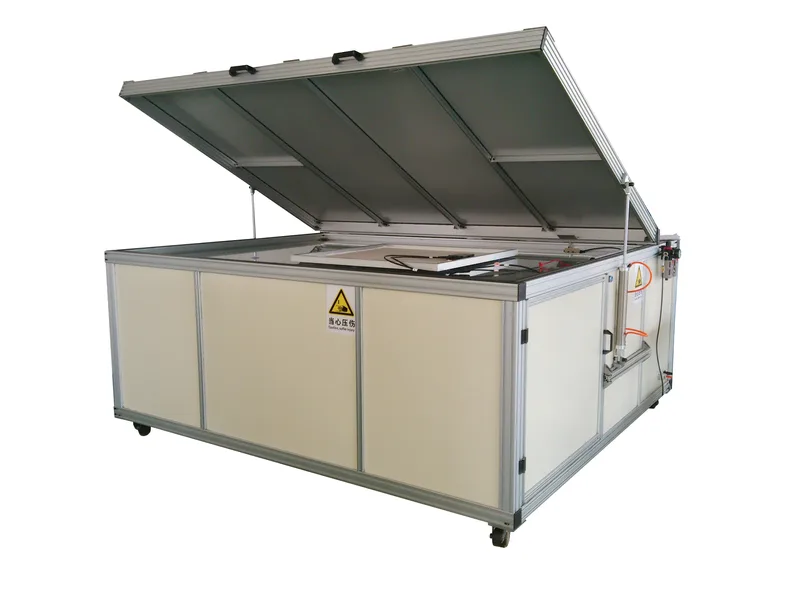
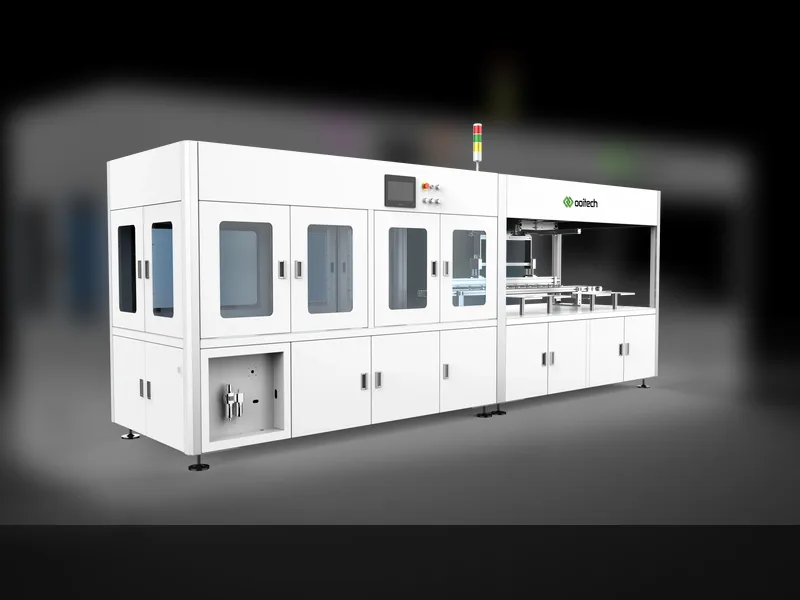
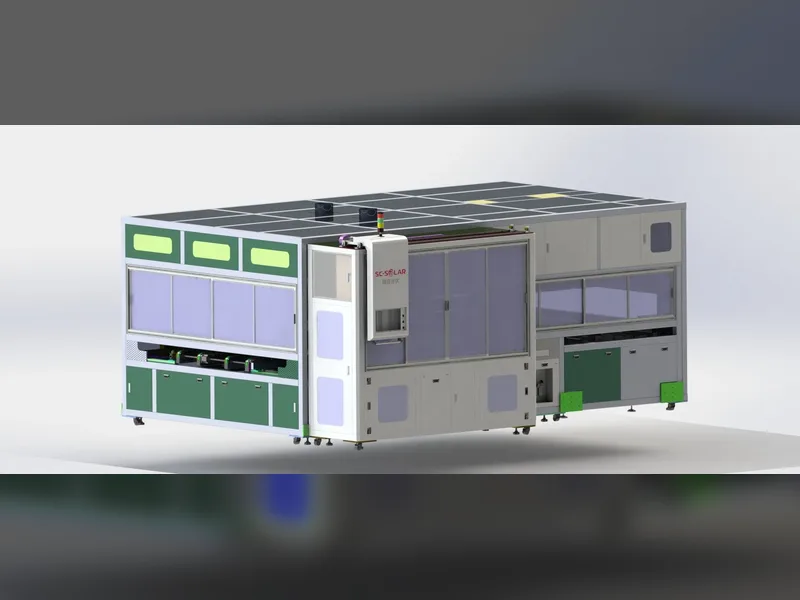
The widely used ALD-SnOx electron transport layer runs into a thickness trade-off because of its high resistivity. Too thick, and the series resistance climbs. Too thin, and it can't block sputter damage or ion diffusion. To study this, a perovskite composite MPPT tester using an AAA-grade LED solar simulator as the aging light source can control cell temperature in several ways and manage the surrounding environment, running long-term stability tests.
This work builds a SnOx/AZO bilayer through an all-ALD process. An ultrathin SnOx keeps the band alignment, while a conductive AZO layer gives a low-resistance path and acts as a dense barrier. That splits charge extraction and physical blocking into two separate jobs. Single-junction wide-bandgap perovskite cells with this structure reached 23.47% efficiency, and tandem devices hit 33.25%. After 1000 hours of continuous illumination they still held 96% of their initial efficiency, which backs up the interface strategy.
Technical Parameters
Perovskite Composite MPPT Tester Specifications
| Parameter | Specification |
|---|---|
| Light source grade | A+AA+ (3A+) LED solar simulator |
| Light source lifetime | 10,000 h+ |
| Spectral output (adjustable) | 350-400nm / 400-750nm / 750-1150nm, independently controlled |
| Environmental chamber | Optional constant temperature & humidity, meets ISOS standard |
| Electronic load | Multiple models, multi-channel independent operation |
| Application | Perovskite single-junction and tandem cell stability testing |
Technical Advantages
ALD Bilayer Fabrication and Electrical Performance
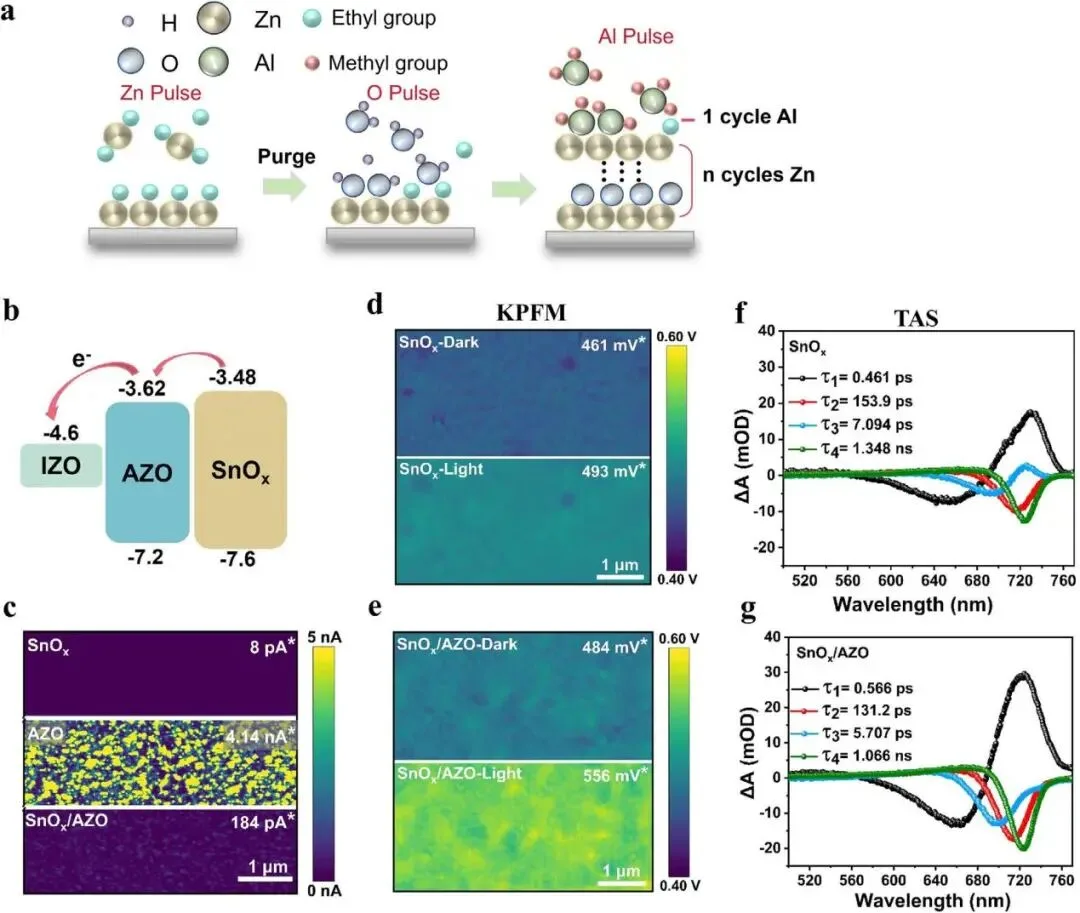
Single-junction tests showed SnOx performs best at 150 cycles. Going thicker raised series resistance and dropped the fill factor. To ease the resistivity limit, the authors added an ALD-grown AZO interlayer. Two stacks were compared: 250-cycle SnOx versus 100-cycle SnOx plus 400-cycle AZO.
J-V measurements showed the SnOx/AZO combination lifted device performance. Energy level analysis found the conduction band minimum steps down from SnOx to AZO to IZO, forming a more favorable staircase band alignment that lowers the interface extraction barrier. c-AFM showed SnOx/AZO and pure AZO conduct much better than pure SnOx. KPFM showed a more uniform surface potential and lower defect density on the SnOx/AZO perovskite film. Transient absorption spectroscopy confirmed faster carrier extraction with SnOx/AZO.
ALD Layer Suppresses Degradation
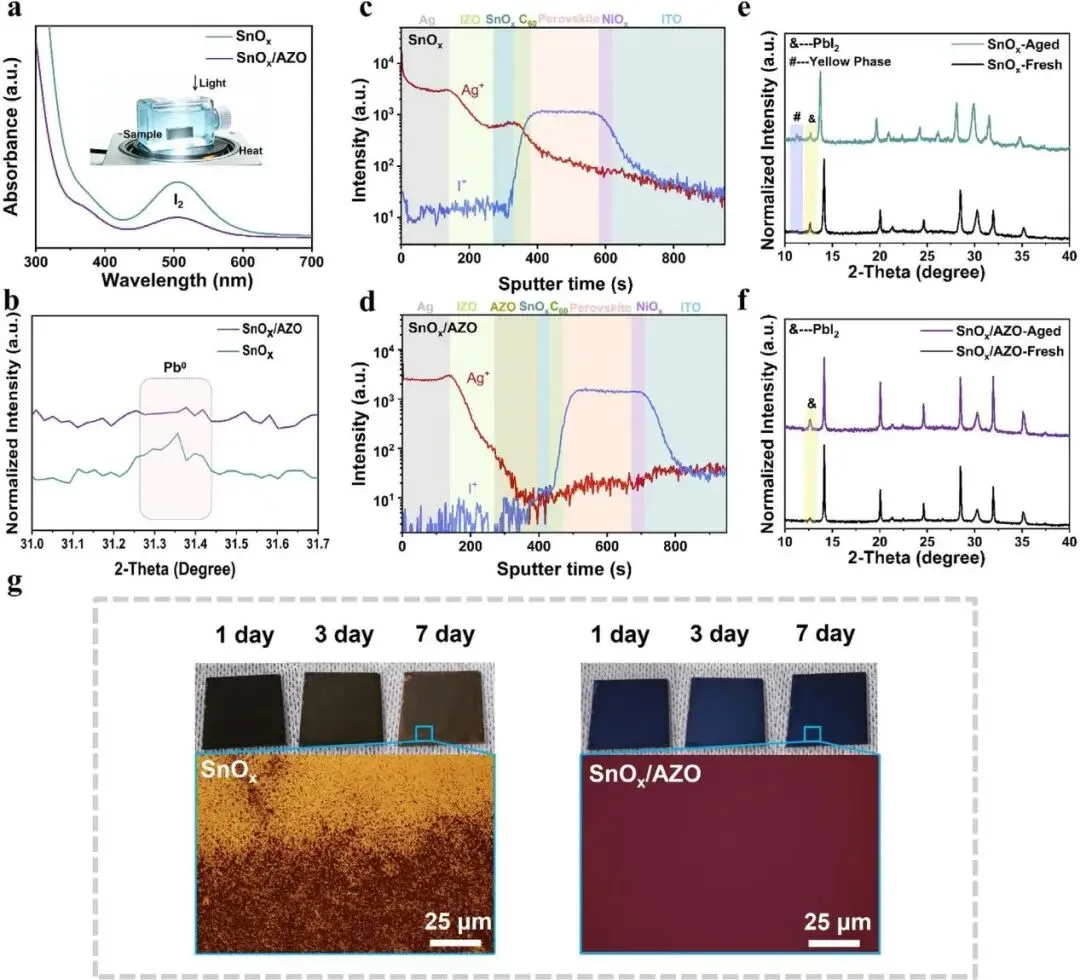
After 400 hours of aging at 85°C under illumination, the SnOx samples showed stronger lead iodide absorption in UV-vis, metallic Pb⁰ diffraction peaks in XRD, and interface voids plus bulk loss in cross-section SEM. In the SnOx/AZO samples, these degradation signs were much weaker. TOF-SIMS showed heavy Ag penetration into the perovskite layer and severe I⁻ diffusion in the SnOx devices, while the SnOx/AZO devices showed no obvious ion diffusion.
After 7 days at 85% RH, the SnOx-covered film developed a yellow δ phase, but SnOx/AZO stayed black. PLQY measurements showed lower non-radiative recombination loss and higher PLQY retention after aging for SnOx/AZO. KPFM showed a big jump in surface defect density for the aged SnOx sample, while SnOx/AZO barely changed.
Product Application
Single-Junction Cell Performance and Stability
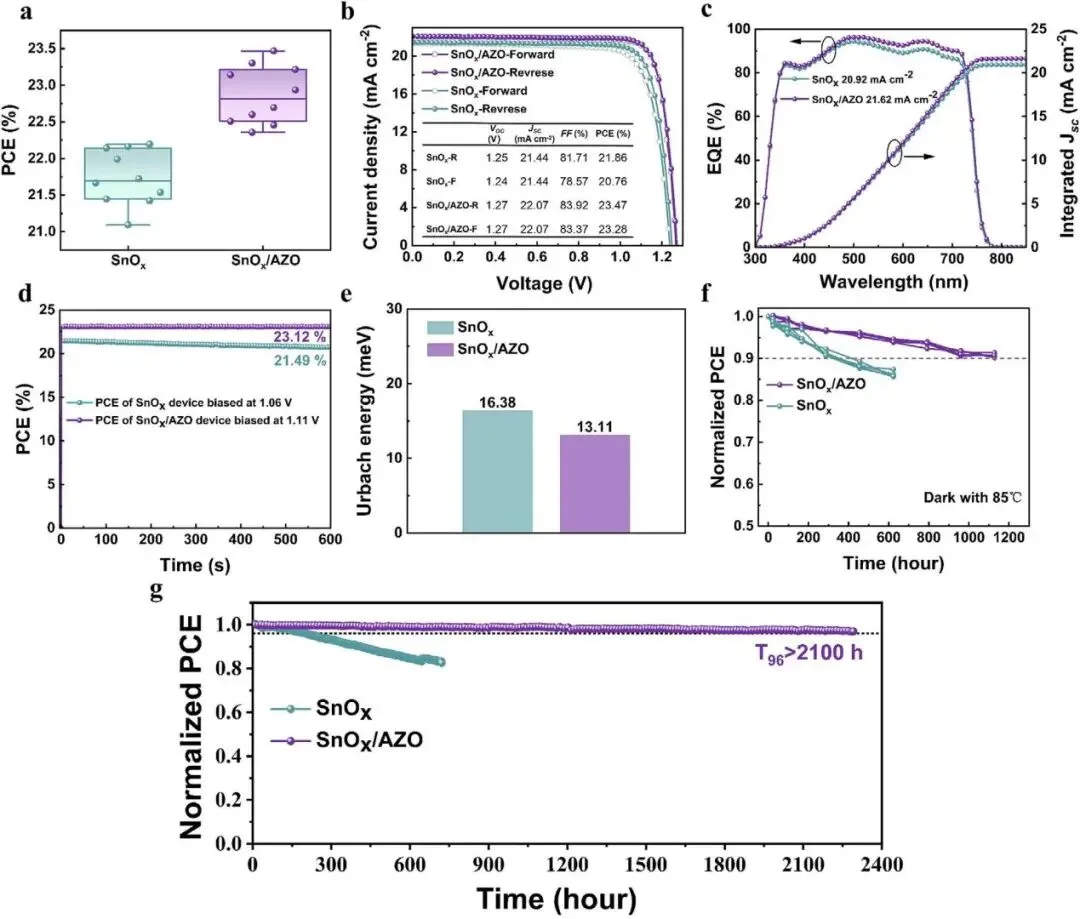
In single-junction devices with the structure ITO / NiOx / Me-4PACz / perovskite / C60 / ALD layer / Ag, the SnOx/AZO champion reached 23.47% efficiency, VOC 1.27 V, FF 83.92%, JSC 22.07 mA/cm², with hysteresis clearly reduced. The EQE-integrated current density was 21.62 mA/cm², above the SnOx device's 20.92 mA/cm². Stabilized power output was 23.12%. The Urbach energy came in at 13.11 meV, below the SnOx device's 16.38 meV.
On stability, after 1100 hours of dark aging at 85°C the SnOx/AZO held above 90% of its initial efficiency, while SnOx was down to 85% by 600 hours. Under 85°C with illumination, SnOx/AZO kept above 80% after 300 hours, while SnOx dropped below 60% after 200 hours. In MPPT testing, SnOx/AZO held 96% after 2000 hours, while SnOx fell to 80% after 700 hours.
Tandem Cell Performance and Stability
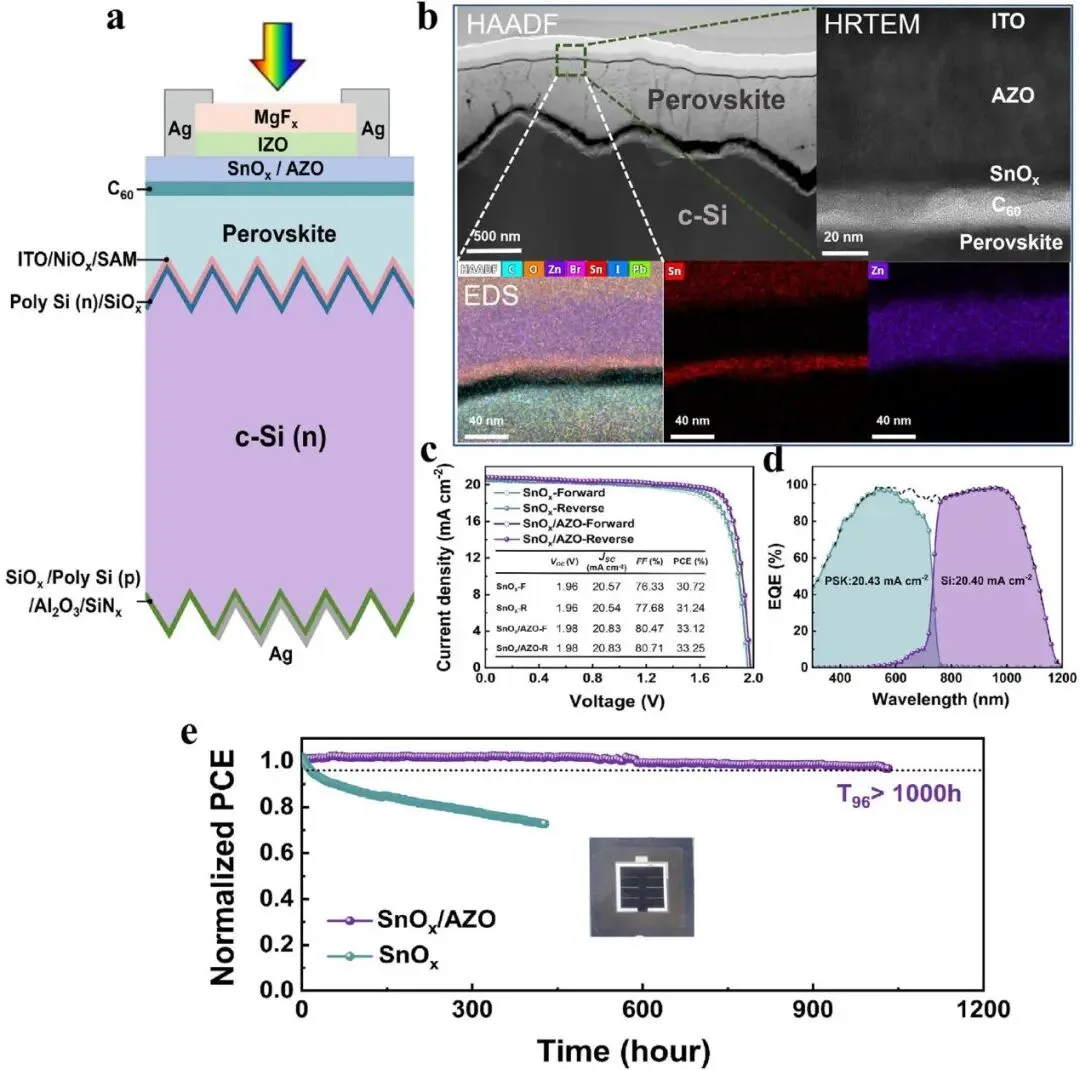
The ALD bilayer was integrated into a perovskite/TOPCon silicon tandem device. HAADF-STEM showed a continuous, dense bilayer with SnOx around 10 nm and AZO around 60 nm, no pinholes or delamination. HR-TEM confirmed the SnOx is amorphous, and EDS showed uniform Zn distribution in the AZO.
The champion tandem device reached 33.25% efficiency, VOC 1.98 V, JSC 20.83 mA/cm², FF 80.71%, with almost no hysteresis. EQE showed top and bottom cell photocurrents of 20.43 and 20.40 mA/cm², a good match. Stabilized power output was 32.38%.
After 1000 hours of thermal aging at 85°C the SnOx/AZO held above 90% efficiency, while SnOx dropped below 90% within 400 hours. In damp-heat testing (double 85), SnOx/AZO stayed above 92% after 400 hours, while SnOx fell below 80% within 200 hours. After 1000 hours of continuous illumination, SnOx/AZO held above 96%, while SnOx dropped below 80% within 300 hours.
Mechanism Summary
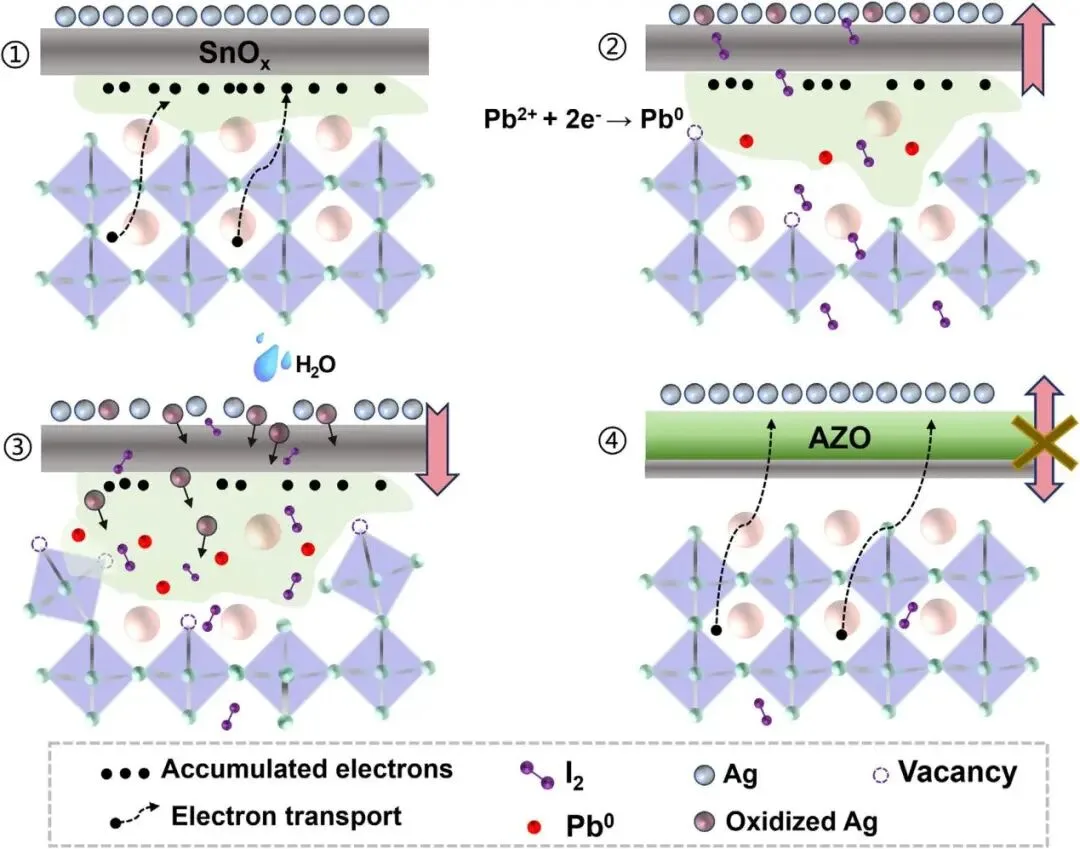
The advantage of the SnOx/AZO bilayer comes down to two things. The conductive AZO cap speeds up electron extraction and cuts interface charge buildup, which suppresses the reaction-driven interface degradation. At the same time, the dense bilayer acts as an effective ion and moisture barrier, holding back iodide-induced silver corrosion and Ag⁺ migration into the perovskite. Faster electron extraction paired with physical ion blocking gives a "functional decoupling" mechanism, so the two effects reinforce device durability together.
This study uses an all-ALD SnOx/AZO bilayer to suppress interface-reaction-driven degradation in perovskite/silicon tandem cells. The bilayer pairs the good band alignment of SnOx with the high conductivity and dense barrier function of AZO, cutting charge accumulation and holding back ion diffusion and moisture ingress. Single-junction devices reached 23.47% efficiency, tandem devices 33.25%, and both kept above 96% of initial efficiency after 1000 hours of MPPT. It shows how central interface engineering is to building high-efficiency, stable perovskite/silicon tandem PV, and points to a real path toward cells that are both efficient and durable.
The perovskite composite MPPT tester, built around an A+AA+ LED solar simulator as the aging light source, gives strong support to perovskite solar cell research. Because perovskite cells are so sensitive to light and temperature, their maximum power point shifts around constantly. The MPPT controller tracks and locks onto that point in real time, so the system always outputs at its best power. That maximizes energy yield and improves the stability and economics of the whole PV system.
Reference: Suppressing Interfacial Reactions in Perovskite/Silicon Tandem Solar Cells via an All-ALD SnOx/AZO Bilayer
Ooitech's View
What stands out here is the "functional decoupling" idea, letting one thin layer handle band alignment and another handle blocking, instead of forcing a single SnOx film to do both jobs and losing on one of them. On the production side, ALD stack uniformity across a full-size module is exactly where line control and metrology matter, and it's the kind of process detail we obsess over when building module lines. If you want to see more of how perovskite and tandem module manufacturing actually comes together on the factory floor, the Ooitech YouTube channel (www.youtube.com/ooitech) is worth a follow.