EPE Encapsulant Lamination Delamination: Line-Shaped
Table of Contents
Quick answer: EPE encapsulant film, also called co-extruded POE encapsulant, is a three-layer film with a polyolefin core between EVA skin layers. The construction exists to get POE's low moisture permeability and resistance to PID without POE's handling difficulties, because the EVA skins bond to glass and backsheet the way a conventional encapsulant does. Line-shaped delamination in an EPE-laminated module usually traces back to one of three causes: insufficient crosslinking in the core layer, contamination on the glass or backsheet surface that blocks adhesion, or a lamination cycle where the temperature ramp let the film flow before the stack settled. Line-shaped rather than patchy delamination is itself a diagnostic clue — it follows the flow direction of the encapsulant, which points to the lamination cycle rather than to the material batch.
PV Module Manufacturing · by Jerry, Ooitech
Introduction: What Is EPE Encapsulant Film?
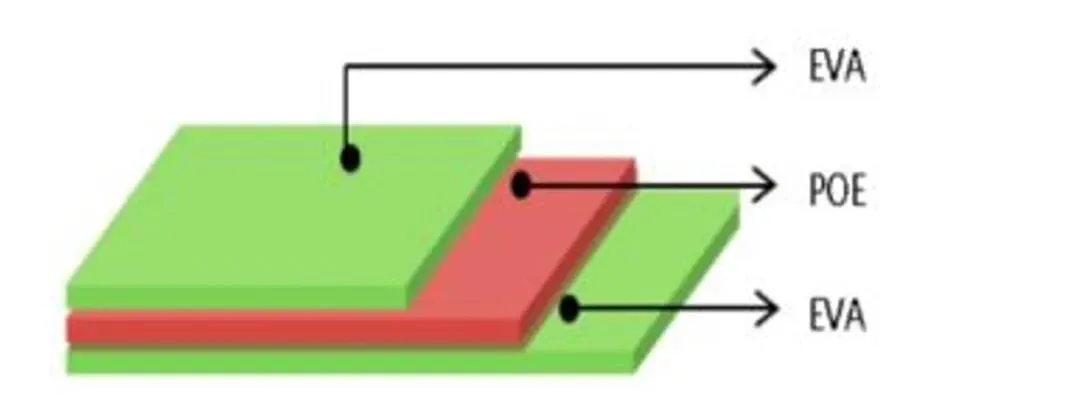
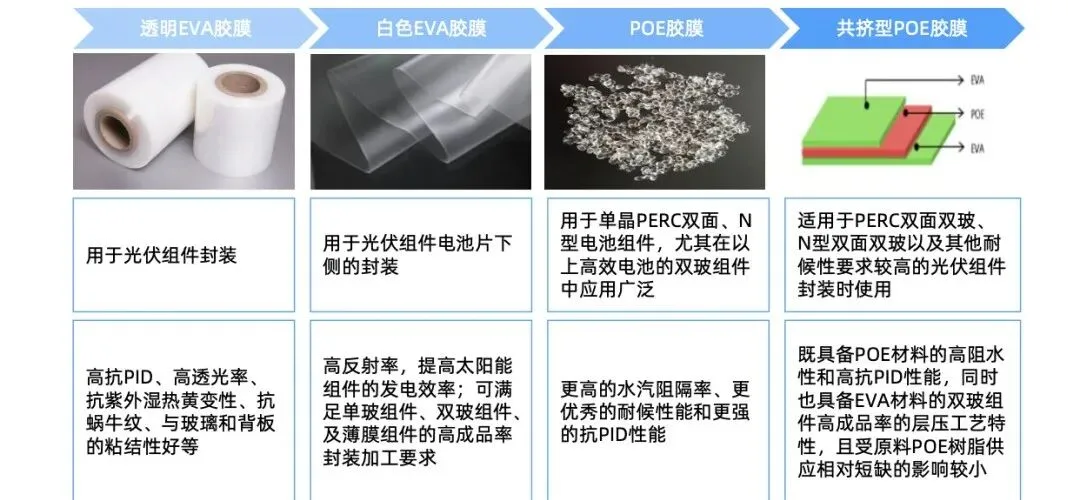
EPE encapsulant film, also known as co-extruded POE encapsulant, is a photovoltaic encapsulation material produced by co-extruding POE resin and EVA resin. In solar module manufacturing, it is mainly used to combine the processing convenience of EVA with the moisture-barrier and anti-PID performance of POE.
Conventional EVA film is widely used in PV module production because it offers good anti-PID performance, high light transmittance, UV and damp-heat yellowing resistance, snail-trail resistance, and strong adhesion to glass and backsheet. However, EVA also has limitations, such as relatively weak moisture barrier performance, higher water vapor transmission, and a higher risk of PID under certain operating conditions.
POE film, by comparison, has a better water vapor barrier, stronger weather resistance, and more reliable anti-PID capability. But POE also has its own processing challenges: its adhesion to glass and backsheet is usually weaker than EVA, its crosslinking reaction is slower, and during module production the film may slip or shift more easily, which can reduce production efficiency.
This is why EPE film was developed. Through a co-extrusion process, POE is wrapped by EVA layers, forming an EVA-POE-EVA sandwich structure. This design keeps the high moisture barrier of POE, helping protect solar cells from water vapor, while also maintaining the good lamination compatibility and easier processability of EVA. In normal production, EPE can improve both module reliability and manufacturing yield when the material and lamination process are well controlled.
Technical Mechanism: Why EPE May Delaminate During Lamination
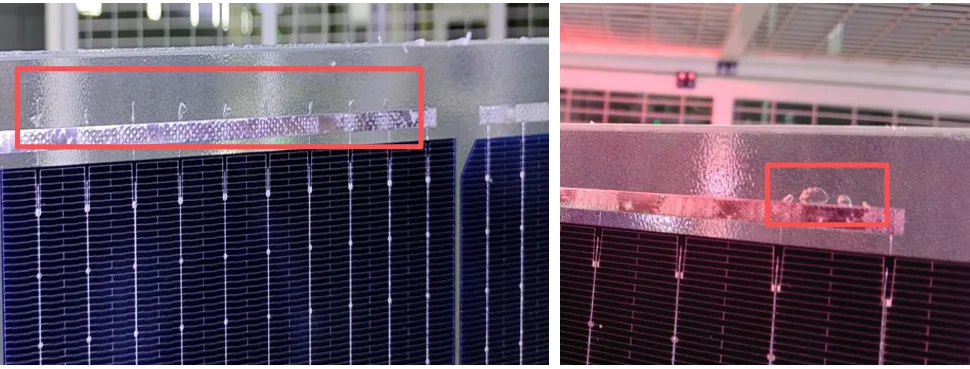
Although EPE combines the advantages of EVA and POE, the two materials do not behave exactly the same during lamination. Their curing curves, crosslinking characteristics, polarity, additive absorption ability, and thermal expansion behavior are different. These differences may lead to interlayer delamination and bubble formation, especially around solder ribbon areas where local pressure and thickness variation are more obvious.
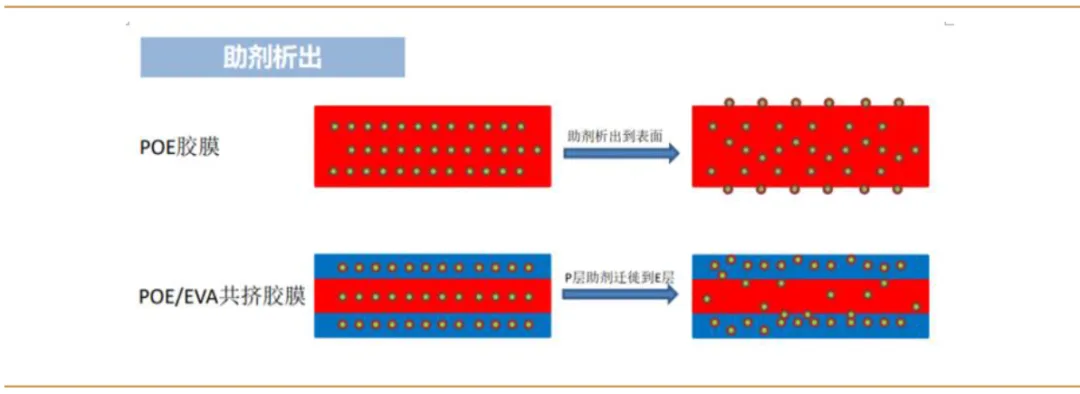
EVA and POE have different polarity. EVA is a polar material, so it has good compatibility with many additives. POE is less polar, so its ability to retain polar additives is different. Over storage time, additives inside the POE layer may gradually migrate toward the EVA layers, which have stronger polarity and better absorption capability.
This additive migration changes the internal structure and performance of the EPE film. As a result, the bonding force between the POE and EVA layers may decrease. In severe cases, the POE layer may be squeezed, separated, or locally delaminated during module lamination. This is also one reason why the shelf life of EPE film is generally shorter than that of single EVA or single POE encapsulant film.
| Key Factor | Mechanism | Possible Defect in Module Lamination |
|---|---|---|
| Additive migration | Polar additives such as crosslinking agents and stabilizers migrate from POE to EVA over time | Lower POE crosslinking degree, reduced cohesion, EPE interlayer delamination |
| Crosslinking speed mismatch | EVA usually crosslinks faster than POE during lamination | EVA layer becomes solid earlier while POE remains molten, causing interlayer stress imbalance |
| Thermal expansion coefficient difference | EVA and POE show different expansion and shrinkage behavior after curing | Internal stress during cooling, possible interlayer separation |
| Local thickness variation | POE layer thickness may be uneven in the TD direction, or EPE becomes locally thinner near ribbons and busbars | Local glue shortage, gas accumulation, line-shaped bubbles |
| Ribbon and busbar overlap pressure | Local stack thickness is higher at soldering positions | Encapsulant flow, local delamination, linear bubbles extending from ribbon areas |
Technical Analysis: Formation of Line-Shaped Bubbles Along Ribbons
The line-shaped bubbles extending from solder ribbons are often related to the combined effect of additive migration, inconsistent crosslinking speed, and different thermal expansion behavior between EVA and POE.
During lamination, EVA crosslinks faster than POE. If the POE layer does not crosslink in time, reaction gases generated during peroxide decomposition may not be fully discharged before pressure is applied. These gases can remain trapped inside the module and form bubbles.
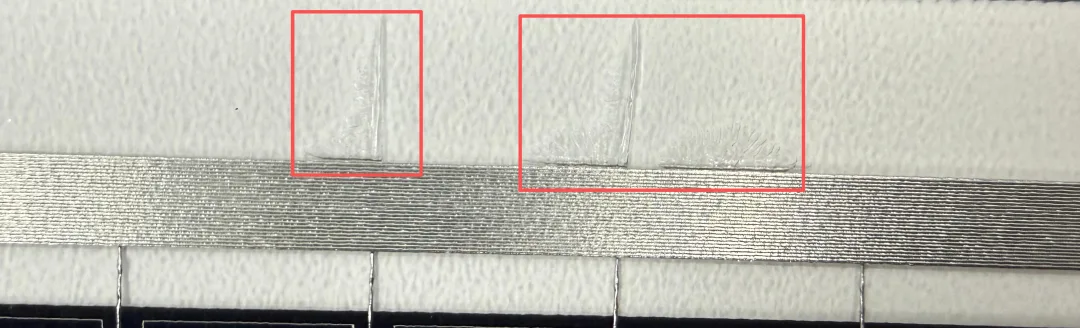
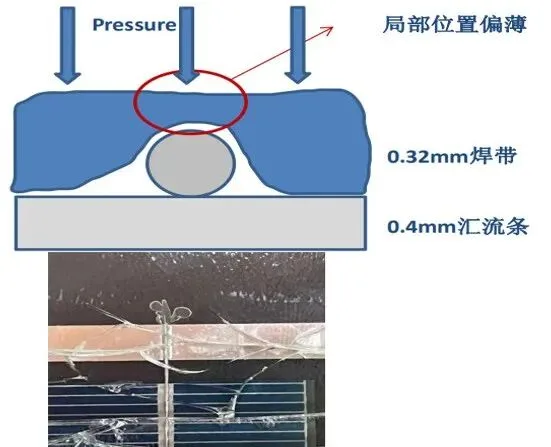
Another common reason is local thinning of the EPE film at the ribbon and busbar positions. The middle POE layer of EPE may have thickness non-uniformity in the TD direction due to raw material factors. In addition, during lamination, the overlapping thickness of ribbons and busbars increases local pressure. This can make EPE thinner at that position, creating a weak point where adhesive shortage or gas accumulation is more likely.
In simple terms, the ribbon area receives higher pressure during lamination. If the EVA layers have already started to crosslink while the POE layer near the ribbon is still in a flowing state, the EPE structure may locally separate. The remaining encapsulant at the ribbon position may behave more like POE, with slower crosslinking and higher flow tendency. Under lamination pressure, this can create colored or transparent line-shaped bubbles spreading outward from the ribbon.
Key process symptoms to watch
Bubbles appear mainly along solder ribbon paths rather than randomly across the whole module.
The defect may look like thin linear air traces extending outward from ribbon or busbar areas.
The problem may become more obvious when EPE film has been stored for a longer time.
The defect may increase when lamination temperature, vacuum time, pressure timing, or curing degree are not well matched with the specific EPE formulation.
Practical Control Suggestions for EPE Lamination Defects
For bubbles caused by the inherent material behavior of EPE encapsulant, the solution should combine material management and lamination process optimization. It is not enough to adjust only one parameter without checking the film storage condition, lamination curve, and ribbon-area pressure distribution.
1. Control EPE material storage time
Plan EPE encapsulant procurement and production usage carefully. Under the condition that production is not affected, reduce the inventory time of EPE film as much as possible. Shorter storage time helps reduce additive migration from the POE layer to EVA layers, keeping the original interlayer bonding and crosslinking behavior more stable.
2. Properly increase the first-chamber lamination temperature
A suitable increase in the first-chamber lamination temperature can accelerate POE crosslinking in the EPE film. This helps avoid the situation where EVA has already reached a relatively high crosslinking degree while POE is still molten. Better synchronization between EVA and POE curing can reduce interlayer stress and help prevent line-shaped bubbles near ribbon positions.
3. Match vacuum, pressure, and curing timing
If pressure is applied too early while the POE layer is still highly fluid, gas may be trapped or pushed along ribbon areas. A well-designed lamination recipe should allow enough time for air extraction and material softening before full pressure is applied. The exact setting should be verified by crosslinking degree tests, peel strength tests, and appearance inspection after lamination.
4. Check ribbon and busbar stack height
Because local pressure is higher around ribbons and busbars, excessive stack thickness can make EPE thinner at these points. Production teams should check soldering flatness, ribbon alignment, busbar overlap, and layup consistency. Reducing local height difference can lower the risk of local encapsulant deformation and bubble formation.
5. Verify incoming EPE quality
For EPE film, incoming inspection should not only check appearance and thickness, but also focus on thickness uniformity, shelf life, storage condition, gel content behavior, and adhesion performance. If possible, trial lamination should be done before mass production when changing suppliers, batches, or module structures.
This blog is based on practical abnormality analysis in PV module production and the following references:
Field experience from abnormal defect analysis during photovoltaic module production
Dow Chemical, Zhang Wenxin, "POE Empowering High-Performance Photovoltaic Modules"
Southwest Securities, "N-Type Iteration, POE Industry Opens a High-Growth Cycle"
Chemical Production and Technology, "Research on Crosslinking Reaction of Polyolefin Encapsulant Film for Photovoltaics"
Ooitech's View
As an equipment supplier, we see it this way: EPE-related ribbon line bubbles are not only a material issue, but also a process-window issue that depends on lamination temperature profile, vacuum efficiency, pressure timing, and layup flatness. For module manufacturers using advanced cell technologies and larger formats, the tolerance for encapsulant flow and local stack height becomes much smaller, so material shelf-life control and lamination recipe validation should be treated as part of the same quality system. A stable solar panel production line needs both good encapsulant selection and disciplined process verification before mass production.