PL Smudges, Blistering, and Boat Marks: Which Step
Table of Contents
Quick answer: Photoluminescence smudges, blistering and boat marks are three distinct defect signatures, and the season matters: from June to September, over 80% of the wafer-level defects on many lines come from the same cluster of process causes. The three look similar in a low-resolution image and have entirely different fixes. A PL smudge usually points to a contamination or handling issue rather than a thermal one. Blistering traces to a deposition or drying step where a layer formed unevenly. Boat marks are a carrier signature — the wafer position in the boat reproduced itself in the process. The layer thicknesses in play sit at 1 nm, 1.5 nm, 3 nm, 5 nm and 6 nm, which is thin enough that a surface effect dominates over bulk behaviour. The diagnostic order should follow the defect shape, not the process order.
PV Module Manufacturing · by Jerry, Ooitech
PL Smudges, Blistering, and Boat Marks: Which Step to Check First?
Every year from June to September, over 80% of solar cell factories experience the exact same headache. The workshop is kept at a constant 25℃, process recipes remain untouched, gas flows are perfectly normal, and temperature curves sit right inside the spec limits. Yet, the minority carrier lifetime after passivation just keeps dropping. Yield fluctuations are usually brushed off as a vague summer effect. This guide breaks down four actionable, trackable root causes and offers practical process adjustments for the summer season.
Problem Scene and Defect Profile
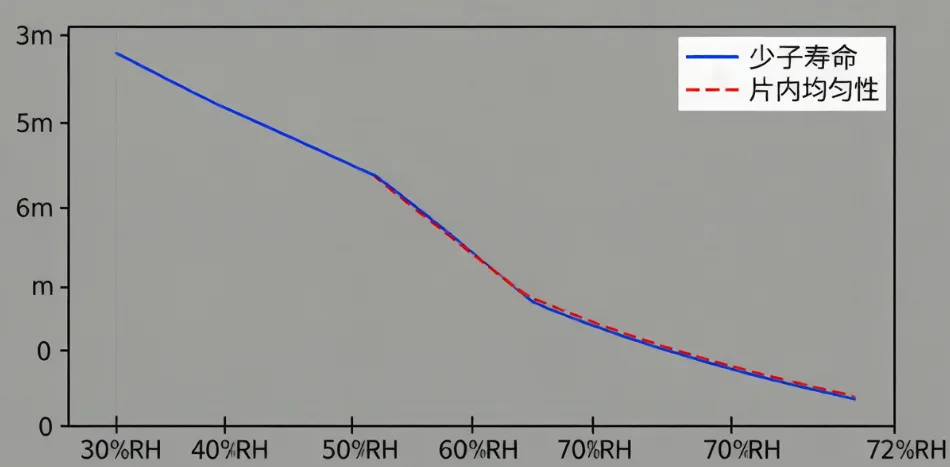
Take a real case from a factory in East China this June. The workshop was a stable 25℃, but the cleanroom humidity gauge hit 72%. Compared to the 30% humidity in winter, that is more than double. Process engineers noticed the post-passivation minority carrier lifetime dropped across the board, falling from the usual 2 ms to 1.2 ms. Even worse, wafers at the top and bottom of the same tube showed a 40% variance in lifetime.
This is not an isolated incident. You can control the workshop temperature, but humidity is a different beast. A sudden summer rainstorm can easily push cleanroom humidity from 50% to 80%. Every single step in the passivation process is highly sensitive to this moisture.
Passivation is not just coating a film. Think of it as a two-stage rocket. Stage one is the deposition itself, relying on chemical passivation from Al₂O₃ or SiNₓ to saturate dangling bonds, plus field-effect passivation to suppress surface recombination. Stage two is hydrogen passivation. High-temperature firing forces the hydrogen out of the film, pushing it into the silicon surface and bulk defects to passivate whatever dangling bonds are left.
The real factor determining your final passivation quality is how well the hydrogen is released during firing. Hydrogen's behavior—from its form in the film to its release kinetics and diffusion path—is heavily tied to both temperature and humidity. That is exactly why summer defects are triggered by humidity changes, not temperature shifts.
Four Humidity Transmission Lines in Passivation
Let's break this down into four specific transmission lines. The workshop might be temperature-controlled, but these four areas are directly impacted by summer conditions.
Line 1: Hydrogen Deviation Caused by Cooling Water Temperature
PECVD chambers need constant cooling during deposition to maintain a precise temperature field. Chillers usually have their condensers sitting on the roof or outside, using river or well water that is entirely at the mercy of the season.
In winter, outdoor temperatures sit around 5–10℃, keeping cooling water perfectly stable at 20–22℃. In summer, the heat pushes past 35℃. Chiller efficiency drops, and cooling water temperatures easily climb to 28–30℃.
Your cleanroom might still be 25℃, but that warmer cooling water directly alters the PECVD chamber wall temperature. The thermal radiation distribution shifts. Wafers sitting at different positions inside the tube experience completely different actual deposition temperatures. The temperature gap between the top and bottom wafers widens, which explains that massive 40% variance in lifetime within the same batch.
Whether you are using ALD for Al₂O₃ or PECVD for SiNₓ, a changed chamber temperature means the film density and hydrogen content will shift.
| Deposition Temperature | Film Characteristics | Hydrogen Behavior |
|---|---|---|
| Slightly Low | Dense, high H content, mainly N-H/Si-H | Needs higher firing temp for full release |
| Slightly High | Loose, high H content, weak H bonds | Releases too fast, gathers at interface |
Industrial production relies on a very tight optimal window balancing film density and hydrogen content. A deviation of just ±5℃ can push you out of that window. When summer cooling water gets too warm, the entire chamber temperature field shifts, and film parameters drift right along with it.
Line 2: AlOₓ Blistering from Mismatched Thermal History
This issue hides in a time gap most people miss. Mainstream ALD equipment typically runs 28–35 cycles for Al₂O₃ deposition, landing at a thickness of 4.5–6 nm. The subsequent PECVD SiNₓ deposition happens between 400–580℃. That temperature is already hot enough to get the hydrogen inside the Al₂O₃ moving aggressively.
If the PECVD heating rate and holding time are dialed in, a portion of the hydrogen in the Al₂O₃ is released smoothly during this preheating phase. The rest stays stable and releases properly later in the firing furnace. Summer conditions ruin this rhythm.
First, ALD process fluctuations happen. The 5 nm Al₂O₃ layer is a sweet spot for cost and passivation, meaning its absolute hydrogen content is naturally high. High summer humidity means more hydrogen gets trapped in the film.
Second, the PECVD SiNₓ deposition acts as a primary annealing phase for the Al₂O₃. If heating is too fast or the high-temperature hold is too short, the hydrogen doesn't release enough.
Third, firing temperatures hit 700–900℃. All that trapped hydrogen erupts at once, diffusing toward the Si/Al₂O₃ interface. It forms H₂ gas molecules and builds massive local pressure.
Finally, when the pressure exceeds the film's adhesion strength, blistering occurs.
High humidity -> More trapped H -> Poor PECVD pre-release -> High firing temp = Blistering.
Under a microscope, you will see the wafer surface covered in tiny blisters 2–10 μm in diameter. Every single blister represents a dead zone where passivation is gone.
Line 3: Elevated Background Moisture in Tube Furnaces
This is easily the most overlooked line, yet incredibly fatal in summer production. During standby time, PECVD tube furnaces are exposed to the atmosphere. Summer air hits 60–80% RH. The furnace tube absorbs way more moisture than it does in winter.
When you pump down and heat up for deposition, that trapped moisture desorbs and mixes with your process gas. This background moisture completely messes with the SiNₓ deposition in three ways:
Refractive Index Drift: SiNₓ needs a strict refractive index of 2.05–2.10 to control light absorption and passivation. Background moisture alters the Si/N ratio. Summer moisture can easily drop the index below 2.05, killing your passivation quality.
Altered Hydrogen Bonds: The H⁺ in water vapor competes with Si-H and N-H bonds in the SiNₓ. It messes up how hydrogen releases during firing later.
Degraded Interface Cleanliness: Moisture forms a metastable Si-OH layer on the wafer surface at the start of deposition. This ruins the bond between the silicon and the Al₂O₃ or SiNₓ, immediately spiking the interface trap density.
Line 4: The Hidden Q-Time Gap Before Tunneling Oxidation
This one happens early in the line, right after alkaline polishing and before tunneling oxide deposition. Bare silicon exposed to air grows a native oxide layer, and the speed of that growth depends entirely on ambient humidity and temperature.
At 25℃ and 80% RH, bare silicon grows a 1 nm native oxide layer in just one hour. If equipment faults or scheduling delays leave those wafers sitting in the cleanroom for two or three hours, that native layer can hit 1.5 nm or thicker.
This native oxide is loose and full of defects. When you try to grow your high-quality 1.2–1.5 nm tunnel oxide on top of it, the two layers combine. Now your tunnel layer is 2–3 nm thick—double the design spec, with terrible structural quality.
This triggers a brutal chain reaction. The overly thick tunnel layer blocks electron tunneling. During polysilicon doping, phosphorus struggles to diffuse through this thick barrier. Areas where the tunnel layer is too thin get over-doped, causing auger recombination and dropping lifetime, which shows up as dark smudges in PL testing. Areas where it is too thick get under-doped, increasing contact resistance. This causes dark edges around the boat marks in EL testing. Ultimately, your open-circuit voltage (Voc) plummets across the whole batch.
Root Cause Summary: Four Transmissions, Not a Single Fault
Summer passivation issues are not new, but engineers waste time checking menus and gas flows because they look for a single point of failure. The root cause is humidity disrupting the entire chain.
Rising cooling water shifts the chamber temperature. High environmental humidity increases hydrogen content and causes blistering. Standby furnace moisture ruins the SiNₓ refractive index. Delayed processing lets native oxide grow out of control, causing PL smudges and boat marks.
Actionable Summer Process Control Suggestions
Here is how to fix it on the floor.
First, monitor your cooling water. Track the inlet temperature and the temperature delta, not just the chamber temp. If cooling water crosses 24℃, check your chillers immediately and manually compensate with PECVD power or deposition time if necessary. Tie your cleanroom dew point to daily monitoring.
Second, tweak your ALD recipes for summer. Bump up the ALD deposition temperature slightly within the 180–300℃ window, or extend the purge time. This makes the film denser and drops the initial hydrogen content, preventing blistering later. Also, extend the heating rate or hold time during PECVD SiNₓ deposition to give hydrogen more time to release smoothly.
Third, bake your tube furnaces more often. Run a short 500℃ bake for 15 minutes every 4 hours during standby to drive out absorbed moisture. If possible, maintain a slight positive pressure N₂ purge during standby.
Fourth, build a dedicated summer passivation baseline recipe. Don't guess. Have a set of ALD and PECVD parameters ready to swap in when the humidity crosses a specific threshold.
Fifth, strictly control your Q-time. Wafers must go from alkaline polishing to the oxidation furnace in under an hour. If there is a delay, store them in a low-humidity nitrogen cabinet.
Summer Passivation Quick Checklist
| No. | Check Item | Control Target | Responsible Person |
|---|---|---|---|
| 1 | Cooling water temp | Daily tracking, alert if over threshold | Equipment/Facility |
| 2 | Cleanroom dew point | Strict adherence to baseline limits | Facility |
| 3 | Tube furnace bake | Short bake every 4 hours standby | Process Engineer |
| 4 | Polishing to Ox Q-time | Under 1 hour | Production Team |
| 5 | ALD/PECVD Recipes | Switch to predefined summer baseline | Process Team |
Ooitech's View
Equipment stability is just as critical as the process recipe when seasonal humidity spikes disrupt the production floor. Factories frequently face yield drops simply because ambient moisture alters the thermal history and hydrogen dynamics of passivation layers. Addressing these hidden variables—like chiller efficiency, atmospheric Q-time, and standby moisture desorption—makes a massive difference in maintaining consistent cell efficiency. Mastering these subtle environmental controls is what separates an average solar panel manufacturing setup from a truly optimized, high-yield production line.