Laminator Vacuum Pumps: Types and the EVA Window
Table of Contents
A laminator is judged on yield, and yield is decided largely by one component that buyers rarely look at during a factory visit: the vacuum pump set. Getting it wrong produces micro-bubbles that no amount of downstream inspection can remove.
PV Module Manufacturing · Lamination Process · by Jerry, Ooitech
1. The EVA Window That Sets Everything Else
Ethylene vinyl acetate does not simply melt and stay put. It passes through two distinct stages, and the gap between them is the time the vacuum system has to work in.
| Stage | Temperature | What it means for vacuum |
|---|---|---|
| Melting | About 70–80 °C | The film enters its molten phase. This is the ideal moment to evacuate, because the encapsulant is soft enough to release trapped air but has not yet begun to set. |
| Crosslinking | About 130 °C | Crosslinking begins and accelerates. Below this temperature the reaction is very slow, which is precisely why the first chamber of a dual-chamber laminator is normally held at or below 125 °C. |
Everything that follows is a consequence of the interval between those two temperatures. If the chamber is already hot when the film melts, the melt-to-crosslink interval is short. In a single-chamber process the chamber typically sits above 140 °C, leaving only about 60 to 90 seconds to reach the required vacuum. Miss that window and air remains trapped in the encapsulant, forming micro-bubbles and defects that show up later in the finished module.
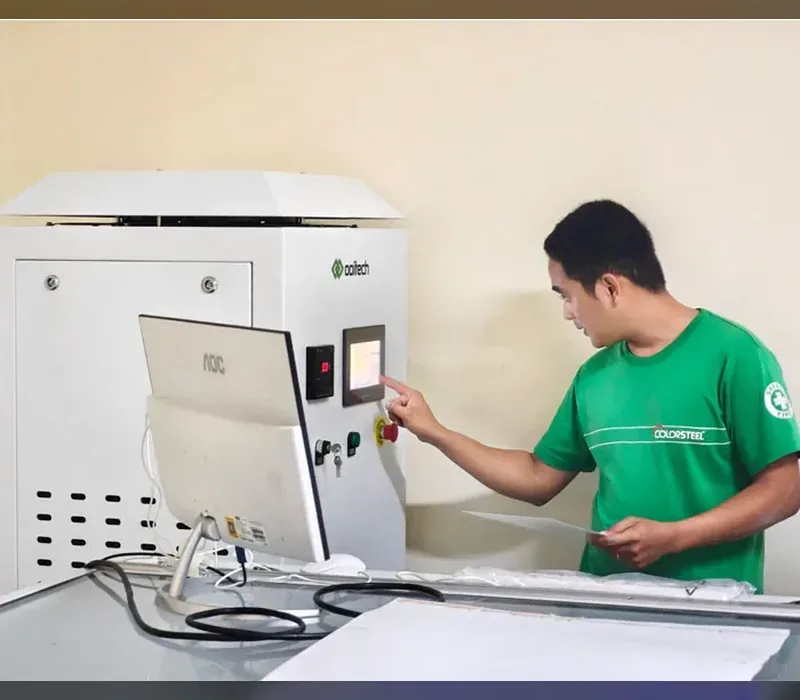
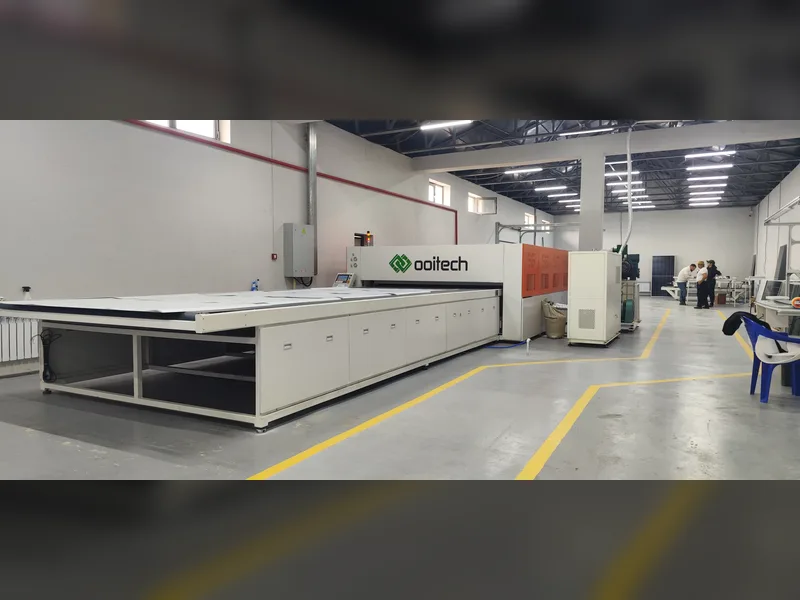
Fig. 1: A laminator with its vacuum pump set installed alongside on the factory floor. The pumps are a separate installation with their own piping, receiver vessel and service access, which is why they are easy to overlook during layout planning and expensive to relocate afterwards.
2. Why Dual-Chamber Laminators Exist
The dual-chamber design is essentially a way of buying time. By holding the first chamber in the 100 to 120 °C range, the encapsulant melts more slowly and crosslinking starts later, which extends the degassing window well beyond what a single hot chamber allows. The module is then transferred to a second, hotter chamber to complete crosslinking.
That is the process reason behind a decision that otherwise looks like a purely mechanical choice. It also explains why the vacuum system is not a peripheral accessory: it is the part of the machine that has to perform within the window the thermal design creates. The wider context of the lamination step is covered in the lamination stage of the production process, and the machine itself in our guide to the solar panel laminator.
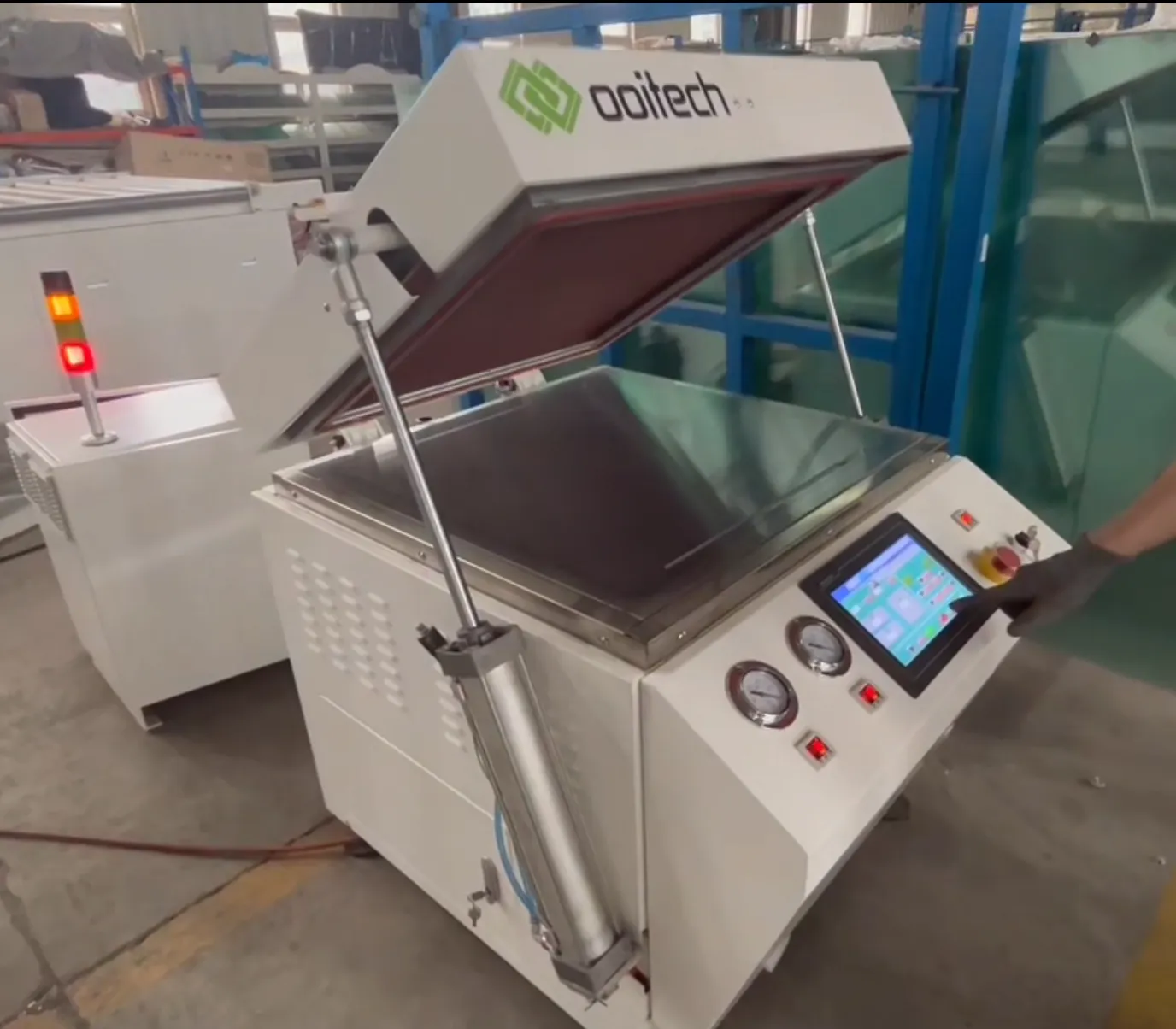
Fig. 2: A laminator chamber with the lid open. The chamber volume, the seal condition and the pumping speed together determine how quickly the required vacuum is reached, and therefore whether the degassing window is met or missed.
3. The Three Pump Types You Will Find on a Laminator
Rotary vane pump
The oil-lubricated rotary vane pump is the workhorse of lamination vacuum systems. A single unit typically pumps at 60 to 100 litres per second. Inside the pump body a rotor is mounted off-centre, carrying vanes that are pushed outward by springs and centrifugal force to stay against the bore. The crescent-shaped space between rotor and bore is divided into several chambers of changing volume.
Each chamber runs a continuous three-part cycle. It opens to the inlet while expanding, drawing gas in. It then closes off and shrinks, compressing the trapped gas. Finally the pressure exceeds atmospheric and the gas lifts the exhaust valve, passing through the oil layer and out. This is a positive displacement pump: it moves fixed volumes of gas rather than relying on any other mechanism.
The oil does more than lubricate. It seals the clearances between the vanes and the bore so gas cannot leak back, it lubricates the moving parts, and because the exhaust valve sits under oil, it prevents atmosphere from flowing back into the chamber when the pump stops. All three functions matter in a lamination system, where backstreaming would contaminate the module.
Roots pump
A Roots pump is almost never used alone. On a laminator it serves as a booster stage, and a common configuration for the first chamber is two rotary vane pumps with one Roots pump. Pumping speeds above 1,200 litres per second are typical, which is why it is used where volume has to be moved quickly.
The mechanism is two figure-eight rotors, gear-driven to rotate in opposite directions in synchronisation. The rotors never touch each other or the bore; clearances are in the order of 0.1 to 0.3 mm, so no oil is needed for sealing or lubrication inside the pumping chamber.
The consequence of that design is the key to understanding where it belongs. A Roots pump has no internal compression: gas is captured in a fixed space and carried round to the outlet without being squeezed. When that space opens to the exhaust, gas at higher pressure flows back, so the pump cannot on its own reach a high compression ratio or discharge to atmosphere. It needs a backing pump to bring the system down to a pressure where the Roots stage works efficiently. That is the real reason a Roots pump is paired with rotary vane pumps rather than replacing them.
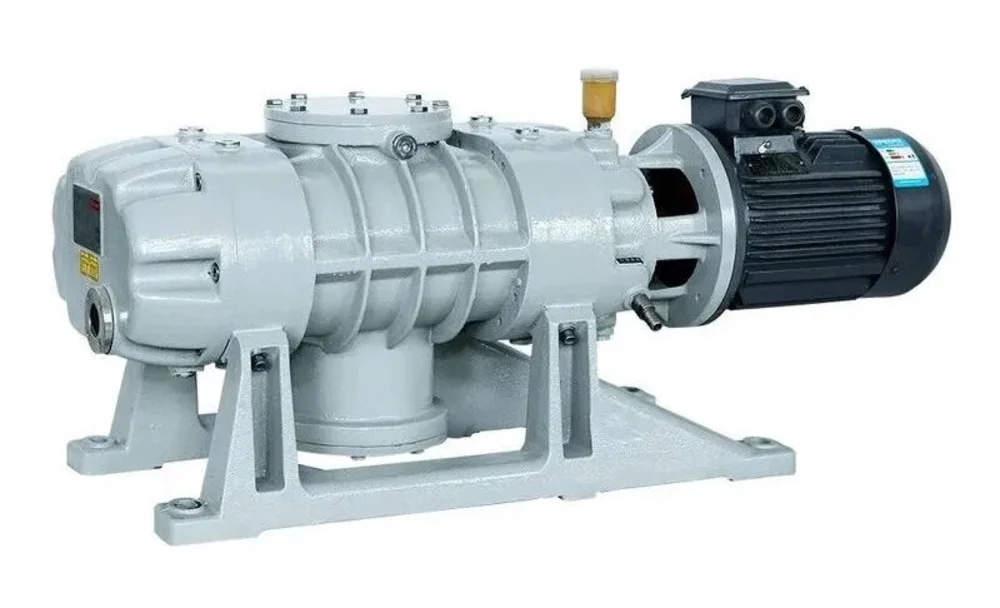
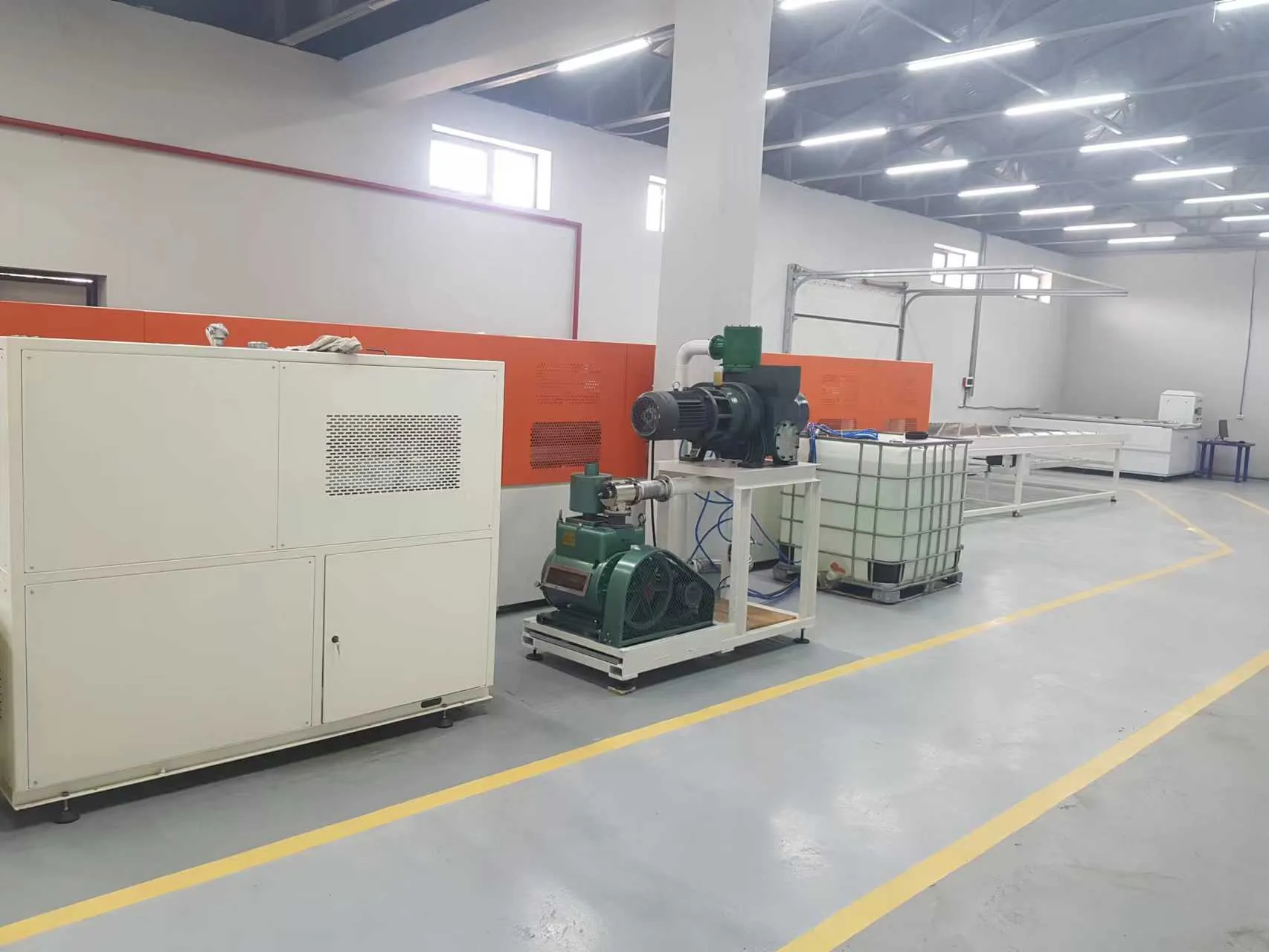
Fig. 3: A Roots pump with its drive motor. Large pumping speed, no contact between rotors, and no ability to work against atmospheric pressure on its own. It is a booster by design, not by convention.
Dry screw pump
The dry screw pump is a fully oil-free positive displacement design, and in higher-end applications it is the replacement for oil-sealed pumps rather than an addition to them. Nothing in the pumping chamber uses oil or water as a sealing or lubricating medium, and the result is a clean vacuum with no oil carry-over into the process.
Inside, a pair of parallel helical rotors with opposite hand are driven by precision timing gears and rotate at speed in opposite directions. As with the Roots design, the rotors do not touch each other or the housing, so no lubricant is needed in the gas path. Gas is captured between the screw and the housing and carried towards the outlet, and the volume steadily decreases along the way, so the gas is compressed before discharge.
Many designs use a variable pitch along the rotor. This spreads the compression more evenly and gives the gas more opportunity to be cooled as it is transported, which keeps the pump body temperature under control. On a laminator, where the gas stream carries EVA volatiles at elevated temperature, that thermal management is part of the pump's fitness for the duty rather than an optional refinement.
4. Comparing the Three
| Rotary vane | Roots | Dry screw | |
|---|---|---|---|
| Role on a laminator | Primary pump | Booster, paired with rotary vane | Primary pump, oil-free alternative |
| Typical pumping speed | 60–100 L/s per unit | Above 1,200 L/s | Application dependent |
| Sealing medium | Oil | None, close clearance only | None, close clearance only |
| Internal compression | Yes | No | Yes, along the screw |
| Can discharge to atmosphere alone | Yes | No, requires a backing pump | Yes |
| Process cleanliness | Oil present; backstreaming must be managed | Clean pumping chamber | Fully oil-free gas path |
| Consumables | Oil and filters | Minimal | Minimal |
Read as a purchasing decision rather than a technical ranking, the trade is straightforward. A rotary vane set costs less and is well understood, at the price of oil changes, filter changes and managing backstreaming. A Roots booster is not optional on larger chambers, because the vane pumps alone cannot move the volume fast enough inside the window. A dry screw pump removes oil from the gas path altogether and is usually chosen where contamination risk or maintenance burden is the deciding factor.
5. Why the Pump Set Belongs in the Laminator Specification
Because the pump configuration is sized against the chamber volume and the degassing window, it is a laminator specification item, not a separate purchase. Three questions settle most of it.
- What is the chamber volume and target pressure? Together with the window length, this sets the required pumping speed and therefore whether a single vane pump is adequate or a Roots booster is needed.
- Single or dual chamber? A dual-chamber machine runs a cooler first chamber, which lengthens the window and relaxes the instantaneous speed requirement, but adds a second chamber to evacuate. This is covered further in how to choose the right solar module laminator.
- What is the maintenance plan? Oil and filter intervals on a vane set, versus the higher capital cost and lower consumable burden of a dry screw. Over a ten-year life the two totals are closer than the purchase prices suggest.
A vacuum system that is undersized for the chamber does not fail immediately. It produces modules that pass final inspection and fail later, and the defect signature — micro-bubbles and voids in the encapsulant — is the subject of not every laminate bubble is the encapsulant's fault. Encapsulant selection interacts with the same window, as set out in our guide to EVA, POE and EPE encapsulant films.
FAQ
Why does a dual-chamber laminator run its first chamber cooler?
To lengthen the degassing window. EVA melts around 70 to 80 °C and begins crosslinking around 130 °C. Holding the first chamber at roughly 100 to 120 °C slows both stages, giving the vacuum system more time to remove trapped air before the encapsulant starts to set.
Why do laminators pair a Roots pump with rotary vane pumps?
Because a Roots pump cannot discharge to atmosphere by itself. Its rotors trap gas in a fixed volume without compressing it, so gas flows back at the outlet and it cannot achieve a high compression ratio alone. It provides high pumping speed for its size, and the rotary vane pumps provide the compression that gets the gas out. Two vane pumps plus one Roots pump is a common first-chamber arrangement.
What does the oil do in a rotary vane pump?
Three things. It seals the clearances between the vanes and the pump bore so gas cannot leak back, it lubricates the moving parts, and because the exhaust valve is immersed in oil it prevents atmosphere from flowing back into the chamber when the pump is not running.
Is a dry screw pump worth the extra cost?
It depends on what you are optimising. A dry screw pump has no oil or water in the pumping chamber, so the vacuum is clean and there is no oil carry-over towards the module, and the consumable burden is lower. Against that, capital cost is higher. Where contamination risk or maintenance headcount is the constraint, the calculation usually favours it; where capital is tight and the process is well controlled, a vane set remains viable.
Why does EVA temperature matter so much to the vacuum system?
Because the two thermal stages define the deadline. The film only releases trapped air effectively once molten, and it stops doing so freely once crosslinking begins. The vacuum system has to reach the required pressure within that interval, which in a single-chamber process above 140 °C may be as little as 60 to 90 seconds.
What happens if the chamber is not pumped down fast enough?
Air remains trapped in the encapsulant as it cures, producing micro-bubbles and voids. These are not always visible at the laminator exit, which makes the problem easy to miss until yield data or field returns reveal it. The defect is a pump performance issue as often as an encapsulant issue.
Final Thoughts
The vacuum pump set is where the thermal design of a laminator becomes a mechanical requirement. EVA melts at 70 to 80 °C and crosslinks from around 130 °C, and the vacuum system has to evacuate the chamber inside the interval between them. That is why dual-chamber machines run a cooler first chamber, why Roots boosters appear on larger chambers, and why oil-free pumping is worth considering where contamination or maintenance is the constraint. When you specify a laminator, ask for the chamber volume, the pump configuration, the pumping speeds and the achievable pump-down time as a set — a machine quoted without them is a machine whose yield you cannot predict. If you are evaluating laminators for a new line, send us the module format and target throughput and we will work through the chamber and pump sizing with you. To see the machine in context, the OTCY-2754DD single-layer double-chamber laminator page covers the chamber arrangement in detail.