Why Solar Panel Glass Is Textured, Not Smooth
Table of Contents
Look closely at the front of a solar module and the glass is not the smooth sheet you find in a window. It is covered in irregular pits. Most people assume this is a manufacturing flaw. It is one of the more carefully engineered surfaces in the whole module.
PV Materials · Module Glass · by Jerry, Ooitech
1. A Designed Surface, Not a Defect
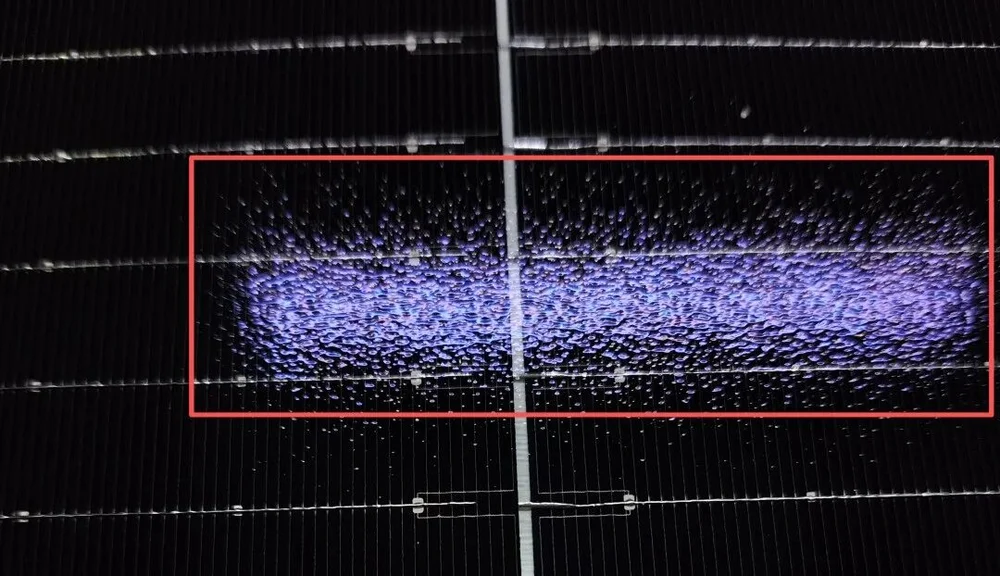
Fig. 1: The front glass of a module under reflected light. The highlighted area shows the irregular pitting that gives the surface its characteristic look. The pattern is deliberate, and it is what turns a mirror into a light collector.
The structure has two faces with different specifications. The outer surface, the one in contact with air, is a textured face of irregular micron-scale pits. The inner surface, the one bonded to the encapsulant, carries a regular embossed pattern. Together they are the reason a module front looks slightly hazy rather than glassy, and both are there for optical reasons.
2. Reason One: Cutting the Reflection Loss
Smooth glass behaves like a partial mirror. Around 8 percent of the sunlight arriving at a polished surface is reflected straight back into the sky and never reaches the cell. On a module that is 8 percent of the energy you paid to generate, lost at the outermost layer before anything else happens.
The textured outer surface breaks that up. Micron-scale bumps scatter the incoming beam so that light arriving at a shallow angle is redirected rather than bounced away, and a share of it is bent into the cell instead of away from it. The same mechanism lengthens the optical path inside the module, which gives the silicon more opportunity to absorb what has already entered.

Fig. 2: A close view of the glass surface. At this scale the pitting resolves into a dense, regular micro-pattern. Scattering and transmission both depend on the geometry of these features, which is why the pattern is specified rather than left to chance.
3. Reason Two: Spreading Light Across the Cell
A second job is uniformity. If light arrives unevenly, some regions of the cell work harder than others and the module operates below the sum of its parts. The combination of a textured outer face and a patterned inner face spreads the incoming light more evenly across the cell surface, so the illuminated area is used more completely and conversion efficiency improves.
This matters more than it sounds on multi-cut and shingled formats, where cells are divided into smaller pieces. Uneven illumination interacts with how those pieces are interconnected, and the reason multi-cut modules behave differently under partial shade is covered in our analysis of multi-cut shade resistance.
4. Reason Three: Light That Arrives at an Angle
Sunlight is perpendicular to a module for only a short part of the day. In the morning, in the evening and through the winter, light arrives at a pronounced angle, and that is where an embossed surface separates itself from a flat one.
As the angle of incidence grows, the transmission of embossed glass rises relative to smooth glass rather than falling away as sharply. In practical terms the module recovers performance at the times of day and year when a flat surface would be losing it. Since a module spends most of its life outside peak perpendicular irradiance, this is not a marginal effect.
5. How the Pits Are Actually Made
Two processes produce the two faces.
| Face | Process | Resulting structure |
|---|---|---|
| Inner (encapsulant side) | Calendering as the glass leaves the furnace: the molten ribbon passes between rollers, one of which carries a precision raised pattern pressed into the semi-molten surface | Regular arrays of defined shapes, commonly pyramid, hexagonal frustum and quadrangular frustum patterns |
| Outer (air side) | Chemical etching to create randomised pits, followed by a nanoscale anti-reflective coating — some anti-glare products form the outer face by calendering instead | Irregular micron-scale texture under a porous anti-reflective layer |
The inner pattern is deterministic: the roller geometry is transferred into the glass, so the shape and spacing of the pits are set by tooling rather than by chance. The outer surface is deliberately random, because a randomised texture scatters broadly instead of diffracting into specific directions. On top of that outer texture sits an anti-reflective coating, typically based on porous silica, which uses a controlled pore structure to reduce reflection further and raise transmission.
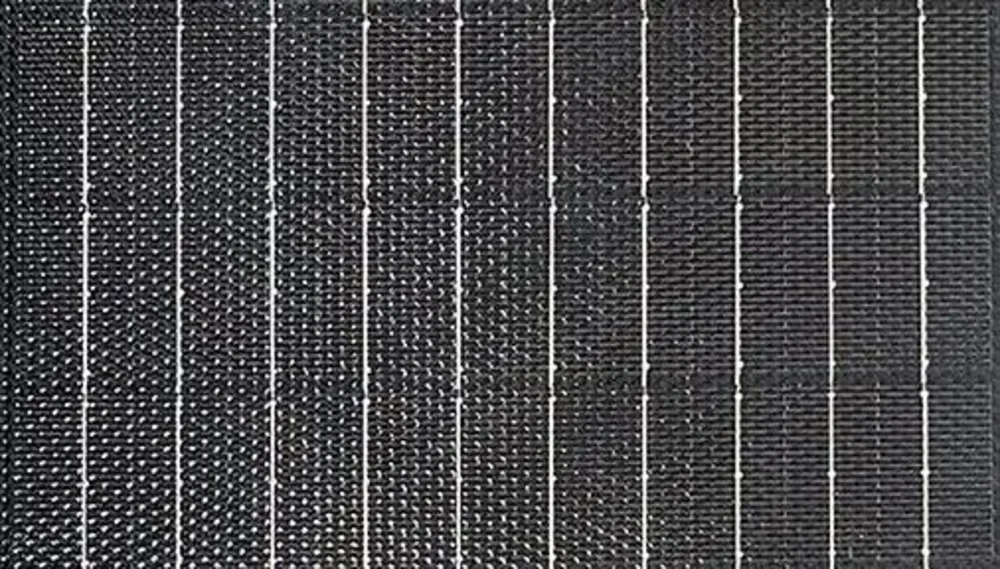
Fig. 3: The embossed pattern on the glass in detail. Because it is transferred from a patterned roller, the geometry is repeatable from sheet to sheet — which is what allows a glass specification to state a pattern rather than a roughness.
6. The Same Trick Elsewhere in the Module
Once you know what to look for, the same design principle appears in several places.
- Double-glass backsheets. The rear glass of a dual-glass module carries a comparable surface treatment, for the same reason: light reaching the back of a bifacial module has to be let in, not reflected.
- Flexible and folding modules. Portable and folding panels use a pitted surface texture on their front sheet to obtain a similar scattering effect without rigid glass.
- ETFE front sheets. Fluoropolymer front sheets are supplied with a matte surface that plays the same anti-reflective role in lightweight modules.
- Front-passivation films. Optical and passivation functions are also being combined at cell level, as in the case of TOPCon front-film SiNx, where a film choice translates directly into module watts.
7. What to Check When You Specify Module Glass
Because the optical benefit comes from the surface rather than the bulk, a glass specification that only lists thickness and tempering is incomplete. Five attributes carry the performance.
| Attribute | Why it matters |
|---|---|
| Iron content | Low-iron glass raises baseline transmission. Ordinary float glass absorbs in the visible range and costs you power before any surface treatment is applied. |
| Outer texture | Determines the reflection and scattering behaviour, and therefore how much of the incident light reaches the cell. |
| Inner embossed pattern | Affects light distribution across the cell and lamination behaviour. Pattern geometry is transferred from tooling, so it is reproducible and should be specified. |
| Anti-reflective coating | Provides the last increment of transmission. Coating durability matters as much as its initial performance, since it faces the weather for 25 years. |
| Tempering quality | Structural rather than optical, but a glass that fails mechanically takes the optical performance with it. See how to tell if semi-tempered glass cracking is spontaneous breakage. |
Ooitech supplies module glass alongside the rest of the bill of materials, including EVA, POE and EPE encapsulant films, ribbons, sealants and frames, which means glass and encapsulant can be matched rather than sourced independently. The glass specification itself is set out on our solar glass product page, and the full bill of materials is broken down in main materials of solar panel modules.
FAQ
Is the rough surface of solar panel glass a defect?
No. It is a designed optical structure. The outer face is a textured surface of irregular micron-scale pits and the inner face carries a regular embossed pattern. Both are specified to increase the amount of light that reaches the cell instead of being reflected away.
How much light does smooth glass reflect?
A polished glass surface reflects roughly 8 percent of incident sunlight. On a module that loss occurs at the outermost layer, before any light reaches the cell, which is why so much engineering effort goes into the surface rather than the bulk of the glass.
How is the patterned inner surface produced?
By calendering. As the glass ribbon leaves the furnace, it passes between rollers and one of them carries a precision raised pattern that is pressed into the still semi-molten surface. Common geometries are pyramid, hexagonal frustum and quadrangular frustum arrays. Because the pattern comes from the roller, it is repeatable from sheet to sheet.
What is the anti-reflective coating made of?
Typically a porous silica-based layer deposited after the outer surface has been etched. Its pore structure is what reduces reflection, so both the material and the pore geometry matter. Durability under UV, moisture and thermal cycling is as important as the initial transmission gain.
Does the texture help in winter and at low sun angles?
Yes, and that is one of its stronger arguments. At large angles of incidence, embossed glass transmits proportionally better than smooth glass, so the module holds up better in the morning, in the evening and through the winter months when light rarely arrives perpendicular to the surface.
Do bifacial and flexible modules use the same approach?
Yes. Dual-glass modules apply a comparable treatment to the rear glass so that light reaching the back can enter. Flexible and folding modules use a pitted front texture, and ETFE front sheets are supplied with a matte surface that serves the same anti-reflective purpose without rigid glass.
Final Thoughts
The pitted surface of module glass is a good reminder that in module manufacturing the cheapest gains are often optical rather than electrical. Reflecting 8 percent of the incoming light away costs nothing to fix at the glass specification stage and cannot be recovered anywhere downstream. When you specify glass, state the iron content, the outer texture, the inner pattern, the anti-reflective coating and the tempering grade together, and match the encapsulant to it rather than buying the two independently. If you are setting up a bill of materials for a new line, send us the module format and the glass you are considering, and we will tell you what the optical specification should include.