How to Tell If Semi-Tempered Glass Cracking
Table of Contents
Quick answer: Semi-tempered glass fails differently from fully tempered glass, and the difference matters when diagnosing a break. Fully tempered glass is designed to break into small blunt fragments; semi-tempered glass has lower surface compression, so a crack propagates further before the panel releases and the failure often appears as a long crack running from an edge rather than a shatter pattern. Local hot spots are one of the contributing conditions, because the thermal gradient they create puts the glass under stress in a small area rather than uniformly. That is why a semi-tempered panel that fails usually shows the crack originating near a hot spot or an edge defect rather than at the point of impact. Reading the crack pattern is what separates a thermal cause from a mechanical one.
PV Module Manufacturing · by Jerry, Ooitech
Product Introduction
Local hot spots are one of the contributing conditions behind glass failures; the thermal consequences for module materials are set out in solar panel hot spots, why temperature matters and what the heat damages.
For the design reasons behind the glass surface structure itself, including the textured outer face and embossed inner pattern, see why solar panel glass is textured.
Glass breakage is one of the most common module faults in daily PV plant O&M and customer complaint handling. Industry O&M data shows that glass damage cases sit above 30% of total module complaints year after year. The hardest one to settle, the one that sparks the most arguments, is where to draw the line between spontaneous glass breakage and human-caused external damage.
Back in the single-glass era, the rule for judging glass breakage was simple and clear. Early single-glass modules used fully tempered glass as the cover. Its internal stress structure is stable. Once it broke on its own, due to nickel sulfide inclusions, uneven internal stress or other inherent defects, it left a very recognizable butterfly mark. Two symmetrical polygonal patterns form around the break point, shaped like butterfly wings, and where the patterns meet you can spot a tiny black inclusion. That is the core signature of internal spontaneous breakage. Find a butterfly mark on site, and you could call it 100% material self-explosion, an original quality issue. If there was an obvious impact pit, local stress concentration or edge damage, then it was human-caused. This rule ran through inspection and complaint assessment for years. No dispute, easy to apply.
Tempered glass spontaneous breakage, showing the butterfly mark
Technical Parameters
Here is the quick contrast between the two glass types and how their breakage behaves.
| Item | Fully tempered glass (single-glass) | Semi-tempered glass (dual-glass) |
|---|---|---|
| Internal compressive stress | High | Low |
| Quench strength | High | Low |
| Signature when self-breaking | Symmetrical butterfly mark | No butterfly mark, gentle scattered cracks |
| Crack pattern | Sharp, radiating from a central inclusion | Even radial / net-like |
| Classic judgment rule | Works, zero dispute | No longer valid |
| Complaint share | — | Glass damage over 30% of module complaints |
Technical Advantages
As dual-glass modules became mainstream, fully tempered glass was replaced across the board by semi-tempered glass, and the old butterfly-mark method stopped working. This is the core reason glass breakage disputes flare up now.
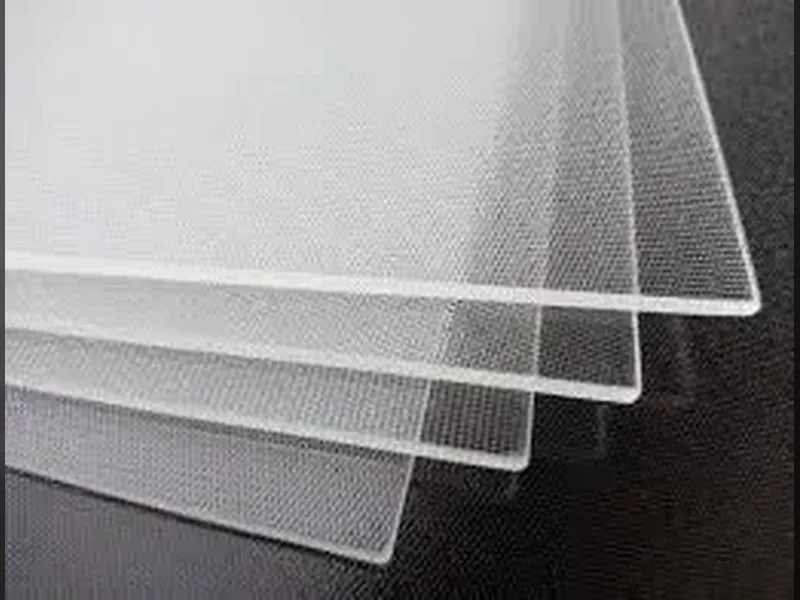
Semi-tempered glass has far lower quench strength and internal compressive stress than fully tempered glass, so it releases stress in a completely different way.
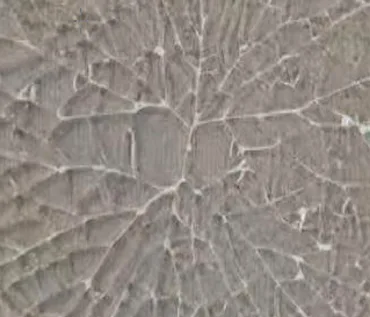
Even when it breaks on its own from inclusions or stress imbalance, it will not form a symmetrical butterfly structure. The cracks are gentler and more spread out.
That look is very close to minor external damage, which leaves on-site O&M and inspection staff with nothing solid to judge by. It has become a real headache in PV complaints.
Still, no butterfly mark does not mean you cannot judge it. The common method today assesses dual-glass semi-tempered glass across four dimensions: origin point, crack shape, damage traces and the site environment.
1. Look at the origin point
Spontaneous breakage of semi-tempered glass usually starts in the middle of the panel, in an intact area with no edge knocks, no mechanical damage, no grinding notches. External damage almost always starts at the edges or the four corners, the weak spots. Of course, if there is a clear impact point on the panel face, that counts separately.
2. Look at the cracks and fragments
Self-breakage is a whole internal stress release, so the cracks spread evenly, radial or net-like, the lines run continuously and neatly, fragments are uniform in size, sections are flat and smooth, no obvious deformation from force. Human external damage gives messy tree-branch cracks, abrupt local lines, fragments of wildly different sizes, a rough section at the break center, and it usually comes with chipped corners, scratches, dents and other physical damage.
3. Use the on-site scene as backup evidence
Spontaneous breakage has no trigger, it just happens, often after day-night temperature swings and long-term stress buildup. On site there is no gravel, no impact traces, no external object blocking or knocking it. External damage can nearly always be traced to a cause, wind-blown sand, O&M foot traffic, an object strike, a knock during installation, and the scene traces are clear.
Product Application
So, dual-glass semi-tempered glass cannot rely on the butterfly mark to prove self-explosion. Because of that, when semi-tempered glass breaks, responsibility usually gets negotiated among the departments inside the module factory or the various parties at the project site. In most cases it is very hard to trace it back to the upstream glass supplier. But dual-glass modules are now mainstream, and dual-glass breakage is far from rare, so the industry badly needs a spontaneous-breakage judgment standard for semi-tempered modules built together with upstream, plus tighter control over glass performance.
Ooitech's View
We see this a lot on production lines too, and the honest truth is prevention beats forensics. Semi-tempered glass in dual-glass builds is unforgiving to edge stress, so how the glass is handled at loading, layup and lamination matters as much as the glass batch itself. Clean glass loading, tight stringer alignment and a well-tuned laminator cycle cut down on the micro-defects that later show up as "mystery" cracks. If you want to see how those steps run in a real dual-glass module line, our YouTube channel www.youtube.com/ooitech has full-line footage worth a subscribe.