Editorial responsibility for this article rests with Wuhan Ooi Photoelectric Technology Co., Ltd. Written and reviewed by the Ooitech editorial team. See our editorial policy for how we write, where AI tools are used, and how to request a correction.
How PV Standards Relate: IEC, UL, GB/T, Industry, Group
Table of Contents
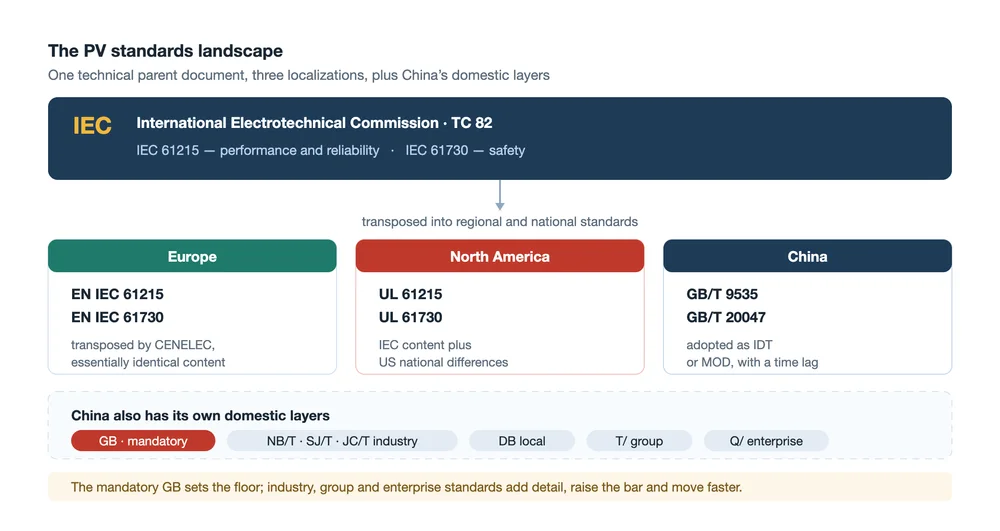
Quick answer: A tender line such as “modules shall comply with IEC 61215, IEC 61730, UL 61730, GB/T 9535 and the relevant industry and group standards” mixes three different things. A standard is a technical document written by a standards body. A certificate is third-party evidence that one model complies with one edition of that document. Market access is the legal or contractual gate where compulsion actually lives. IEC writes the parent documents for PV; EN, UL and GB/T are localizations of them, with China adding mandatory GB standards plus industry, local, group and enterprise layers on top.
Sort those three out and most of the confusion around the standard numbers disappears.
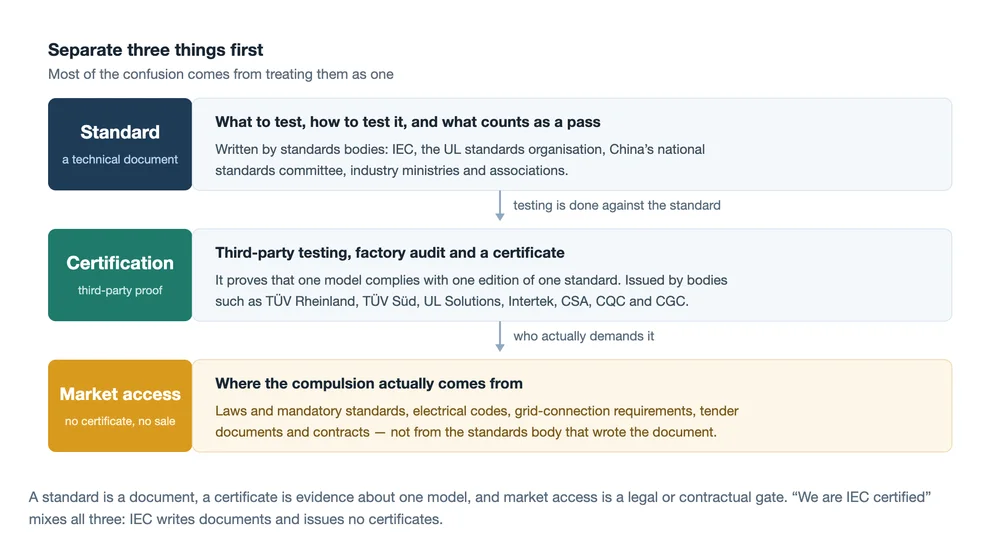
Standards, Certification, Market Access
A standard specifies what is tested, how it is tested and what counts as a pass, and it is written by a standards organisation. Certification is the third-party process — testing, a factory audit, a certificate — that proves a particular model meets a particular edition. Market access is the rule that says a product cannot be sold or installed without a given certificate, and that rule comes from law, an electrical code, a grid-connection requirement, a tender document or a contract.
This is why the common phrase “we are IEC certified” does not survive inspection: IEC publishes documents and issues no certificates. Certificates are issued by bodies such as TÜV Rheinland, TÜV Süd, UL Solutions, Intertek, CSA, CQC and CGC, and they name the standard edition they were issued against.
IEC Is the Technical Parent Document
PV sits under IEC Technical Committee 82. Two series carry the module side: IEC 61215 for design qualification of performance and reliability, and IEC 61730 for safety qualification. Around them sit documents of different weight:
- IS — international standard. The formal standard, and the document other countries transpose: IEC 61215, IEC 61730.
- TS — technical specification. An agreed approach for a technology still developing: IEC TS 62915 on retesting after change, IEC TS 63126 on high-temperature operation, IEC TS 63209 on extended stress testing.
- TR — technical report. Informative only, and not a requirement.
One point is routinely missed: an IEC standard is voluntary. Its weight comes from three places — being transposed into national standards, being adopted by certification schemes, and being written into purchase contracts. Under the IEC system, the IECEE CB scheme exists to make one test serve many countries: a CB certificate and report can be converted into local certificates by member-country bodies, which removes a round of duplicate testing.
It is also worth reading what the standard says about itself: IEC 61215 states that its results cannot be interpreted as a quantitative prediction of module lifetime. It is a gate that filters out early design faults, not a life test. The comparison of IEC 61215 and IEC 61730 covers what each of the two pillars actually qualifies.
UL: The North American Localization, and Where Its Force Comes From
UL is a private organisation, not a US government department. Since 2022 it has been split: UL Standards & Engagement is the non-profit that writes standards, while UL Solutions is the company that tests and certifies. So “the UL standard” and “UL certification” are again two different things, and listing to a UL standard can be done by other bodies too — Intertek with the ETL mark, CSA, TÜV and others — provided they are NRTLs recognised by US OSHA.
The reason everyone says a US project needs UL comes from two links further down the chain: the NEC electrical code, and local inspection and acceptance. Neither is issued by UL.
On the relationship with IEC: North America historically used UL 1703, whose structure and test logic differed enough from IEC that exporters had to run two full programmes. The turning point was December 2017, when UL 61730-1 and -2 were published based on IEC 61730:2016 plus a set of US national differences written to satisfy the NEC — the North American fire type rating among them. The UL 61215 series follows the same approach, and new editions of UL 61730-1 and -2 were issued in March 2026. In short: UL 61730 ≈ IEC 61730 plus US national differences. For a manufacturer this means most tests can be combined into one sample set and one test round producing two reports, while the difference items still have to be tested separately and cannot be skipped.
North American PV systems also bring in neighbouring standards: UL 2703 for racking and grounding, UL 1741 for inverters, UL 3741 for PV hazard control, UL 4703 for PV wire and UL 6703 for connectors.
China: Five Categories, Six Layers
China’s Standardization Law, in force since 1 January 2018, defines five categories: national, industry, local, group and enterprise standards. National standards split again into mandatory and recommended, while industry and local standards are recommended by nature.
| Layer | Code | Who issues it | PV examples |
|---|---|---|---|
| Mandatory national | GB | Approved or authorised by the State Council | The module safety requirements standard published in 2026 |
| Recommended national | GB/T | National standards committee | GB/T 9535.1 and .2 (module design qualification); GB/T 29848 (EVA film); GB/T 31034 (backsheet) |
| Industry | NB/T, SJ/T, JC/T, DL/T | Relevant industry ministries | NB/T 32004 (grid-tied inverters); JC/T 2001 (PV glass) |
| Local | DB plus a region code | Provinces and larger municipalities | Mostly distributed-generation construction and acceptance |
| Group | T/ plus a body code | Associations and industry alliances | T/CPIA, T/CEC |
| Enterprise | Q/ plus a company code | The company itself | Internal control standards for modules and materials |
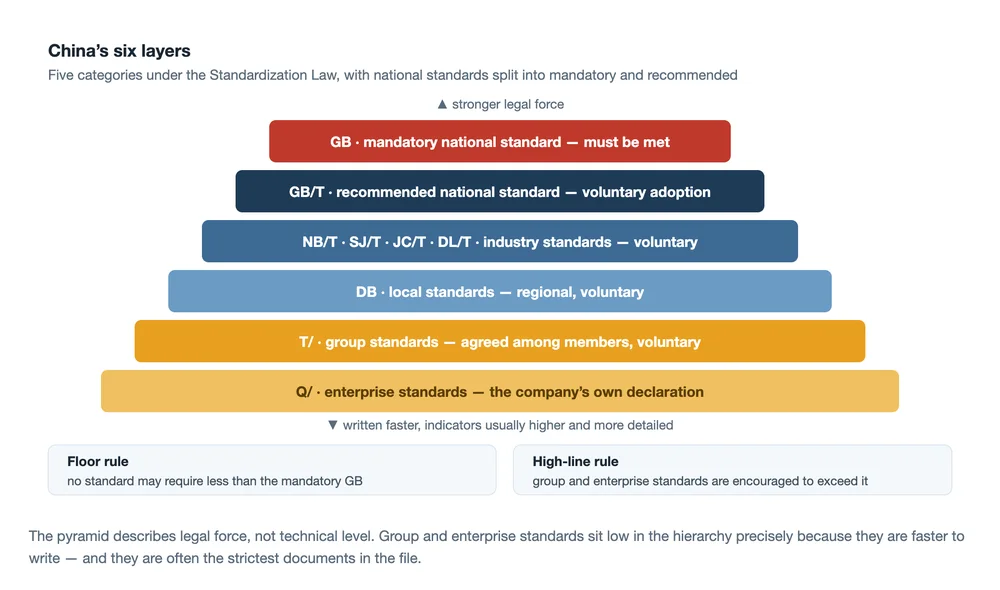
Three rules govern the layers. The floor rule: no recommended, industry, local, group or enterprise standard may require less than the mandatory national standard, and products that do not meet a mandatory standard may not be produced, sold or imported. The high-line rule: companies and associations are encouraged to write group and enterprise standards above the recommended level. And the third: “recommended” does not mean optional in practice — once a standard is cited by regulation, written into a contract or tender, or declared on the product, packaging or documentation, it becomes binding.
The reason there are so many industry prefixes is that PV spans several industries: manufacturing sits with electronics (SJ), power plants and grid connection with energy and electricity (NB, DL), glass with building materials (JC), and building-integrated PV also touches construction (JG). One module passes through standards from several ministries on its way from material to grid.
Group standards exist for one reason: speed. National and industry standards are revised on a cycle measured in years, which new cell structures, new encapsulants and new applications cannot wait for. A group standard can standardise “how to test and how to compare” first and be upgraded later into an industry or national standard, or proposed to IEC. So group standards sit low in the hierarchy in terms of legal effect, not technical level — many are stricter and newer than the national standard they sit under. Engineering-construction national standards (GB 5xxxxx numbering, such as the PV power station design code) belong to a separate system and are outside this map.
Adoption, and the Time Lag That Comes With It
China’s mirror committee for IEC/TC 82 is SAC/TC 90, and a large share of national standards are transposed from IEC documents. The degree of adoption is printed on the cover: IDT for identical adoption, where technical content and structure are unchanged and only editorial changes are made; MOD for modified adoption, where technical differences exist and are listed clause by clause; and NEQ for not equivalent, which records a relationship but is not an adoption. A cover line such as “GB/T 20047.1—2006 / IEC 61730-1:2004, IDT” tells you exactly which IEC edition the national standard is based on.
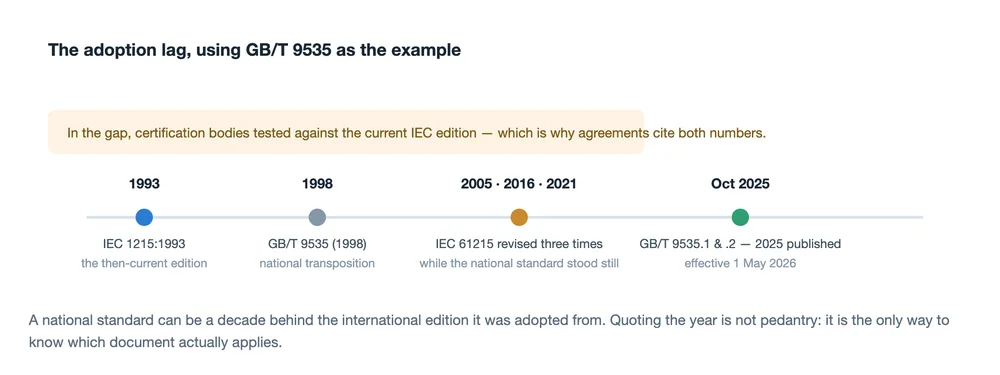
The complication is the lag. GB/T 9535 is the standard example: the 1998 edition corresponded to IEC 1215:1993, and while IEC 61215 was revised in 2005, 2016 and 2021, the national standard only caught up with GB/T 9535.1—2025 and GB/T 9535.2—2025, published in October 2025 and effective from 1 May 2026. Through the intervening years, the industry’s working practice was for certification bodies to test against the current IEC edition — which is exactly why Chinese technical agreements often cite an IEC and a GB/T number side by side.
The practical rule that follows: always quote the year. “IEC 61730” and “IEC 61730:2023” are different documents,
What Changed in 2026
For a long time modules had no dedicated mandatory national standard at product level and were not inside the compulsory CCC certification catalogue; the quality threshold came from voluntary certification plus buyer requirements. That changed in 2026, as reported by the ministries and the press:
- May 2026: two mandatory national standards were published — one on module safety requirements, covering electrical, mechanical and fire safety and restrictions on hazardous substances, and one on module nameplate marking, aimed at power misstatement and specifying tolerances and verification methods for nameplate electrical parameters. Both take effect on 1 June 2027.
- Later in 2026: mandatory standards on energy efficiency limits and grades for crystalline silicon modules and inverters, and energy consumption quotas for polysilicon and monocrystalline silicon, take effect on 1 January 2027. Efficiency is graded in three levels, and level three is the threshold for market entry.
Read against the layer diagram, the significance is simple: the top layer went from nearly empty to solid. Compliance used to mean satisfying the customer first; it now means satisfying the law first. As with any standards development, the dates and scope should be confirmed against the official texts before they are written into a specification.
Five Misconceptions Worth Retiring
- “We have IEC certification.” IEC issues no certificates. The accurate statement is that a named body issued a certificate against a named edition of IEC 61215 or IEC 61730.
- “UL is the US mandatory national standard.” UL is a private organisation and its standards are voluntary; the compulsion comes from the NEC and local acceptance.
- “GB/T is recommended, so it can be ignored.” Once written into a contract, cited by regulation or declared on the product, a recommended standard becomes binding.
- “Group standards are the lowest layer, so they ask the least.” The layer describes legal effect, not technical ambition. Group and enterprise standards are frequently the strictest documents in the file.
- “Passing IEC 61215 means 25 years.” The qualification test is designed to expose early design and material failures, and the standard itself states that the result is not a lifetime prediction.
What Each Market Looks At
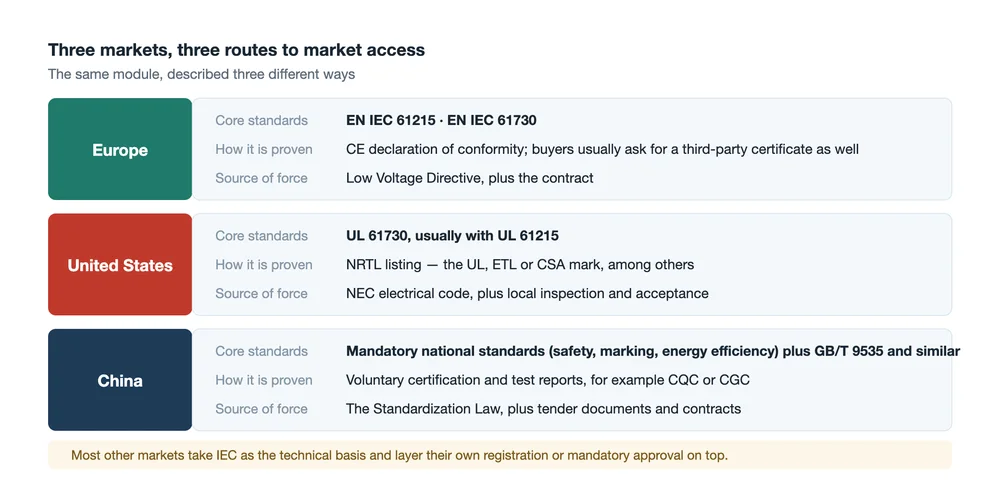
Faced with a technical agreement or a tender document, read it in this order: first the mandatory items, because the destination country’s law and mandatory standards are not negotiable; then the version numbers, checking that your certificates and reports are issued against the edition the contract names; and only then the tightened requirements in buyer specifications, group standards and enterprise standards, which is usually where the cost and the risk sit.
Standards status can be checked through official channels rather than a search engine: China’s national standards information platform for GB, industry and local standards, the national group standards platform for T/ documents, and the IEC webstore for IEC documents and their status.
What This Means When You Specify Equipment
The map has a direct consequence for a factory: the standards a buyer names determine the test programme, and the test programme determines the equipment list. If a specification demands both an IEC edition and a GB/T edition, then the tests behind both have to be available — either in-house or through a laboratory. That is the practical reason a module line is specified together with its test equipment rather than afterwards, and why the in-house tests — IV, EL, insulation and withstand, bypass diode, visual — are the ones worth owning outright. The equipment behind the standards is set out in the IEC certification test equipment overview, with examples such as a PV safety comprehensive tester, and the reliability test items themselves are described in PV module reliability tests.
FAQ
Is IEC the same as certification?
No. IEC writes standards. Certification is a separate activity carried out by third-party bodies, which test and audit against those standards and issue certificates naming the edition.
Why does a US project require UL if UL standards are voluntary?
Because the NEC electrical code and local inspection require a listed product, and listing is normally evidenced by an NRTL mark. The force comes from the code and the acceptance process, not from UL itself.
What does UL 61730 mean next to IEC 61730?
UL 61730 is based on IEC 61730 with US national differences added. Most tests can be combined into a single programme, but the difference items have to be tested separately.
What do IDT and MOD mean on a Chinese standard?
They describe how a national standard adopts an international one: IDT means the technical content is identical, MOD means it was modified and the differences are listed. NEQ only records a relationship and is not an adoption.
Why do Chinese technical agreements cite both IEC and GB/T numbers?
Because national adoption lags the international revisions. During the gap, certification bodies test against the current IEC edition, so agreements name both to remove ambiguity about which edition applies.
Do group standards have any legal force?
They are voluntary in themselves, but they become binding when a contract or tender requires them, when regulation cites them, or when a company declares compliance with them on the product or in its documentation.
Final Thoughts
One sentence covers the map: IEC writes the common technical language, EN, UL and GB/T localise it, mandatory national standards draw the floor, and industry, group and enterprise standards add detail and raise the line; certification verifies, while regulation and contracts decide what is compulsory. When a standard is quoted at you, ask which of the three things it is, which edition it is, and who is forcing it. Those questions resolve most of the arguments that start with a row of numbers in a tender.
Standards and regulatory dates are as reported in the source material and current to October 2026; confirm scope, editions and effective dates against the official standard texts and the certification body’s position before relying on them in a specification.
Related: IEC TS 62915 and module retesting explains which changes force which tests, and how an existing certificate is carried forward.
Related: TOPCon UVID and the r-UVID / ir-UVID split adds the recovery step that is being written into IEC TS 63624-1.
Further reading and background data
Public reference material on this topic, published by the organisations that maintain the industry's technology roadmap and market data: