Editorial responsibility for this article rests with Wuhan Ooi Photoelectric Technology Co., Ltd. Written and reviewed by the Ooitech editorial team. See our editorial policy for how we write, where AI tools are used, and how to request a correction.
IEC TS 62915: What a Module Change Forces You to Retest
Table of Contents
Quick answer: Once a module holds an IEC 61215 and IEC 61730 certificate, a change to the design, a material or a component does not automatically leave the certificate valid — but it does not force a full requalification either. IEC TS 62915 is the retest guideline that connects the two: it maps each type of change to the specific MQT items of IEC 61215 and MST items of IEC 61730 that have to be repeated. The current edition is Ed. 2.0, published in September 2023, with an editorial corrigendum in August 2024. It adds no new test methods of its own: every test, sample count and pass criterion still comes from the two base standards.
The scenarios are familiar: a cheaper encapsulant film from a second supplier, glass thinned from 3.2 mm to 2.0 mm, a larger next-generation cell, a 1500 V version for a new market. Each looks minor; the question is whether the module on the line is still the module that was certified.
Why a Retest Guideline Exists at All
A full qualification is expensive and slow: it consumes several modules and runs thermal cycling, damp heat, humidity freeze, UV and mechanical load sequences over a period measured in months. PV is simultaneously a fast-iterating and cost-pressured industry, so the bill of materials is never static. That produces a genuine dilemma.
- Retest everything on every change and the cycle time and cost become unsustainable, and the introduction of new materials and technologies is held back.
- Retest nothing and the certificate describes a product that is no longer the one being shipped, which makes certification meaningless.
Without a common rule, the same change could attract a different test programme at different bodies or in different projects. IEC fixed the retest rules as a technical specification in 2018, and its scope states the purpose plainly: to give a uniform method of maintaining type approval, design and safety qualification for modules that have changed or are about to change.
What It Is, and What It Is Not
| Item | Detail |
|---|---|
| Document number | IEC TS 62915 |
| Title | Photovoltaic (PV) modules — Type approval, design and safety qualification — Retesting |
| Document type | TS — technical specification, not a full international standard |
| Committee | IEC TC 82, solar photovoltaic energy systems |
| Current edition | Ed. 2.0, September 2023, replacing the 2018 first edition; corrigendum COR1, August 2024 |
| Applies to | Wafer-based technologies (WBT, which includes crystalline silicon) and monolithic integrated thin-film modules (MLI) |
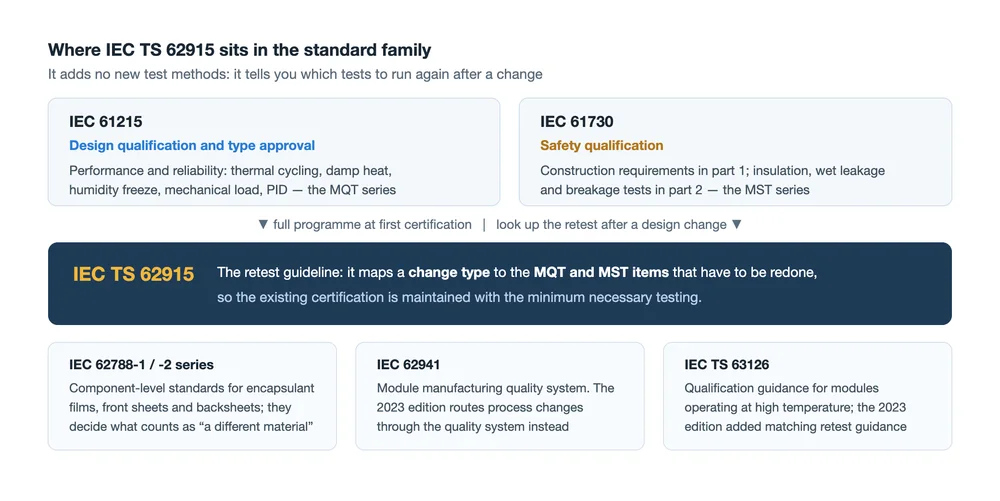
The key to reading the document is its position: it creates no new test methods. Every test item, sample quantity and acceptance criterion comes from IEC 61215 and IEC 61730. What 62915 does is establish the correspondence between a change type and the tests to be repeated. Its effect is stated as clearly: a product that passes the specified sequences is considered to comply with the standards on which its original full qualification was based — in other words, the existing certification carries forward.
The TS format matters too. In the IEC system an IS is a formal international standard while a TS is a technical specification issued while practice is still developing, and this one says openly that it provides assistance and that engineering judgement may be needed in places. It is a guideline, not a checklist that covers every situation.
How the Standard Is Organized: A Change Map
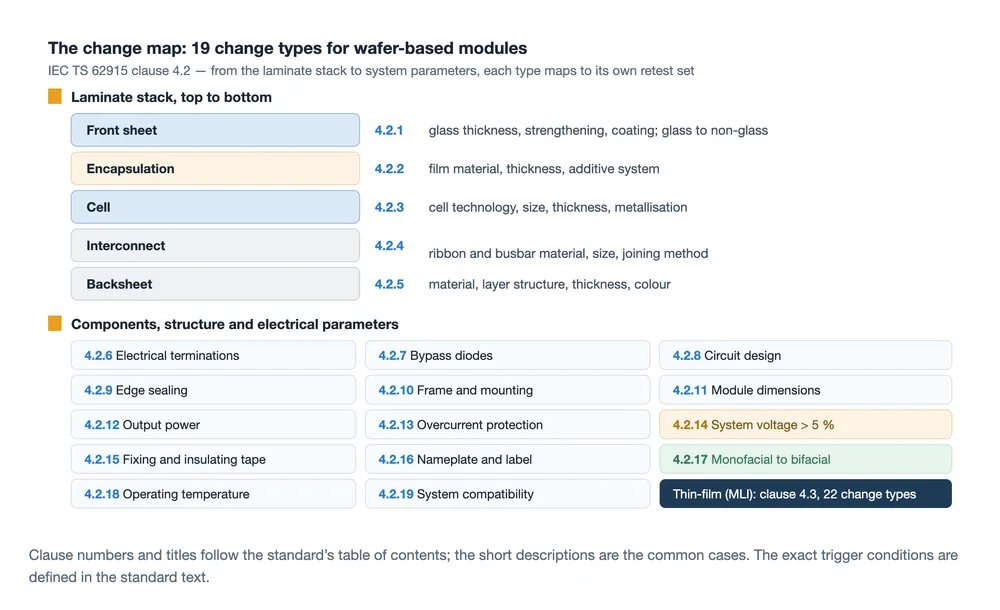
The core of the 2023 edition is clause 4, Retesting. Clause 4.1 holds the general rules that apply to every retest. Clause 4.2 gives the test programmes for wafer-based modules, divided into 19 subsections by change type. Clause 4.3 does the same for thin-film modules in 22 subsections, covering only the thin-film-specific content such as the transparent front electrode, the back electrode and edge deletion, without repeating what 4.2 already says. Annex A is normative: Table A.1 summarises all retest requirements, Figure A.1 gives the combined IEC 61215 and IEC 61730 test flow, and A.3 provides the method for evaluating new material or component combinations.
Each subsection follows the same pattern: first which situations count as a change, then the MQT items to be repeated under IEC 61215 and the MST items under IEC 61730. The 2023 edition lists the two separately, which makes the document clearer whether a manufacturer holds one qualification or both.
The codes recur constantly when reading a retest programme. MQT items belong to IEC 61215-2; MST items belong to IEC 61730-2.
| Code | Test | Code | Test |
|---|---|---|---|
| MQT 01 | Visual inspection | MQT 13 | Damp heat |
| MQT 03 | Insulation test | MQT 15 | Wet leakage current |
| MQT 06.1 | Performance at STC | MQT 16 | Static mechanical load |
| MQT 09 | Hot-spot endurance | MQT 17 | Hail |
| MQT 10 | UV preconditioning | MQT 19 | Stabilisation |
| MQT 11 | Thermal cycling | MQT 20 | Dynamic mechanical load |
| MQT 12 | Humidity freeze | MQT 21 | Potential-induced degradation |
On the safety side the recurring codes include MST 01 (visual inspection), MST 03 (maximum power determination), MST 16 (insulation), MST 17 (wet leakage current), MST 32 (module breakage) and MST 53 (damp heat). The engineering detail behind several of these, such as the damp heat exposure itself, is set out in the DH1000 damp heat test.
The Six General Rules That Decide How You Use the Tables
Clause 4.1 is the part worth reading closely, because it governs how the tables are applied rather than what is tested.
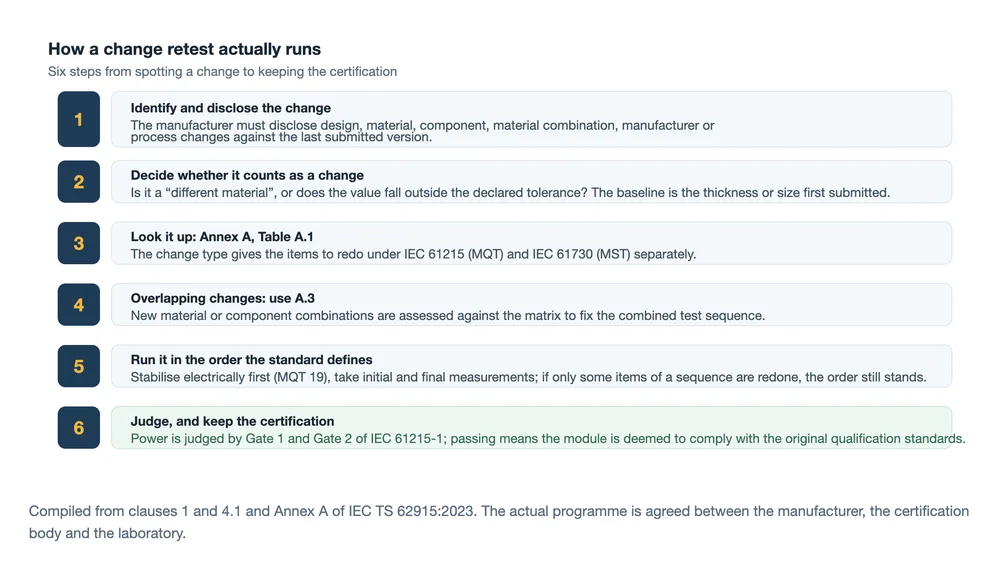
- Disclosure is the manufacturer’s duty. The manufacturer must declare changes in design, material, component, material combination, manufacturer or process relative to the last submitted version — and must supply the component-level data if it wants to use that data to reduce the retest scope.
- What counts as a “different material”. The definition is a material differing in chemical composition, type designation or specification, where specification covers electrical, optical and mechanical properties including nominal values and tolerances. A note adds that the same material from a different supplier or production site is not necessarily a different material, provided it can be clearly demonstrated.
- The baseline is the first submitted value, judged against tolerance. When assessing a new thickness or dimension, the reference is the value originally tested; a new value outside the declared tolerance may be treated as a change. And if the tolerance the manufacturer declares is itself wider than the change ratio that triggers retesting — the standard’s own example is a 10 % reduction in front glass thickness — the part has to be submitted at the most unfavourable limit.
- Stabilise first, then compare before and after. Every module submitted for retest is electrically stabilised (MQT 19), and the applicable standard’s initial and final measurements are taken around the test: MQT 01, 03, 06.1, 15 and 19 in a 61215 programme, or MST 01, 03, 16 and 17 in a 61730 programme.
- The order cannot be changed. If only some items of a sequence are repeated, they still run in the order the original standard specifies. Items may be skipped; they may not be reordered.
- Overlapping changes go through A.3. Change the encapsulant and the backsheet at once and the combination must be evaluated against the matrix in A.3, which is illustrated with a worked example in Figure A.2.
Two further points sit on top of the list. Any change affecting the optical path or the electrical circuit has to include the STC power measurement (MQT 06.1). And in 61215-related retests the stabilised power, open-circuit voltage and short-circuit current are assessed against the nameplate nominal values (Gate 1), while the relative power change before and after the test is assessed against the criteria of IEC 61215-1 (Gate 2).
Thresholds Worth Knowing
A few clauses and corrigendum clarifications give a feel for how the trigger conditions work:
- Glass front sheet to a non-glass front sheet (or the reverse) is not a retest at all — the type of the front sheet changes fundamentally, so a full qualification is required. It is effectively a new product.
- Thinning the front glass is the standard’s own example in the general rules: a reduction of 10 % triggers retesting, which is the clause most often encountered as module glass has become thinner.
- Cell size changes were clarified through the 2024 corrigendum discussion: a change in cell length, width or area above 10 % requires retesting, while a change below 10 % requires none provided that the cell spacing and the cell-to-busbar spacing stay the same or increase.
- System voltage increases are handled in clause 4.2.14, whose title states the threshold: an increase of more than 5 %. Going from 1000 V to 1500 V falls inside it.
- Same design and size, different power bin is dealt with separately in clause 4.2.12, which is the common case when extending a power range.
- Monofacial to bifacial gained its own clause, 4.2.17, in the 2023 edition.
These are illustrations rather than a checklist: each change type contains further cases and exceptions. A retest programme should be built from the standard text, Table A.1 and the certification body’s assessment.
What the Second Edition Changed
Ed. 2.0 is a technical revision rather than an editorial tidy-up, and three of its changes affect daily work most:
- Alignment with the new base standards. References moved to IEC 61215:2021 and IEC 61730:2023, and the two tests introduced in those editions — dynamic mechanical load (MQT 20) and PID (MQT 21) — were brought into the retest requirements.
- Process changes are handled differently. The first edition’s clauses for specific process changes were removed and replaced by a general requirement to maintain a consistent quality management system in line with IEC 62941. Process change control is thus delegated to the quality system.
- Material changes are tied to component-level standards. The IEC 62788-1 and 62788-2 series were introduced to define what counts as a change in encapsulant films, front sheets and backsheets.
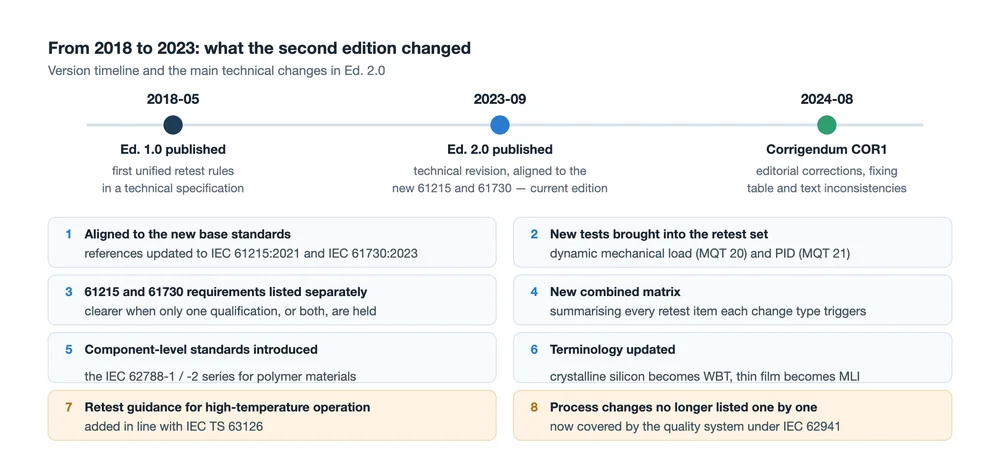
The other five points are the separate listing of 61215 and 61730 requirements, the new combined matrix, the terminology update from crystalline silicon and thin film to WBT and MLI with clause 4.3 trimmed of duplication, the added retest guidance for high-temperature operation in line with IEC TS 63126, and the removal of the clause-by-clause listing of process changes. COR1, issued in August 2024, is mainly editorial — correcting inconsistencies between tables and text and wording that could be misread. The document’s stability period runs to 2026, when it will be confirmed, withdrawn or revised; technical questions raised by the working group were left for the next edition.
What This Means in Practice
- Put the retest assessment into design review. When a new material or a cost-reduction proposal is raised, estimate the retest items and the lead time against Table A.1 at that point. Starting the certification question after the samples are built is usually too late.
- Combine changes into one submission. Where several changes are pending, grouping them into a single retest round and using the A.3 combination rules to avoid duplicate sequences is faster and cheaper than submitting item by item.
- Plan tolerances and boundaries at first certification. Because assessment is anchored to the first submitted values, the thickness, dimensions and tolerances chosen at that moment define the room available for later changes.
- Manage the material’s identity. The judgement of “different material” rests on composition, type designation and specification. A supplier quietly changing a formulation without changing the type designation is the hardest change to detect, and controlling it depends on incoming inspection and a supplier change-notification agreement.
- Passing a retest is not a field guarantee. IEC 61215 and 61730 are qualification tests that look for obvious design defects rather than predicting lifetime, and the retest guideline carries forward only that level of assurance. For significant changes, extended testing and field data still have their place.
For the equipment side, the practical consequence is that the retest programme defines which measurements a factory needs access to. The before-and-after electrical measurements and the insulation and wet-leakage tests are the ones worth having in-house, while the long ageing sequences normally go to a laboratory. The equipment behind that split is described in the IEC certification test equipment overview, and the full set of module tests in PV module reliability tests.
FAQ
Does any change to a module invalidate its certificate?
It puts the certificate in question rather than voiding it automatically. Changes that fall within the declared tolerances and are not material or component substitutions may need no retest at all; others are mapped to a defined retest set by IEC TS 62915.
Does IEC TS 62915 introduce new tests?
No. Every test item, sample quantity and acceptance criterion comes from IEC 61215 and IEC 61730. The guideline only decides which of those items must be repeated for a given change.
Is a supplier change enough to trigger retesting?
Not by itself. A note in the general rules says the same material from a different supplier or production site does not necessarily count as a different material, as long as it can be clearly demonstrated. Composition, type designation and specification are what decide.
What are MQT and MST?
They are the test item codes used in the two base standards: MQT items sit in IEC 61215-2, covering design qualification, while MST items sit in IEC 61730-2, covering safety qualification.
Can parts of a sequence be skipped?
Yes — items not required for that change can be skipped, but the remaining items must still run in the order defined by the base standard. Skipping is allowed; reordering is not.
What happens if several changes are made at once?
The combination is evaluated using the matrix in Annex A.3, which determines the test sequence needed for the combined change. Grouping changes this way is usually cheaper than submitting them one at a time.
Final Thoughts
IEC TS 62915 answers a plain question: the product changed, so how does the certificate stay valid? Its answer is to identify the change, look it up, and repeat what is necessary — neither waving changes through nor repeating the whole qualification. For a module manufacturer, reading the guideline properly is what allows cost reduction, technology iteration and compliance to be pursued in the same programme instead of taking turns.
Standard structure, clause numbers and edition dates follow the source material and IEC TS 62915:2023 (Ed. 2.0) with corrigendum COR1:2024; confirm the current text, Table A.1 and the applicable requirements with the certification body before building a retest programme.
Further reading and background data
Public reference material on this topic, published by the organisations that maintain the industry's technology roadmap and market data: