Quick answer: Choose a solar panel laminator machine by matching chamber format, membrane style and control system to your module size and encapsulant, then run it with a recipe that pulls the air out before the membrane presses and holds the stack through cross-linking — and keep it clean, sealed and leak-free.
Solar Panel Laminator Machine: How to Choose and Run One
What lamination actually does to a module
Before lamination a module is loose glass, encapsulant, cells and backsheet held by alignment alone; after it, a sealed product that must survive decades outdoors. Four jobs happen at once.
Air removal. Trapped air becomes a void, then a moisture path, a partial-discharge site and a cosmetic reject. Vacuum removes it before the stack is compressed.
Cross-linking. EVA, POE and EPE are not thermoplastics that simply melt: heat softens them, then the peroxide in the film decomposes and bonds polymer chains into a tough, transparent, insulating barrier. Because that is chemistry rather than a melting point, a recipe cannot be copied between materials — see our guide to the laminator as the heart of PV module encapsulation.
Adhesion and stability. The laminate must bond to glass and to backsheet or rear glass, encapsulate every ribbon, and emerge flat and square — framing and junction-box stations downstream assume a flat module.
Machine configurations and what each one is for
A solar panel laminator machine is not one product. Configurations differ in chamber count, stacking, pressure method and line integration; module format and product mix drive the choice more than price.
| Configuration | How it works | Best fit |
|---|
| Single-chamber | One chamber, one module per cycle | Narrow range, pilot lines |
| Single-layer, double-chamber | Two chambers under one control system and one operator | Two recipes at once, more output per footprint |
| Double-layer (stacked) | Two independent chambers stacked, each with its own membrane and heating | Mixed BIPV, framed, glass-glass |
| Multi-chamber in-line | Several chambers in series inside a full-automatic line | High-volume single format |
| Semi-automatic | Operator loads and unloads; cycle is automatic | Batch work, retrofits |
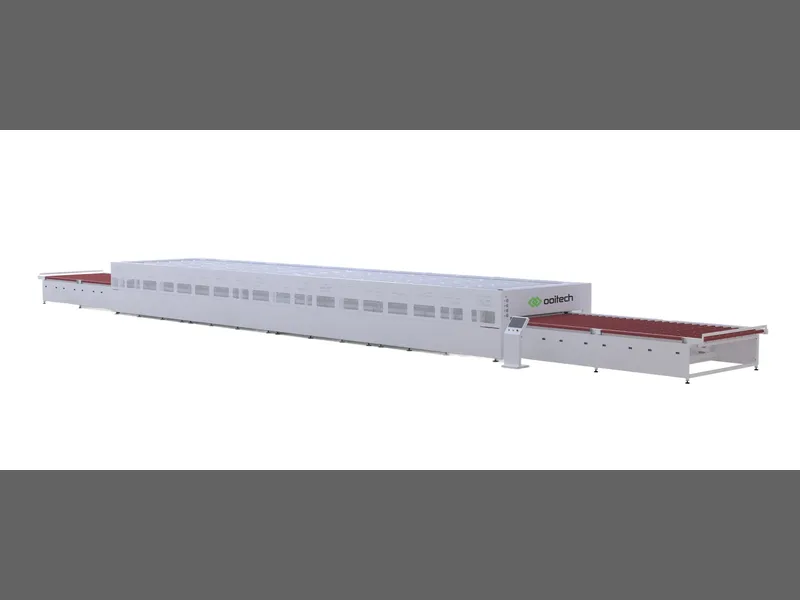
The OTCY-2754DD is a single-layer double-chamber automatic laminator built around BIPV and framed modules — two chambers, so a heavy BIPV laminate and a standard framed module each run their own recipe without stopping production. The OCY-H600D is a semi-automatic laminator, the usual answer where volumes do not justify a fully automatic transfer system.
Membrane versus bladder
In a membrane machine a sheet clamped at the chamber edge is drawn onto the module by vacuum above it and atmospheric pressure presses; a bladder machine pushes an inflatable cushion down instead. Membranes conform better around frames and thick edges, bladders are simpler to service. Either way chamber flatness and membrane tension matter more than any nominal rating.
Framed, frameless, BIPV and glass-glass
A frameless module pressed flat against a plate behaves predictably. A framed one has aluminium standing proud of the glass, so the membrane must bridge the frame without levering it aside — the mechanism behind frame jumping. BIPV laminates are thicker and often asymmetric, needing gentler ramps. Glass-glass has no backsheet to hide behind: every bubble stays visible, so the recipe must serve cosmetics as well as bond strength.
Semi-automatic versus in-line is logistics. In a full-automatic line the laminator sits between layup and the downstream stations at a fixed rhythm — with testing and EL stations such as the OEL-S2400 and framing such as the OTZK-A setting that rhythm either side. Our comparison of how to choose the right solar module laminator works through the sizing arithmetic.
The cycle, stage by stage
- Evacuation. Air is drawn from both faces, or one face against a plate. Voids are prevented here.
- Heating. The stack reaches the temperature at which the encapsulant flows; starting heat during or after evacuation changes how far the film flows before pressing.
- Pressing. The membrane descends, driving softened encapsulant into every gap around ribbons, busbars and cell edges.
- Dwell and cure. Held while cross-linking proceeds — usually the longest stage, and the one setting gel content.
- Cooling. Held under pressure so the laminate does not shrink from the glass or curl at the edges.
- Release. Vacuum breaks, the chamber opens, the module leaves. Releasing early causes edge delamination.
Vacuum system and the EVA window
Vacuum comes from rotary-vane oil pumps, oil-less dry or diaphragm pumps, Roots blower combinations, or water-ring pumps. Oil-sealed pumps pull deeper but need oil changes and mist control; dry pumps run cleaner. Some PV module laminator designs evacuate both faces of the stack, some only the top — the difference shows as edge voids on thick glass-glass.
What matters is the EVA window: the band where the encapsulant is fluid enough to flow and let air out, but not yet gelled enough to lock it in. Evacuate too slowly and the film gels with air still inside; too fast through a narrow gap and the membrane bridges the edge and seals air in. Recipe design is largely the art of parking inside that window — our article on laminator vacuum pumps, types and the EVA window explains the interaction.
Defect playbook
| Defect | Cause | Check and fix |
|---|
| Bubbles and voids | Air left in the stack, or moisture released after gel point | Check pump-down, seal integrity, film storage and shelf life. Start with the real causes behind solar module bubbles. |
| Edge delamination | Weak adhesion, early release, contaminated glass or film | Inspect the release sequence and cooling hold. If it follows ribbon lines it is a flow problem, not pressure. |
| Ribbon-line bubbles | Film cannot wet out under ribbon and busbar before gelling | Slow the ramp, lengthen the flow period, and check ribbon geometry against the layup drawing. |
| Frame jumping | Membrane bridges the frame and levers it off the glass | Check frame seating and membrane tension, then soften the pressure ramp. |
| Cell cracks near busbars | Soldering stress plus an uneven ramp at the overlap | Inspect bussing overlap upstream. See why bussing overlap causes cell cracks during lamination. |
| Backsheet wrinkles | Uneven tension, trapped air, asymmetric heating | Check layup alignment and that the sheet is pulled flat before closing. One-sided wrinkles mean a plate that is not flat or an off-centre module. |
Throughput and line balancing
On most lines the laminator is the slowest station, so its cycle time — not the stringer or the framer — sets takt: available time divided by modules required. A cycle longer than takt is a bottleneck no matter how fast everything else runs. Three honest fixes exist. Add parallel capacity, a second chamber or a double-chamber unit, so two modules are in process while the operator loads the next. Shorten the recipe where the encapsulant allows, trading dwell against gel content in the test lab. Or accept the takt the solar panel laminator machine imposes and size buffers and downstream capacity around it. What never works is starving it: an in-line laminator waiting for modules loses more output than a slow recipe will.
Daily operation and maintenance
Membrane care. Membrane and release film collect EVA residue, shards and glass dust. Wipe down, inspect for pinholes and creases, and replace on schedule — a pinhole gives a repeatable void pattern that is expensive to trace.
Chamber cleanliness. EVA drips, cell fragments and flux residue land on the plate and print onto every module that follows it.
Seal and leak checks. Inspect the perimeter gasket for cuts and hardening, then close the empty chamber, isolate the pump and watch the gauge. A slowly decaying reading warns of a seal problem long before bubbles appear.
Cure tracking. Log recipe ID, batch, film lot and cycle, and cross-check with gel content or peel tests on samples. Records turn a bad afternoon into a diagnosis. Ooitech supplies equipment turnkey with operator training and after-sales service, so recipe book and maintenance schedule are built with the line.
What to specify when buying
- Chamber size against module format, with margin for frames, jigs and your largest BIPV panel.
- Membrane type and tensioning, and how fast one operator can change it.
- Control system and recipe logging: stored recipes per product, alarm history, exportable cycle records.
- Safety interlocks on doors, over-temperature, pressure and vacuum, plus a documented emergency release.
- Spare membrane and seal supply from day one: both are consumables and both stop the line.
FAQ
What does a solar panel laminator machine actually do?
It removes air from between glass, encapsulant, cells and backsheet, melts the film so it flows around every ribbon and gap, then holds the stack under heat and pressure until it cross-links into a sealed, insulating unit.
Single-chamber or double-chamber?
Add a chamber when required output exceeds what one chamber's cycle allows, or when you run genuinely different recipes. For one format at modest volume, a single chamber is simpler to maintain.
How long does a lamination cycle take?
It depends on encapsulant chemistry, film thickness, construction and required gel content, so a figure quoted without those inputs is meaningless. Ask for a cycle trial on your own laminate stack.
Can one machine run EVA, POE and EPE?
Yes, with separate stored recipes. POE and EPE generally need a longer flow period and a gentler ramp than EVA because they wet out around ribbons slowly, so each material must be validated rather than adapted by feel.
Which maintenance matters most?
Membrane and release film condition, plate cleanliness, perimeter seal inspection and regular vacuum leak checks. Those four separate a machine that runs clean for years from one producing intermittent bubbles nobody can trace.
Sizing a solar panel laminator machine for a new or existing line? Send your module formats and target output and we will match a configuration, recipe plan and training package to them — request a quote.