TOPCon Front-Film SiNx Wins Big: 3-4W More Module Power
Table of Contents
Quick answer: Front-film silicon nitride thickness on a TOPCon cell turns out to be worth measurable module power. A line comparison between two groups of cells with different front-film recipes produced a 3 W to 4 W difference in module output, with the better recipe gaining around 2.8 W. SiNx works as both an anti-reflective coating and a source of hydrogen passivation, and those two jobs pull the optimum thickness in different directions: too thin and reflectance rises, too thick and the film's optical and passivation behaviour changes. The recipes in question sat in the 15 nm to 45 nm range, with several layers between 20 nm and 30 nm. Because the layer is deposited in the same PECVD step either way, the gain costs nothing in equipment — it is a recipe change, which is why front-film optimisation is one of the cheapest remaining efficiency levers on a TOPCon line.
PV Module Manufacturing · by Jerry, Ooitech
Product Introduction
You ran a comparison on the line. Two groups of TOPCon cells, different front-film recipes.
Gradient film group: SiNx/SiOxNy/SiOx gradient stack (with low-refractive-index SiOx/SiOxNy layers)
Pure SiNx group: pure multilayer SiNx
The result came back backwards.
Cell level: the gradient group was 0.05%-0.1% higher in efficiency than the pure SiNx group. On the cell, the gradient film clearly looked better.
Module level: after lamination into 66-cell 210×210 modules, the pure SiNx group was actually 3-4W higher in power (measured on the line).
"The group with lower cell efficiency ended up with higher module power." Quality kept asking why, and you can't just answer "packaging gain."
This piece uses one solid paper to settle that counterintuitive optical math.
Technical Parameters
Cell efficiency ≠ module power. Lamination sits in between.
Keep one thing tight in your head: cell efficiency and module power are not a simple multiplication.
Using a 66-cell 210×210 TOPCon module with 25.7%-grade cells as the baseline, line data shows a 0.1% cell efficiency gap maps to about 2.8W of module power. By that coefficient:
| Comparison | Cell-level gap | Expected module gap | Measured module result |
|---|---|---|---|
| Gradient film vs pure SiNx | +0.05%-0.1% (gradient higher) | +1.4-2.8W (gradient should win) | Pure SiNx +3-4W (reversed) |
The direction flipped completely. The cell-level advantage got eaten in lamination.
Module power is not cell efficiency multiplied directly. Glass, encapsulant and backsheet bring optical coupling gain (positive) but also current mismatch and distribution loss (negative). The net is the measured power. Different anti-reflection recipes produce very different post-lamination nets, and that's the root of "lose at cell, win at module."
This mechanism was already pinned down by Zhang et al. 2019 (Energies, DOI:10.3390/en12061168) on a PERC platform, backed by SunSolve simulation and module measurement.
Technical Advantages
One PERC paper explains the inversion clearly
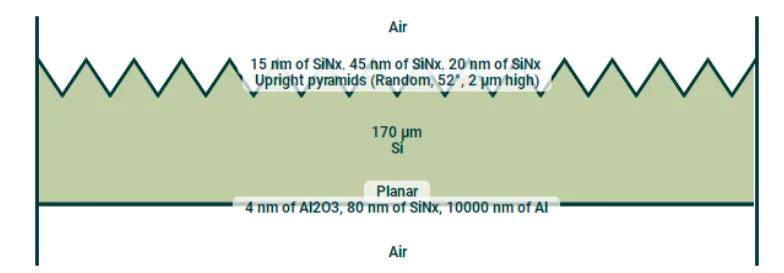
Zhang 2019 studied a front three-layer anti-reflection coating on mono PERC. The first two layers stayed fixed SiNx (20nm/45nm). Only the third layer changed.
Plan A: third layer 15nm SiNx (refractive index 1.99)
Plan B3: third layer 30nm SiOx (refractive index 1.46)
Using SunSolve optical simulation (pyramid texture included), they computed weighted average reflectance WAR (300-1100nm):
| Plan | Third layer | WAR (300-1100nm) |
|---|---|---|
| A | 15nm SiNx | 3.12% |
| B3 | 30nm SiOx | 2.78% |
| B5 | 50nm SiOx | 2.46% (thicker, lower) |
At cell level, B3 reflects less than A, measured Isc 62mA higher, efficiency 21.50% vs 21.35% (+0.15% abs). The film with a low-index SiOx layer just wins on the cell.
But at module level, the plot flips. Section 3.3 says it plainly:
"Because the EVA encapsulant absorbs short-wavelength light, the spectral response advantage of the 30nm SiOx cell is partly masked... the module power gain is only 0.9W... putting SiOx into the module cut the cell-level performance gain by 57%."
The specifics:
CTM ratio: 30nm SiOx 96.1% vs 15nm SiNx 96.5%. The SiOx one is actually lower.
The +0.15% cell-level advantage lost 57% of its gain after lamination.
Module power gain only 0.9W.
That's the paper-level explanation for your case. The gradient group (with SiOx/SiOxNy low-index layers, like Zhang's B3) wins 0.05-0.1% at cell level through short-wave anti-reflection. But after lamination, EVA absorbs the <380nm short-wave light, the gradient group's short-wave edge gets smothered, CTM drops, and at the same efficiency grade the pure SiNx group overtakes it.
Product Application
Where the gap is, and how big
① Cell level: gradient group wins 0.05%-0.1%, about 1.4-2.8W
By the 66-cell 210 TOPCon line baseline (0.1% cell efficiency ≈ 2.8W module power), the gradient group runs 0.05%-0.1% higher at cell level, which should mean 1.4-2.8W higher at module.
② Module level: pure SiNx actually higher by 3-4W (line measured)
Measured, the pure SiNx group's module power is 3-4W higher than the gradient group. Add back the small cell-level disadvantage, and it means the pure SiNx group contributes 4.4-6.8W more in the packaging stage alone. Against a 720W baseline, that's a 0.61%-0.94% packaging-gain difference.
③ Literature backing: Zhang 2019's "57% cut" (PERC platform)
Zhang's PERC finding lines up closely: the film with a SiOx third layer wins +0.15% at cell level, but after lamination the gain is cut 57% and CTM ratio drops 0.4 points.
Converted to 66-cell 210 TOPCon, the 0.1% cell-level advantage leaves only about 0.04% after lamination, and the module can absolutely invert. Same source, same cause as your line result of "pure SiNx higher by 3-4W."
④ Why does the gradient group fall behind at module level?
The gradient film with SiOx/SiOxNy has its main strength in 300-500nm short-wave anti-reflection. But that's exactly the band where glass + EVA absorb hardest in the module. The gradient film's short-wave edge gets eaten straight by the packaging materials. Meanwhile pure multilayer SiNx does its anti-reflection thoroughly in the >400nm visible-to-near-infrared main band (still effective after lamination, where silicon's quantum response is higher), so it cashes in more at module level.
Getting it onto the line: don't judge by cell efficiency alone
① Can it run on the line now?
Both can. Pure multilayer SiNx is a mature route. The gradient film (SiNx/SiOxNy/SiOx) can also be done on tube PECVD, just one more coating layer plus one more step of N/O ratio and three-layer thickness matching control.
Recently the TOPCon industry has been re-promoting the "front-film SiNx multilayer" approach to replace the "front-film nitrous-oxide multilayer" process. The data you saw is line-level evidence of that trend. It's not that the gradient film isn't good, it's that it flunked the lamination exam.
② Is it worth it?
Depends how you count. Look at cell efficiency alone and the gradient film is 0.05-0.1% prettier. But at module level pure multilayer SiNx overtakes by 3-4W, and at current TOPCon module per-watt pricing, that's real premium room.
Front-film selection has to use a two-metric view: cell efficiency plus packaging gain. Don't stare at that one cell-level number, or you end up like the gradient group, winning face at the cell and losing substance at the module.
③ Is it stable?
This needs its own check. Both are multilayer films, and long-term reliability (film stability under damp heat, matching with different encapsulants) has to be measured. The UNSW Hoex team's earlier work already showed TOPCon is extremely sensitive to encapsulation formulas. Anti-reflection film and encapsulant are coupled. Change the coating and the encapsulant choice may need to follow.
Line-worker pitfall tip: when comparing two front-film processes, don't just compare cell efficiency. A 0.05-0.1% cell-level gap looks small, but the module can invert by several watts. Measure both cell efficiency and module power, especially for high-end modules chasing power-grade premiums.
Limits: what the paper doesn't say
Zhang 2019 is PERC-platform evidence, not TOPCon. But the front anti-reflection optics share the same origin: EVA absorbs short-wave, SiOx films lose their short-wave edge, CTM drops. That's a general rule of packaging optics, and TOPCon front film follows it. This line case is TOPCon, consistent in direction with the paper. Recommend re-running it on your own line with EQE spectral response plus a pre/post-lamination reflection split.
The mechanism is this article's inference, not a verdict. The physical explanation for "pure multilayer SiNx has higher packaging gain" (effective spectrum trimmed + low parasitic absorption) needs EQE spectral response and pre/post-lamination reflection/absorption split data to nail down. This piece gives the physical framework and direction. Which band dominates and where the parasitic absorption comes from await line spectral data.
The 0.61%-0.94% packaging-gain gap is an order-of-magnitude estimate back-calculated from 3-4W and 0.05-0.1%. Different encapsulants (EVA/POE/EPE) and different glass (coated/uncoated) will move that number.
Bifacial modules and UV-cut encapsulant further change short-wave utilization. The gap between the two groups may redistribute under a dual-glass + UV-pass scenario.
Summary
Same TOPCon cells, gradient group wins 0.1% at cell level, and after packaging loses 4W. The difference isn't just efficiency, it's that the exam the anti-reflection film sits changed at the module stage.
The cell exam tests full-spectrum short-wave, and the gradient group answers well. The module exam tests the effective spectrum after packaging, and the pure SiNx group turns it around.
That 2019 PERC paper already said it: put SiOx into the module and the cell-level gain gets cut 57%. The 3-4W inversion measured on the line matches the paper's conclusion in direction.
For front-film selection, don't let that single cell-efficiency number set the tempo. Count packaging gain into the total.
Ooitech's View
The cell-versus-module gap here is exactly the trap we watch for when we hand over a module line. A coating that shines on the cell can quietly bleed watts once glass and EVA go on top, so we always tell clients to lock the anti-reflection choice against real CTM data, not lab efficiency. Since Ooitech only builds module production lines, this cell-to-module coupling is where our lamination and process-training work actually earns its keep. If you want to see how these choices play out on a running TOPCon line, the Ooitech YouTube channel (www.youtube.com/ooitech) has plenty of factory footage worth a follow.