Multi-Cut Solar Modules: A Practical Analysis
Table of Contents
Quick answer: Multi-cut solar modules divide a full cell into three, four or more strips and arrange them so the current per strip is lower and the resistive loss in the ribbon is smaller. The idea is not new — half-cut was the first step in the same direction — but it returned to prominence from 2025 as module power targets rose and four-cut tooling became available. The gain comes from two effects: thinner strips carry less current, which allows thinner ribbon and lower series resistance, and the smaller cell area means a cracked strip costs less output. The costs are multiplied cutting and stringing work, tighter placement tolerances, and more joints per module. Practical analysis of a multi-cut line therefore always comes down to the same trade: the efficiency gained at the cell level against the yield lost at the cutting and stringing stations.
PV Module Manufacturing · by Jerry, Ooitech
Multi-Cut Solar Modules: Why the Topic Is Back
Starting from 2025, the idea of “multi-cut” solar modules has become hot again in the PV industry. At this year’s SNEC exhibition, many module manufacturers presented new designs such as third-cut and quarter-cut modules. It seems that manufacturers are no longer satisfied with the conventional half-cut format. The industry is asking a very practical question: how many times can one solar cell be cut, and what real value does it bring?
This article takes a closer look at what multi-cut modules are, why they are being discussed again, and what advantages and limitations they have in terms of shading resistance.
What Is a Multi-Cut Solar Module?
A “multi-cut” solar module usually means that a full-size solar cell is cut into several smaller cell units, which are then interconnected through series or parallel circuit design and laminated into a complete PV module.
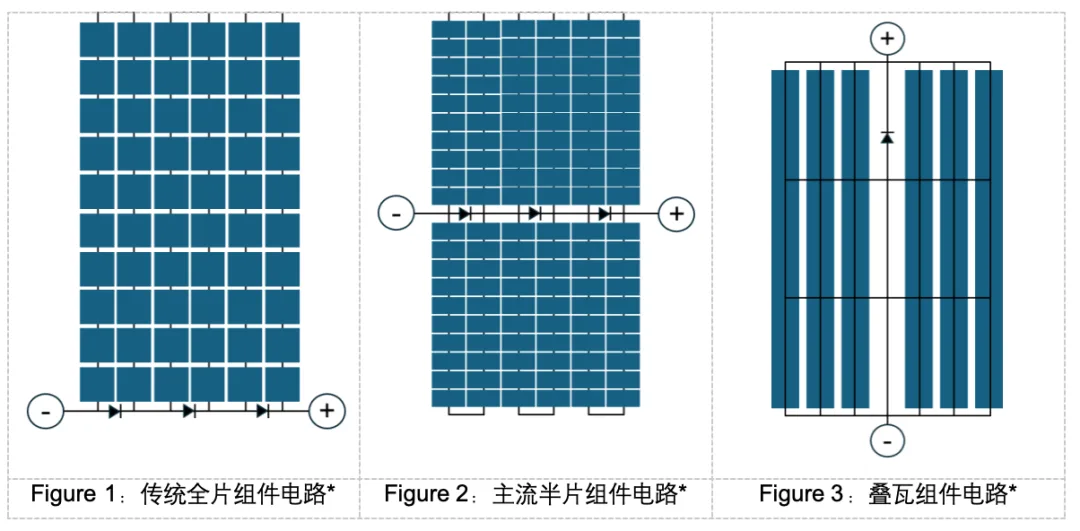
Common formats include:
Half-cut cells: one full cell is cut into 2 pieces, currently the mainstream design
Third-cut cells: one cell is cut into 3 pieces
Multi-cut cells: one cell is cut into more small pieces, such as 4-cut, 5-cut or 6-cut designs
Shingled modules: also a special type of multi-cut application, with overlapping cell strips
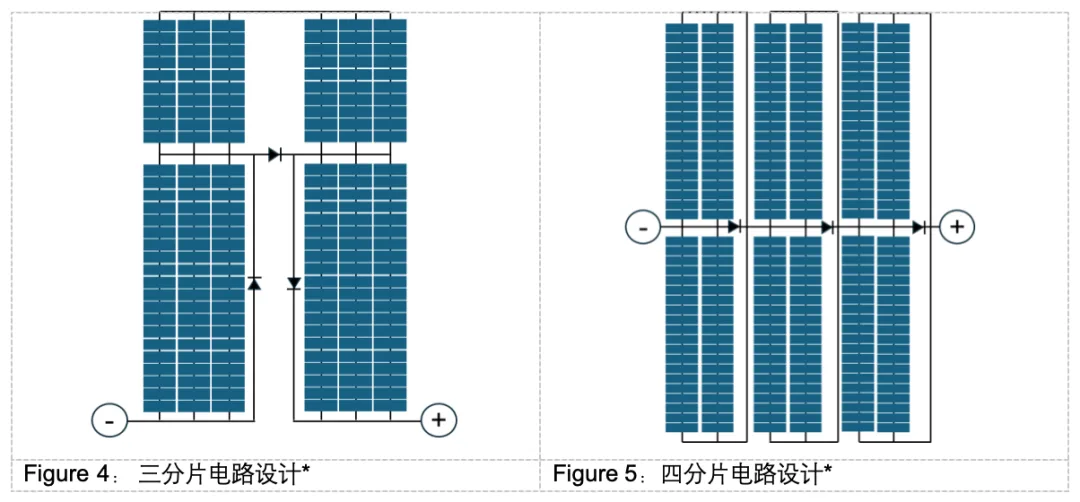
Note: The diagrams above only show typical circuit concepts. They do not represent the exact product designs of specific manufacturers.
Why Manufacturers Use Multi-Cut Designs
The main purpose of multi-cut design is to reduce the operating current of each cell unit and optimize the internal circuit connection of the module. By doing so, the module can reduce electrical losses and improve energy generation under complicated real-world conditions.
The main benefits include:
Lower operating current: After a solar cell is cut into smaller units, the current of each sub-cell is reduced accordingly.
Lower resistance loss: The internal resistance loss of a PV module is proportional to the square of the current.
Ploss = I²R
So when the current is reduced, resistance loss in ribbons, busbars and internal conductive paths also decreases.
Higher module output power: With lower internal electrical loss, the module can usually achieve a certain power gain under standard test conditions.
Reduced hot spot risk: Lower current helps reduce heating under partial shading, improving the module’s hot spot behavior.
Better shading tolerance: With proper circuit design, the impact of local shading can be limited to a smaller area, allowing unshaded areas to continue generating power.
Circuit Design: How Local Shading Affects Solar Module Output
A solar cell can be roughly regarded as a current source. Under good sunlight, the cell generates current. When part of the cell is shaded, its power generation ability drops, and the output current also decreases.
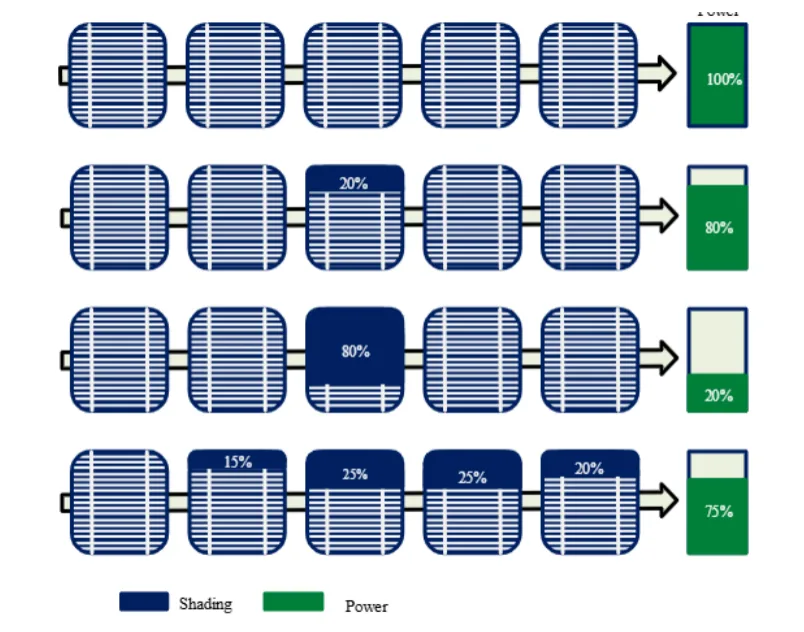
Figure 6: Effect of shading on the output of a single cell string
In a traditional full-cell module, multiple cells are connected in series to form a cell string. If one cell, or a few cells, are shaded, the shaded cells will limit the current output of the entire string. In simple words, the output current of the same cell string is usually determined by the weakest cell, which is often the cell with the heaviest shading.
Under severe shading, the shaded cell may even become reverse biased. Instead of generating power, it becomes an electrical load and produces local heat. This is the well-known hot spot effect.
To reduce hot spot risk, PV modules are normally equipped with bypass diodes. When one cell string is seriously shaded, the bypass diode conducts and allows current to bypass the affected string. This protects the cells, but the bypassed string can no longer contribute power. As a result, the module output power drops significantly.
Therefore, the shading resistance of a module is not only determined by the solar cell itself. It also depends heavily on the internal circuit design of the module.
The Basic Logic of Multi-Cut Modules: Splitting High Current into Lower Current
A multi-cut module cuts standard cells into smaller cell units and then connects them through suitable series and parallel circuits. Compared with traditional full-cell modules, one important feature of multi-cut design is that each cut cell unit works at a lower current.
Assume the operating current of a full cell is I0. If it is evenly cut into n pieces, the theoretical current of each cut cell unit is approximately:
Icell = I0 / n
For example:
In a half-cut module, each half-cell unit has a current of about I0/2.
In a third-cut module, each third-cut cell unit has a current of about I0/3.
In a quarter-cut module, each quarter-cut cell unit has a current of about I0/4.
Of course, real current values are also affected by laser cutting quality, edge passivation, ribbon design, resistance loss and module layout. But from the basic principle, the operating current of multi-cut cell units is clearly lower than that of full cells.
When current is reduced, two direct benefits appear.
Lower Resistance Loss
When current decreases, resistance loss in ribbons and interconnection areas drops significantly. Taking a quarter-cut module as an example, under ideal conditions with other factors unchanged, its resistance loss may theoretically be reduced to one sixteenth of that of a full-cell module.
Local Shading Impact Can Be Limited More Easily
With a more segmented circuit design, current mismatch caused by shade can be restricted to a local area instead of affecting a larger cell string.
For example, when two shading objects of the same area fall on a full-cell module and a half-cut module, the object may cover 80% of one full cell in the full-cell module. In the half-cut module, the same object may be distributed over two half-cells, shading 30% of one half-cell and 50% of another. In this case, the current mismatch pattern and affected area will be different.
The Key Point: More Flexible Series and Parallel Circuit Design
Multi-cut module design is not just about cutting cells into smaller pieces. The real factor that determines shading resistance is how the cells are connected after cutting.
In a traditional full-cell module, cells are usually connected in series, and the module is divided into three circuit sections by three bypass diodes. When one cell is seriously shaded, it may affect the output of about one third of the whole module area.
In a multi-cut module, the original large cell string can be divided into smaller power generation units through a more detailed series-parallel design. Parallel paths also allow more flexible current distribution.
Taking a quarter-cut module as an example, with a proper circuit layout, the impact of shading on a single cut cell can be limited to about one twelfth of the circuit area. By comparison, in traditional full-cell or half-cut modules, shading in the same position may influence a much larger part of the cell string output.
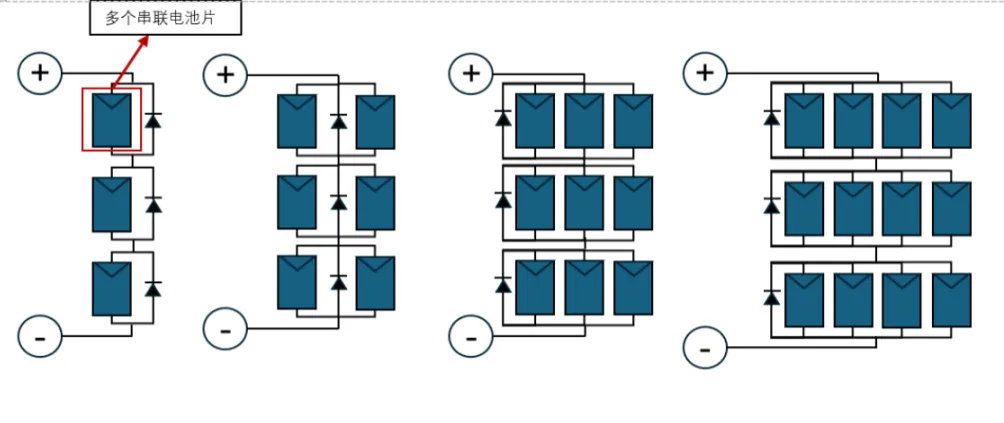
Figure 7: Equivalent circuit diagrams of full-cell, half-cut, third-cut and quarter-cut modules
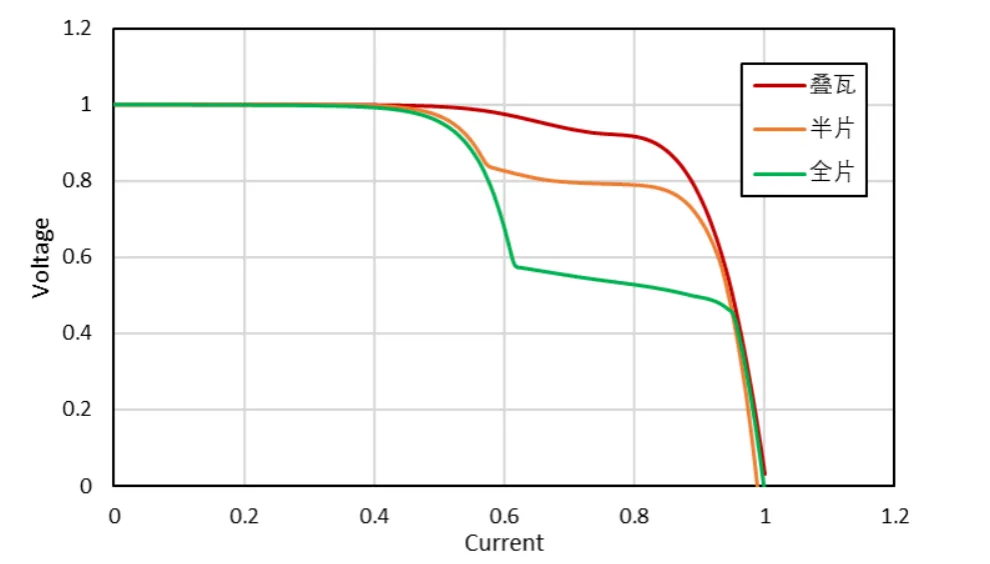
Figure 8: Under the same 50% shading of the minimum power generation unit, shingled modules can maintain higher power
Therefore, multi-cut modules can maintain better output under partial shading by using more detailed circuit sections and parallel current paths. The core design logic includes:
Cutting cells into smaller power generation units
Using proper series connection to achieve the required module voltage
Using parallel branches to reduce current in each branch
Using bypass diodes to limit power loss in shaded areas
Allowing unshaded areas to continue generating power as much as possible
Important Limitations: Multi-Cut Is Not Always Better Under Every Shade Pattern
Although this article focuses on how multi-cut circuit design can improve shading resistance, multi-cut modules do not always have an advantage in every shading scenario.
The key point discussed above is this: when the shaded proportion of the cell unit is the same, multi-cut modules often achieve higher output power. However, under the same shadow size and shape, because each cut cell unit has a smaller area, the shaded proportion of that unit may actually become higher. This can cause output power to drop.
For example, when shading occurs along the short side of a module, especially in early morning or late afternoon when the sun angle is low, the shadow may cover the bottom row of cells. For a half-cut module, the bottom row may be only 70% shaded. But for a quarter-cut module, because each cut cell is shorter in height, the same shadow may completely cover the bottom row of quarter-cut cells. This can lead to a significant output drop in the corresponding circuit section, or even make part of the cell string lose output ability.
In addition, third-cut modules may have top-bottom asymmetry due to layout and circuit design. When the same shadow area or shape appears on different sides of the module, the actual output loss may not be the same. In some specific shading conditions, a third-cut module may even have greater power loss than a half-cut module.
So, when evaluating power loss caused by shadow, we cannot only look at the shaded area. We also need to consider the actual internal series-parallel circuit distribution, bypass diode protection zones, shadow shape and shadow position.
From High Power to High Energy Resilience
As PV module power continues to increase, industry competition is no longer only about peak power under standard test conditions. For real solar power plants, long-term energy yield and stability under complex operating environments are becoming more important.
Quarter-cut and other multi-cut modules use smaller cell units, lower operating current and more flexible series-parallel circuits to reduce the impact of local shading on total module output. Their core value is simple: localize the effect of shade, keep the unshaded area working, and improve energy generation stability in real applications.
In commercial and industrial rooftops, residential rooftops, BIPV projects and other scenarios with local shading risk, quarter-cut modules may become an important technical route to improve system yield and operational reliability.
Ooitech's View
As an equipment supplier working closely with solar module manufacturing lines, Ooitech sees multi-cut technology as more than a cell-format change; it is a combined challenge involving laser cutting accuracy, stringing stability, circuit layout and quality inspection. For manufacturers considering half-cut, third-cut, quarter-cut or shingled products, the production line must be evaluated together with the module’s electrical architecture, because shading performance depends strongly on how each small cell unit is interconnected and protected. In our view, the next stage of module competition will not only compare nameplate wattage, but also compare how reliably a module keeps producing energy under dust, leaves, roof obstacles and low-angle shadows.