Editorial responsibility for this article rests with Wuhan Ooi Photoelectric Technology Co., Ltd. Written and reviewed by the Ooitech editorial team. See our editorial policy for how we write, where AI tools are used, and how to request a correction.
PV Encapsulant Film Test Methods: Reading the Report
Table of Contents
Quick answer: An encapsulant film test report lists a handful of numbers, and nearly all of them are measured on a coupon that was laminated first, conditioned, then tested. The pass lines are the floors in two Chinese trade standards, T/CPIA 0004-2017 for EVA and T/CPIA 0071-2024 for co-extruded film. Peel to glass must clear 60 N/cm before aging and 30 N/cm after. Transmittance across 380 to 1100 nm must clear 90.5 percent for EVA and 90 percent for co-extruded film. Volume resistivity must clear 1.0 × 10¹⁵ ohm-cm for clear film and 1.0 × 10¹⁴ ohm-cm for white EVA. None of that tells you the film is good until you know the laminate recipe, the glass type, the sample thickness and the extraction time behind each number. A pass line is a floor, not a target, and the number that matters is the one that survives aging.
You meet an encapsulant through a report full of pass marks. The interesting part is never the pass. It is what the number was measured on, and how far the pass line sits from what the module actually needs.
Three buckets the report sorts into
Two things are worth settling before any single indicator. First, most of them are measured on a laminated sample, not on the roll. An encapsulant does its jobs only after the lamination step, so gel content, peel strength, transmittance, resistivity and the aging results all come from a coupon that was laminated on the recipe your laminator runs every day, then left at about 23 degrees C and 50 percent relative humidity before testing. Only the roll specs, grammage, thickness and shrinkage, are read on the film as shipped.
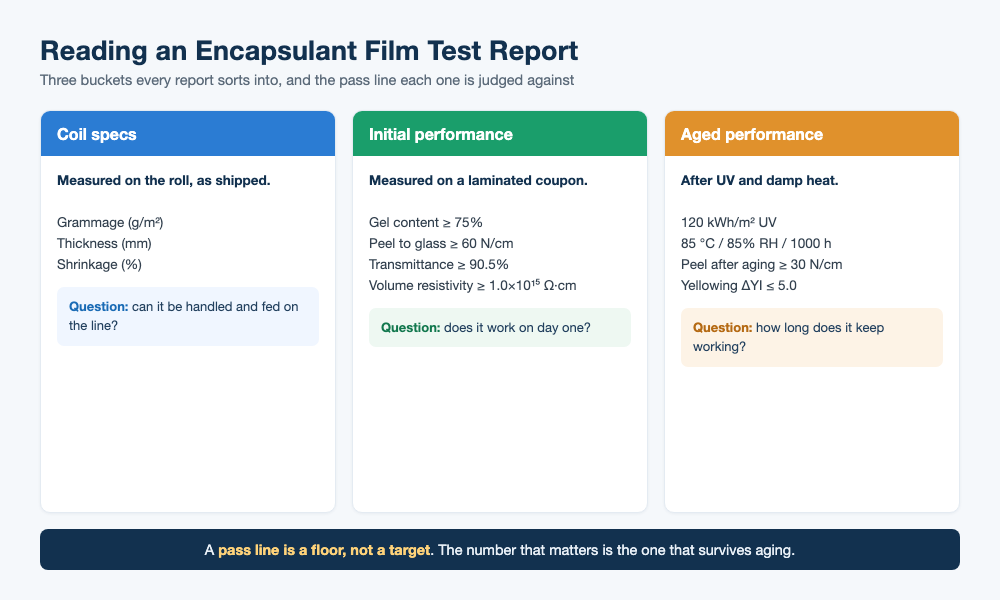
Second, the indicators fall into three buckets, and each answers a different question.
| Bucket | What sits in it | The question it answers |
|---|---|---|
| Coil specs | Grammage, thickness, shrinkage | Can it be handled and fed |
| Initial performance | Gel content, peel, transmittance, resistivity, dielectric strength | Does it work on day one |
| Aged performance | Peel and yellowing after UV and damp heat | How long does it keep working |
The three buckets an encapsulant report sorts into, with the pass line each one is judged against. The aged bucket is the one that decides how long the module keeps working.
The first two decide whether you can buy the film. The third decides whether you should.
The spec sheet in one table
The two standards agree on most of the pass lines and split only at the edges, where EVA and co-extruded film are built differently. This is the table to keep beside the incoming inspection bench.
| Indicator | How it is measured | EVA (T/CPIA 0004-2017) | Co-extruded (T/CPIA 0071-2024) |
|---|---|---|---|
| Transmittance, 380 to 1100 nm | Integrating sphere, laminated sample | at least 90.5% | at least 90% |
| Transmittance, 290 to 380 nm | Integrating sphere, laminated sample | UV-transmissive at least 70%, UV-cut at most 30% | same |
| Gel content | Xylene extraction | at least 75% | 75% to 95% |
| Peel to glass | 180 degree, 10 mm strip, 100 mm/min | above 60 N/cm | at least 60 N/cm |
| Volume resistivity | Laminated sample, 1000 V, read at 60 min | at least 1.0 × 10¹⁵ ohm-cm | at least 1.0 × 10¹⁵ ohm-cm |
| Dielectric strength | Power-frequency breakdown | at least 25.0 kV/mm | at least 28.0 kV/mm |
| After UV and damp heat | 120 kWh/m²; 85 C, 85% RH, 1000 h | peel above 30 N/cm, yellowing change below 5.0 | peel at least 30 N/cm, yellowing change at most 5.0 |
Three rows deserve more than the table gives them. Peel strength, transmittance and resistivity are where a passing report and a usable film stop meaning the same thing.
Peel strength: the number that matters after aging
Peel strength is an adhesion number. The test runs to GB/T 2790 as a 180 degree peel: a 10 mm strip is cut from the laminated sample and pulled at 100 mm/min while the force is recorded. Both standards ask for at least 60 N/cm against glass before aging and at least 30 N/cm after.
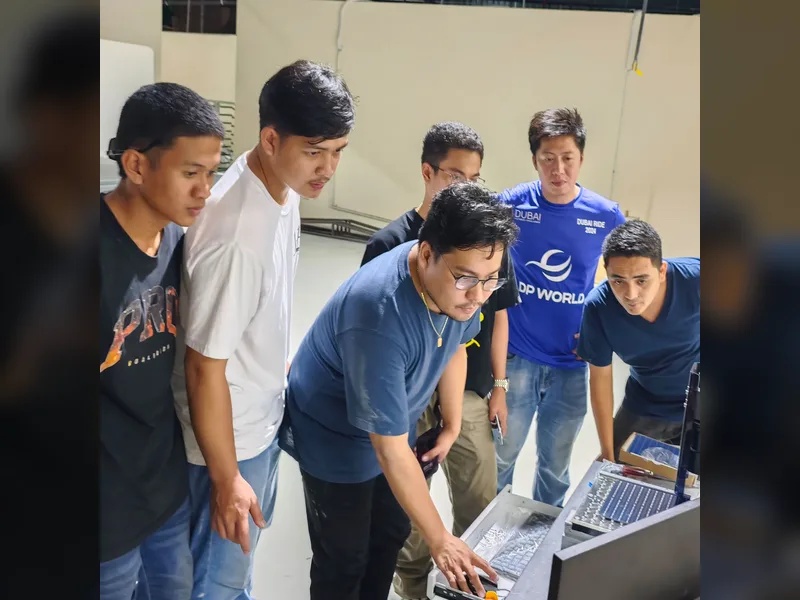
We pull 10 mm wide sample strips at 100 mm/min on our mechanical test bench, verifying that the peel force reaches at least 60 N/cm before initiating thermal or moisture aging runs.
The initial number is not the interesting one. A technical agreement almost always sets the incoming value far above 60 N/cm, so a fresh film clears it without trouble. The real question is what is left after UV and damp heat, and two details decide that.
Glass type changes the result
The standard names the glass, and the glass changes the number. For a single glass module the coupon uses 3.2 mm ultra-white embossed tempered glass. For a double glass module it uses 2.0 mm ultra-white embossed or float semi-tempered glass. A peel result from one glass is not comparable to a result from the other.
The failure interface matters
After peeling, look at where it broke. If the film separated from the glass at the interface, that is an adhesion failure. If the film tore inside itself, that is a cohesion failure. The two can report the same number and mean opposite things, and a film that fails at the interface will only get worse in the field, where it usually surfaces first as bubbles.
Transmittance: the average hides the curve
Transmittance is measured with a spectrophotometer fitted with an integrating sphere, scanning 290 to 1100 nm, and averaged over two bands. The band from 380 to 1100 nm is the power generating range, where EVA must clear 90.5 percent and co-extruded film 90 percent. The band from 290 to 380 nm is the ultraviolet range.
UV cut versus UV transmissive
The ultraviolet band splits the film into two types. A UV transmissive grade must pass at least 70 percent there, a UV cut grade at most 30 percent. White film is not judged on transmission at all: it is judged on reflectance over 400 to 700 nm, where the EVA standard asks for at least 90 percent.
An average hides the shape of the curve. For a TOPCon cell that is sensitive to ultraviolet, where the cutoff wavelength lands and how steep the edge is matter more than a single number. When you qualify a film, ask for the full spectrum, not the mean.
Volume resistivity and the PID connection
Volume resistivity is an electrical number measured on the laminated sample. The standard asks for at least 48 hours of conditioning at 23 degrees C and 50 percent relative humidity, then 1000 V applied and read at 60 minutes. Clear EVA and co-extruded film must clear 1.0 × 10¹⁵ ohm-cm, white EVA 1.0 × 10¹⁴ ohm-cm. The same electrical block lists dielectric strength, at least 25.0 kV/mm for EVA and 28.0 kV/mm for co-extruded film, and a comparative tracking index of at least 400 V. On a production line these are the numbers a hipot and insulation tester reads back on every finished module.
We condition our laminated test coupons at 23 degrees C and 50 percent relative humidity for 48 hours, then apply 1000 V for 60 minutes to measure electrical leakage.
Dielectric strength and the tracking index answer a different question from resistivity. Resistivity says how slowly current leaks through the bulk. Dielectric strength says how much voltage the film takes before it breaks down, and the comparative tracking index says how well the surface resists a conductive path forming under contamination. All three drop together when a film absorbs water, which is why the electrical block is read as a set, not as three independent pass marks.
Why the temperature matters
Resistivity is sensitive to temperature and humidity. Raise the temperature and the number drops, sometimes sharply. PID happens in exactly those hot and humid conditions, so a film that clears the room temperature line can still run short of margin at 60 degrees C. Some technical agreements add a high temperature resistivity check for that reason. A room temperature pass is not proof of high temperature headroom.
Water vapor transmission: absent from the standard
The odd one out is water vapor transmission rate, usually shortened to WVTR. Neither standard puts a limit on it, but a technical agreement for a double glass or n-type module almost always does. The usual method is an infrared sensor at 38 degrees C and 90 percent relative humidity. Published values put EVA near 25 g/m² per 24 hours and POE near 3 g/m² per 24 hours.
WVTR scales with thickness, so two results at different thicknesses cannot be compared directly. Before you accept or reject a report, check the sample thickness and the test conditions, not just the number.
Why the standard stays silent is worth understanding. A single glass module still breathes through the backsheet, so the film is not the only barrier and a slow film can let the laminate pass. A double glass or n-type module is sealed on both faces, so whatever water gets in stays in, and it is the film that has to keep sodium and moisture away from the cell. That is why the technical agreement, not the trade standard, is the document that actually governs WVTR.
Aging: the final exam
Everything before this point is an initial grade. Aging is the exam. Both standards run the same two aging routes, ultraviolet at 120 kWh/m² and damp heat at 85 degrees C and 85 percent relative humidity for 1000 hours, and both judge the film on two criteria: peel to glass of at least 30 N/cm afterwards, and a yellowing index change of at most 5.0, measured to ASTM E313.
| Aging route | Condition | Pass line after aging |
|---|---|---|
| Ultraviolet | 120 kWh/m² | Peel to glass at least 30 N/cm |
| Damp heat | 85 C, 85% RH, 1000 h | Peel to glass at least 30 N/cm |
| Yellowing, both routes | ASTM E313 | Delta-YI at most 5.0 |
This is material level aging. The sample is a simplified laminate, not a finished module. It is a different test from the module level sequence in the module reliability test list, and a film that passes material aging is not the same thing as a module that passes the full sequence. When an encapsulant does age out in the field, the usual symptom is delamination that starts at the cell edge and walks inward.
Gel content: the indicator with a longer story
Gel content belongs in the sheet, and it deserves one note because it is the indicator most likely to be gamed. The pass line is at least 75 percent for EVA and 75 to 95 percent for co-extruded film, measured by xylene extraction. The catch is the extraction time: the national method extracts for 5 hours, the IEC 62788-1-6 method runs differently, and at low cure the two read differently enough to move a film across the line. The same standard also offers a DSC route through residual reaction enthalpy, which is faster and suits line monitoring but is a different quantity from a gel content percentage.
What the extraction actually measures
The arbitration method starts from a laminated coupon roughly 200 by 200 mm with release film on both faces, cured on the production recipe and cooled. The cured film is cut into granules smaller than 3 by 3 mm, and 0.5 g plus or minus 0.05 g is weighed into a 120 mesh stainless steel bag. Three specimens are run per sample, extracted in xylene, dried at 140 degrees C to constant weight, cooled in a desiccator for 30 minutes, and averaged. What survives the extraction is the crosslinked network; what dissolves is the uncured part. The share of the first is the gel content.
The two failure modes sit on either side of the window. Under-cure leaves uncured chains, so the film stays soft, the peel number drops and bubbles can grow when the module runs hot. Over-cure drives the crosslink density too high, so the film turns stiff and brittle, and the laminate gets more sensitive to thermal cycling and mechanical shock. The spec is asking you to hold the window between the two, not to chase the maximum.
Reading an incoming report in practice
Four habits turn a stack of reports into a decision.
- Check the conditions before the numbers. Extraction time, laminate recipe, glass type and sample thickness. If any of these differ between two reports, the numbers are not comparable.
- Watch consistency, not a single value. The spread across rolls in a batch, and across positions on one roll, usually says more than the mean.
- Split what you test on arrival from what you test periodically. Shrinkage, grammage and gel content suit every batch, with DSC as a fast screen. Aging takes too long for a daily gate, so it runs as type testing plus periodic sampling.
- Ask for curves, not numbers. A transmittance spectrum and a peel curve carry more than their averages.
Where these numbers come from
The pass lines in the table come from two China Photovoltaic Industry Association trade standards, T/CPIA 0004-2017 for EVA encapsulant film and T/CPIA 0071-2024 for co-extruded film. The national standard GB/T 29848-2018 and individual technical agreements may set different limits. The gel content extraction conditions come from the T/CPIA 0004-2017 arbitration method, and the note that the national and IEC methods disagree comes from work published in EPJ Photovoltaics in 2024, which we have not reproduced.
The WVTR figures of about 25 g/m² per 24 hours for EVA and about 3 g/m² per 24 hours for POE are published values that vary with thickness and formula, not measurements we ran. We have not produced a coupon series for this article. Treat the incoming inspection habits as a way to spend a shift, not as a validated procedure.
Q: Is a peel strength of 80 N/cm better than 60?
Not necessarily. Both clear the line. What matters is the value after aging and where the failure happens. A film at 60 that fails cohesively can outlast a film at 80 that fails at the interface.
Q: Why is the white EVA resistivity line lower?
White EVA carries pigment to reflect light, and the filler changes the electrical behavior. The standard sets its floor at 1.0 × 10¹⁴ ohm-cm instead of 1.0 × 10¹⁵ ohm-cm. Judge it against its own line, not the clear film line.
Q: Does the standard require a WVTR test?
No. Neither T/CPIA 0004-2017 nor T/CPIA 0071-2024 sets a WVTR limit. It shows up in technical agreements, mostly for double glass and n-type modules, where moisture ingress matters more.
Q: Can I compare two suppliers transmittance reports directly?
Only if the coupons used the same glass, the same laminate recipe and the same spectrometer setup. Otherwise the comparison is between two different experiments wearing the same label.
Q: What does a yellowing change of 5.0 actually measure?
It is the change in yellowing index measured to ASTM E313 after aging. It catches the film turning yellow and losing transmittance. The limit is the same in both standards, at 5.0.
Q: Why do material and module level aging disagree?
They test different things. Material aging runs on a simplified laminate and isolates the film. Module aging in IEC 61215 runs on the full build, so failures there can come from glass, backsheet or the junction box, not the film.
Q: Should I test every roll on arrival?
Test the cheap and fast things every batch: shrinkage, grammage and gel content, with DSC as a screen. Reserve peel, resistivity and aging for a tighter sampling plan plus type testing, since those take longer and cost more.
Q: What conditions change a resistivity result?
Temperature and humidity. Resistivity drops as temperature rises, so a sample tested cold reads higher than one tested hot. The standard fixes 23 degrees C and 50 percent RH for a reason. Check both before you trust the number.
Final thoughts
A pass line is a floor, not a target. The film that matters is the one whose numbers were measured under conditions you can name, whose spread across the roll is tight, and whose peel strength is still there after the damp heat. Read the conditions first, the numbers second, and keep the aging result as the one you actually bet the warranty on.
For downstream electrical validation, OOITech supplies the CHT9980A and CHT9981A PV safety comprehensive tester to measure hipot, insulation resistance, ground continuity, and wet leakage on finished panels. Send us your module stack, packaging drawings, or laminated test samples for evaluation, and our team will help verify insulation performance.