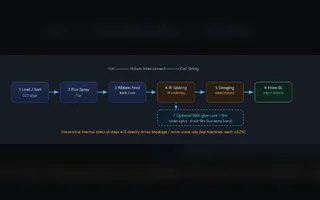
Quick answer: A solar panel production line is the ordered set of stations that turns cells into finished modules — cutting, tabbing, layup, bussing, lamination, framing, junction-box fitting, testing — supplied semi-automatic or fully automatic and sized to a capacity tier from 5 MW to 1–2 GW, with layout, utilities and staffing following that tier.
Solar Panel Production Line: Configurations from 5 MW to 1 GW
Buyers rarely get into trouble over one machine. They get into trouble over the line as a project: a capacity tier chosen before anyone checked the utility room, an automation level chosen without counting operators, a footprint drawn before anyone asked how long the laminator queue really is.
What a solar panel production line contains
The sequence is fixed. What changes between a 5 MW workshop and a gigawatt plant is how much is done by hand, how much buffer sits between stations, and how much inspection runs automatically.
- Cell preparation — sorting, then laser cutting or scribing for half-cell, shingled or back-contact work.
- Tabbing and stringing — ribbon soldering or adhesive bonding into strings with repeatable joints.
- Layup — strings onto glass with encapsulant and backsheet or rear glass, in circuit order.
- Bussing and isolation — joining string ends into the module circuit and insulating joints.
- Pre-lamination inspection — visual and EL check while defects are still repairable.
- Lamination — heat, vacuum and pressure curing the encapsulant and drawing air out.
- Framing and junction box — trimming, frame adhesive, box soldering or glue filling, curing.
- Final testing — EL imaging, IV under a sun simulator, hipot tests, sorting, packing.
Two stations set the rhythm downstream: a tabber-stringer such as the AM050FH for MBB half-cell strings, and IV measurement on an AAA-class simulator such as the OTMT. Everything else is specified by function and by its interface with neighbours.
Semi-automatic versus full-automatic
The distinction is not "machines versus no machines". A semi-automatic solar panel production line uses the same process equipment; operators move modules between stations and carry more visual judgement. A full-automatic line adds transfer, buffering, automatic laminator loading and traceability, so modules are never lifted by hand.
Manual transfer costs headcount and brings handling damage no test fully catches. Consistency is the real argument as capacity grows: manual layup is fine at a handful of modules per shift and becomes the main source of misalignment at hundreds. Fault recovery runs the other way — a visible jam is cleared by an operator, an automatic line needs a written procedure.
How the configuration changes from 5 MW to 1 GW
Tiers Ooitech builds to: 5 MW, 10 MW, 20 MW, 30 MW, 60 MW, 120 MW, 150 MW, 300 MW, 600 MW and 1–2 GW. The table shows how the character of the line shifts; it guides the decision rather than specifying it.
| Tier | Character | What drives the design |
|---|
| 5 MW | Semi-automatic, compact | Smallest capital outlay; manual transfer. |
| 10 MW | Semi-automatic, some automation | Where manual work limits quality. |
| 20 MW | Semi-automatic, more stations | Buffer and flow above machine speed. |
| 30 MW | Hybrid | Laminator loading is the bottleneck. |
| 60 MW | Mostly automatic | In-line inspection and traceability. |
| 120 MW | Full-automatic turnkey | Transfer, buffering, data integrated. |
| 150 MW | Full-automatic, multi-format | Changeover time and line balance. |
| 300 MW | Fully automatic, parallel flow | Redundancy and maintenance access. |
| 600 MW | Plant-scale | Utilities, logistics, MES. |
| 1–2 GW | Multi-line plant | Shared utilities and quality system. |
Two rules survive every tier. Capacity is set by the slowest station in the chain, not the fastest machine on the quotation. And semi-automatic to automatic is a step in project complexity before it is a step in station count. First-time buyers often start on the 5 MW semi-automatic line while designing the building so a later automatic configuration fits the same footprint.
Layout and floor-space logic
Layout follows the material, not the drawing sheet. The line runs one way from glass loading to packing, and every handover raises the same questions: where modules wait, who moves them, how a reject leaves the flow without blocking it. Straight line, U-shape returning finished modules to the glass aisle, or two aisles with layup and lamination back to back.
Floor space is consumed by buffer, not machines. Between layup and the laminator there must be enough queue to keep it fed through a stoppage; between laminator and framing there must be room for cooling. Maintenance aisles, cabinet clearance and a route wide enough to remove a laminator are costly to retrofit.
Utilities: power, air, water, environment
Utilities are the part of a solar panel production line signed off last and blamed first. Connected load is dominated by laminators, the sun simulator and chilling plant, and distribution must be sized for simultaneous operation, not a nominal sum. Compressed air is drawn at many small points — cylinders, grippers, glue dispensing, fixtures — so stable pressure matters more than total volume.
Chilled water is required by the laminator and by some laser and test equipment; the specification should state the temperature and flow the machine expects, sized with margin for summer. Lamination and adhesive curing also need a clean, controlled room — a workshop comfortable for people is not automatically suitable for encapsulation.
Staffing per shift by automation level
Headcount is read off the layout, not guessed from a brochure. On a semi-automatic line people are distributed along the process — every manual handover is a person, concentrated at layup, bussing and inspection. On a full-automatic line the same output needs staff at glass loading, quality gates, packing and maintenance.
At quotation stage the question is the organisation the vendor assumes: people per shift, skills, whether changeover takes one person or two, who clears a fault at three in the morning. Ooitech supplies turnkey with training, so the staffing plan and training plan should arrive as one document.
Commissioning and training sequence
Commissioning runs from utilities verification and single-station dry runs, through section integration, to a full-line run on real material before handover. Training runs in parallel, not afterwards: operators learn a station while it is set, maintenance staff learn the drawings on the machine they will repair.
Two documents make or break the phase — the pre-installation checklist issued before shipment, stating what must be finished in the building before the crates arrive, and the handover protocol, stating what is demonstrated, on what material, and who signs.
How to write an RFQ for a solar panel production line
A good RFQ describes a factory, not a list of machine names. State the product first: module size and format, cell type and configuration, glass, frame or frameless, junction-box type, and the mix if more than one runs. Then the commercial frame: target tier, shifts per day, planned expansion, and whether the site is new or a conversion.
- Site facts — floor area, ceiling height, floor loading, power, air, water, drainage.
- Scope boundaries — where the vendor stops and you begin.
- Automation expectation per section, not one global label.
- Interfaces — traceability, data collection, MES or ERP.
- Deliverables — layouts, utility schedule, manuals, spare-parts list, training, acceptance criteria.
- Service terms — response route, spare-part lead time, remote support, warranty scope.
Comparability is the point: two quotations for the same "automatic solar panel production line" rarely cover the same scope, and a section-by-section response is how you find out. The discipline is identical when comparing a 120 MW automatic line with a 600 MW turnkey configuration.
Common specification mistakes
- Capacity without product. A tier means nothing until the module format is defined.
- The fastest machine, not a balanced line. The bottleneck simply moves.
- Inspection outside the scope. EL and IV testing are process equipment, not extras.
- Negotiating training away. Untrained operators generate scrap from day one.
Sequence matters more than any single specification; the process is mapped in the ten-step manufacturing process and in how a line works from cells to modules.
FAQ
How long does it take to build and commission a line?
It follows capacity tier, automation level and how fast the building is ready. A compact semi-automatic line is a short project; a fully automatic multi-section line needs longer build, installation and integration. Ask for a section-by-section schedule so site works run in parallel.
Can a semi-automatic line be upgraded to automatic later?
Yes, if layout and utilities are planned for it. The usual path adds transfer and buffering between sections, then automatic laminator loading, keeping the same core equipment. Constraints are floor space, spare electrical capacity, and air and cooling margin.
What determines the price of a solar panel production line?
Capacity tier, automation level per section, station count, the formats handled, and the scope boundary — whether loading, handling, inspection and packing are included. Utility plant and building works are separate budget lines. Quotations compare only when the RFQ forces a section-by-section response; cost structure by capacity shows how those sheets are read.
Do we need to buy the whole line at once?
Not necessarily, but sequence matters. The stations that set quality — stringing, lamination, testing — are hardest to substitute; handling and packing can start manual. Buy the process before the transport, keep the layout complete from day one, and phase automation into a line built to receive it.
A solar panel production line is a long-lived asset, and the proposal you sign decides how it behaves for years. Send your product specification, target tier and site data through the quotation request form and ask for a section-by-section scope; the station-level machine overview is the natural next read.