Solar Panel Production Line Cost by Capacity — 12 Real Quotation Sheets, 5 MW to 600 MW
Table of Contents
Solar Panel Production Line Cost by Capacity — 12 Real Quotation Sheets, 5 MW to 600 MW
Every total on this page is an actual Ooitech quotation, not an industry estimate: what a solar panel production line costs at each capacity tier, which machines move the number, and the six budget lines the equipment sheet never shows.
PV Module Manufacturing · Equipment & Investment Guide · by Jerry, Ooitech
1. The Solar Panel Production Line Cost Ladder — Twelve Actual Quotations
Most solar panel production line cost articles published online give you one number for one capacity and stop there. A buyer's real question is different: how does the number move as my plan moves? If your offtake negotiations land 80 MW instead of 120 MW, what does the equipment budget become? If a lender pushes you from 150 MW to 200 MW, how much of the increment is machines and how much is everything else? The table below answers that with quotation totals — all FOB Shanghai, all including the installation and commissioning line item where noted.
| Capacity | Automation level | Quote date | Stringer config | Laminator config | Total, FOB Shanghai (USD) | Equipment $/W |
|---|---|---|---|---|---|---|
| 5 MW | Semi-automatic | Jul 2024 | SS-1500 class ×1 | Compact single-chamber | 169,100 | 0.0338 |
| 10 MW | Semi-automatic | Jan 2026 | SS-1500 class ×1 | 2658 oil-heating | 209,200 | 0.0209 |
| 20 MW | Semi-automatic | Jan 2025 | SS-2500 ×1 | OCY-2666 | 307,600 | 0.0154 |
| 30 MW | Automatic (simplified) | Jan 2026 | SS-1500 ×1 | 2658 | 455,500 | 0.0152 |
| 60 MW | Automatic | Jun 2026 | SS-2500 ×1 | Single-chamber full-auto | 641,500 | 0.0107 |
| 100 MW (double-glass) | Automatic, layup-bussing integrated | Jun 2025 | SS-2500 ×2 | Double-chamber | 1,027,000 | 0.0103 |
| 120 MW (glass-backsheet) | Automatic | Apr 2024 | SS-2500 ×2 | Double-chamber | 1,085,500 | 0.0090 |
| 120 MW (double-glass) | Automatic, layup-bussing integrated | Jul 2026 | SS-2500 ×2 | Double-chamber | 1,030,000 | 0.0086 |
| 150 MW | Automatic, high-spec | Feb 2025 | ATW high-speed ×1 | Double-chamber | 1,712,500 | 0.0114 |
| 200 MW (double-glass) | Automatic, inline curing | Jul 2026 | ATW class | Double-chamber | 1,669,500 | 0.0083 |
| 300 MW (double-glass) | Fully automatic | Sep 2026 | ATW 6800 cells/h ×2 | Double-chamber double-layer ×1 | 2,537,000 | 0.0085 |
| 600 MW (double-glass) | Fully automatic | Mar 2026 | ATW 6800 cells/h ×4 | Double-chamber double-layer ×2 | 4,336,000 | 0.0072 |
Equipment cost per watt — every point is one real quotation sheet.
Fig. 1: Solar panel production line cost per watt falls steeply up to ~60 MW, flattens through the 100–120 MW tier, and rises again at 150 MW where high-speed stringing and automatic bussing enter the sheet. The floor is $0.0072/W at 600 MW.
Three patterns in that curve directly affect your budget decisions. First, the steep left side: going from 5 MW to 60 MW cuts equipment cost per watt by two-thirds, because the fixed cost of a test-and-finish section — IV tester, EL tester, framing, conveyors — spreads over twelve times the output. Nobody should build a 5 MW line expecting scale economics; you build it to prove a market or a process. Second, the flat middle: 100, 120 and even 200 MW quotes sit between $0.0083 and $0.0103 per watt, because beyond two stringers and a double-chamber laminator, added capacity is added copies of proven machines rather than new capability. Third, the orange bar at 150 MW: per-watt cost moves up, to $0.0114, and that is not an error. The 150 MW sheet swaps in a high-speed ATW stringer ($380k against $120k for an SS-2500), a $250k automatic bussing machine, and a Gsolar Class A IV tester at $65k. You pay more per watt to buy throughput per operator and tighter process control — the trade only pays when the line runs 24 hours against committed offtake. In other words, the solar panel manufacturing unit cost you can reach is set less by the tier you buy than by the utilization you sustain: a 120 MW line run at 60% produces 72 MW while depreciation and salaries stay sized for 120.
2. Entry Tier (5–30 MW): Where the Semi-Automatic Budget Goes
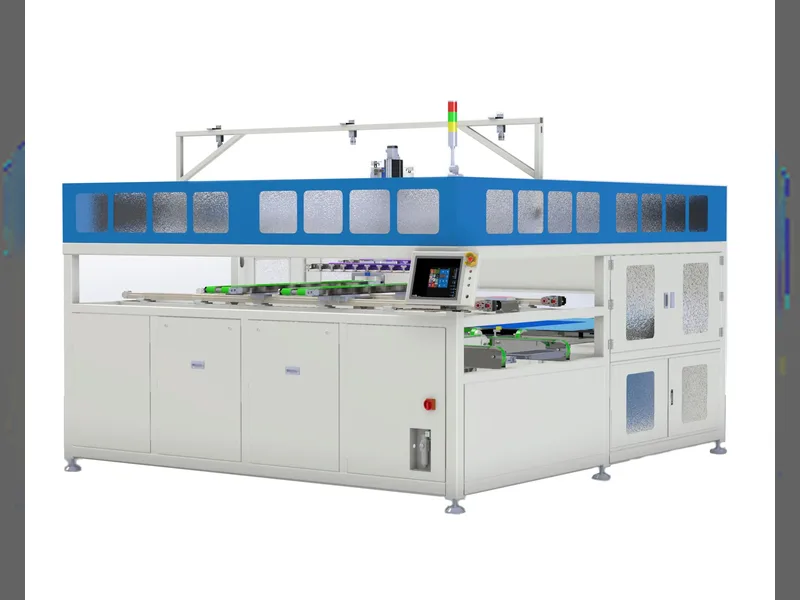
A semi-automatic solar panel factory line concentrates its cost in exactly two machines. On the 20 MW sheet — $307,600 total, sixteen line items — the SS-2500 tabber-stringer is $120,000 and the OCY-2666 laminator is $90,000. Together: 68% of the equipment budget. The remaining $97,600 buys the entire quality gate (laser scribing $20k, IV sun simulator $20k, cell tester $15k, EL defect tester $15k), semi-automatic framing ($6k), four manual layup stations ($4.8k), and the unglamorous carriers, cutters, and the air compressor and ribbon-bending machine added on the January 2025 revision. The 5 MW and 10 MW sheets follow the same shape at smaller scale: $60k stringer, $30–68k laminator, roughly $40k of testers, and the total landing at $169,100 and $209,200 respectively.
That concentration has a practical consequence for buyers at this tier: you are not comparison-shopping thirty machines, you are comparison-shopping two. The stringer decision sets your cell compatibility (3–20BB, 156–210 mm, half-cut and quarter-cut), your breakage floor (≤0.2% on A-grade cells for both SS-1500 and SS-2500), and your ceiling on future formats. The laminator decision sets your throughput and your temperature uniformity (±1 to ±2 °C on the 2666 class). Everything else is nearly commodity. When two semi-automatic quotes differ by more than about 15%, the difference is almost always in these two lines — model numbers, chamber count, or heating type — and not in the station list.
What we tell entry-tier buyers to resist is cutting the quality gate. The temptation at $169k total is to delete the $15k EL tester or the $20k IV simulator and "add them next year." But stringing microcracks are invisible without EL, and without an IV tester you are shipping power classes you cannot verify — which no certifying lab or serious offtaker will accept. The $35k for both testers is the cheapest yield insurance in the entire factory; the modules it screens out at 5 MW scale would otherwise surface as warranty claims at year three.
One more entry-tier number worth internalizing: labor. A semi-automatic line runs on manual layup, manual bussing, manual trimming and manual j-box work — the staffing sheet for a comparable automatic line (Section 7) counts 24 operators per shift, and the semi tier adds to that rather than subtracting. In markets where operator wages are $400–700 per month, that trade is rational. In a European or US Gulf Coast build, it is not, and the correct entry point is the 60 MW automatic tier even at triple the equipment price.
3. The Middle Tier (60–120 MW): Where Automation Starts Paying
The 60 MW quotation at $641,500 is, in our experience, the sheet first-time industrial investors should study hardest, because it is the smallest line on which every process step is handled automatically end to end: automatic glass loading, automatic layup, a single-chamber full-automatic laminator, an all-in-one framing cell at $135k with integrated glue dispensing, and automatic IV and EL testers closing the line. Per watt it costs $0.0107 — thirty percent below the 30 MW sheet — and the saving comes precisely from the labor rows it deletes: where the 30 MW line has manual bussing tables and manual trimming, the 60 MW line has none.
The 100–120 MW tier adds redundancy rather than new concepts: a second stringer ($240k for the pair), a double-chamber laminator ($150–180k), and — on the 2025–2026 double-glass sheets — an integrated layup-bussing machine at $128–160k that merges two stations and their operators into one. Note what the three quotes in this tier show about module format: the July 2026 double-glass 120 MW line totals $1,030,000, slightly below the April 2024 glass-backsheet 120 MW at $1,085,500, despite adding a second glass loader and an automatic taping machine. Two years of scope refinement absorbed the extra stations. Format choice at this tier is a market decision, not a major equipment-cost decision — the swing between glass-backsheet and double-glass is under 6% of the equipment total, while it changes your sellable product mix completely.
The 120 MW tier is also where our quotation sheets start encoding hard operational data you will need for the rest of the budget. The April 2024 sheet specifies the building: roughly 1,000 m² of production hall, 4.2–6 m ceiling, doors 5–6 m wide, column spacing above 6 m or none at all, and about 700 kW of installed electrical power. Staffing at this tier is 12–15 operators plus two engineers per shift, running 24 hours at 32 panels per hour. Hold those numbers — they reappear in Section 7 as budget lines the equipment sheet does not carry.
4. The High Tier (150–600 MW): Buying Throughput and Control
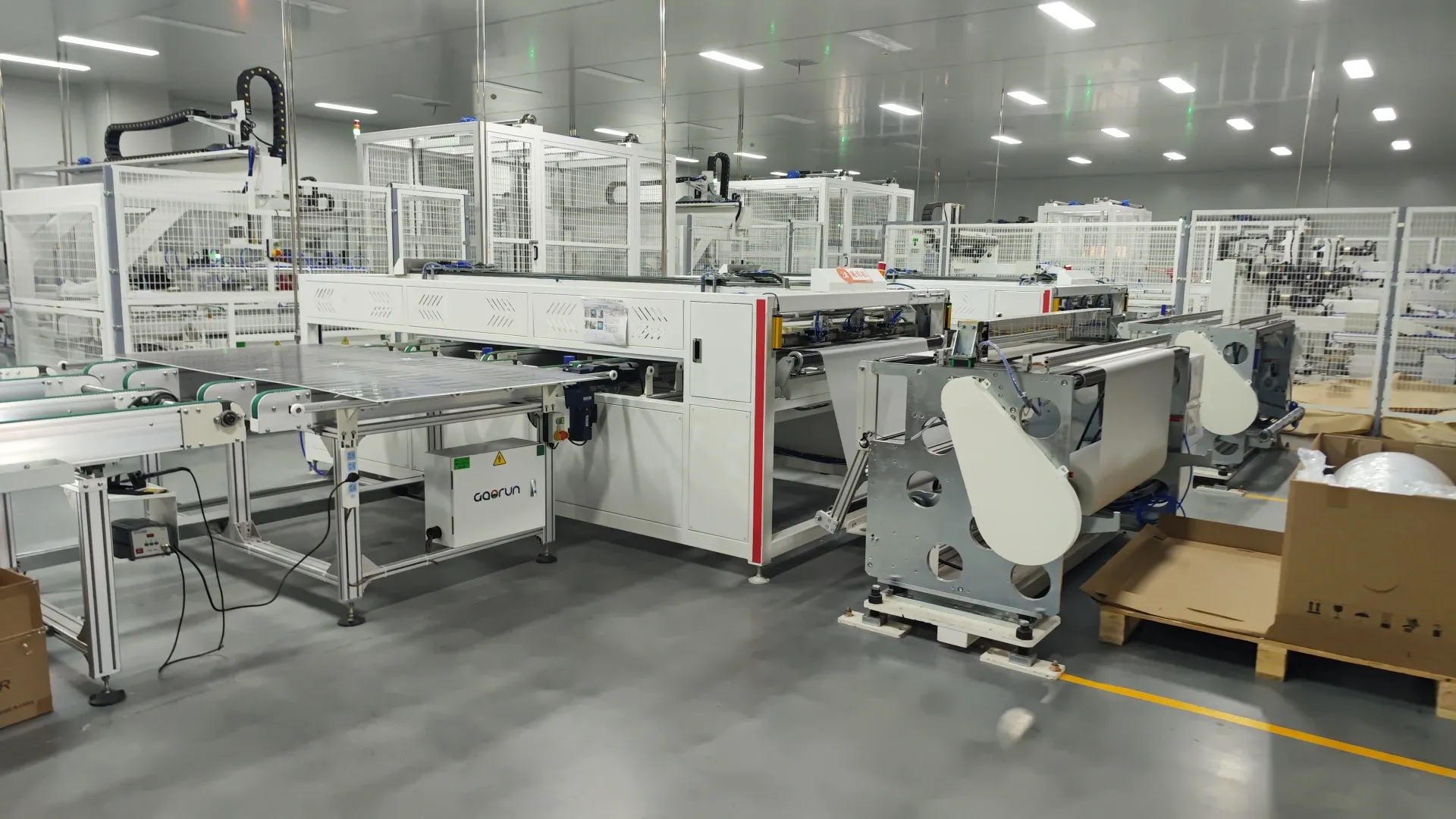
Above 150 MW the sheets change character. The ATW-class stringer — 6,800 cells per hour against the SS-2500's 2,400 — costs $380–390k per unit and appears in multiples: one at 150 MW, two at 300 MW, four at 600 MW, for $1.56M of stringing at the top of the ladder. Lamination moves to double-chamber double-layer machines at $360k each. And the sheets grow rework infrastructure that smaller lines never carry: glass rework machines ($25k each, four at 600 MW), repair tables with folding channels, lifters, and — at the very top — an automatic sorter ($60k), corner wrapping ($20k), and a final view-check station, because at 6,800 cells per hour a defect stream no human paces is guaranteed unless machines catch it.
The 300 MW and 600 MW numbers — $2,537,000 and $4,336,000 — are the sheets where the "fully automatic factory" phrase in brochures becomes literal: the 600 MW list runs to 63 line items and the manual working tables that dotted every smaller sheet have disappeared entirely. Per-watt cost bottoms at $0.0072. But read the composition before celebrating the floor: 62% of the 600 MW total is stringing and lamination alone, meaning a capacity misjudgment at this scale is a multi-million-dollar error, not a scheduling problem. A 600 MW line against 300 MW of actual demand duplicates roughly $2M of machines idling at 50% utilization while depreciation, power and salaries stay sized for 600. Our honest advice at this tier is unchanged from the article-level advice: size to contracted offtake, and remember that the 200 MW sheet at $1,669,500 plus a later second line usually beats one 400 MW monument for the same total spend — with far less schedule risk.
5. What Actually Moves the Total: Machine-Level Economics
Across all twelve sheets, four machine groups drive roughly 80% of every quotation. Everything else — conveyors at $2,000–3,000, turning units at $3,500, buffers at $10,000, working tables at $4,000–4,500 — scales with line length and looks like noise on any single sheet while quietly summing to 15–25% of the total. This is the exact seam where low-scope quotes cut: removing eight "optional" conveyor and turning positions shaves visible dollars off a total while permanently costing line balance.
| Machine group | 5–30 MW tier | 60–120 MW tier | 150–600 MW tier |
|---|---|---|---|
| Tabber & stringer | SS-1500 class, $60,000 each | SS-2500, $120,000 each, 1–2 units | ATW ≥6800 cells/h, $380–390,000 each, 1–4 units |
| Laminator | Compact $30k · 2658 $68–85k · 2666 $90k | Double-chamber $150–180k | Double-chamber double-layer $360k ×1–2 |
| Bussing | Manual work tables, $4,000 | Automatic $128–250k, or manual on the 2024 120 MW sheet | Automatic $180–250k |
| Framing | Semi-automatic $6,000 | Automatic $45k + offline glue unit $15k; all-in-one $135k | All-in-one with glue-flow control $150–160k |
| IV tester | $20,000 standard | $25,000 standard | Gsolar Class A, $60–65,000 |
| EL tester | $15,000, 24 MP | $20k 4-camera; $30k 8-camera pre-lam | $30k 12-camera, plus final view check |
Unit prices are stable enough across two years of sheets to serve as anchors in any negotiation: an SS-1500 stringer is $60,000 on every sheet it appears on; a 90° turning unit is $3,500 in 2022 and in 2026; the OLS-20A laser scribing machine is $20,000 throughout. When a competing quote shows one of these anchors 40% off market, the honest interpretation is not "better price" but "different specification or different scope" — which is exactly the audit the checklist in Section 6 runs.
6. Comparing Suppliers: the Scope Audit Behind Every "Same Capacity" Claim
European quotations for the 100–200 MW tier run €3–5M where ours run ~$1.03–1.09M. Some of that spread is labor cost and margin; most of it is scope, and scope differences survive translation into any supplier comparison. Run every solar panel manufacturing plant cost proposal you receive against these six questions — each one traces to a line item that actually varies between our own 2024 and 2026 sheets, so the differences are real, not hypothetical:
| Scope question | What it moves | Where it shows on our sheets |
|---|---|---|
| Is bussing automatic or manual? | The single largest swing: $4k tables vs $128–250k machine — plus 6–8 operators per shift forever | 30/60 MW manual vs 100 MW+ automatic |
| Which stringer class — 2400 or 6800 cells/h? | $60k vs $380k+; sets your true capacity ceiling regardless of the MW label | SS-1500 vs SS-2500 vs ATW across every tier |
| Pre-lamination EL with how many cameras? | $20k 4-camera vs $30k 8–12-camera; determines whether microcracks are caught before the irreversible step | 100 MW vs 150/300 MW sheets |
| Framing: separate machines or all-in-one? | $45k + $15k + $5k stations vs $135–160k integrated cell; different floor, labor and glue-control story | 120 MW vs 60 MW/150 MW sheets |
| Is installation in the total? | $20–60k plus engineer travel; "excluded" returns later as change orders | Every sheet prices it explicitly |
| Who owns the line's takt end to end? | Multi-vendor assemblies idle 20–25% when individual machines meet spec but rates don't match | The reason we sell complete lines |
On the brand question itself, PVknowhow's published assessment is worth quoting because it matches what our own sheets imply: the per-watt difference between premium German equipment and cheaper alternatives is close to negligible, because materials dominate the cost of every module a line will ever produce. The cost battle is won in purchasing and utilization — which is the next section.
7. The Six Budget Lines the Equipment Sheet Never Carries — Total Solar Panel Factory Cost
A complete solar panel manufacturing plant cost estimate stacks six more lines on top of the equipment total, and in every feasibility review I have sat through, at least two of them were underfunded. The full solar panel factory cost is what a lender will ask you to justify, not the FOB total. The numbers below come from the same quotation archive: building and power requirements from the 120 MW sheet's factory section, staffing from the 150 MW staffing plan, and materials from the June 2025 BOM quotation for a 585 W TOPCon module.
| Budget line | 20 MW semi-auto | 120 MW automatic | Source |
|---|---|---|---|
| Equipment, FOB Shanghai | $307,600 | $1,085,500 | Quotation sheets, this page |
| Freight, insurance, duties, inland | Quoted by destination — budget before comparing FOB totals | — | |
| Building: ~1,000 m² hall, 4.2–6 m ceiling, 5–6 m doors | Country-dependent | ~€1.5M for an EU-class new build | 120 MW sheet factory section |
| Installed power | ~150–200 kW class | ~700 kW | 120 MW sheet |
| Staff per shift | Semi adds manual stations | 12–15 operators + 2 engineers | 120 MW sheet; 150 MW staffing plan: 24/shift |
| Material working capital | ~$180k per production-month | ~$1.07M per production-month | $55.65 per 585 W panel × throughput |
| Certification (IEC 61215 + 61730, per design) | €15–25k × number of designs, plus market add-ons (UL 1703, IEC 61701, IEC 62716, CB) | — | |
| Ramp-up losses (2–3 months sub-rated yield) | Six-figure at any scale; materials ≈95% of production cost, so each bad-yield month at 120 MW burns >$500k of cells and glass | — | |
The material line deserves its own sentence because it is the one that kills projects: cells alone are 41.5% of the per-panel bill ($23.10 of $55.65 on the 585 W BOM — cells, then frame at $8.50, glass at $7.69, solder strip, backsheet, POE, EVA, junction box, sealant), and the purchasing terms for a first-year factory with no volume history are effectively 100% prepayment. A 120 MW line eating $55.65 of materials per panel at 32 panels per hour needs over a million dollars of working capital circulating before a single invoice goes out. The equipment quote is the floor of the budget; this table is the budget.
And the ramp-up line is why the takt question in Section 6 is not academic. Commissioning means the line runs; it does not mean rated yield. Operators need two to three months, materials run at full price throughout, and in a multi-vendor assembly where the stringer outpaces the laminator, the mismatch burns materials around the clock. One party owning the whole line's takt — the position Ooitech sells, with engineers staying through installation and lifetime remote process support as standard scope — is not a comfort feature. It is the only line item in the entire budget that directly shortens the loss-making window.
8. Full Equipment Lists — Three Representative Sheets
Every row below traces to the quotation file. Start with the tier nearest your plan; the 20 MW and 120 MW glass-backsheet sheets are itemized line-by-line in our companion article on total plant cost.
60 MW automatic — $641,500 (June 2026) · SS-2500 stringer + single-chamber laminator + all-in-one framing
| # | Item | Qty | Total USD |
|---|---|---|---|
| 1 | Laser scribing machine, 1/2-cut with auto-splitting | 1 | 20,000 |
| 2 | Solar cell tester | 1 | 15,000 |
| 3 | PV ribbon bending machine C350-SZM | 1 | 5,000 |
| 4 | Automatic tabber & stringer, 3–20BB | 1 | 120,000 |
| 5 | Automatic layup machine | 1 | 50,000 |
| 6 | Automatic glass loading machine | 1 | 25,000 |
| 7–12 | Conveyors, turning units, manual bussing tables, buffer, pre-lamination EL tester | 9 | 55,000 |
| 13 | Single-chamber full-automatic laminator | 1 | 90,000 |
| 14–17 | Turning units, trimming station, flipping inspection, centering conveyors | 5 | 30,000 |
| 18 | All-in-one framing machine with integrated glue dispensing | 1 | 135,000 |
| 19–22 | Junction-box gluing + potting machines, working tables, conveyors | 5 | 32,000 |
| 23–24 | IV tester sun simulator + final EL defect tester | 2 | 45,000 |
| 25–26 | Center control system + installation, training & commissioning | 2 | 28,000 |
| TOTAL, FOB Shanghai | 641,500 | ||
150 MW automatic high-spec — $1,712,500 (February 2025) · ATW stringer + automatic bussing + Gsolar Class A IV · 45 items
| # | Item | Qty | Total USD |
|---|---|---|---|
| 1 | High-speed automatic tabber stringer (ATW class) | 1 | 380,000 |
| 2–10 | Layup machine, double-head glass loader, EVA/TPT cutting & layup ×3, conveyors, buffers, turning units | 15 | 167,500 |
| 11 | Automatic bussing machine | 1 | 250,000 |
| 12–18 | Automatic taping machine, working tables, 8-camera EL tester, folding channels | 8 | 106,500 |
| 19 | Double-chamber full-automatic laminator | 1 | 180,000 |
| 20–29 | Post-lamination conveyors, automatic trimming unit, flipping inspection, turning units | 14 | 94,000 |
| 30 | Framing machine with glue-flow control system + buffer | 1 | 150,000 |
| 31–41 | Junction-box glue dispensing, plate-chain curing conveyor, IV/EL conveyors, 180° flipping units | 13 | 181,000 |
| 42–44 | IV tester solar simulator, Gsolar Class A, 100 ms · 4-camera EL tester · center control system | 3 | 100,000 |
| 45 | Installation and commissioning | — | 60,000 |
| TOTAL, FOB Shanghai | 1,712,500 | ||
600 MW fully automatic — $4,336,000 (March 2026) · 4× ATW stringers + 2× double-layer laminators · 63 items
| # | Item | Qty | Total USD |
|---|---|---|---|
| 1 | High-speed automatic tabber stringers, 6,800 cells/hour | 4 | 1,560,000 |
| 2–11 | Layup machines ×4, glass loaders, EVA/TPT cutting & layup ×3, conveyors, buffers, turning units | 24 | 476,000 |
| 12–21 | Automatic bussing, taping, 12-camera EL testers ×2, four-edge banding tape machines ×2, repair stations | 14 | 630,500 |
| 22–29 | Glass rework machines ×4, lifters ×4, buffers, folding channels | 13 | 227,000 |
| 30 | Double-chamber double-layer laminators | 2 | 720,000 |
| 31–41 | Post-lamination handling, automatic trimming, flipping inspection, turning units | 16 | 121,500 |
| 42–52 | Framing with glue-flow control, automatic junction-box welding, curing conveyor, automatic Hi-Pot testers ×2 | 10 | 275,000 |
| 53–62 | IV tester, final EL tester, final view-check station, corner wrapping machine, automatic sorter | 8 | 235,000 |
| 63 | Center control system + installation and commissioning | 2 | 85,000 |
| TOTAL, FOB Shanghai | 4,336,000 | ||
9. Standard Commercial Terms Across the Ladder
Payment and delivery
All prices FOB Shanghai; quotation validity about one month
Payment: 30% TT deposit, 70% before shipment; large automatic lines structured 30/60/10 against PO, shipment and acceptance
Production lead time: 35–40 days (semi-automatic) · 60–70 working days (automatic)
Equipment warranty and spare-parts terms quoted per contract; consumables and random spare lists shipped with the machines
Installation and training
Semi-automatic tier: free remote installation support for your engineers; optional on-site visit $20,000 for 14 days
Automatic tiers: on-site installation, training and commissioning priced into the sheet — $20k (30/60 MW), $30–35k (100–120 MW), $50–60k (150 MW+), 30–40 days with 2–3 engineers
Extended engineer time beyond the included window: ~$200 per engineer per day plus travel and living
Lifetime remote process support included as standard scope on complete lines
10. FAQ — Solar Panel Production Line Cost
How much does a solar panel production line cost in 2026?
From the twelve actual quotations above: $169,100 for 5 MW semi-automatic, $307,600 for 20 MW, $641,500 for 60 MW automatic, $1.03–1.09M for 100–120 MW, $1.71M for 150 MW high-spec, $2.54M for 300 MW and $4.34M for 600 MW fully automatic — all FOB Shanghai including installation. European quotes for the same 100–200 MW tier run €3–5M, mostly on scope differences covered in Section 6.
Which tier should a first-time factory builder choose?
Match the tier to contracted offtake, not ambition. Under $350k, a 5–20 MW semi-automatic line proves the market with two machines carrying 70% of the cost. The $450k–1.1M band (30–120 MW automatic) is where most serious new entrants land — our most-studied sheet is the 60 MW at $641,500, the smallest fully automatic line. Above $1.7M you are buying throughput per operator; only justified with locked offtake and 24-hour operation.
Is equipment the biggest part of solar panel manufacturing plant cost?
No — it is the floor. On top of the FOB total come freight and duties, the building (~1,000 m² and ~700 kW at 120 MW), 12–24 staff per shift, material working capital ($55.65 per 585 W panel at June 2025 prices, paid effectively 100% in advance for a first-year buyer), certification at €15–25k per module design, and 2–3 months of ramp-up losses. Section 7 prices each line.
Why does the 150 MW line cost more per watt than the 120 MW line?
Because the 150 MW sheet buys a different class of machine: a $380k high-speed ATW stringer against a $120k SS-2500, a $250k automatic bussing machine, and a Gsolar Class A IV tester. Per-watt equipment cost rises from ~$0.0086 to $0.0114 — the premium buys throughput per operator and tighter process control, which pays only at high utilization.
How do I compare two quotes for the "same" capacity?
Audit scope, not totals: bussing automatic or manual, stringer class (2,400 vs 6,800 cells/h), EL camera count, framing integrated or stations, installation included, and who owns line takt. The checklist and the machine-group price matrix in Sections 5–6 give you the reference prices to do it in ten minutes.
Can I start semi-automatic and upgrade later?
Yes, and it is the standard path. Testers carry forward unchanged; an SS-1500 line upgrades by adding stringers and moving to double-chamber lamination as volume justifies. What does not upgrade cheaply is a hall sized too small — the 120 MW sheet's 1,000 m², 6 m column-spacing and 700 kW requirements are worth building in from day one even for a smaller first line.
Get the actual sheet for your tier
Tell us your capacity target, module format (glass-backsheet or double-glass) and market — and you will receive the current quotation sheet in the same format as everything on this page: every machine, every price, the factory layout drawing, and the material BOM. No charge, no obligation.
Quotation references dated 2024–2026, shown for structure and scale; confirm a current sheet with Ooitech before budgeting.