Editorial responsibility for this article rests with Wuhan Ooi Photoelectric Technology Co., Ltd. Written and reviewed by the Ooitech editorial team. See our editorial policy for how we write, where AI tools are used, and how to request a correction.
PV DC Cable Types: H1Z2Z2-K, IEC 62930 and PV1-F
Table of Contents
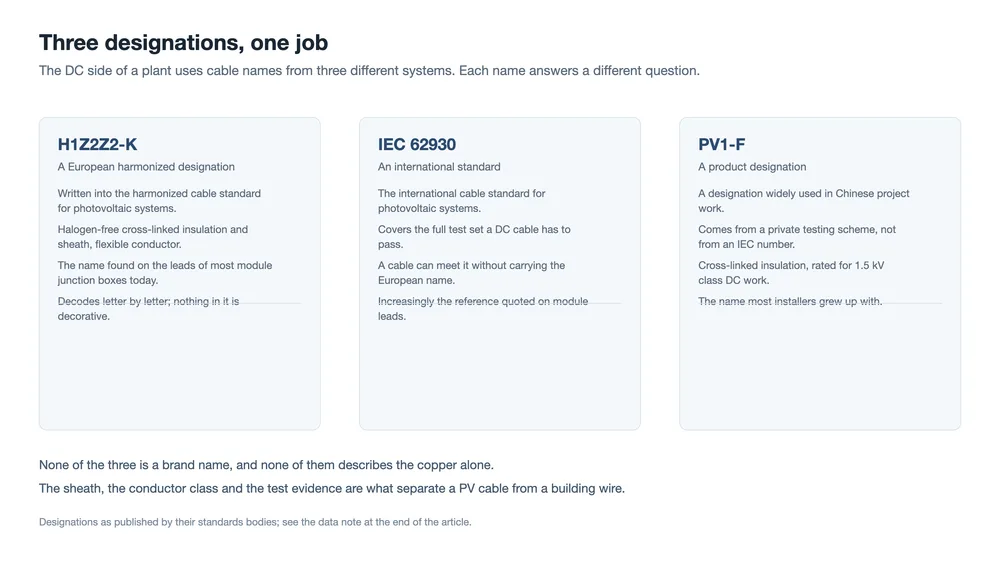
Quick answer: The three names on photovoltaic DC cable come from three different systems. H1Z2Z2-K is a European harmonized designation, IEC 62930 is the international cable standard, and PV1-F is a product designation that comes out of a private testing scheme. Each letter in H1Z2Z2-K fixes a property: halogen-free cross-linked insulation, halogen-free cross-linked sheath, flexible stranded conductor. None of the three names says anything about how thick the copper is, and none of them is a brand. What separates a photovoltaic cable from a building wire is the compound around the copper and the tests the finished cable has passed.
Anyone who has ordered cable for a plant has noticed that the DC side never uses the familiar building-wire names. The order goes out for H1Z2Z2-K, or for something described as meeting IEC 62930, or for PV1-F. The names look like product codes because that is roughly what two of them are, but they come from three different systems, and the differences between those systems show up later, in a cable tray or on a roof.
The confusion is understandable. A photovoltaic cable is copper, insulation and a sheath, exactly like a building wire, and the copper is not the interesting part. The DC side of a plant runs at a high voltage that never crosses zero. The cable sits in direct sun for decades, and it heats up inside a junction box in summer. It also cools below freezing on winter nights, and it is pulled through trays and around corners during installation. The material decisions that survive that are different from the material decisions that make sense inside a wall.
This article is about reading the names and about the interface where those names have to agree with something else on the module: the connector and the junction box the cable is attached to.
One job, three naming systems
A cable name can come from a national or regional system that has been harmonized across several countries, from an international standard, or from a private testing scheme run by a certification body. All three end up in the same project, and they are not interchangeable labels for the same document.
The practical consequence is that two cables with different names can both be correct for the DC side while a third cable with a familiar name is not correct at all. Comparing them means asking which system the name belongs to, and then asking what the cable actually had to pass to earn it.
| Name | Where it comes from | What the name itself tells you | Where you meet it |
|---|---|---|---|
| H1Z2Z2-K | European harmonized cable standard (published as EN 50618) | Halogen-free cross-linked insulation and sheath, flexible stranded conductor, a defined voltage class | Moulded onto the leads of most module junction boxes sold into Europe |
| Cable meeting IEC 62930 | International standard for cables used in photovoltaic systems | The cable passed the full test set that standard defines; the name on the sheath may follow another system | Module leads and site cable, increasingly quoted as the reference |
| PV1-F | A private testing scheme, usually cited as 2 PfG 1169, not an IEC number | A recognised photovoltaic product designation, without being an international standard number | Site wiring on projects where that designation is what the specification asks for |
Reading H1Z2Z2-K letter by letter
The harmonized designation is the most readable of the three, because every character carries one decision. The leading H marks a type harmonized across the European systems rather than a national type. The 1 is a voltage class, not a cross-section and not a current rating. The two Z entries describe the insulation and the sheath: Z for a halogen-free cross-linked compound, with the 2 indicating the specific material family. The hyphen and K at the end describe the conductor: flexible, stranded copper, intended to be bent and to be crimped into a contact.
Two details are worth pulling out, because they are the ones people skip. First, the two Z entries are separate: a cable can have a halogen-free insulation and a different sheath, and the designation is what tells you whether both were covered. Second, K is a statement about the conductor construction, which is what makes the cable handle well in a junction box and what makes it crimp into a connector properly. A stranded flexible conductor also has more surface area for the same cross-section and behaves differently under a screw terminal than a solid core does.
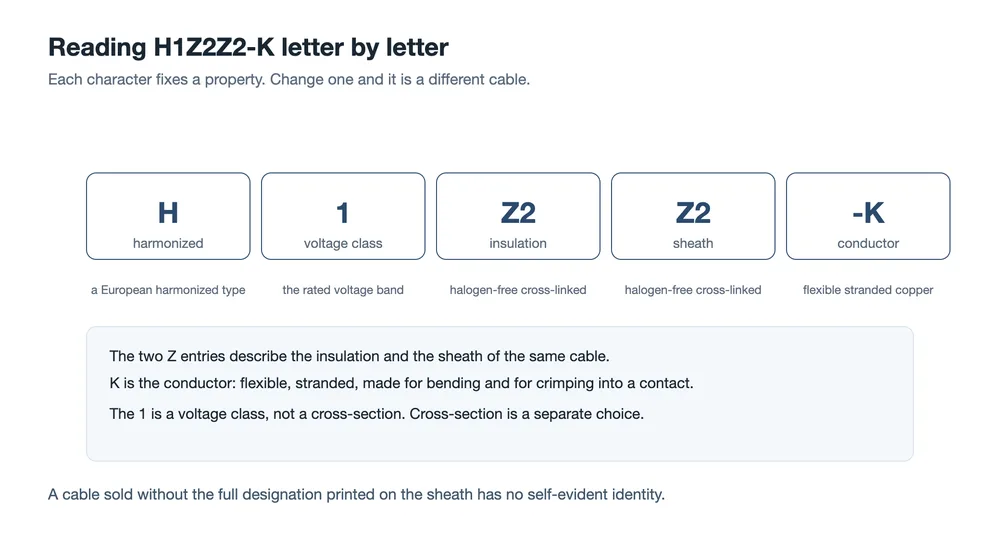
What the designation does not contain is the cross-section. That is chosen separately, from the current the string carries, the voltage drop the designer is willing to accept and the way the cable is installed. A cable tray in free air and a conduit run inside a wall do not shed heat in the same way, so the same cross-section does not carry the same current in both places. Nothing in the harmonized name removes that calculation from the designer's desk.
What the international standard asks for
IEC 62930 is written for the application rather than for a country. It specifies the cable construction and then specifies the test programme the finished cable has to survive, which is the part that matters when you are holding two similar-looking cables and trying to decide whether they are the same product.
The test set addresses the environment the cable actually lives in. Weathering and ultraviolet exposure act on the outside surface. Damp heat and thermal ageing act on the material over time. Solvent and oil resistance matter because a cable on a roof touches things that a wall cable never does. Cold bending checks what happens when the same sheath has to be formed at a temperature well below the one it was extruded at. Ozone resistance and a DC voltage withstand test close the list. A halogen-free designation adds the behaviour of the material in a fire: what it does not release, and how much smoke and acid gas it produces.
The name on a sheath can therefore be one system while the evidence behind it is another. A cable can be marked H1Z2Z2-K and be qualified to the international test programme, or be marked with a manufacturer's own type code and still be qualified. That is why a specification that names a standard and asks for the test report is stronger than a specification that names a designation and stops there.
It is also worth knowing that the trade shorthand for the international standard can itself cause confusion. You will see the standard written as IEC 131 in some ordering material. There is no separate standard with that meaning: the number is 62930, and the shorthand is a habit rather than a second specification.
Why an ordinary building wire fails on a roof
The failure of a polyvinyl chloride sheathed building wire outdoors is not a mystery and it is not gradual in a harmless way. The compound contains plasticiser that keeps it flexible. Over years of heat and sunlight the plasticiser migrates out, and the ultraviolet component of sunlight breaks polymer chains at the surface. The sheath loses its flexibility, chalks and then hardens. Once it hardens, movement at a tray edge or a temperature cycle is enough to open a crack.
Water follows the crack. From that point the insulation is working in conditions it was never chosen for, and the end of the chain is a leakage path on a conductor that is carrying full string voltage. On the DC side the consequence is worse than the equivalent fault on an AC circuit, and the reason has nothing to do with cable materials. An alternating current passes through zero every half cycle, so an arc that forms at a zero crossing tends to go out. A DC arc has no such moment.
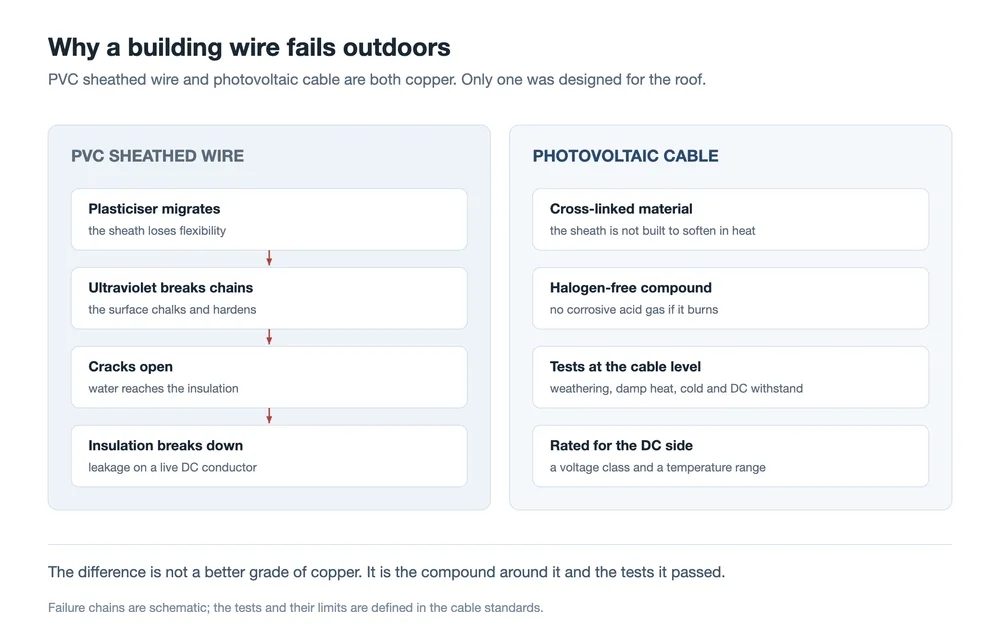
The two cables in that comparison contain similar copper. What differs is the compound around it, the way the material is cross-linked rather than thermoplastic, and the tests the finished cable had to pass. This is the part that a purchaser looking only at conductor cross-section cannot see, and it is the part that decides what the cable looks like after five summers.
Where the stress comes from
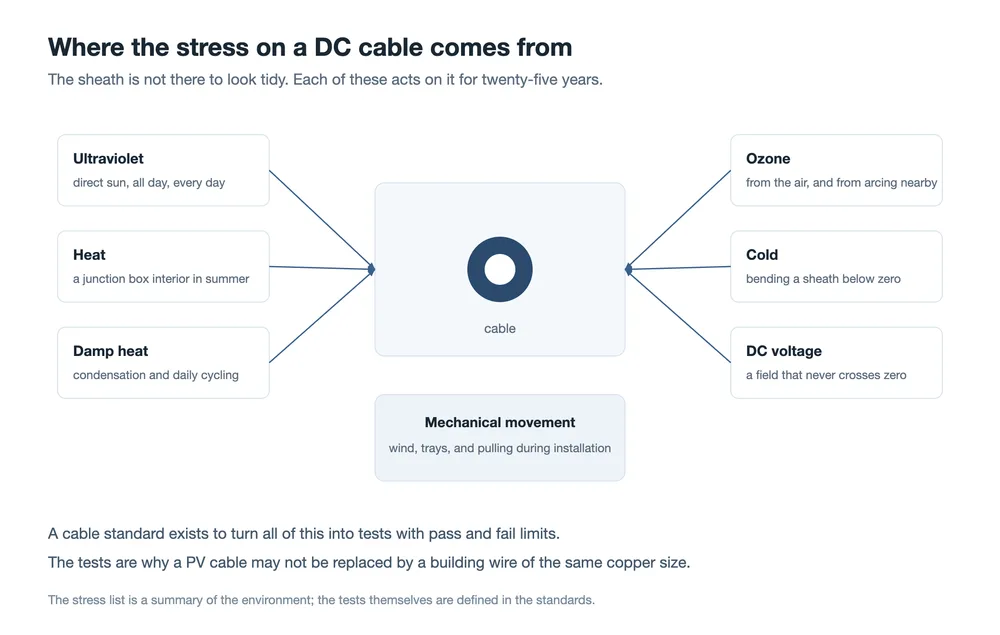
It helps to keep the list of stresses concrete, because a cable standard is essentially that list converted into tests with pass limits. Sunlight delivers ultraviolet radiation all day. A junction box in summer is a small enclosed volume heated by the module behind it, and the lead sits in that volume. Damp heat cycling is condensation followed by evaporation, over and over, at the point where the sheath meets a connector or a gland. Ozone is present in the air and is also produced by arcing, which means a poorly made joint can damage the cable near it. Cold matters at the moment of installation, when a sheath at zero degrees is bent around a corner and keeps the deformation.
Mechanical movement is the one that gets underestimated. Wind moves cables on a tray, thermal cycling lengthens and shortens them slightly, and the pulling tension during installation is often the largest force the cable ever sees. A photovoltaic cable is specified to survive all of that for the life of the plant, which is why the finished-cable tests matter more than the raw material data sheet.
Two decisions, one interface
On a real project the cable question splits in two, and the two halves are decided by different people. The lead that leaves the module junction box is chosen at the module factory, in the same design freeze as the junction box, the diode layout and the connector. It arrives attached, potted and tested with the module. The cable that runs between strings and into a combiner box is chosen by whoever designs the plant, and it is pulled, dressed and terminated on site.
The place where those two decisions meet is the joint. A connector is rated for a range of conductor cross-sections and a range of sheath outer diameters, with a seal that works across that range. If the site cable has a sheath outside the seal's range, the joint is water-resistant on paper and not in the field. If the conductor class is wrong for the contact, the crimp looks acceptable and has less contact area than the design intends. Both problems are invisible after the joint is closed, and both are decided before anyone climbs the roof.
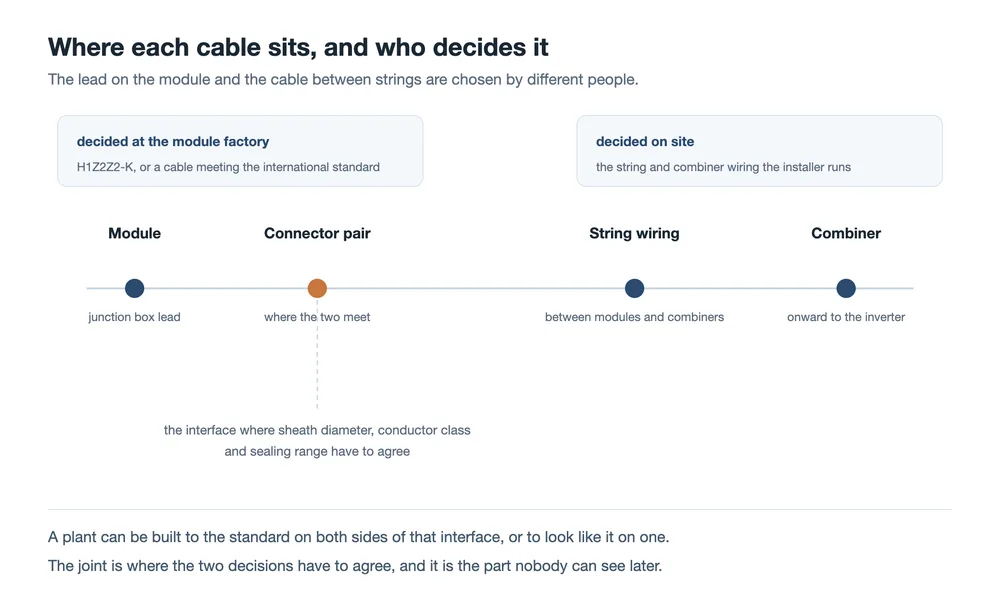
This is also where cable questions connect to the connector discussion. A connector certified to a standard is certified as a system, with a cable range quoted in the certificate. Substituting a cable outside that range takes the assembly out of the certification, even when both parts are individually fine. The same logic runs through the module lead: it was qualified with the connector on the end of it, and the cable is part of that assembly rather than an accessory.
For more on that interface, including what a compatibility claim does and does not prove, see MC4 or MC4-compatible and the ratings comparison in MC4 vs MC4-Evo 2.
Checking an incoming cable
None of this requires a laboratory. It requires looking at the right things in the right order, and asking for documents rather than accepting a description. The list below is what a receiving inspection can actually verify at the goods-in door.
| What to check | Why it matters | How it goes wrong |
|---|---|---|
| The full designation printed on the sheath | A cable that does not carry its own type cannot be identified after installation | Marked only with a manufacturer code or a cross-section |
| The standard or scheme the supplier claims, and the test report behind it | Moves the conversation from a name to evidence | A claim of compliance with no document and no report number |
| Conductor class and strand count | Decides whether the crimp achieves its rated contact area | A stiffer conductor that resists the contact and the bend radius |
| Sheath outer diameter against the connector's quoted range | The seal works across a diameter range, not at a single number | A cable that closes but does not seal |
| Temperature rating and halogen-free statement | The lead sits in a hot enclosure; the fire behaviour is a design requirement | A rating quoted for a different installation condition |
| Batch and traceability | A field problem has to be traced back to a coil, not to a supplier in general | Coils with no batch marking mixed into one string |
What changes on the module line
For a module maker, the cable decision is not a purchasing detail, because the lead is part of a qualified assembly. Changing the lead means changing a component that was tested with the junction box, the potting compound and the connector, and it means re-examining the assembly against the standards the module is certified to. That is why the lead type tends to stay fixed for a long time even when a cheaper cable appears.
The physical consequences show up at specific stations. The lead has to bend inside the box without pressing on the diode or the solder joint, which sets a minimum bending radius and a maximum stiffness. It passes through a gland or a moulded exit whose sealing range is fixed. It is then crimped or welded to a connector in a process whose tooling is chosen for a conductor class. The junction box assembly line, the box welding and glue processes and the curing step were all set up around those numbers.
The line layout and station sequence behind that are described in the junction box assembling line and in the station and line layout guide, with the welding step itself covered in junction box welding.
FAQ
Is PV1-F an IEC standard?
No. PV1-F is a product designation that comes out of a private testing scheme, not a number in the IEC catalogue. That does not make it invalid or unsuitable; it means a specification that names PV1-F is naming a product type, while a specification that names IEC 62930 is naming a standard the cable has to be tested against.
Can I use a cable marked H1Z2Z2-K and a cable marked PV1-F in the same string?
Nothing in the cable standards forbids it, and electrically the string does not care. The practical objection is that the two cables may age at different rates, so one part of the run reaches the end of its useful life before the other. Since the cable is also the piece that fails invisibly, keeping a single type per string makes both commissioning and later fault-finding simpler.
Does a thicker conductor make a cable photovoltaic grade?
No. Cross-section is about current and voltage drop. Photovoltaic grade is about the compound, the cross-linking and the test programme. A large cross-section building wire is still a building wire, and its sheath will behave outdoors exactly as a small one does.
Why does halogen-free matter on a roof?
A halogen-containing sheath releases corrosive and toxic gas when it burns, and the gas attacks metal nearby. On a roof, that means the fire can damage equipment beyond the cable itself, and it makes the fire harder to approach. A halogen-free compound reduces that contribution, which is one reason the harmonized designation specifies it for both the insulation and the sheath.
How do I choose the cross-section for a string?
From the string current, the installation method, the ambient temperature and the voltage drop the design allows. The installation method matters because a cable in free air sheds heat better than the same cable bundled in a conduit. The calculation is ordinary electrical design; the cable standard defines the limits the chosen cable has to respect, not the cross-section you should pick.
The module already comes with a lead. Does the cable still matter?
It matters at the joint. The lead's conductor class and sheath diameter are what the connector on the module and the connector on the site cable have to match, and the lead's temperature and fire behaviour are part of the module's qualification. Buying a module with a lead that suits the site cable and the local requirement is cheaper than fixing the mismatch later.
A name is a claim you can check
The three designations exist because three different systems needed a way to describe the same job, and because the DC side of a plant is a harder place for a cable than a wall. Reading them is mostly a matter of knowing which system you are looking at and then asking what the cable had to survive. The letters describe the compound and the conductor construction. They were never meant to describe the copper weight, and they were never a substitute for a test report.
For a plant owner the useful habit is narrow: at goods-in, look at the marking, the conductor class, the sheath diameter against the connector range, and the documents. For a module maker the cable is part of an assembly that was qualified as a whole, and that is the reason a lead change is a design change rather than a substitution.
Related reading:
MC4 or MC4-compatible? What the connector name means
MC4 vs MC4-Evo 2: ratings, mixing rules and line impact
Junction box welding machine KS-01C
Junction box glue filling machine SPZ-A
Solar junction box and diode box, IP67/IP68
Automatic solar panel junction box assembling line
Solar panel manufacturing machine stations and line layout
How a solar panel is made: every step and every check
Frame gluing and junction box glue machines
PV module reliability tests: cell versus module failure causes
Data note: the letter-by-letter reading of H1Z2Z2-K and the attribution of the three designations follow the published cable standards and public scheme documents; readers should treat the standard texts as authoritative. The test items listed above are a summary of the areas those standards cover, not a substitute for the test clauses. No performance figure in this article comes from testing by the author. The failure sequence of a PVC sheathed wire and the stress diagram are schematic illustrations of mechanisms, not measured lifetimes.