MC4 vs MC4-Evo 2: Ratings, Mixing Rules and Line Impact
Table of Contents
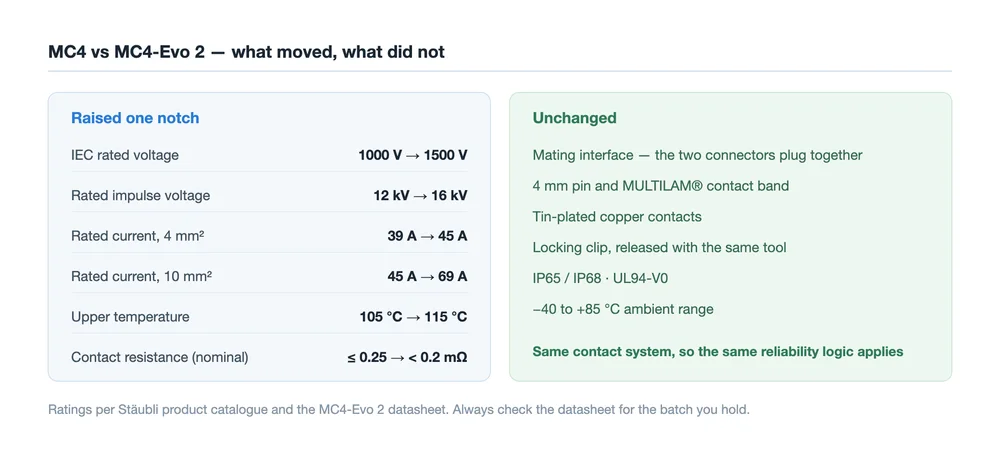
Quick answer: MC4-Evo 2 is the 1500 V generation of the MC4 connector. The mating interface, the 4 mm pin and the MULTILAM® contact band are carried over, so the two plug together and share the same contact technology — but the housing, the insulation design and the ratings were redone. Under IEC 62852 the classic MC4 is rated 1000 V while Evo 2 is 1500 V in the IEC, UL and JET systems; rated current rises from 39 A to 45 A on 4 mm² cable, and the upper temperature from 105 °C to 115 °C. A mixed pair is permitted only between genuine parts of the same manufacturer, and the joint is then rated at the lower of the two, which caps a mixed connection at 1000 V.
Two batches of modules can look identical at the connector and still be specified differently. The difference is in the numbers and in the tooling.
It Is Not About the Plug
Both connectors come from the same manufacturer and belong to the same product family, so the intuitive question — will they fit — has a simple answer. The question that matters for a system design or a purchase order is what the joint is rated for once they do fit, and that is where the two part numbers diverge.
What Changed
| Parameter | MC4 | MC4-Evo 2 |
|---|---|---|
| Rated voltage, IEC | 1000 V | 1500 V |
| Rated voltage, UL | 1500 V | 1500 V |
| Rated impulse voltage | 12 kV | 16 kV |
| Rated current, 4 mm² | 39 A | 45 A |
| Rated current, 10 mm² | 45 A | 69 A |
| Upper temperature | 105 °C | 115 °C (IEC TS 63126 Level 2 listed) |
| Contact resistance, nominal | ≤ 0.25 mΩ | < 0.2 mΩ |
| Housing material | PC / PA | PA |
| Cable outer diameter ranges | approx. 5–7.4 mm and 5.9–8.8 mm | 4.7–6.4 mm and 6.4–8.4 mm |
| Ambient range · protection · flame rating | −40 to +85 °C · IP65/IP68 · UL94-V0 | −40 to +85 °C · IP65/IP68 · UL94-V0 |
A note on the voltage line, because it is the one that gets quoted out of context: the classic MC4 does appear with 1500 V in older certification documents, including a UL listing and earlier TÜV approvals. Under the current IEC 62852 the same part is a 1000 V connector. When the system voltage is the question, read the datasheet for the exact batch rather than a catalogue page or a forum post.
Why the Voltage Step Exists
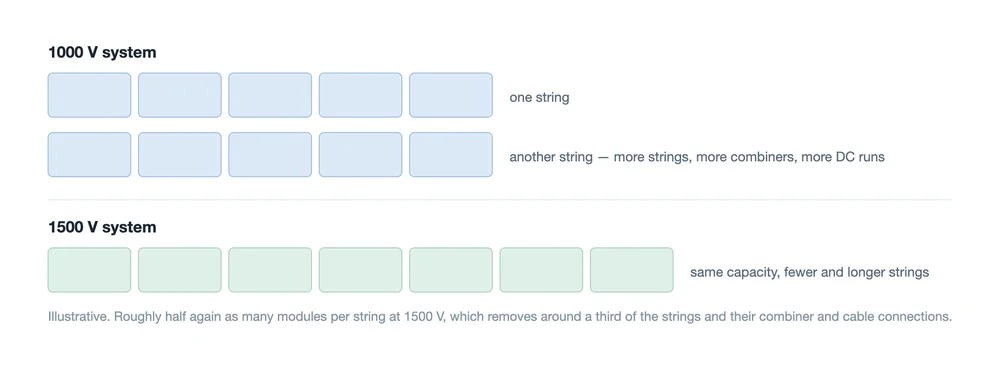
Raising the string voltage is a system cost decision before it is a connector decision. At 1500 V a string carries roughly half again as many modules as the same string at 1000 V, so for the same plant capacity the number of strings falls by about a third. Fewer strings means fewer combiner inputs, fewer DC cable runs and fewer joints to make and to inspect — which is why utility-scale plants moved to 1500 V, and why the connector had to follow.
Current and Temperature: Where the Margin Went
Module currents climbed while the connector rating did not. Large-format modules now draw currents in the high teens of amps, and a design margin plus bifacial gain on top of that leaves less headroom at the connector than a decade ago — especially where ambient temperature is high and derating applies. That is the practical reason for the current step at 4 mm² and the much larger one at 10 mm², and for the 10 °C increase in the upper temperature rating.
The pattern to remember is that the gap between the two models widens as the cable gets thicker. On 4 mm² the difference is one step; on 10 mm² it is the difference between a connector that is comfortable in a large array and one that is not.
What Did Not Change
The contact system is identical: the 4 mm pin, the MULTILAM® multi-contact band and the tin-plated copper contacts carry over, the locking clip still needs the same release tool, and the protection, flame and ambient ratings are unchanged. In other words, the long-term degradation mechanisms are the same mechanisms, so field experience accumulated on classic MC4 remains informative for Evo 2.
One comparison that circulates in the market should be set aside: claims that the classic MC4 lacks salt-mist or ammonia resistance. Both models are listed with salt-spray testing to IEC 60068-2-52 severity 6 and with ammonia testing in the manufacturer catalogue. It is not a difference between the two part numbers.
Mixing Them: Allowed, but Rated at the Lower Value
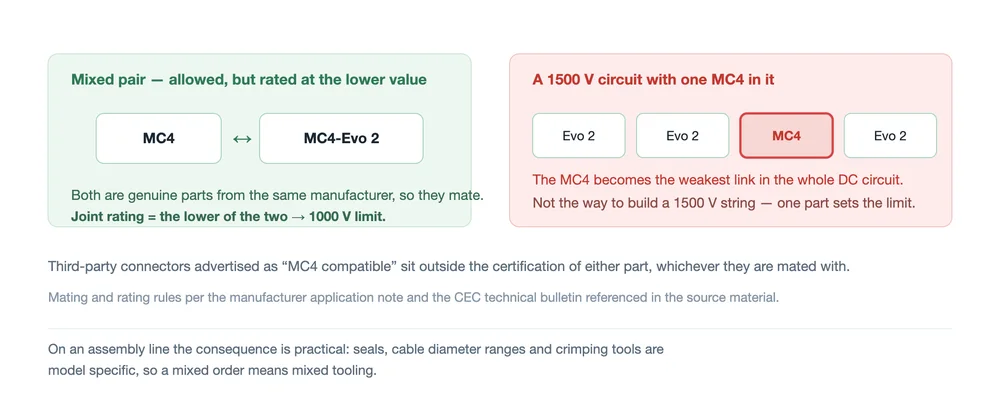
The two mate, and the manufacturer states compatibility within the same product family — which satisfies the same-manufacturer, same-type requirement behind the standard. What follows is the rule that decides real installations: a mated pair is rated at the lower of the two parts. An MC4 mated to an MC4-Evo 2 therefore produces a 1000 V connection, and the guidance from distributor application notes and the Australian CEC technical bulletin points the same way.
In practice that gives two clean cases and one that is wrong. Modules with Evo 2 connectors feeding a 1000 V inverter whose input is MC4 are fine — the system is already at the lower rating. A 1500 V string that picks up a single MC4 anywhere in the DC circuit is not: that one part becomes the weakest link for the whole loop. And connectors from other brands advertised as “MC4 compatible” are outside the certification of either part, whichever they are mated with.
What It Changes on a Junction Box Line
For a module maker the connector choice is not only a BOM line. On a junction box assembling line the two part numbers mean different consumables and different tooling:
- Seals and cable diameters. The cable outer-diameter ranges do not coincide, so the seal set for one model does not cover the other. A line that runs both needs both seal kits on the station and a positive identification step before crimping.
- Crimping tools. The metal terminals differ, and the crimp tool for MC4 does not apply to Evo 2. Tooling has to be allocated per model, which turns a mixed order into a changeover and traceability question rather than a stock question.
- Incoming identification. The housing ribs, the part number on body and packaging, and above all the connector model printed on the module nameplate and datasheet are the three checks, in increasing order of reliability. On a line running several module types, that check belongs in the incoming inspection record.
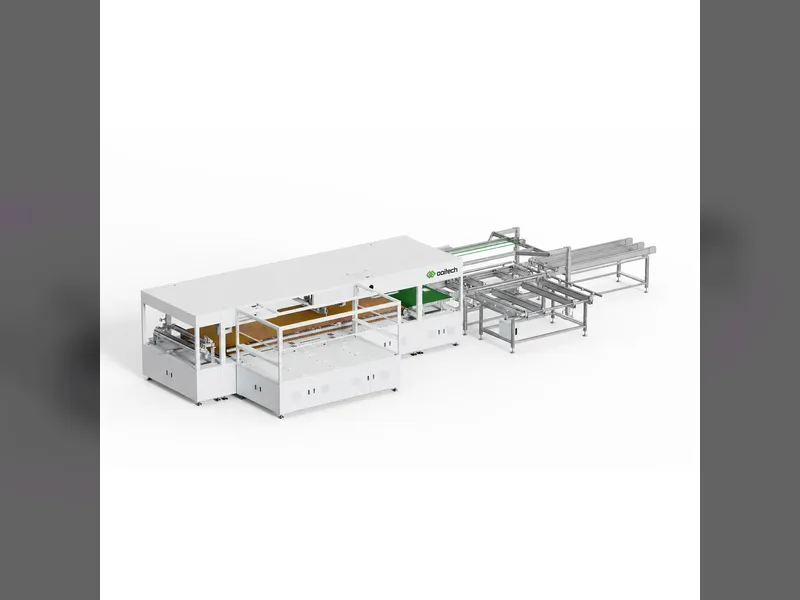
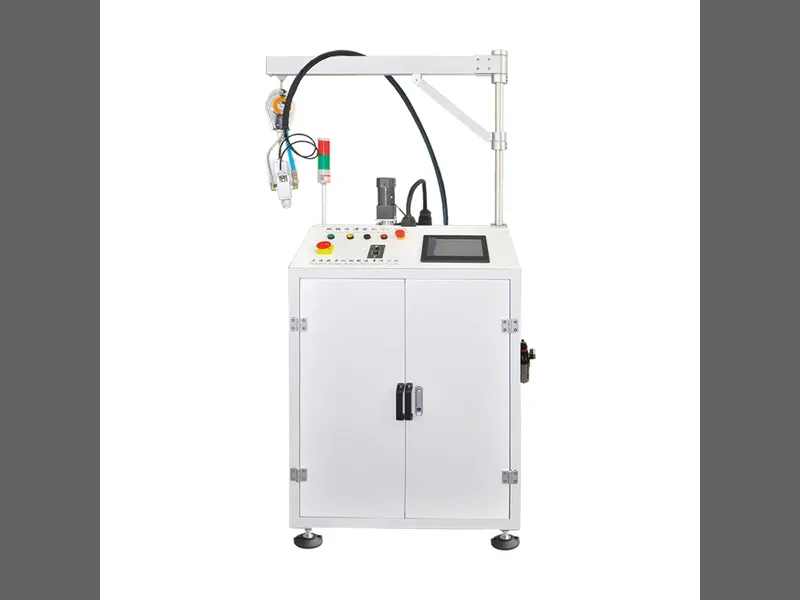
- Assembly stations. Machines that insert and fasten connectors, such as the MC4 connector assembly station in an automatic junction box assembling line, are specified around a connector family. Confirming the family before the line is configured is cheaper than changing fixtures afterwards.
The junction box itself is the other half of the interface: sealing, potting and the cable exit are specified together with the connector, as set out in the junction box and diode box overview.
How to Choose
- 1500 V ground-mounted plants: use Evo 2 throughout the DC circuit — modules, extension leads, combiner inputs and inverter ports. One downgraded part sets the limit for the loop, so there is no partial version of this.
- 1000 V residential and commercial rooftops: either model meets the requirement. Match whatever the inverter and optimiser ports are fitted with, then decide on cost.
- Hot rooftops, BIPV and desert sites: prefer Evo 2. The extra 10 °C of upper temperature rating is worth more where rear ventilation is poor and ambient temperature is high.
- Large cross-sections and high-current runs: prefer Evo 2 for 6 mm² and 10 mm² combiner and extension cables, where the current margin is much wider.
- O&M and spares on existing plants: match the original model and check the crimp tool and seal set at the same time, not afterwards.
How to Tell Which One You Have
Three checks, in increasing order of reliability: the housing, where Evo 2 carries a ribbed structure; the part number on the body and packaging, where the classic parts are PV-KST4 and PV-KBT4 and the Evo 2 numbers carry the Evo 2 designation; and the module nameplate or datasheet, which states the connector model and is the only one that decides a dispute.
FAQ
Can MC4 and MC4-Evo 2 be connected to each other?
Yes, between genuine parts of the same manufacturer, because they belong to one product family. The mated joint is then rated at the lower of the two parts, which limits it to a 1000 V system.
Is the classic MC4 a 1500 V connector?
Its UL listing shows 1500 V and earlier TÜV approvals did too, but under the current IEC 62852 its rated voltage is 1000 V. Always read the datasheet of the specific batch.
What is the main practical difference on site?
Tooling. The terminals differ and the crimping tool for one model does not apply to the other, and the cable outer-diameter ranges do not match, so seals and tools have to be prepared per model.
Do the two have the same contact system?
Yes: the same 4 mm pin, MULTILAM® contact band and tin-plated copper contacts. That is why the field reliability experience of the classic part remains relevant to the newer one.
Is it true that only the classic MC4 lacks salt-mist resistance?
No. Both models are listed with salt-spray testing and ammonia testing in the manufacturer catalogue, so this is not a difference between them.
Can third-party “MC4 compatible” connectors be mixed in?
Not within the certification of the original parts. Whatever they are mated with, the connection falls outside the certified combination, which matters for warranty and for the system voltage claim.
Final Thoughts
MC4-Evo 2 does not replace MC4; it raises three ratings — voltage, current and temperature — on the same interface and the same contact technology, to match 1500 V systems and higher-current modules. Three habits cover most of the risk: choose by system voltage, prepare tools and seals by model, and confirm the connector on the nameplate rather than by eye. For a production line, settle the connector family before the stations are specified.
Ratings and mixing rules quoted from the connector manufacturer’s product catalogue and datasheet, and from distributor application notes; check the current datasheet for the batch in use. MC4, MC4-Evo 2 and MULTILAM are trademarks of Stäubli.