Does Shading Always Cause Hot Spots? Reverse Bias Explained
Table of Contents
Quick answer: Shading raises hot-spot risk, but shading alone does not create a hot spot. Three things decide the outcome: the current the series branch forces through the shaded cell, the cell’s reverse voltage-current behaviour, and whether a bypass diode is conducting. When the branch current exceeds what the shaded cell can generate, that cell is pushed into reverse bias and starts absorbing power instead of delivering it, which is what raises its temperature. Because the branch current depends on the operating point, the same shadow can be harmless at open circuit and severe at short circuit.
Most explanations stop at “shade makes hot spots.” The useful question is which shadow, at which operating point, on which cell.
A Hot Spot Begins as a Current Mismatch
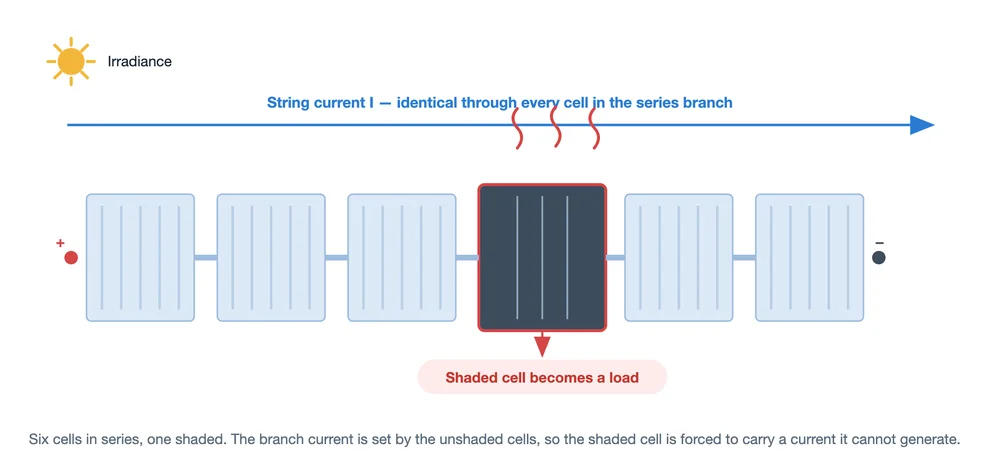
Cells inside a module are connected in series branches, and the current through a series branch is the same through every element in it. Under uniform irradiance the cells have similar current-voltage behaviour, so the branch settles on a working point where all of them contribute.
Shading changes one cell’s ability to generate current. If the branch current exceeds what that cell can supply at its reduced irradiance, the cell can no longer keep up, and the branch forces it into reverse bias. The mismatch, not the shadow by itself, is the starting point.
Modern modules are not one simple series chain: half-cut cells, multi-cut cells and parallel substrings mean the physical cell count and the electrical branch are not the same thing. Any statement about branch current applies to one series branch, and the module’s actual circuit has to be checked before drawing conclusions about a specific product.
Reverse Bias: From Generator to Load
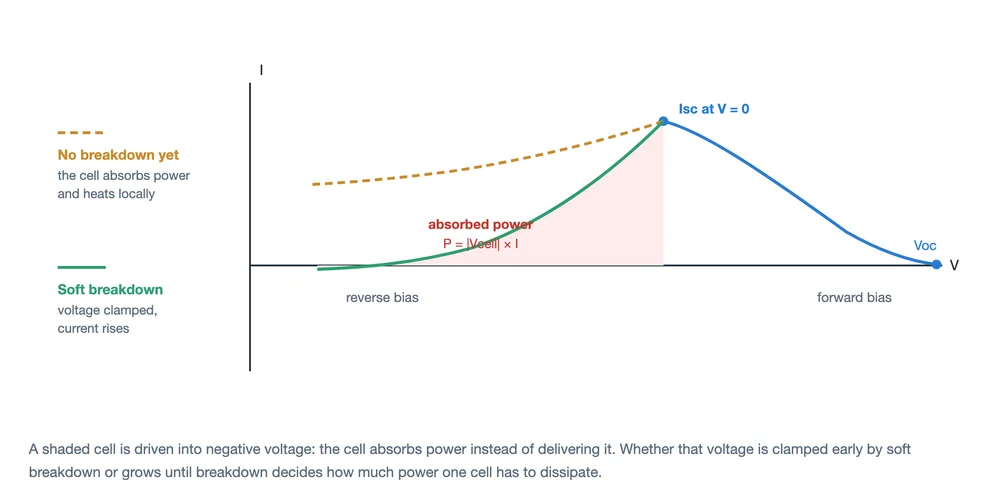
In reverse bias the polarity of the voltage across the shaded cell flips relative to normal operation. Taking the normal generation direction as positive, the cell voltage becomes negative while the branch current stays positive, so the power the cell absorbs is:
Pabsorbed = |Vcell| × I
That power becomes heat inside the cell. Whether it becomes a hot spot depends on where it is dissipated and for how long: a concentrated spot on one cell raises local temperature far more than the same wattage spread over an area, and the packaging and cooling path decide how fast the heat leaves.
The Reverse Characteristic Decides How Hot
Cells do not all behave the same way once they are reverse-biased. Two patterns matter:
- Reverse bias without breakdown. The cell absorbs power and heats, and the voltage it reaches is set jointly by its reverse characteristic, the forward behaviour of the remaining cells, and the external working point of the string.
- Breakdown or current crowding. Once reverse voltage reaches the breakdown region, the voltage is clamped over a narrow range while the current rises quickly. If that current concentrates into a defect or a small area, local power density rises and so does hot-spot risk.
This is why cell architecture changes hot-spot temperature. Back-contact cells with a soft reverse breakdown characteristic start conducting at a lower reverse voltage, so the voltage the cell has to sustain is clamped earlier and the module runs cooler under partial shade — the mechanism behind the shading tolerance of BC solar cells. The comparison only holds within the same test conditions; it is not a blanket claim that one architecture never has hot spots.
Open Circuit, MPPT and Short Circuit Are Not the Same Case
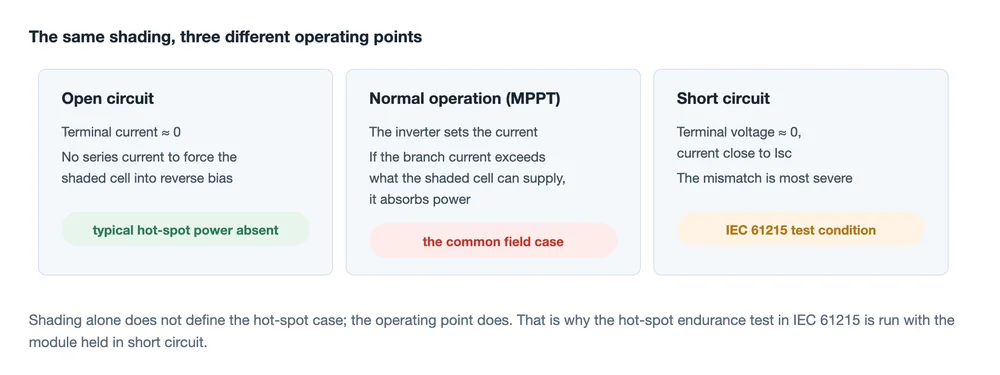
The branch current that forces a cell into reverse bias is not a fixed number; it depends on how the module is being operated.
Open circuit. Terminal current is close to zero, so there is no series current to push the shaded cell into reverse bias, and the classic hot-spot power is absent. That does not make a module immune to local heating from other defects or abnormal conditions.
Normal operation. Connected to a load or tracked at maximum power, the current is set by the module I-V characteristic together with the other series modules, the inverter control strategy and the shading pattern. If that current exceeds what the shaded cell can supply, it reverse-biases and absorbs power. This is the case that matters in the field, because it is where modules spend their life.
Short circuit. Terminal voltage is about zero and current is close to short-circuit current. In a simplified series chain the cell voltages sum to the terminal voltage, so the positive voltages of the healthy cells can be cancelled by the negative voltage of the shaded one — the mismatch case is at its most severe. Real modules also contain bypass diodes, parallel substrings and complex interconnection, so the simplified relation cannot be applied blindly. Short circuit is nonetheless one of the conditions assessed for hot-spot endurance, which is why the hot-spot test in IEC 61215 is performed with the module in short circuit.
What a Bypass Diode Does, and What It Does Not
Crystalline silicon modules normally place a bypass diode across each substring of cells. When the reverse voltage across a shaded substring reaches the conduction condition, the diode can conduct, provide a path around that substring and limit the reverse voltage it has to withstand.
Two limits follow from that design. A bypass diode protects a substring, not each individual cell, so cells inside a partially shaded substring can still see reverse voltage and current. And diode conduction is not guaranteed for every shading pattern: it depends on substring voltage, the shape of the shadow and the circuit layout. A bypass diode is a mitigation measure, not a reason to treat shading and cell defects as unimportant.
Why Heavier Shading Is Not Always Hotter
Heavier shading lowers the shaded cell’s generated current and makes the mismatch more likely, but it also changes the branch current, the reverse voltage, the diode state and how the heat is distributed. The relationship between shading ratio and temperature is therefore not monotonic: a partial shadow of a particular shape can produce a less favourable local power distribution than a full shadow over the same cell.
Practical consequence: judging risk from the shaded area alone is unreliable. What matters is where the shadow falls relative to the cell and substring boundaries, and how long it stays there.
Where Hot-Spot Risk Is Settled Before the Module Ships
Because the mechanism is electrical, a large part of hot-spot behaviour is fixed during manufacturing rather than during operation. Three process steps matter most:
- Cell sorting and matching. Cells with divergent current at the operating point create mismatch inside the module before any shading is involved. Current binning narrows that spread.
- Defect detection. Cracks, soldering defects and shunted regions concentrate the reverse current and become the spot where heat localises. Inline EL inspection and electrical characterisation are how those defects are removed before encapsulation.
- Diode and circuit verification. Bypass diode placement and its electrical check decide how much reverse voltage a substring has to carry in the field.
On the operation side, the practical levers are fewer but real: reduce long-term local shading from branches, buildings, bird droppings and dust; clean and inspect on the schedule the module and system documentation defines, without climbing onto or touching live components; and treat abnormal generation or visible local heating, discolouration or glass damage as a case for qualified maintenance personnel. Infrared inspection helps locate a problem, but the reading has to be interpreted together with irradiance, ambient temperature, load state and module construction.
FAQ
Does shading always cause a hot spot?
No. Shading only creates the conditions for a hot spot. Whether the shaded cell actually reverse-biases and how hot it gets depends on the branch current, the cell reverse characteristic and the bypass diode state.
Do bypass diodes prevent hot spots completely?
No. They protect substrings rather than individual cells, and they only act once the substring voltage reaches the conduction condition. They reduce severity and risk; they do not remove the need to control shading and cell defects.
Why is the IEC 61215 hot-spot test run in short circuit?
Because short circuit is the condition in which the mismatch between a shaded cell and the rest of the string is most severe. Testing there exercises the worst case rather than a benign operating point.
Can a module operate for years with shading and never show a hot spot?
Yes. Low-irradiance, diffuse or intermittent shading often never drives enough mismatch to create a damaging spot. Risk rises with long-term, localised shadows that fall inside a substring and stay there.
Is a hot spot always visible as a burnt mark?
Not in the early stages. Temperature differences can exist without visible damage, which is why infrared inspection is used alongside visual inspection, and why the reading has to be interpreted against irradiance and load conditions.
Does cell technology change hot-spot severity?
It can. The reverse breakdown behaviour of the cell determines how early the reverse voltage is clamped, so architectures with soft reverse characteristics tend to run cooler under partial shade. The comparison has to be made under the same test conditions.
Final Thoughts
A hot spot is an electrical event before it is a thermal one, which is why the answer to “will this shadow cause one” is never yes or no on the shadow alone. Fix the mismatch first: match cells, remove defects, verify the diodes, and keep long-term local shading off the array. When you evaluate a module for a shaded site, ask for the reverse characteristic and the hot-spot endurance result rather than a marketing temperature figure.