Why BC Solar Cells Handle Shading Better
Table of Contents
Quick answer: Back-contact solar cells handle partial shading better than front-contact cells because both polarity contacts sit on the rear, which changes how current redistributes when part of the module is shaded. In a front-contact module a shaded cell can be forced into reverse bias and dissipate power as heat; the cell temperature can climb toward 120 °C to 160 °C at the shaded junction while the surrounding module stays near 90 °C. The rear-junction geometry of BC cells reduces the reverse-bias stress a shaded cell sees and spreads the loss across a shorter conductive path. The benefit is real but bounded: BC cells still need bypass diodes and still lose output when shaded. What changes is how much heat the shaded cell has to absorb before the diode conducts, which is what decides whether a shading event is a temporary output loss or a permanent defect.
PV Module Manufacturing · by Jerry, Ooitech
Introduction
For what a hot spot does to the encapsulant, backsheet, glass and interconnects — and why temperature is a safety margin rather than just a performance number — see solar panel hot spots, why temperature matters and what the heat damages.
Shading is a very common problem in real-world PV installations.
Tree shadows, utility poles, dust, bird droppings, snow, even slightly inconsistent module mounting angles can all cause partial shading. Shading not only lowers module output, it can also trigger a more serious issue: hot spots.
Over the past few years, BC solar cells have drawn more and more attention in distributed rooftop, balcony PV, and premium modules. One key reason is this: BC solar cells usually offer better shading tolerance, and their hot spot temperatures stay lower under shading.
At SNEC, you often see manufacturers shade part of a cell string and then use the water height from a pump to show off the shading tolerance of their BC products.
So why do BC cells have this advantage? What is the physics behind it?
Let's try to explain it in fairly simple terms.
Why Does Shading Cause Hot Spots
Why does shading cause hot spots?
Cells inside a PV module are usually connected in series.
A series circuit has one defining trait: the current must be the same everywhere.
That means the current through the whole string is set by the loop as a whole. When every cell gets full light, each one generates power and they all sit in a fairly consistent state.
But if one cell gets shaded, the photo-generated current it can produce drops. If the whole string still needs to carry a large current, that shaded cell can be pushed into reverse bias by the other unshaded cells. At that point it stops being a power source and turns into a power consumer.
For partial shading, the shaded cell doesn't stop generating completely. Its unshaded area still produces some photo-current. So what actually has to flow through the reverse breakdown path, leakage path, or bypass path is not the full string current, but the difference between the string current and the current that cell can still produce.
This difference can be called the mismatch current:
Imismatch = Istring - Igenerate
So the hot spot power dissipation can be roughly written as:
Photspot ≈ ∣Vrev∣ × Imismatch
which is:
Photspot ≈ ∣Vrev∣ × (Istring - Igenerate)
This formula points to one key thing: at the same string current, the higher the reverse voltage, the more power the shaded cell dissipates, and the hotter the hot spot gets.
So one of the keys to resisting hot spots is:
how to lower the reverse voltage on the shaded cell and make the heating more even.
This is exactly where BC cells shine.
How BC Cells Differ In Structure
How is a BC cell structurally different from a regular cell?
Ordinary crystalline silicon cells usually use a front-and-back contact structure.
Put simply:
The front has fine gridlines and busbars, and light enters from the front;
Current is generated inside the cell and then collected through front and back electrodes.
A BC cell, meaning Back Contact, has one standout feature:
both positive and negative electrodes sit on the back of the cell, with no metal gridlines on the front.
That gives two direct benefits:
No gridline shading on the front, so more light-receiving area;
The back electrodes can be built into an interdigitated pattern, so current collection is more even.
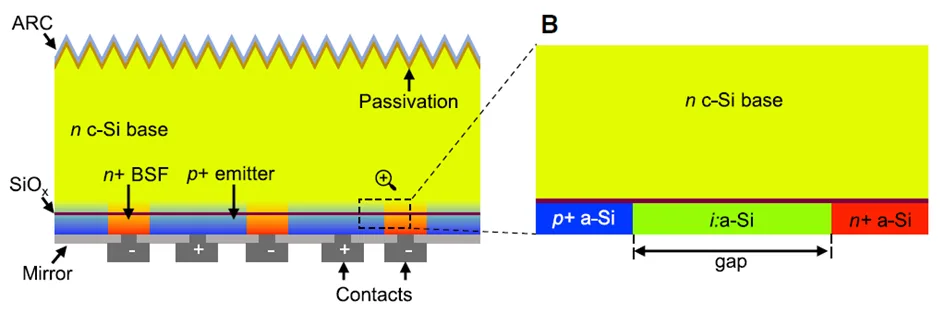
Figure 1 Schematic of BC cell structure.
Source: Calcabrini, A., Procel Moya, P., Huang, B., Kambhampati, V., Manganiello, P., Muttillo, M., Zeman, M., & Isabella, O. (2022). Low-breakdown-voltage solar cells for shading-tolerant photovoltaic modules. Cell Reports Physical Science, 3(12), 101155. https://doi.org/10.1016/j.xcrp.2022.101155
The back of a BC cell carries many interleaved p-regions and n-regions. Between these regions sit lots of short, heavily-doped PN junctions. From a circuit view, it no longer behaves like a single large diode, but more like many small diodes in parallel. Under reverse bias, these distributed PN junctions can form a more even reverse conduction path.
Because these back PN junctions are short and locally heavily doped, they can enter reverse breakdown at a relatively low reverse voltage.
Of course, this depends on the specific design parameters of the BC cell.
For example, the smaller the gap between the p-region and n-region, the stronger the local field, and usually the easier it is to form a lower reverse breakdown voltage. But that can also bring trade-offs in leakage and shunt resistance. So the shading tolerance of a BC cell is not a fixed value. It ties closely to the specific cell structure, back pattern design, gap size, doping concentration, passivation quality, and manufacturing process.
Why BC Cells Lose Less Power Under Shading
Why do BC cells lose less power after shading?
When a module gets partially shaded, the string current pushes the shaded cell into reverse bias. As shading worsens, the total voltage across that substring keeps dropping.
In traditional modules, a bypass diode is usually placed in parallel across a section of the string. The bypass diode is not actively switched on by a controller. It is a passive device. Whether it conducts depends only on the voltage across it. When the total voltage of that substring goes sufficiently negative, the bypass diode gets forward biased and turns on automatically.
The turn-on condition can be written as:
Vsubstring ≤ -Vf
Vsubstring is the total voltage of the substring protected by the bypass diode;
Vf is the forward voltage drop of the bypass diode.
For a substring, its total voltage can be understood as:
Vsubstring = ∑Vunshaded + ∑Vshaded
where:
Unshaded cells still produce a forward voltage;
Shaded cells are reverse biased and produce a negative voltage.
The bypass diode turn-on condition can be read as:
∣∑Vshaded∣ ≥ ∑Vunshaded + Vf
In other words:
the total reverse voltage of the shaded cells has to exceed the total forward voltage of the remaining unshaded cells, plus the forward drop of the bypass diode, before the bypass diode turns on.
The advantage of BC modules is that, before the external bypass diode even turns on, the interdigitated back PN junction structure of the BC cell itself already provides some distributed reverse conduction capability. This behaves a bit like a built-in Zener diode inside the cell.
Under reverse bias, the interdigitated back PN junctions of a BC cell can form distributed reverse conduction at a lower voltage, limiting further rise of the reverse voltage. So under partial shading, when the external bypass diode has not yet turned on, a BC module can still keep a relatively high output power.
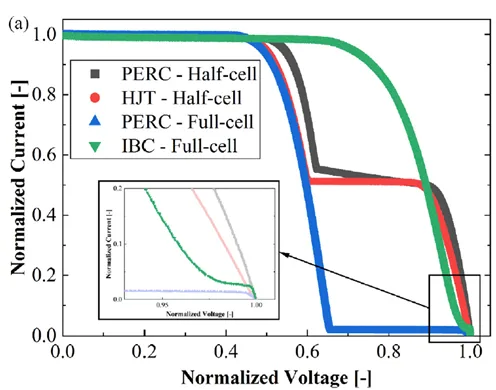
Figure 2 IV curve of the module with one cell shaded.
Source: E. Özkalay, F. Valoti, M. Caccivio, A. Virtuani, G. Friesen, and C. Ballif, "The effect of partial shading on the reliability of photovoltaic modules in the built-environment," EPJ Photovoltaics, vol. 15, p. 7, Jan. 2024, doi: 10.1051/epjpv/2024001. Available: https://doi.org/10.1051/epjpv/2024001
Better Tolerance Doesn't Mean Immune To Shading
Better shading tolerance doesn't mean BC cells are immune to shading
One common misconception needs clearing up.
Better shading tolerance does not mean a BC cell is unaffected by shading.
Any PV cell produces less power once it's shaded.
If the shaded area within one substring gets too large, or several cells are fully shaded, then the total reverse voltage of the shaded cells can still eventually exceed the total forward voltage of the remaining unshaded cells. At that point the external bypass diode turns on.
Once the bypass diode turns on, current routes around that whole substring. The unshaded cells in that substring get bypassed too, and their contribution to output drops sharply. So when the shaded area is large, the generation advantage of a BC module weakens as well.
The scenarios where BC modules really shine are usually:
One cell or a few cells get partial shading;
The shaded area in each substring stays small;
Shading is diagonal, strip-shaped, or locally scattered;
The external bypass diode has not fully turned on.
For example, a diagonal shadow from a utility pole might leave each substring with only a small shaded area. In that case, a BC module tends to show its better shading-tolerant generation.
Why BC Modules Run Cooler Hot Spots
Why do BC modules have lower hot spot temperatures?
There are mainly two reasons BC modules run cooler hot spots.
First, the reverse current is more spread out
For ordinary cells, the reverse current distribution is often uneven. Reverse breakdown may first occur at some local weak spots, such as:
Local defect sites;
Cell edges;
Metallization anomalies;
Microcracks or contaminated areas;
Regions with weaker local passivation.
These spots act like weak points.
Once the reverse current concentrates at these weak points, the local power density gets very high, the temperature rises fast, and a clear hot spot forms.
It's like using the same amount of heat on two objects:
A whole metal plate;
A pinpoint-sized spot.
The latter heats up faster for sure.
So the risk for an ordinary cell under shading isn't "even heating across the whole cell," but strong local point heating.
A BC cell has many interdigitated PN junctions on its back. Reverse conduction can spread more easily across multiple regions instead of concentrating at a few defect points.
So the reverse current in a BC cell distributes more evenly, the local power density stays lower, and the hot spot temperature stays lower too.
Second, the reverse breakdown voltage is lower
From the hot spot power formula:
Photspot ≈ ∣Vrev∣ × Imismatch
at the same mismatch current, a lower reverse voltage means less power dissipation.
That's why a low reverse breakdown voltage can actually act as a protection mechanism in shading scenarios.
Here's a simple example.
Say the string current is 10A and one cell gets heavily shaded.
If an ordinary cell reaches 15V reverse voltage after shading, the power it dissipates is roughly:
P = 15V × 10A = 150W
If a BC cell clamps due to its back structure and the reverse voltage is limited to around 6V, the power it dissipates is roughly:
P = 6V × 10A = 60W
The difference is very clear.
Real hot spot temperature depends on shaded area, ambient temperature, wind speed, module encapsulation, glass size, cell design, and test method, so you can't judge it by a single fixed number.
But in some real tests and field experience, BC modules usually run lower hot spot temperatures than conventional ones. For example, some BC modules can keep hot spot temperature below about 120 °C, while other module types may reach 160 °C or even higher.
Some specially designed BC cells achieve something like a "built-in bypass diode inside the cell." That can bring the hot spot temperature down to about 90 °C while a reference module sits around 190 °C, showing that this kind of distributed reverse conduction design can cut hot spot temperature significantly.
Is Lower Reverse Breakdown Voltage Always Better
Is a lower reverse breakdown voltage always better?
Not necessarily.
A low reverse breakdown voltage helps lower hot spot temperature during shading, but it can also bring design trade-offs.
If the reverse conduction path is poorly designed, it may increase leakage and lower shunt resistance, which hurts the cell's normal generation performance.
So a high-efficiency BC cell usually has to balance two goals:
During normal operation, keep high efficiency, low leakage, and high shunt resistance;
Under shading reverse bias, form a safe and even reverse conduction at a lower voltage.
That's also why shading tolerance varies between different BC cells.
Some BC cells lean toward efficiency and may build stronger isolation, so their reverse breakdown voltage runs higher. Others lean toward shading tolerance and may design lower, more even reverse breakdown paths.
So you can't simply say "all BC cells have the same shading tolerance." A more accurate way to put it is:
a well-designed BC cell can use its interdigitated back PN junction structure to achieve lower and more even reverse breakdown, and that improves shading and hot spot tolerance.
BC Cell Advantages Summed Up
BC cell advantages summed up
Taken together, the advantages of BC cells under shading mainly include:
Smaller module generation loss under small-area shading, before the external bypass diode turns on;
Lower local power density;
Lower hot spot temperature;
Higher module safety margin.
What This Means For Module Applications
What does this mean for module applications?
In real use, shading often can't be fully avoided.
Especially in distributed scenarios, such as:
Residential rooftops;
Commercial and industrial rooftops;
Balcony PV;
BIPV;
Multi-orientation mounting;
Sites surrounded by complex buildings.
In these applications, modules can frequently face local shading.
If a cell has better shading tolerance and lower hot spot temperature, it means:
Better module safety: low hot spot temperature reduces encapsulation aging, backsheet damage, local glass stress, and electrical risk.
Better long-term reliability: local high temperature speeds up material aging. The weaker the hot spot, the more stable the module stays over time.
More controllable generation loss: when local shading is unavoidable, a BC module can ease part of the power loss.
Friendlier system design.
BC modules adapt better to complex roofs, distributed mounting environments, and multi-shading scenarios.
Summary
Summary
BC cells offer better shading tolerance and lower hot spot temperature, not because they "aren't affected by shading," but because they have advantages in structure and reverse bias behavior.
Under shading, ordinary cells may see reverse breakdown concentrate at local defect points, leading to high local power density and high hot spot temperature.
The interdigitated back PN junction structure of a BC cell acts like a distributed built-in reverse clamp. Under shading, it can form reverse conduction at a lower reverse voltage and spread the reverse current more evenly, which lowers both hot spot power and hot spot temperature.
But keep in mind, BC cells aren't fully immune to shading. When the shaded area is too large, several cells are fully shaded, and the substring voltage goes sufficiently negative, the external bypass diode still turns on. At that point the bypassed substring output drops noticeably.
So a more accurate way to say it:
the advantage of a BC cell isn't to eliminate the effect of shading, but to make that effect more controllable. Under small-area shading, it reduces power loss; under heavy shading, it lowers hot spot risk.
That's the root reason BC cells hold an advantage in complex shading environments.
Ooitech's View
The interesting part here is that shading tolerance isn't just a cell design choice, it also depends on how consistently that interdigitated back pattern gets reproduced across every cell in a line. Small drifts in metallization, gap size, or passivation quality can shift the reverse breakdown behavior we just described, which is why process control on BC module lines matters as much as the cell recipe. Ooitech has spent years building turnkey module production lines for TOPCon, HPBC, ABC and other BC-type modules, so we watch these back-contact process windows closely. If you want to see how these modules actually get built on the factory floor, our YouTube channel at www.youtube.com/ooitech has a lot of real production line footage worth a look.