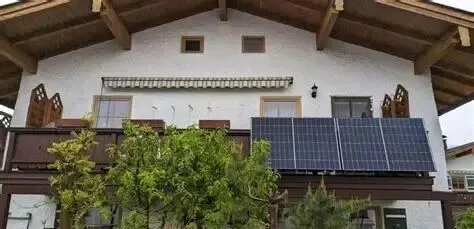
What Is Balcony Solar? A Plug-and-Play PV System
Table of Contents
Quick answer: Balcony solar is a lightweight, plug-and-play photovoltaic system designed for apartment dwellers who cannot install a rooftop array. A typical unit runs one or two modules in the 200 W to 800 W range, connects through a micro-inverter to a standard household circuit at 220 V, and feeds power directly into the home rather than exporting to the grid. The balance-of-system works at low voltage on the module side but has to satisfy local connection rules, which in some markets cap the permitted output at 600 W or 800 W and require a certified inverter. The product implications for a manufacturer are weight, module dimensions sized to a balcony railing, and a mounting system that needs no roof penetration. It is a consumer product with consumer expectations about appearance and installation effort.
PV Module Manufacturing · by Jerry, Ooitech
What Is Balcony Solar
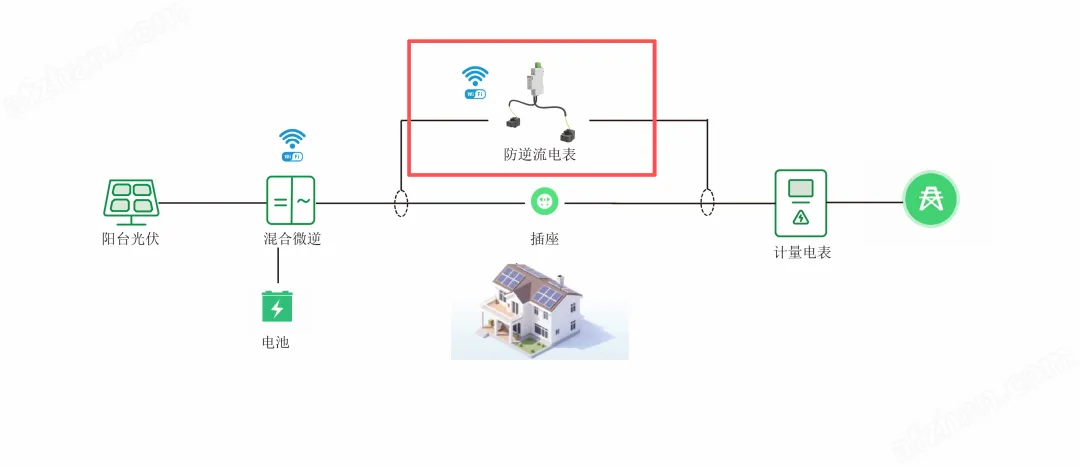
Balcony solar, or the balcony solar system, is a lightweight distributed PV system built for urban homes and small commercial spaces. The core setup is simple: PV modules, a micro inverter, a dedicated mounting bracket, and an anti-backflow meter. Higher-end kits add a storage module, turning it into an integrated solar-plus-storage solution.
The biggest selling point is "plug and play." You don't need a big professional installation crew. Users can set it up themselves or with minimal help, which makes it a good fit for apartment dwellers and street-facing shops that can't use traditional rooftop PV. It runs on a "self-generate, self-consume, store the surplus" logic, and anti-backflow tech makes sure the power never feeds back into the public grid. Grid-connected, but not grid-feeding.
Technical Parameters
What Makes Up a Balcony Solar System
PV Module is the "energy collector" of the system, the core power-generating unit that turns sunlight directly into DC electricity. Mainstream products use high-efficiency monocrystalline silicon modules, with high conversion efficiency, long life (25 years and up), and a clean look that blends into the building. Output usually sits between 200W and 800W. Unlike traditional modules that often run 2.5㎡ or more, balcony modules are sized to fit the limited space of a balcony.
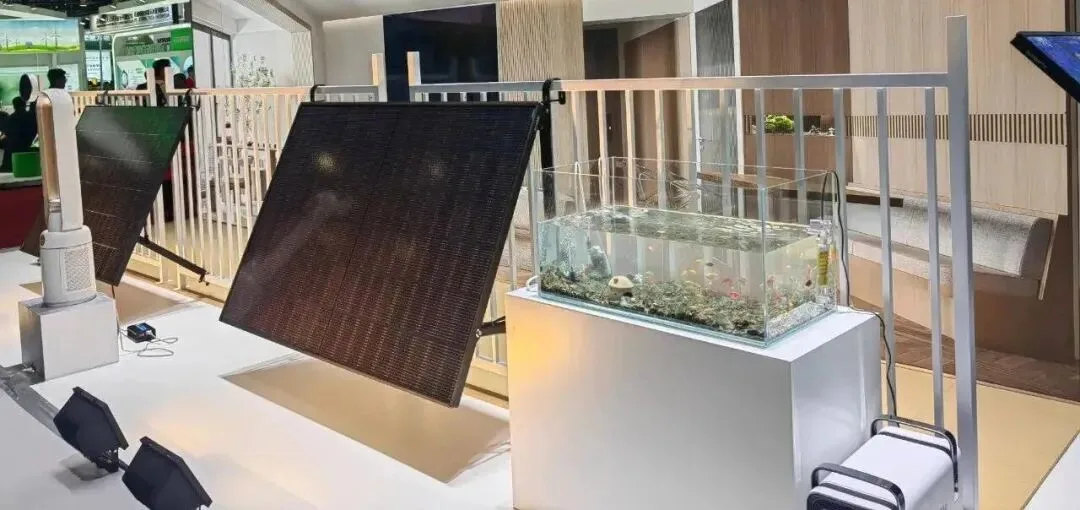
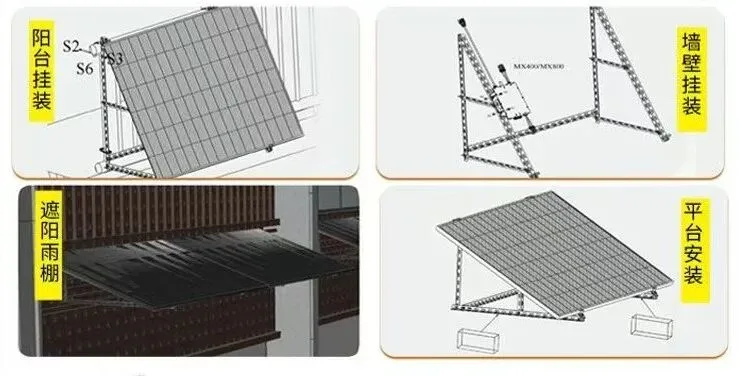
Dedicated Bracket holds the module securely on the balcony railing, exterior wall, or ground, and tunes the tilt angle to optimize output. This is the key difference from early fixed brackets. These brackets usually offer an adjustable tilt (say 0°–60°), so users can adjust by season and sun height to keep the module at its best angle. Tests show the difference in yield can reach 40% across the year. Manufacturers also offer different mounting options, so you're not limited to the balcony. Walls, awnings, flat ground all work.
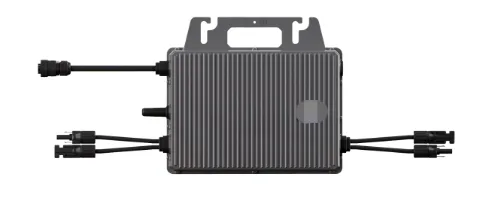
Micro Inverter converts the DC power from the module into the 220V AC your home can use, and acts as the smart control core of the system. The new generation hits over 99% conversion efficiency, so energy loss is low. As a smart controller, it monitors and coordinates generation, storage, and consumption in real time, keeping things efficient and safe. Some models even support remote monitoring and smart scheduling through a phone app.
Traditional PV inverters often work at 1000V or even 1500V, while a micro inverter runs at just 60V or 120V, which keeps users much safer. It's also small and light (as low as 1.8 kg), easy to install, and DIY-friendly for non-professionals. That's the heart of the "plug and play" experience.
Anti-Backflow Meter is the key device that makes "grid-connected but not grid-feeding" possible. It monitors consumption and generation in real time, dynamically controls the PV output, and stops surplus power from flowing back to the public grid. It supports WIFI, Bluetooth and other wireless comms, so users can check data and manage things remotely from a phone app. The compact DIN-rail design is easy to install, and features like automatic phase-sequence recognition and fault diagnostics lower the bar for non-professional users.
Technical Advantages
Plug and play: DIY installation, no major construction needed
Safety first: micro inverter works at only 60V or 120V
High efficiency: micro inverter conversion over 99%, module efficiency high and stable
Flexible mounting: railings, walls, awnings, flat ground, adjustable tilt 0°–60°
Smart control: real-time monitoring, remote app management, optional storage for solar-plus-storage
Product Application
The Balcony Solar Market
Be honest here. In China, the state grid and Southern Power Grid keep supply stable, service is good, faults get fixed fast, and electricity is relatively cheap and steady. So personally I'm not that bullish on balcony solar's prospects in the Chinese market.
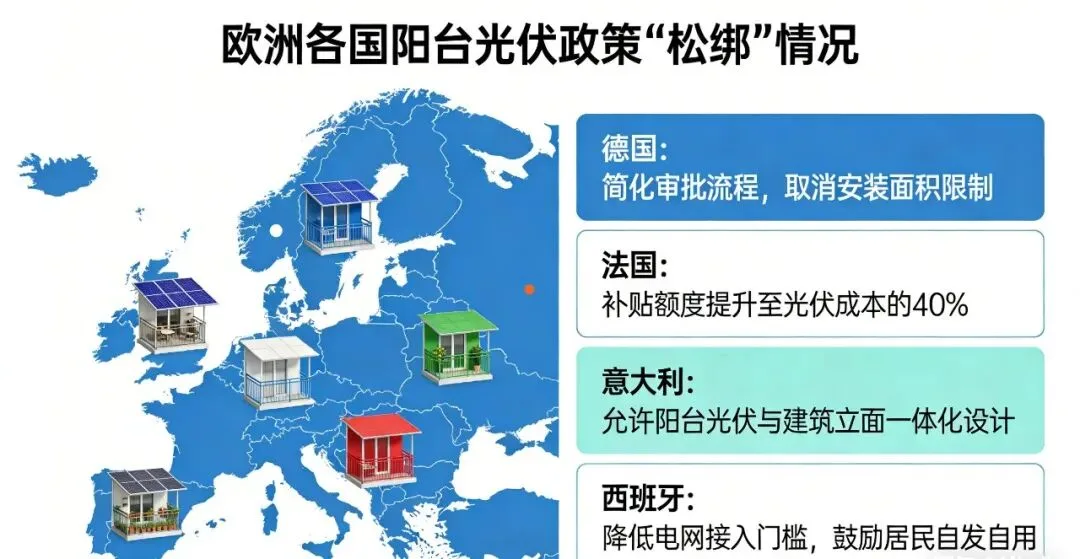
Europe is a different story. The market there is huge. First, policy support. Since 2024, Germany officially dropped the mandatory bidirectional meter requirement for PV systems of 800W and under, meaning qualifying small distributed systems can plug straight into the home grid and start generating (Plug & Play).
This change is seen as a key "loosening" for balcony solar (Balkonkraftwerk). Users can deploy fast, no grid rebuild needed. Austria simplified its approval process and barred apartment owner associations from unreasonably refusing balcony solar installs. France went with a "zero approval" policy, so no permit is needed. Italy rolled out subsidies and tax breaks to lower the investment threshold. Poland's "My Electricity" subsidy program pushed distributed PV installs past 1.3 million units. Luxembourg brought in supportive policies with simpler installation and financial incentives. And the UK relaxed balcony solar rules from 2024, allowing plug-and-play devices onto the home grid.
Then there's grid instability and price swings. Because power in Europe and the US is run by private companies, fault response tends to be slow, and prices ride the oil and gas markets. That's why the European balcony solar market has more room to grow. Take Germany: cumulative installs top 1 million units, with about 435,000 added in 2025, and balcony solar making up 40%+ of new household installs. In 2025, 60%+ of newly sold systems came with storage (1–3kWh), so solar-plus-storage is now the mainstream. China, by contrast, had only around 1,000 balcony systems in 2024, and just crossed 10,000 in 2025.
① On the morning of January 3, 2026 local time, a large-scale blackout hit southwest Berlin after cable damage. It started with a fire in a container under a bridge in the Lichterfelde area, and the flames spread and damaged several cables leading to a power plant. The outage hit most of Wannsee, Zehlendorf and Lichterfelde in southwest Berlin, affecting about 50,000 households plus local nursing homes and hospitals, and knocking out some traffic lights and mobile network service. The Berlin grid later reported that replacing the lines after the fire was complex, so the outage dragged on until the 8th. As of January 6, about 25,000 households and over 1,100 businesses were still without power.
② On September 9, 2025, near the Adlershof tech park in southeast Berlin, two utility poles were set on fire and destroyed, triggering a large-scale blackout. Early on, about 50,000 households were affected. That day and evening, the utility restored power to roughly 30,000, but on the 10th about 20,000 households were still dark. That afternoon, another 6,000 or so were restored through a temporary fix, which soon failed again, and power didn't come back until the following morning. Around 23:00 on the 10th, a second emergency plan also had a brief failure, cutting power again to nearly 30,000 households for about 20 minutes.
Ooitech's View
Balcony solar is basically the module business shrunk down to apartment scale, and the same module lines that build full-size panels can turn out these compact 200–800W plates just as well. What really moves this market is regulation like Germany's 800W rule, plus that jump to 60%+ of new kits shipping with storage, which tells you demand is heading toward integrated solar-plus-storage. At Ooitech we focus on the module production side (not cells), from MBB and TOPCon down to flexible and thin-film formats, so we watch these European policy shifts closely. If you want to see how these panels actually get made on the line, our YouTube channel www.youtube.com/ooitech is worth a follow.