Editorial responsibility for this article rests with Wuhan Ooi Photoelectric Technology Co., Ltd. Written and reviewed by the Ooitech editorial team. See our editorial policy for how we write, where AI tools are used, and how to request a correction.
PV Encapsulant Film: EVA, White EVA, POE, EPE and Beyond
Table of Contents
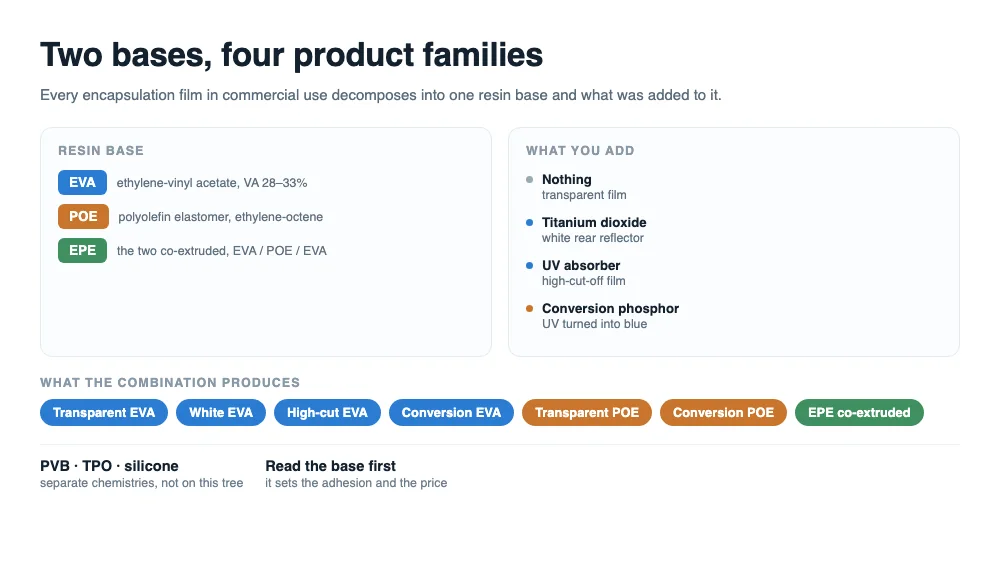
Quick answer: every encapsulation film in commercial use is one of two resin bases, EVA or POE, plus something added to it. EPE is the two bases co-extruded into one sheet, white EVA is EVA with a white pigment, and conversion film is either base with a phosphor. Learn the base and the additive, and any new product name resolves into a film you already understand.
The previous piece in this series set out the five jobs encapsulation has to do. This one is the other half of the map: the materials that do those jobs, what each is good at, and which module architecture each was built for.
The naming is what makes the family look larger than it is. A catalogue lists transparent EVA, white EVA, EPE, POE, high-transmission EVA, UV-cut EVA and conversion film as if they were seven materials. They are two polymers arranged in different ways, and once that is clear the selection conversation gets much shorter.
Two axes: a base and an additive
Every film has a resin base, and the base sets its character. There are only two in volume production. EVA, ethylene-vinyl acetate, carries vinyl acetate at roughly 28 to 33 percent in the photovoltaic grade; the ester group is polar, which is why EVA bonds to glass easily and why it can hydrolyse. POE, a polyolefin elastomer usually based on ethylene and octene, has no ester group at all, which is why it is a much better moisture barrier and why it is harder to formulate.
The second axis is what is added to the base. A white pigment makes a reflective rear film. Extra UV absorber makes a high cut-off film. A phosphor makes a conversion film. Nothing added gives you the transparent standard grade.
EPE is the one combination that works along both axes at once: an EVA skin, a POE core and a second EVA skin, extruded together rather than blended. That single construction is why it has taken so much of the TOPCon business, and it is the reason a film can now be described as having a front face and a back face with different jobs.
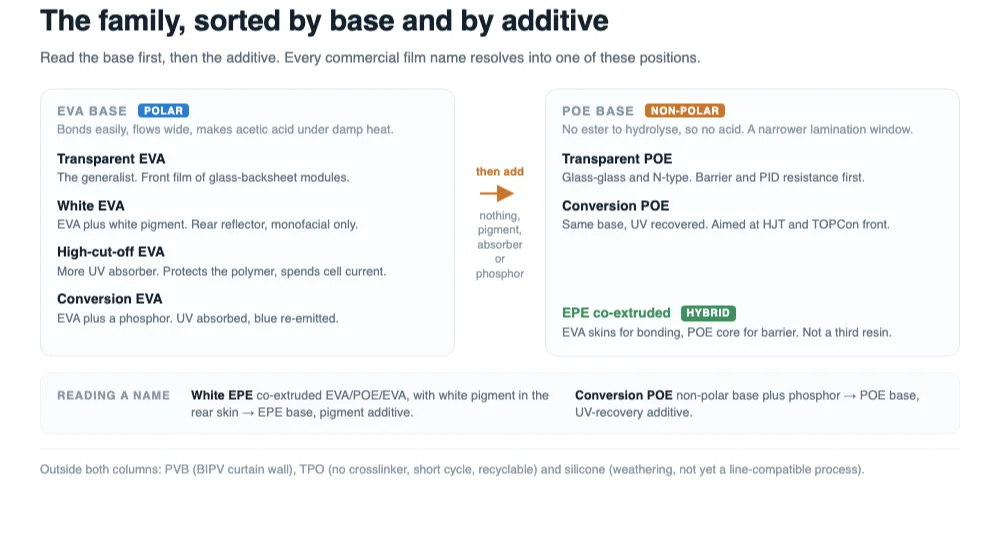
Read a name off a datasheet against that tree and there is no ambiguity left. White EPE is a co-extruded film with pigment in the rear skin. Conversion POE is a non-polar base with a phosphor. Both answers took one line, and both say more about performance than the brand name does.
Transparent EVA: the generalist that pays for it in acid
EVA earned its place by being easy. The polar ester group bonds to glass and to backsheet without heroic formulation work, it is compatible with crosslinking agents, silanes and stabilisers, it flows well enough to give a forgiving lamination window, and it is the cheapest of the options. For two decades that combination made it almost synonymous with encapsulation.
The weakness comes from the same functional group. Under damp heat the acetate side group hydrolyses, and the acetic acid that forms attacks the gridlines and the ribbon. Water vapour transmission is high — commonly quoted around 25 g/m² per 24 hours at 38 °C and 90% relative humidity, roughly eight times the POE figure — and volume resistivity is lower, so PID resistance has to be recovered through formulation rather than coming from the polymer.
This is why transparent EVA is best understood as the film of the glass-backsheet, monofacial module. That market is shrinking: glass-backsheet had about 60 percent share in 2023, fell below half in 2024, and the ITRPV roadmap has it at roughly 23 percent a decade out. The film is not failing; the module format it was designed for is losing ground.
There is still a large, sensible use for it. Several module makers run EVA on the front and a POE-based film on the rear, on the reasoning that the front is where the light and the cost-performance leverage are, and the rear is where the barrier matters most. The two faces of a module do different jobs, and nothing requires them to use the same film.
There is also a third path that keeps the base and fixes the weakness: optimised EVA grades with lower acid formation and a stronger PID package. They cost more than standard EVA and less than POE, and they let a line stay on the same lamination recipe. Whether they are enough depends on how long the module has to last in your climate, which is a warranty question rather than a material question.
White EVA: recovering the light that leaked between cells
A monofacial module has gaps between cells, and gaps between the cell string and the frame. Light that lands there with a transparent rear film continues into the backsheet and is lost. White EVA, which is EVA loaded with a white pigment, sits behind the cells and scatters that light back up; part of it reflects off the inner glass surface and returns to the cell. The mechanism is simple and the effect is real, which is why white film became standard on the rear of monofacial modules.
It is also a rear-only material with two hard limits. It does not transmit, so a bifacial module cannot use it — the gain would be spent blocking the rear irradiance the product is sold on. And it flows: during lamination the white layer can creep up over the cell edge and, in bad cases, onto the front face, which is the defect the industry calls white overflow. The standard countermeasure is a pre-crosslinked white film, partially cured before shipment so that it still bonds but no longer travels.
White EVA held about 16 percent of the Chinese market in 2024, and CPIA expects the shares to stay near that level as monofacial volumes decline. It is on the losing side of the glass-backsheet transition for exactly the reason above. If you are running monofacial, it is close to free performance. If you are running bifacial, it is not an option, and no amount of qualification testing changes that.
POE: the film that cannot make acetic acid
POE is an ethylene-octene copolymer with a saturated backbone and no ester to hydrolyse. Everything that follows from that is a direct benefit: no acetic acid to corrode the metallisation, a water vapour transmission rate near 3 g/m² per 24 hours on the same basis where EVA sits near 25, a volume resistivity high enough to make PID resistance a property of the material rather than of the additive package, and elasticity that survives low temperature, where EVA stiffens noticeably around minus twenty.
The non-polar surface is also the problem. Additives are less compatible in POE, so they migrate and bloom more readily; adhesion to glass depends more heavily on the formulation; the melt flows less willingly, so lamination takes longer and the process window is narrower. A narrower window in a lamination press shows up as cell shift and string slip, not as a failed electrical test, which is why POE lines tend to need more process discipline rather than more inspection.
Cost is the other half of the story. POE resin has historically come from a short list of suppliers — Dow, ExxonMobil, Mitsui and LG Chem among them — so price and allocation move with capacity additions rather than with demand alone. That combination, better performance and a structurally higher price, is what created the opening for EPE.
EPE: EVA and POE stacked in one sheet
If EVA bonds well and POE blocks water well, the obvious move is to stop choosing. EPE co-extrudes EVA, POE and EVA into a single sheet: the skins give adhesion and flow, the core gives the barrier and the insulation. Because the core carries the moisture duty, the amount of POE in a module drops sharply, which is the cost argument, and the electrical performance stays close to pure POE, which is the reliability argument.
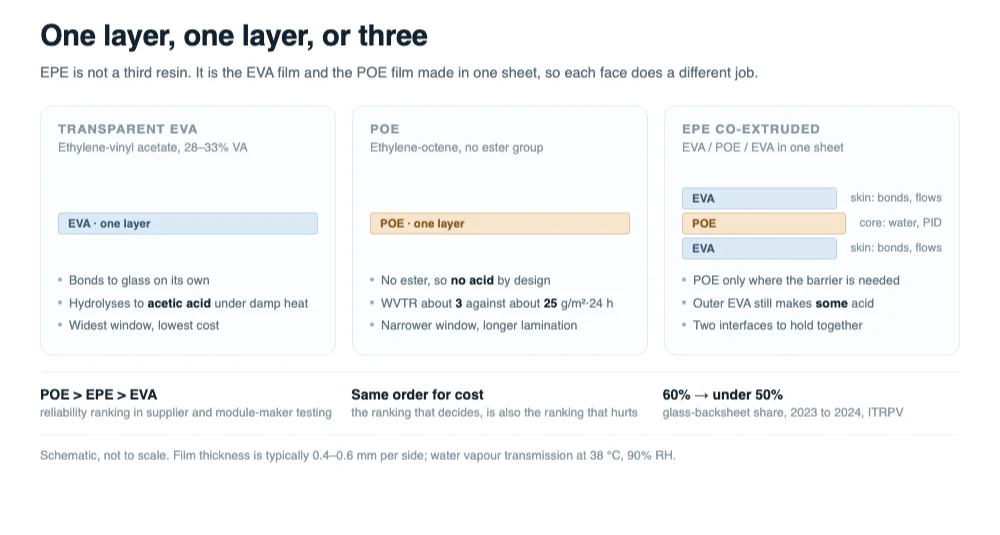
It is not a free lunch. Two interfaces now have to hold, the thickness ratio between core and skins has to be controlled run to run, and additives can migrate from one layer into another. The outer EVA still produces some acetic acid, so an EPE module is not acid-free in the way a pure POE module is. And when an EPE laminate does fail, it tends to fail at an interface, which is why the characteristic defect is a line of bubbles along the ribbon rather than a general haze.
The market has voted: EPE is where the growth is, particularly on TOPCon, and it is now the largest single POE-class product in China. For a module maker the practical question is not whether EPE works but which EPE — core ratio, total thickness, and which skin faces the glass. Those three lines belong in the purchase specification, not in a datasheet footnote.
Where UV-conversion film fits
Conversion film is not a base; it is an additive sitting on one of the bases above. The logic is straightforward once you accept that N-type cells, HJT especially, are sensitive to ultraviolet. The conventional answer is a front film with enough UV absorber to keep the short wavelengths away from the cell. The conversion answer is to absorb the same photons and re-emit them in the blue, where the cell still has good quantum efficiency.
So a conversion film and a high-cut-off film are opposites in intent, even though both contain a UV absorber of some kind. One throws the ultraviolet energy away to protect the polymer and the cell; the other tries to recover part of it. Which is correct depends on how much UVID your cell actually suffers and what the phosphor costs, and that comparison is a calculation in its own right.
The open question on this route is not the mechanism but the durability of the conversion agent itself. Suppliers report very small losses after accelerated exposure equivalent to decades in the field, and those numbers should be read as supplier claims until an independent damp-heat and UV sequence reproduces them on the finished laminate. The emission band, the shift and the efficiency of the conversion are covered in more detail in our note on UV light-conversion film.
PVB, TPO and silicone: routes that win outside the mainstream
Three chemistries sit outside the EVA and POE tree, and each one is the right answer to a question the mainstream films cannot answer.
PVB has been the interlayer of architectural laminated glass for decades. It bonds strongly to glass, absorbs impact and holds fragments, which is exactly what a building-integrated façade or a safety glazing needs. Its weakness is moisture: PVB is hygroscopic and needs edge sealing, and it costs more than EVA. In BIPV curtain walls those trade-offs are acceptable because the product is a building element first.
When processing PVB for architectural glass assemblies, we extend the initial vacuum stage before applying diaphragm pressure to evacuate air thoroughly from the perimeter and cell gaps.
TPO needs no crosslinking agent at all. It melts, bonds and sets on cooling, so the lamination cycle is short and the laminate is easier to recycle at end of life. The challenge is creep at operating temperature, which is why TPO is watched closely for perovskite and other low-temperature processes where a 150 °C cure is unwelcome rather than for mainstream silicon.
Silicone has the best weathering and UV stability of the group and the worst fit with a conventional line: different cure chemistry, different handling, higher cost. It survives in specialty and research work, and it is the reference point that shows how much of the mainstream choice is driven by line compatibility rather than by material performance.
All three were marginalised because they could not beat EVA on cost for a standard module. BIPV, flexible and lightweight modules, and perovskite tandems are the applications where the standard module assumptions stop holding, and that is where these routes are getting a second hearing.
Matching film to module architecture
The table below pairs the common architectures with the films usually specified for them. Read it as a starting point for a qualification plan, not as a rule: two lines building the same module type can justify different films on failure history alone.
| Module architecture | Front | Rear | What drives the choice |
|---|---|---|---|
| Monofacial, glass-backsheet, PERC | Transparent EVA | White EVA | Lowest cost per watt; rear light has nowhere to go, so reflect it back |
| Bifacial, glass-glass, TOPCon | EPE or POE | EPE or POE | Both faces must transmit; barrier and PID resistance both matter |
| HJT, glass-glass | POE or EPE, optionally conversion | POE or EPE | Highest barrier requirement, plus UVID protection on the front |
| BIPV and curtain wall | PVB | PVB | Safety glazing and building code, not watts per square metre |
| Flexible and lightweight | TPO or thin POE | TPO | No heavy glass, short cycle, recyclability |
| Perovskite tandem, pilot | TPO or low-temperature | TPO | Temperature budget below the conventional cure, so creep becomes the question |
One cell in that table is empty on purpose: front and rear need not match. Splitting the films is a legitimate way to spend money where the stress is, and it is what several makers do when the front has to stay transparent and the rear carries the moisture duty.
How the mix actually moved
POE-class films, meaning pure POE plus EPE, went from roughly 23 percent of the Chinese market in 2021 to about 35 percent in 2022 and 41 percent in 2024. In the 2024 figures EPE alone was 27.8 percent and pure POE 13.2 percent, which is the clearest single indicator that the co-extruded compromise is now the mainstream product rather than the clever alternative.
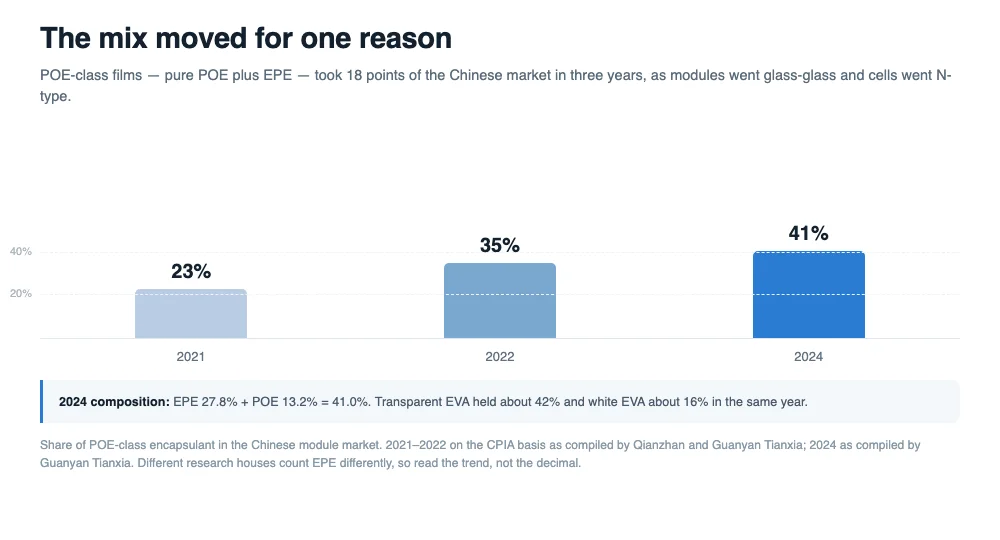
The reason is the module, not the film. As glass-glass became the default and N-type cells became the technology being sold, moisture ingress and PID moved from secondary concerns to the top of the failure list, and the films that address them moved from premium to standard. In supplier and module-maker testing the reliability order comes out POE first, EPE second, EVA last, and the cost order runs the same way — which is a tidy way of saying the industry is buying protection it can almost afford.
Different research houses count EPE differently, so the absolute numbers move between reports while the direction does not. Treat the trend as solid and the decimal as approximate, and if you need the current figure for a business case, take it from the CPIA roadmap edition that your customer also uses.
What to re-qualify before you switch
Changing film is not a part substitution, and the failures that follow a switch usually come from the process rather than from the material. Five things need to be re-established on your own line before the change goes into production.
The lamination recipe. POE and EPE flow less readily than EVA, so dwell time and temperature get retuned. A recipe carried over unchanged will produce bubbles and incomplete fill long before any material property is at fault.
When setting recipes for POE and EPE, we split heating and pressing across two chambers to eliminate air before the core melts, preventing void formation along the ribbons.
The cure target. Gel content is measured the same way but the target band shifts with the chemistry, and the extraction method matters. Fix the standard and the extraction time in the specification, because two labs following two different methods will disagree about the same roll.
Peel against the actual backsheet. Adhesion is a property of the joint, not of the film. Testing to a reference laminate tells you that the film is consistent; testing to the backsheet you actually buy tells you whether the module will delaminate.
The accelerated sequences. Damp heat, PID and UV preconditioning on the finished laminate, run in the order your certification body uses. A film can pass three of these and fail the fourth, and the fourth is usually the one your climate exposes you to.
The power and inspection baseline. Moving from white to transparent on the rear changes the bifaciality and therefore the nameplate; moving from EVA to EPE changes the characteristic defect from haze to interface bubbles, so the visual inspection criteria have to move with it. Both are easy to forget and both show up later as a customer complaint.
Then run the pair, not the film. Front and rear are laminated together and cure in the same thermal cycle, so a fast-curing front under a slower rear core is a recipe for one layer being undercured. Build the qualification coupon from the exact BOM you intend to ship, and keep a reference laminate from the old BOM to compare against.
Frequently asked questions
Is POE always better than EVA?
On barrier and PID resistance, yes, and the reliability ranking of POE, then EPE, then EVA is consistent across supplier and module-maker testing. It is not automatically better for your line: POE is more expensive, needs a longer lamination cycle and a tighter process window, and on a monofacial glass-backsheet product the extra barrier buys protection the application does not need.
Why is EPE cheaper than pure POE if it contains POE?
Because the POE is only a core layer. The barrier duty is carried by a fraction of the total thickness, so the expensive resin is used where it is needed and EVA fills the rest. You get most of the moisture performance at a blended cost that sits between the two materials.
Can white EVA be used on a bifacial module?
No. White film does not transmit, so it eliminates the rear yield that the product is sold on. Its gain only exists on monofacial modules, where the light reaching the rear would otherwise be lost.
What causes white overflow, and how is it prevented?
White film flows during lamination and can climb over the cell edge, sometimes onto the front face. The usual countermeasure is pre-crosslinking: the white layer is partially cured before shipment so that it still bonds but has limited travel. The rest is lamination control — temperature ramp and pressure.
Is EPE more prone to delamination than EVA?
It has more interfaces, so it has more places to fail, and the typical defect is a line of bubbles along the ribbon rather than a broad haze. That does not make it weaker overall — its core is a better barrier than EVA — but it does mean the failure you will see first is different, and your inspection criteria should expect it.
Does a conversion film replace a UV-cut film?
They are opposites. A high-cut-off film removes ultraviolet to protect the polymer and the cell; a conversion film absorbs the same photons and re-emits them as visible light. Choosing between them is an energy-accounting question, not a preference.
Which film should an HJT line use?
The combination that addresses both of HJT's weaknesses: a high-barrier film, so POE or an EPE with a substantial core, and a front film that manages ultraviolet, either by cutting it off or converting it. HJT is also the technology most exposed to low-temperature processing, so check the cure temperature against the cell before the barrier properties.
Can the front and rear use different films?
Yes, and it is common. The front carries the optical duty and usually the stricter UV requirement; the rear carries the moisture duty. Splitting them lets you put cost where the stress is, provided you validate the pair as a system rather than each film on its own.
Final thoughts
The family looks crowded until it is sorted by base and additive, and then it collapses to a short list: EVA where cost and process forgiveness matter, POE where moisture and PID matter, EPE where both do and the budget is real, and the specialty chemistries where the module stops being a standard module. Choose by the failure mode you cannot afford, and the name on the roll becomes obvious.
- PV Encapsulant Film: Five Jobs Behind a 25-Year Warranty
- UV Light-Conversion Film: Functions, Principle and Key Quality Parameters
- EPE Encapsulant Delamination: Line-Shaped Bubbles Along the Ribbons
- Not Every Laminate Bubble Is the Encapsulant's Fault
- Laminator Vacuum Pumps and the EVA Process Window
- DH1000 Damp Heat Test: Failure Modes and Mechanisms
- Snail Trails on Solar Panels: Causes and Prevention
- EVA, POE and EPE Encapsulant Film: Technical Guide
Data notes: market shares are for the Chinese module market. The 2021 and 2022 POE-class figures follow the CPIA basis as compiled by Qianzhan and Guanyan Tianxia; the 2024 split (EPE 27.8%, POE 13.2%) is Guanyan Tianxia's compilation, and the transparent EVA (about 42 percent) and white EVA (about 16 percent) figures are CPIA figures reported in TaiyangNews, Backsheets & Encapsulation 2024-2025. Water vapour transmission rates are commonly published values at 38 °C and 90% relative humidity and vary with thickness, formulation and method. Glass-backsheet share is from the 15th edition of ITRPV. Film properties should be confirmed against the supplier's own technical data and your qualification results.
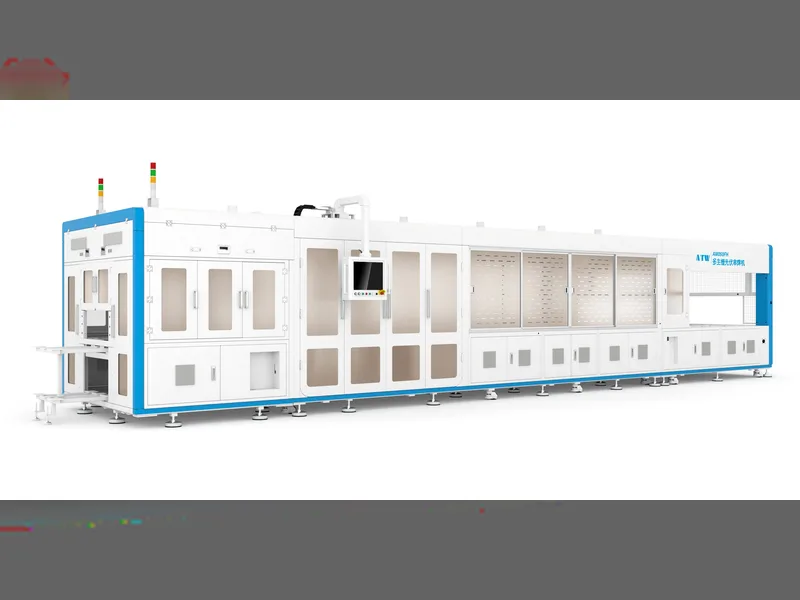
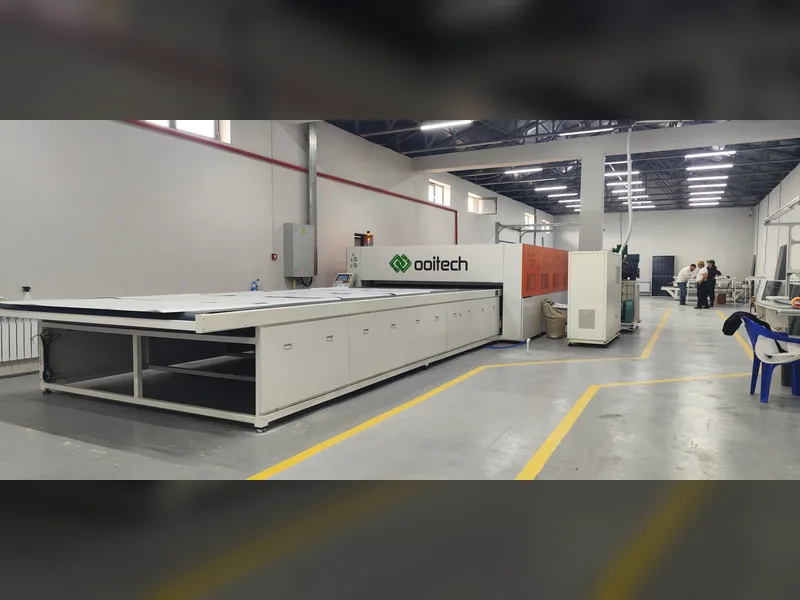
For lines handling these encapsulants, OOITech builds the OTcy 2754DD single-layer double-chamber BIPV laminator to run stable thermal cycles for EVA, POE, EPE, and PVB stacks. Send us your module stack, drawings, or glass samples to evaluate cycle parameters and verify crosslinking performance on our equipment.