Editorial responsibility for this article rests with Wuhan Ooi Photoelectric Technology Co., Ltd. Written and reviewed by the Ooitech editorial team. See our editorial policy for how we write, where AI tools are used, and how to request a correction.
PV Encapsulant Film: Five Jobs Behind a 25-Year Warranty
Table of Contents
Quick answer: The encapsulant does five jobs at once — it bonds glass to backsheet, transmits light, insulates at 1500 V, blocks water vapour and absorbs the mismatch between materials that expand at different rates. All five are locked in during one lamination cycle, and all five are controlled by the same variable: how far the resin crosslinks.
Open a module and you can name the glass, the cells, the ribbons, the frame and the junction box. The film between them is invisible once it is laminated — transparent, odourless, with no edge to measure and no part number on the outside.
You notice it only when something goes wrong. In our failure analysis work over the past decade, yellowing, delamination, snail trails, PID and corroded gridlines all trace back to this layer, or to what this layer failed to stop.
So before comparing EVA, POE and EPE, it is worth answering the plainer question: what is the film actually paid to do? This is the first piece in a series on encapsulant film. It starts with the five jobs and the single variable that governs all of them.
It is the only material that touches everything
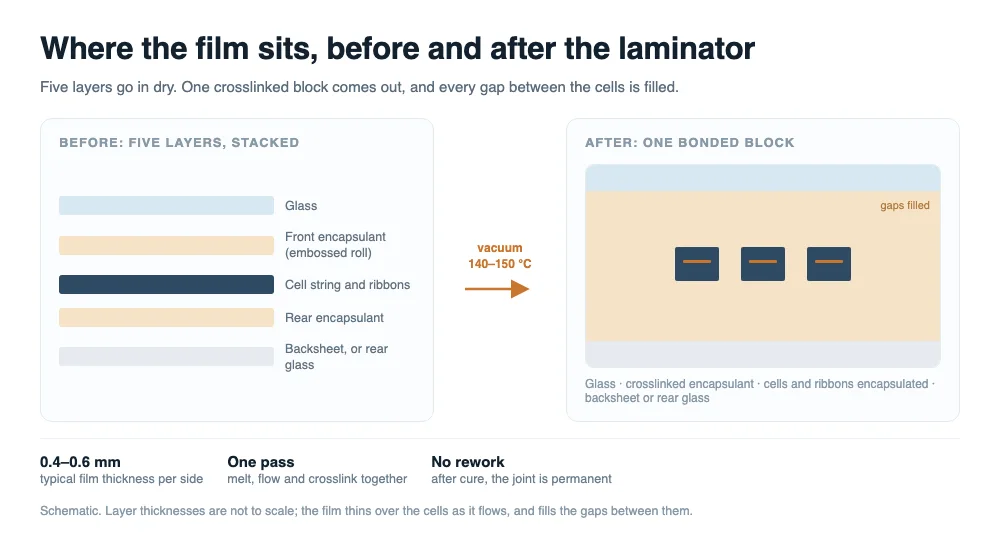
A conventional crystalline silicon module, from the light side down, is a stack: glass, front encapsulant, the cell string, rear encapsulant, and a backsheet — or a rear glass in a glass-glass module. The film sits above and below the cells, so it is the only packaging material in direct, full-area contact with the cells themselves.
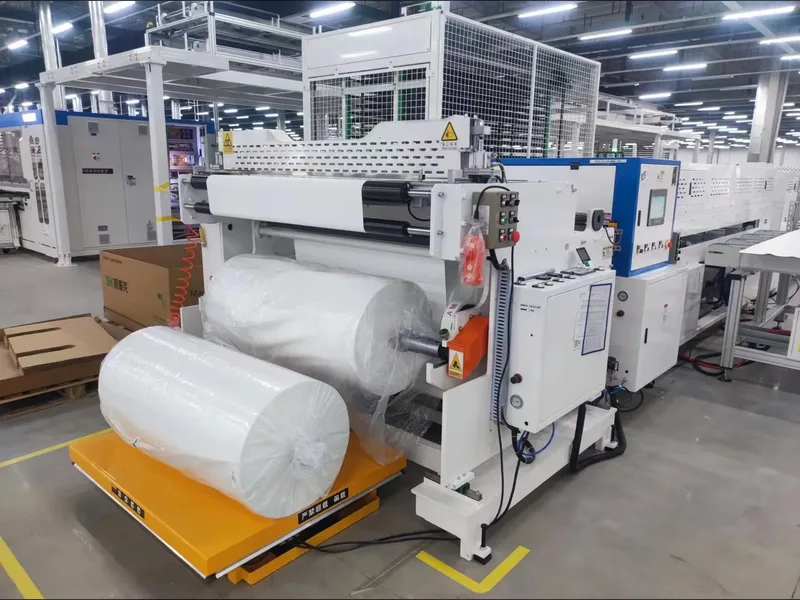
Before lamination it is a roll of embossed sheet. Inside the laminator, under vacuum and at roughly 140 to 150 °C, it does three things in sequence. It melts and flows, filling the gaps between cells and around the ribbons. The peroxide in the formulation decomposes and starts the resin crosslinking. Then it cools, and what comes out is no longer a film that can be melted — it is a transparent, elastic, infusible rubber body that has swallowed the cell string.
We hold our laminators under vacuum between 140 and 150 °C during the thermal cycle to ensure complete resin flow around the cell ribbons before peroxide decomposition completes crosslinking.
That sequence explains a habit worth adopting: every number on a film datasheet is a promise about the cured state, not the roll. Thickness, flow, adhesion and modulus in the finished laminate are what the module lives with for 25 years.
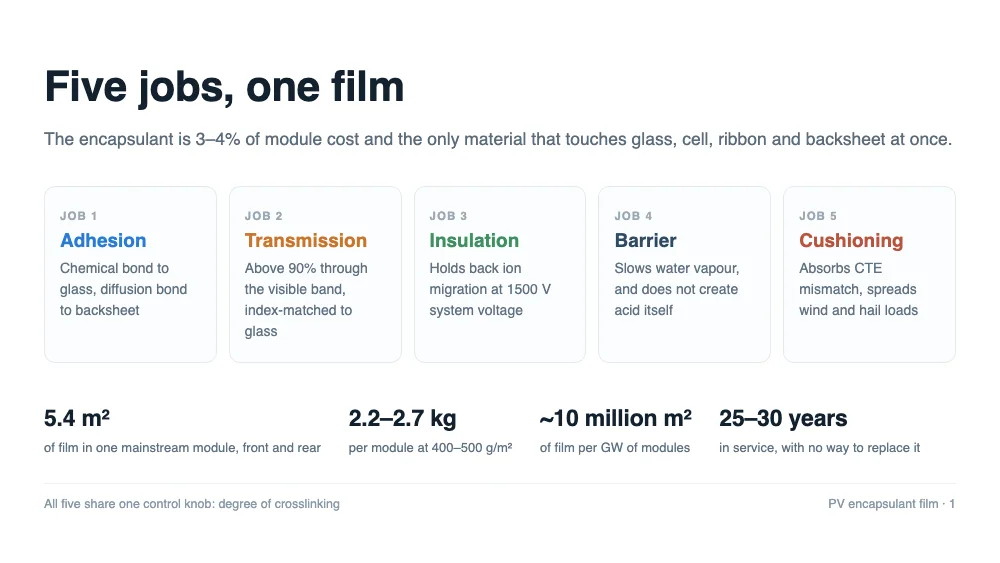
The quantities are easy to underestimate. A mainstream module of 2382 × 1134 mm carries about 2.70 m² of film per layer, so roughly 5.4 m² front and rear, weighing 2.2 to 2.7 kg at a typical 400 to 500 g/m². Scale up and one gigawatt of modules consumes on the order of 10 million square metres of film.
Job one: adhesion, by two different mechanisms
Glass, silicon, copper ribbon and backsheet have different surface chemistry and different expansion coefficients. None of them naturally sticks to another. The film's first job is to build interfaces at each one that can survive 25 years outdoors.
At the glass it works chemically. A silane coupling agent in the formulation condenses with hydroxyl groups on the glass surface to form Si–O–Si bonds, while its other end ties into the resin network. That is a chemical bond, not the physical adsorption you get from a pressure-sensitive adhesive, and it is why glass adhesion survives damp heat when a tape bond does not.
At the backsheet the mechanism is different: compatibility and interdiffusion. The inner layer of a typical backsheet is a PE or EVA-type modified layer, and at lamination temperature the two melts diffuse into each other and set as one interface. A backsheet whose inner layer is not designed for this will delaminate regardless of how good the film is.
The metric is peel strength, measured separately for film-to-glass and film-to-backsheet. The number that matters is not the initial value but the retention after damp heat and UV ageing — a film that starts at 100 N/cm and falls to 30 after 1000 hours is a different product from one that starts at 80 and holds at 70.
Adhesion failure shows up as delamination, and delamination rarely costs power immediately. It opens a path for moisture, and that path is where the next three or four failure modes begin. If you find one delaminated module on a rack, treat it as a moisture-ingress report rather than a cosmetic defect.
Job two: transmission, where the interface matters more than the number
The front film sits on the optical path. Sunlight crosses the glass, then the film, before it reaches the cell, so the film has two ways to lose light and two ways to protect the module.
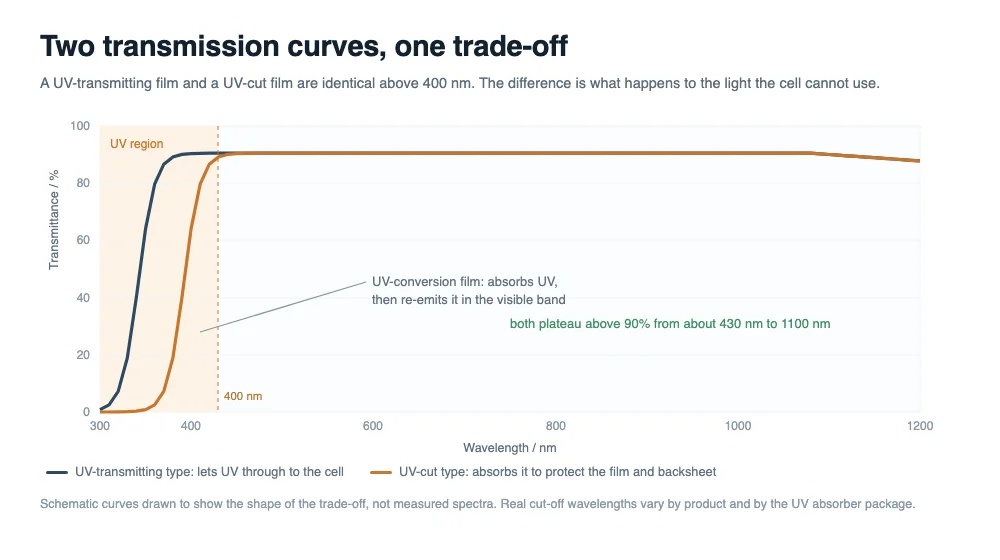
First, be transparent. Mainstream clear films transmit above 90% across the visible and near-infrared band, and are expected to stay that way — no yellowing over decades of UV and heat.
Second, be optically invisible. EVA and POE have a refractive index around 1.48 to 1.49, very close to glass at about 1.5. Light crossing that interface barely reflects. A bubble or a delamination replaces the film with air (n ≈ 1.0) and the reflection loss at that interface climbs sharply — which is why optical defects and power loss often appear together, even though the film itself has not yellowed.
The trade-off hides in the ultraviolet. Films normally carry a UV absorber, cutting part of the UV band to protect the polymer and the backsheet from yellowing. But the UV that is cut is also light that no longer reaches the cell. N-type TOPCon front surfaces are more sensitive to UV than earlier architectures, so two routes have appeared: high-cut films that block more UV, and UV-conversion films that absorb UV and re-emit it in the visible band. The curves below show the shape of that decision.
The rear film splits into two cases. A monofacial module usually gets a white or highly reflective film, which bounces light that passes between the cells back toward the front and adds power. A bifacial module needs the rear film to let light in, so it has to be transparent — and then it no longer contributes the reflective gain.
Job three: insulation at 1500 V
System voltages in utility-scale plants are now commonly 1500 V. Inside the module, the cell string can sit at a potential difference of a thousand volts or more relative to the grounded frame, and the film is one of the main dielectric layers between the cells and that frame.
The material property is volume resistivity. POE-type films are typically an order of magnitude higher than EVA, which is one reason they resist potential-induced degradation better. Under an electric field, sodium ions from the glass migrate toward the cell surface; the higher the film's resistivity, the slower the ion drift and the later and milder the PID.
Module-level tests see this job directly: the insulation withstand (hipot) test and the wet leakage current test both check whether the film kept the circuit isolated from the frame after moisture exposure. A film can pass a dry hipot before lamination-cycle conditioning and fail wet leakage afterwards, so the pair belongs in the qualification plan together.
We run dry hipot and wet leakage current tests up to 1500 V on finished laminates to verify that the cured encapsulant maintains electrical isolation between the cells and the frame after moisture exposure.
High voltage is a necessary condition for PID rather than a sufficient one, but the film is the first barrier standing between the voltage and the cell. Changing to a higher-resistivity film is one of the few levers that works without touching the system design.
Job four: barrier, with a twist that EVA cannot escape
Start by correcting a common assumption: the film is not a seal. Water vapour will get in. The only question is how fast, and by which route. In a glass-backsheet module most moisture enters through the backsheet; in a glass-glass module, where both faces are glass, it comes in mainly around the perimeter edge.
On that job the two main chemistries differ clearly: POE has a markedly lower water vapour transmission rate than EVA. But the more important difference is something EVA does to itself. Its vinyl acetate groups hydrolyse slowly under damp heat and release acetic acid. That acid attacks the silver gridlines and the ribbon surface, raises series resistance, and is one of the standard mechanisms behind power loss after damp heat testing.
So barrier means two things, and only one of them is about the outside world: keep water out, and avoid generating a corrodent on the inside. That is the whole argument for glass-glass modules and for corrosion-sensitive N-type cells moving toward POE and EPE co-extruded films, where the EVA layer is kept away from the cell surface.
Barrier failure is slow and it is rarely attributed to the film at first. Corroded gridlines, rising series resistance, snail trails along the ribbons — all of these are downstream symptoms of a moisture path plus an acid source. When a damp heat test fails, the film is worth checking before the cell is blamed.
Job five: cushioning, for cells that keep getting thinner
Cells are now around 130 µm thick: stiff, brittle, and mechanically the weakest sheet in the stack. The materials around them move at very different rates — glass around 9 ppm/K, silicon about 3 ppm/K, copper ribbon about 17 ppm/K. Every daily temperature swing and every seasonal cycle pulls them apart by different amounts.
The film is the compliant layer that absorbs that disagreement, so the cell and the solder joints are not asked to carry it. It also spreads mechanical load: wind pressure, snow load and hail impact arrive as concentrated forces, and the film distributes them so that microcracks and breakage stay rare.
There is a third, newer function. After lamination the film wraps the ribbons and holds them in place. In zero-busbar modules, where fine wires may be held by adhesive rather than soldered at the stringer, contact to the fingers depends substantially on the film pressing and fixing the wire during lamination. The film's flow behaviour and modulus become electrical parameters at that point, not just mechanical ones. That is the direct link between this series and the ribbon series: the joint moved into the laminator, and the film became part of the joint.
Low temperature behaviour belongs in the same paragraph. As the ambient drops, EVA stiffens noticeably while POE keeps more of its elasticity, so cushioning degrades less in cold climates. If you specify a module for a cold-climate site, the glass transition behaviour of the film is as relevant as the cell's temperature coefficient.
All five jobs run off one control knob
The five jobs look independent, and in datasheets they are measured by independent tests. In the laminate they share one variable: the degree of crosslinking, usually reported as gel content.
Under-cured film creeps at high temperature. Adhesion weakens, cushioning softens, the film can flow out of the edge, and the module starts to look tired within a few years. Over-cured film goes the other way: it becomes brittle, impact resistance falls, and adhesion drops again because a rigid network cannot wet and conform. There is an optimum band, and it is narrow enough that gel content is one of the two or three numbers a lamination engineer actually watches.
| Job | Key metric | Typical symptom when it fails |
|---|---|---|
| Adhesion | Peel strength, initial and after ageing; gel content | Delamination, then moisture ingress |
| Transmission | Transmittance, UV cut-off wavelength, yellowness index ΔYI | Yellowing, gradual power loss |
| Insulation | Volume resistivity; hipot and wet leakage at module level | PID, wet leakage failures |
| Barrier | Water vapour transmission rate; acid value and acetic acid release | Gridline corrosion, rising series resistance, snail trails |
| Cushioning | Gel content, modulus, shrinkage | Microcracks, breakage, cell displacement |
One caveat on measuring gel content, because it decides whether incoming material passes at all. GB/T 29848 and IEC 62788-1-6 use different extraction times in the gel content procedure, and published work has found the national-standard method returning systematically higher values — the gap widening at lower cure levels. Some POE films have specification lines that fall in exactly that region. A supplier and a customer can therefore disagree about the same roll while both are following their own standard correctly.
The practical answer is to fix the method in the purchase specification, name the standard and the extraction time, and qualify the film against the method you will use in production. We will go through the test methods in detail in a later piece in this series.
Where the five jobs conflict
Once the five jobs are separated, it becomes clear that some of them pull in opposite directions. Three conflicts account for most of the arguments in a film selection meeting.
UV blocking against power. More absorber protects the polymer and the backsheet, and removes light the cell could have used. N-type cells pushed this conflict into the open, and the two answers — high cut-off films and UV-conversion films — are different bets on how much of that band is worth recovering.
Cure level against toughness. Higher gel content reduces creep and holds the laminate together at temperature, but a tighter network is a more brittle one. In cold-climate and hail-exposed installations the balance shifts toward the tougher end, which is a mechanical argument most film datasheets do not make explicitly.
Flow against bond-line control. The film has to flow far enough to fill the gaps around cells and ribbons, and not so far that it starves the edge or leaves the ribbon without polymer over it. Thinner cells and finer ribbons both narrow that window, and zero-busbar construction narrows it further because the film is now also the thing holding the wire against the finger.
None of these can be optimised one at a time. That is why film selection ends up as a ranked list of failure modes rather than a scorecard: you decide which conflict your product can live with, and you write the specification around the job that must not fail.
Turning the five jobs into a purchase specification
Most film disputes we see are not about whether a product is good. They are about two parties measuring different things, or measuring the same thing differently. The fix is unglamorous: one line per job in the specification, with the method named alongside the number.
| Specification line | What to state | Why it matters on the line |
|---|---|---|
| Base film | Chemistry (EVA, POE, EPE), thickness with tolerance, embossing | Sets flow, cushioning and the lamination window you can hold |
| Cure | Gel content range, standard and extraction time named explicitly | The one variable that moves all five jobs; the one most often measured differently |
| Adhesion | Peel strength to glass and to the actual backsheet, initial and after damp heat and UV | Delamination is the entry point for the other failures |
| Optics | Transmittance, UV cut-off or conversion behaviour, yellowness index after ageing | Fixes the UV trade-off instead of leaving it to the film supplier |
| Electrical | Volume resistivity, with the test voltage and conditioning stated | The lever for PID on high-voltage strings |
| Barrier | Water vapour transmission rate; acid value or acetate release for EVA-containing films | Predicts corrosion risk in damp heat, not just moisture ingress |
Two practical notes. First, peel strength should be measured against the backsheet you will actually use, not a reference laminate — the film-to-backsheet interface is a joint product of both materials. Second, if the module is glass-glass, moisture comes in at the edge, so edge sealing and the perimeter adhesive bead deserve the same attention as the film's barrier data.
Beyond the film itself, the two process variables that decide whether the specification is met are the temperature ramp inside the laminator and the time spent above melt. A profile that reaches temperature too slowly lets the film flow before the peroxide has begun to work; one that runs too hot crosslinks the surface first and traps the rest. Neither failure shows up in a film datasheet, and both show up in gel content measurements taken from the finished laminate.
Three to four percent of the cost, none of the repairability
Film accounts for roughly 3 to 4% of module cost — some analyses put it at 4 to 7% depending on period and accounting basis. Either way it is one of the cheapest line items in the bill of materials, and it has a property the frame and the junction box do not: once laminated, it cannot be replaced or repaired. The 25 to 30 year warranty has to be carried by the film for the whole distance.
That liability is why the product mix has fragmented so quickly. In the 2024 China market, transparent EVA still holds about 42%, EPE co-extruded film is close to 28%, and white EVA and POE each take a bit over 10%. The single-chemistry era is over; the choice is now made by failure mode and by cell architecture.
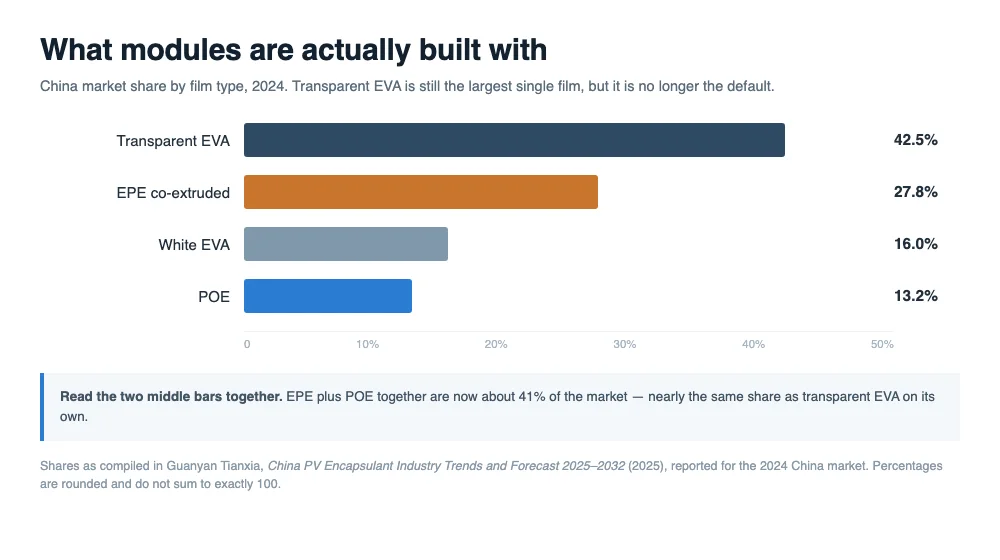
For a buyer, that reframes the decision. You are not choosing the cheapest film that laminates cleanly. You are choosing which of the five jobs you cannot afford to have fail in the field — and then paying for the film that protects that one, while accepting the cost somewhere else.
Frequently asked questions
Does a higher transmittance film always give more power?
No. Two effects can cancel the headline number. A film that cuts UV to protect itself gives up some of the short-wavelength response, and any bubble or delamination adds an air interface with a real reflection loss. Compare transmittance and UV behaviour together, and check the laminate for optical defects before blaming the film.
Is POE always better than EVA?
No. POE wins on resistivity and on moisture barrier, and it does not generate acetic acid, which matters for corrosion-sensitive cells and glass-glass construction. EVA remains cheaper, laminates over a wider process window in many lines, and is well proven in monofacial glass-backsheet modules. The right question is which failure mode your project cannot afford, not which chemistry is newer.
Why did my module yellow if the film passed UV testing?
A UV test is a dose and a temperature, and both matter. Yellowing can come from an exhausted UV absorber package, from lamination at excessive temperature, or from contaminants in the laminate. Ask for the ageing condition behind the yellowness index claim, and compare it with the irradiance and temperature your product will actually see.
Can delamination be repaired in the field?
No. Once cured, the film cannot be re-melted, and there is no way to re-bond a laminated interface from outside the module. Delamination is a permanent change that has also opened a moisture path, so the practical response is to assess the affected population rather than the single module.
Which film should a glass-glass N-type module use?
Most commonly POE or an EPE co-extruded film, for the resistivity and the absence of acetic acid at the cell surface, with the EVA layers kept toward the glass. Confirm it against your own damp heat and PID results rather than a general recommendation, because cell architecture, glass composition and system voltage all shift the answer.
What gel content should we specify?
A range, together with the standard and the extraction time. A number without a method is not a specification, because GB/T 29848 and IEC 62788-1-6 do not return the same value on the same sample. Set the range from your own lamination trials and verify it on finished laminate, not only on incoming rolls.
Does the film affect PID only through resistivity?
Resistivity is the main material lever, but not the only path. Delamination and voids create local moisture and ion paths, and acid generation changes the chemistry at the gridline. A high-resistivity film in a badly laminated module can still fail, which is why adhesion and gel content belong in the same qualification plan as resistivity.
Can white EVA be used on a bifacial module?
No, not on the rear face of a bifacial module that is meant to collect light from behind. White film reflects light back toward the cells, which is a gain in monofacial modules and a loss in bifacial ones. Bifacial rear films are transparent, and they give up the reflective gain in exchange for rear-side yield.
Final thoughts
The encapsulant is the cheapest material in the module and the only one that cannot be repaired. It bonds, transmits, insulates, blocks and cushions at the same time, and all five are governed by one number that is measured two different ways. Get the specification, the method and the lamination window aligned, and the film stops being the invisible part of the stack — it becomes the part you can actually argue about with data.
Related reading:
- EVA, POE and EPE encapsulant film: complete technical guide
- EPE encapsulant delamination and line-shaped bubbles along ribbons
- Not every laminate bubble is the encapsulant's fault
- Laminator vacuum pumps and the EVA window
- DH1000 damp heat test: failure modes and mechanisms
- Snail trails on solar panels: causes and prevention
- Hot spots, microcracks and PID: three slow module failures
- PV ribbon soldering: the joint, the window and the 0BB shift
Sources: GB/T 29848-2018 and T/CPIA 0004-2017 for EVA film requirements; IEC 62788-1-6:2017+AMD1:2020 for the gel content procedure, with the reported GB/T versus IEC difference from a 2024 EPJ Photovoltaics study; market shares as compiled in Guanyan Tianxia, China PV Encapsulant Industry Trends and Forecast 2025–2032 (2025) for the 2024 China market; thermal expansion coefficients, refractive indices and cell thickness quoted as typical industry values that vary by material grade and process.
For production lines verifying dielectric performance, OOITech supplies the CHT9980A and CHT9981A PV safety comprehensive tester to measure hipot, insulation resistance, ground continuity, and wet leakage on finished laminates. Send us your module stack, frame drawings, or test samples for evaluation, and our technical team will review your insulation test requirements.