Editorial responsibility for this article rests with Wuhan Ooi Photoelectric Technology Co., Ltd. Written and reviewed by the Ooitech editorial team. See our editorial policy for how we write, where AI tools are used, and how to request a correction.
PV Encapsulant Film Embossing: Four Patterns, Three Jobs
Table of Contents
Quick answer: Embossing is the raised pattern pressed into an encapsulant film as it leaves the extrusion die, and it is the only part of an EVA, EPE or POE sheet that touches glass before lamination. It does three jobs. It opens narrow channels so gas can travel to the edge of the stack, it keeps the film from blocking onto itself on the roll, and it raises friction so the sheet stops sliding on glass and cells stop shifting. The trade describes these faces with four informal family names borrowed from tire treads: pagoda or pyramid relief, diamond, random and grid. No standard fixes those names and no standard sets a roughness value. Most film sold today is double-sided, with regular pyramid or truncated pyramid relief on one face for friction and air path, and a random matte on the other for blocking and residual bubbles.
A film face is a machine part. Its geometry decides whether a stack degasses in time, whether a roll unwinds cleanly, and whether a string stays where the operator placed it.
Why an Unlaminated Film Needs a Pattern
Before lamination the encapsulant is a dry sheet laid over glass, cells and ribbon. The nominal surface never touches the glass, because the raised features hold it off. Contact happens at the tops of those features, and friction, gas escape and separation all follow from their shape.
The first job is friction against glass. A sheet that slides during layup, or during the transfer into the laminator, drags the string with it. The operator then either re-lays it or accepts cells out of position, and that second outcome is a scrap decision made later, at electroluminescence, when the sheet is already bonded.
The other jobs are less visible: an air path for degassing, a separator that stops film from blocking on the roll, and the roughness that holds cells while the stack is under vacuum. All of them come from the same shallow relief, and all are lost when the features collapse at the nip. The face of the film and the lamination stage of module assembly are therefore one subject, not two.
The Four Pattern Families in Use Today
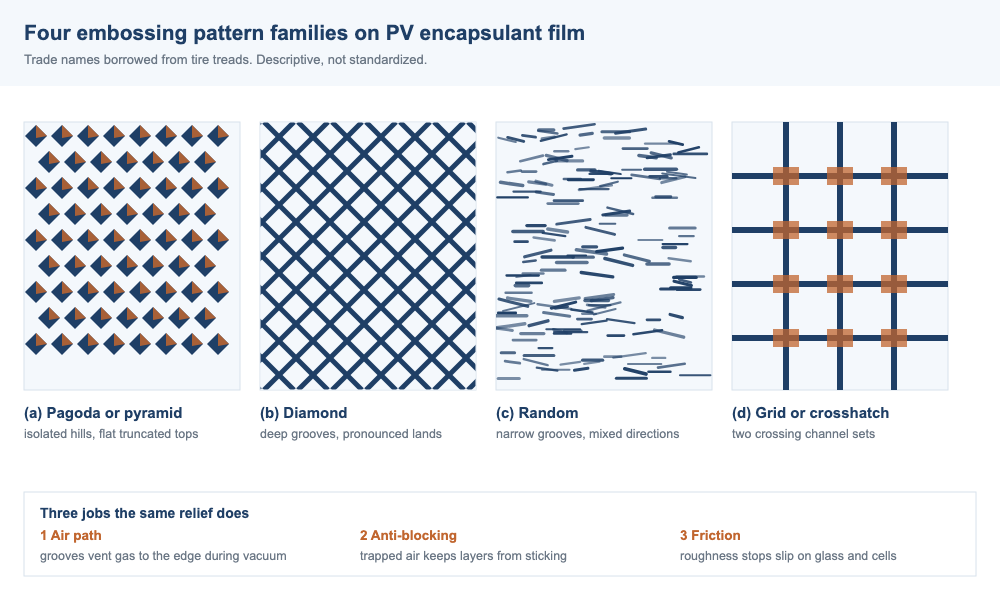
The industry has no agreed way to describe an encapsulant pattern. One practitioner borrowed the tire-tread classification and grouped the common faces into four families: pagoda, diamond, random and grid. The grouping is descriptive, not normative. It is still useful, because an order that says pyramid without geometry is ambiguous.
Figure 1. The four families as the trade describes them: pagoda or pyramid, diamond, random and grid. The names are descriptive, not standardized.
What separates the four is where the material sits: isolated hills, deep channels, or a shallow irregular skin. That choice sets how the face behaves under vacuum, and why two films of equal gram weight can run differently on one laminator.
Pagoda and Pyramid Relief
A metal roll engraved with four-sided features presses rows of small hills into the face, separated by channels. A truncated top survives nip pressure better than a sharp apex. This is the family most often paired with a matte back face.
Diamond
Diamond puts deeper grooves and more pronounced lands into the face. It is the strongest of the four against slip, and shows up fastest on a line already losing the sheet. The cost lands elsewhere: a pronounced relief releases less cleanly from the chill roll and leaves more residual pickup, so diamond tends to be a targeted change rather than a default.
Random, or Irregular
Random faces carry narrow grooves, often mostly longitudinal at the center and turning in mixed directions across the width. The trade treats this as transitional. It is balanced rather than extreme: it tolerates a faster line, vents in more than one direction, and cleans off the emboss roll easily, because residue has no single channel to settle in.
Grid and Crosshatch
A grid face is pressed with two sets of crossing channels, so the surface reads like the warp and weft of woven fabric. The channels stay continuous across the sheet, which makes the family tolerant of different glass textures: gas has no preferred direction and the pattern needs no alignment with the glass.
| Family | Geometry you can see | Strongest at | Where it costs you |
|---|---|---|---|
| Pagoda or pyramid | Rows of four-sided hills, flat tops when truncated | Friction plus a defined air path | A worn roll rounds the tops; the air path closes first |
| Diamond | Deep grooves, pronounced high lands | Anti-slip on lines already losing the sheet | Release from the chill roll, residual pickup |
| Random | Narrow grooves in mixed directions | Balance across line speed, easy roll cleaning | Weaker directional venting |
| Grid or crosshatch | Two crossing channel sets, like woven cloth | Any glass texture, no preferred vent direction | More contact area once features flatten |
Read the table as trade-offs: the family that vents best is not the one that releases best, and a line that solved slip with diamond meets a pickup problem the same week.
How the Pattern Gets Into the Film
Film runs through melt extrusion, emboss roll pressing and cooling release, then gauging, annealing and winding. The melt leaves a flat die into a nip formed by the emboss roll and a chill roll, and the pattern is pressed in while the sheet is soft enough to take it.
The roll material decides what geometry is possible. A metal roll can be engraved with repeating solids: pyramids, cones, truncated pyramids. A rubber roll cannot. It is given a matte effect by loading the rubber with a filler such as silicon carbide, and what it prints is random roughness rather than a defined solid.
That difference is why double-sided film exists. One face runs over engraved metal and receives geometry, the other over rubber and receives texture, and the two faces are then specified separately.
Two-Sided Film: Regular Relief on One Face, Matte on the Other
The common construction is a regular relief face and a random matte face. The relief face is the one specified for friction against glass and for the air path. The matte face carries blocking and residual bubbles. On EPE both faces are still EVA skins over a POE core, so the face a laminator sees is an EVA face even when the middle of the sheet is not.
This is a compromise between two requirements that pull against each other. A face tuned for venting wants distinct channels and lands. A face tuned for blocking wants trapped air and low real contact area. One face forces a choice, two faces avoid it, and that is why the arrangement reached high volume across EVA, EPE and POE instead of staying a premium option.
Other geometries exist: wave patterns, net patterns, and variants that keep a family name while changing the pitch, usually where a glass texture closes the channels.
The Air Path Is the Product
During lamination the stack is evacuated, then pressed. Gas trapped between film and glass, and between film and cells, can only leave along the path the pattern provides. A flat film gives it nowhere to go: early unembossed film produced bubbles for exactly that reason, and the problem pushed embossing into the standard process.
During the initial evacuation stage, we hold diaphragm pressure off the module until the relief grooves pull air out from the cell gaps, preventing premature channel collapse before heating.
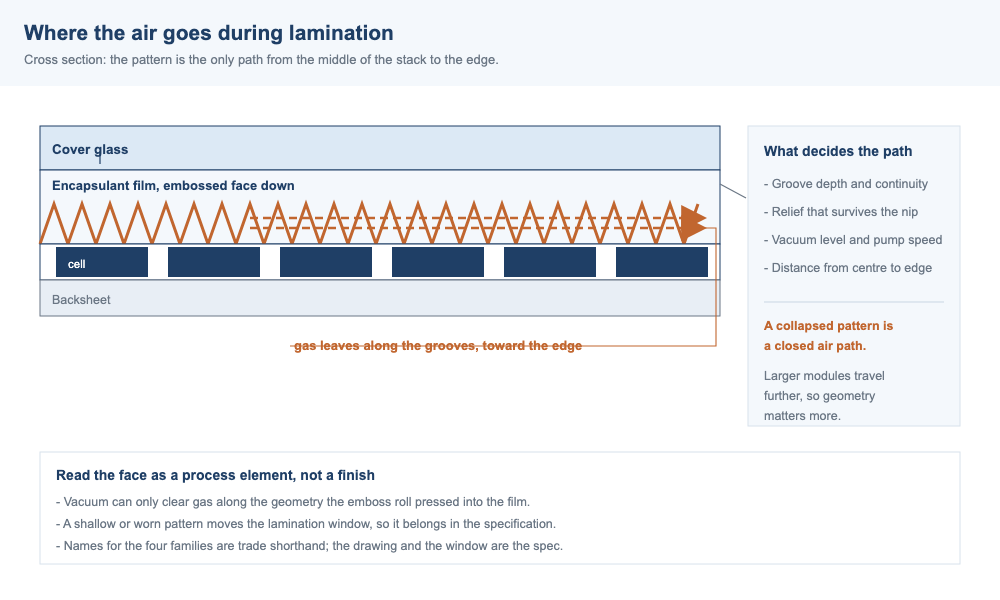
Figure 2. Grooves pressed into the film form a path from the middle of the stack to the edge. Vacuum can only clear gas along the geometry the face provides.
The effect scales with module size. A large-format module puts more distance between the middle of the stack and the edge, so the same geometry takes longer to clear and the gain from a better pattern is larger. A pattern change is therefore a change to the lamination window, not a cosmetic detail.
Pattern and laminator belong in one conversation, because the vacuum stage can only work with the geometry it is given; the machine side is set out in the note on single and double chamber laminators. A bubble along a ribbon is not automatically the film's fault either, as laminate bubbles that are not the encapsulant makes clear, and on EPE the same channel question meets interlayer adhesion in line-shaped bubbles along cell ribbons.
Blocking: The Problem Nobody Sees Until the Gripper Misses
EVA is thermoplastic, and the source puts its melting range at 60 to 90 degrees Celsius. Film at plant temperature is already compliant, so two layers pressed on a roll can merge. Two layers of compliant film on a roll press into each other, and when the roll unwinds they can come off as one piece.
The pattern answers this with trapped air. Voids between the features hold a thin film of gas between the layers, which lowers real contact area and lets the sheets separate. Without it a gripper cannot pick up a film stuck to the one below, and the line stops.
Blocking is also a storage question. A roll that sat warm for a week blocks more than one used fresh, and a matte face flattened in storage cannot recover its voids. When a line reports blocking, check the pattern and check how the roll was kept.
Slip, Cell Shift, and Why POE Is Harder
Higher roughness raises friction between the film and the cells as well as between the film and the glass. That matters during layup and again under vacuum, when the encapsulant starts to flow and the cells are held by friction and by the ribbon. A shallow pattern lets a string walk; a defined relief holds it. On thin cells and busbarless designs the margin is smaller, which the shift to 0BB cell interconnection makes harder to ignore.
POE is the harder case, and the reason is chemistry rather than geometry. POE is non-polar, its additives migrate to the surface more readily, and a smooth oil-like film forms there. Friction drops even when the pattern is unchanged, so a face that is adequate on EVA can be marginal on POE. The source is direct: the anti-slip requirement on POE is higher, not equal, and the fix is usually a different face rather than a tighter layup routine.
What You Can and Cannot Read From a Film Face
On the lines we audit, a visual check still tells you the family and the gross condition. You can see whether rows are crushed, whether the relief has sagged into a rounded profile, whether patches carry no pattern, and whether a roll mark repeats across the width. Those failures mostly start at the nip, not in the formulation.
A visual check does not give you depth, pitch or roughness. Those numbers are rarely on a datasheet and no standard sets them. A pattern is specified by supplier drawing and by the lamination window it was validated in. If a supplier quotes a roughness figure, ask which instrument produced it and on which face: a number without a method is not comparable between plants.
Incoming inspection is still useful without those numbers. Compare a sample against the approved first article under the same light, and look for a repeating signature that would point to a damaged roll.
When a Pattern Change Pulls Requalification With It
A pattern change is a construction change. It alters the air path, so it moves the lamination window, and it can alter adhesion at the glass interface. Under the module change rules that govern retesting it is not a paperwork edit: it sits with changes of film type, which means lamination checks, damp heat and thermal cycling, as set out in the list of module reliability tests.
The practical sequence is to qualify the pattern on the line before it reaches a specification. Run the stack at the fast end of the intended window, look for edge and ribbon bubbles, and then decide. A pattern that works only at a slow cycle will be run too fast within three months, and the cost shows up as cycle time rather than as scrap.
When we qualify a candidate pattern, we laminate sample stacks at the shortest evacuation window and examine the perimeter and cell interconnects to confirm the channels cleared all air before edge pinch-off.
The Six Lines of a Pattern Specification
Most pattern disputes come from a specification that names a family and stops there. Six lines close the gap. First, family and a sketch of the geometry, with pitch and land shape drawn rather than described. Second, which face carries the relief. Third, the relief character in words: sharp or truncated, deep or shallow, continuous channel or isolated hill. Fourth, the roll type, because engraved metal and loaded rubber do not make the same geometry. Fifth, the matte face and its duty. Sixth, the lamination window in which the pattern was validated.
| Symptom | What it points to on the film | First check |
|---|---|---|
| Bubbles along ribbons and near the edge | Channel closed at the nip, or relief sagged | Nip temperature and roll wear, before the recipe |
| Sheet slides off the glass during transfer | Friction face too shallow, or wrong face against glass | Which face is up on the layup table |
| Line stops at unwind, gripper misses the film | Blocking; matte face flattened or roll stored warm | Storage temperature and time on the roll |
| Cells shift after lamination | Low roughness at the cell face, or bloomed POE surface | POE storage and additive bloom, then the pattern |
| Residual pickup on the chill roll | Relief too pronounced for clean release | Release step and roll condition |
The second table is a triage order, not a diagnosis. In the specifications we review, the sixth line is the one usually missing. The table exists to stop a line from changing the lamination recipe every time a bubble appears, when the first useful question is what the face looked like before it entered the machine.
The equipment side is easier to check than the film side. On our OTcy 2754DD single-layer double-chamber laminator the two chambers run at different set points, so a film that vents poorly is visible before the second chamber closes the edge. Cycle data and footprint sit on the laminator product page.
Where these numbers come from
The source is a Chinese practitioner article on encapsulant film patterns, published by the account Photovoltaic New Knowledge. It cites two Chinese documents: an analysis of how pattern choice affects film use, and a LONGi patent on a double-sided embossed EVA film for solar use. The article is descriptive. It names four families and three functions and explains the metal-roll versus rubber-roll split, but it publishes no depths, pitches or roughness values.
The one quantitative statement carried over is the EVA softening and melting range of 60 to 90 degrees Celsius, used in the sense the source uses it, to explain why a compliant sheet blocks at room temperature. The four-family taxonomy is one practitioner's mapping from tire treads, not a standard. Both tables restate the tradeoffs the source describes and were not measured for this page. Nothing here is a specification value.
Frequently asked questions
Q: Does every encapsulant film have a pattern?
Almost all film sold for module lamination is embossed, because venting and blocking both fail without it. Flat film survives in specialist uses.
Q: Which face of the film goes against the glass?
The relief face, since that is the face specified for friction against glass and for the air path. The matte face carries blocking. Record which face is up, because a reversed roll produces slip that looks like a bad batch.
Q: Can a pattern cause bubbles instead of removing them?
Yes. If the relief sags at the nip, or the channels are closed by a glass texture, the path disappears. That failure looks identical to an encapsulant problem and is usually found by checking nip temperature and roll wear first.
Q: Is a deeper pattern always better?
No. Depth buys air path and friction and costs release. A pronounced relief releases less cleanly from the chill roll and leaves more residual pickup, which is why diamond faces are used as a targeted change rather than a universal default.
Q: Why does POE slip more than EVA?
POE is non-polar and its additives migrate to the surface more readily, leaving a smooth oil-like layer. Friction falls even when the pattern is identical, so the anti-slip requirement for POE is higher rather than the same.
Q: Does the pattern change the film thickness?
It makes a single thickness meaningless, because a gauge reading depends on whether the probe lands on a feature or in a channel. That is why film is bought by gram weight and the pattern is specified as geometry.
Q: Can I order a pattern by name alone?
Not safely. The four names are informal and no standard defines them, so two suppliers can both say pyramid and deliver different pitch and land shape. Order with a sketch, a face designation and a roll type.
Q: Does a pattern change affect module certification?
It can. A pattern change alters the air path and the glass interface, so it belongs with the construction changes that trigger retesting: lamination checks, damp heat and thermal cycling.
Final thoughts
A pattern looks like a surface detail until a line loses a sheet. Then it is the cheapest variable in the stack: a roll change instead of a chemistry change, and a conversation about venting instead of a scrap report. The four families are informal and no standard will settle a dispute about them. What settles it is a specification that draws the geometry, names the face, and states the window in which the pattern was proven.
For module lines running textured glass and varied encapsulant profiles, OOITech builds the OTcy 2754DD single-layer double-chamber BIPV laminator to balance venting and press stages across independent chambers. Send your drawings, glass stack specifications, or test film samples to our process engineers for cycle evaluation and recipe matching.