Editorial responsibility for this article rests with Wuhan Ooi Photoelectric Technology Co., Ltd. Written and reviewed by the Ooitech editorial team. See our editorial policy for how we write, where AI tools are used, and how to request a correction.
Offshore Solar Anti-Corrosion: The 4,200-Hour Deadline
Table of Contents
Quick answer: China’s energy regulator approved NB/T 12126—2026, an offshore photovoltaic structural corrosion standard, on 9 October 2026. It takes effect on 9 April 2027, and the full text is not on sale yet, so nobody outside the drafting group can quote a clause. What is already fixed is the arithmetic. A coating system for the CX atmosphere or for the immersed zones needs 4,200 hours of laboratory aging, which is 175 days, and the notice gave 169. Add sample preparation, a laboratory queue and a written report, and the calendar is spent before the first panel is even sprayed. This article separates what the announcement states from what the draft group standard suggests, sets out the zone-by-zone bill of materials, and marks the line where module testing ends and structural testing begins.
A standard that has not been published is still a deadline. That is the whole practical content of this one, and it is worth taking seriously before the text arrives.
What the announcement actually says
On 21 October the National Energy Administration published announcement No. 4 of 2026, dated 9 October, approving 287 energy industry standards at once. One entry in the list is the one that matters here: NB/T 12126—2026, Technical specification for anti-corrosion of offshore photovoltaic structures, effective 9 April 2027.
The rest of the entry is thin, and it is worth being precise about how thin. It is a recommended industry standard, published by China Water and Power Press. The catalogue lists no standard that it replaces. The gap between approval and enforcement is 182 days, and the gap between publication and enforcement is 169.
What the announcement does not say is broader. Whether the scope covers piles, upper racks and floating bodies together, or only part of that set. Whether it prescribes a recommended system per corrosion zone, or leaves the system to the designer. Whether its cathodic protection criteria are its own or borrowed from offshore wind practice. Until the text is on sale, any sentence of the form “clause 6.3 of NB/T 12126 requires” is a guess wearing a citation.
A number with no text still changes the bid
Before this standard, offshore photovoltaic corrosion protection was borrowed. The drafting notes for the group standard T/CSPSTC 136 state it plainly: there was no domestic specification aimed at offshore photovoltaic steel structures, and the earlier T/CSIQ 8010—2018 addresses onshore products and contains no cathodic protection requirement. What projects did instead was to take NB/T 10626 from offshore wind, or DNV-RP-B401, and apply them by analogy.
That produced a document web rather than a document hierarchy, and the web is what a specification writer has to work with this quarter.
| Layer | Document | Status | What it gives you now |
|---|---|---|---|
| Industry | NB/T 12126—2026, offshore PV structure anti-corrosion | Approved, effective 2027-04-09 | A title, a scope promise and a date. Text not yet published. |
| Group | T/CSPSTC 136—2024, offshore PV steel structure anti-corrosion | In force since 2024-10-30 | The most complete public proxy: zones, coating systems, test durations |
| Group | T/CEPPC 47—2025, powder coating for PV steel structures | In force | The powder route, including offshore use |
| Group | T/HNECER 0019—2026, powder coating for offshore PV racks | In force | Epoxy primer powder plus polyester topcoat |
| National plan | 20256253-Z-606, corrosion control for offshore PV systems | Planned, assigned 2025-11 | System level, still being drafted |
| Wind, borrowed | NB/T 10626, ISO 24656, DNV-RP-B401 | In force | The conventional stand-ins. Not PV-specific. |
One pile, five environments
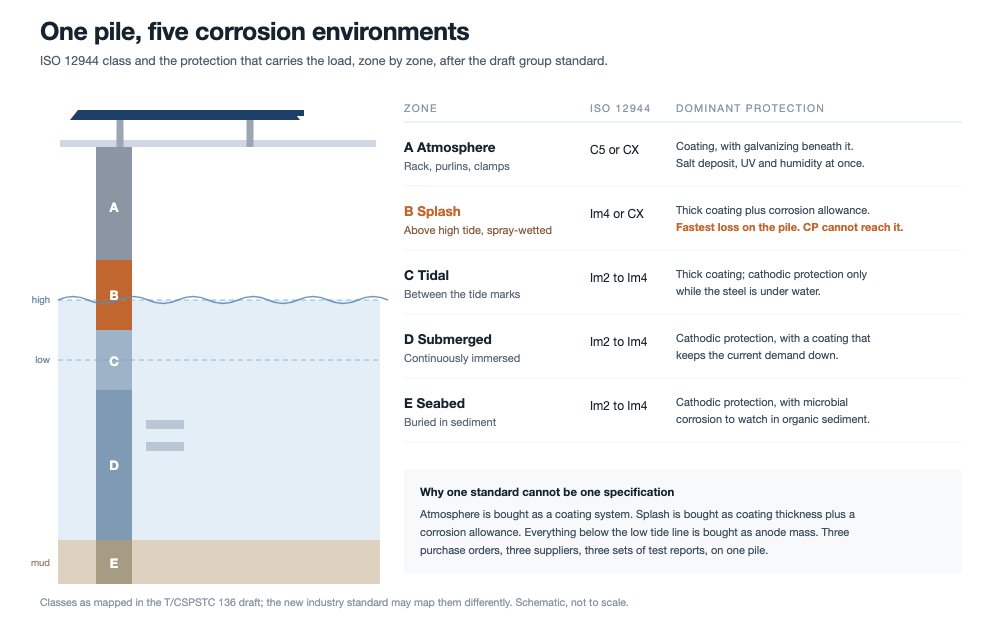
The zone map, redrawn in English from the source article. One pile, five environments, three procurement logics.
A single pile passes through five environments on its way to the seabed, and the industry slices it the same way every time. The atmosphere sees salt deposit, ultraviolet and high humidity together, and ISO 12944 puts marine atmosphere in the CX class. The splash zone, above the high tide mark and wetted by spray, sees wet and dry cycling with plenty of oxygen and the mechanical work of waves. It loses steel faster than any other part of the pile, and because it is not permanently submerged, cathodic protection cannot reach it. The tidal zone is immersed on a schedule. The submerged zone is where cathodic protection does most of its work. The seabed zone is oxygen-poor but carries a microbial corrosion risk that a coating survey will not show.
Zone assignment is what generates the bill of materials, and the draft group standard ties the two together: atmosphere at C5 for coastal or CX for offshore, splash and tidal at Im4 or Im2 combined with CX, immersed and seabed at Im2 to Im4. It also asks for a protection system designed for not less than 25 years, which is the module lifetime stated in the same document.
Three purchase orders on one pile
The dry-film thickness table in the draft shows how far apart the zones really are.
| Zone | Example system, minimum dry film | Total dry film |
|---|---|---|
| Atmosphere, C5 | Zinc-rich epoxy 60 µm + high-build epoxy 200 µm + weather-resistant topcoat 60 µm | 320 µm |
| Atmosphere, CX | Zinc-rich epoxy 60 µm + high-build epoxy 220 µm + topcoat 80 µm | 360 µm |
| Non-atmospheric, with cathodic protection | Abrasion-resistant epoxy or glass-flake epoxy 800 µm + topcoat 60 µm | 860 µm |
| Non-atmospheric, without cathodic protection | Polyester glass-flake 1,000 µm + topcoat 60 µm | 1,060 µm |
Read those four rows as three different supply chains. Atmosphere is bought as a coating system and priced per square metre of paint. Splash is bought as coating thickness plus a corrosion allowance on the steel itself, because paint alone does not survive there. Everything below the low tide line is bought as anode mass, with the coating present mainly to reduce the current the anodes have to deliver. A pile therefore has at least three bills of materials, three suppliers and three sets of test reports attached to it, and the specification that arrives in April will be judged against all of them.
Every number in that table comes from the draft group standard published for comment in July 2024, not from NB/T 12126. The published version may move them. Use them as the shape of the requirement, not as the requirement.
The nine categories, and four traps
The source article sorts the scope into nine categories of material. It presents the list as a skeleton drawn from the group standard, wind practice and project experience, not as clauses, and that is how it is reproduced here.
| Category | Typical items | What gets verified |
|---|---|---|
| A Structure | Carbon or low-alloy steel piles, trusses, racks, purlins | Grade, corrosion allowance, original rust grade |
| B Fasteners | Bolts, washers, gusset plates | Corrosion resistance not below the parent steel; galvanic isolation |
| C Surface preparation | Blasting abrasive, repair materials | Surface grade, roughness, soluble salts |
| D Organic coating | Zinc-rich primer, high-build epoxy, glass flake, topcoat, powder | Salt spray, cyclic aging, seawater immersion, cathodic disbondment, VOC |
| E Thermal spray | Zinc, aluminum or zinc-aluminum plus sealer | Thickness, bond strength, procedure qualification |
| F Cathodic protection | Sacrificial anodes, auxiliary anodes, reference electrodes, transformer rectifier, cable | Chemistry, electrochemical performance, electrical continuity |
| G Sealing | Sealants for gaps, cable penetrations | Salt spray and aging of the material |
| H Monitoring | Corrosion sensors, reference electrodes, loggers | Accuracy, input impedance, live readout |
| I Service stock | Touch-up paint, replacement anodes, probes | Compatibility with the original system |
Four of these rows are where projects lose money without noticing.
- Galvanic coupling at the fasteners. The draft requires connecting hardware to be no less corrosion-resistant than the parent material. A stainless bolt holding a carbon steel bracket looks like the careful choice and is the wrong one, because the two metals form a couple in seawater and the steel beside the bolt corrodes faster than it would have on its own. The fix is an insulating barrier, which is a design detail, not a purchase decision.
- Electrical continuity. Cathodic protection only works as a circuit, so the draft asks for contact resistance between structural parts below 0.1 Ω, with bonding cable across non-welded joints. Coating at a bolted joint is exactly what breaks that circuit, and nobody inspects it after commissioning.
- Anode selection in fishing waters. Where aquaculture shares the water, the draft suggests low-zinc aluminum anodes. Offshore photovoltaic projects are often built alongside fish farms, so this clause is less theoretical than it sounds.
- VOC in the paint. The draft caps coating VOC at 420 g/L. We expect environmental compliance to move from a checkbox into the technical specification of more tenders, which changes which products a coater can bid with.
Two more numbers from the same document are worth carrying into a design review. Coating work is limited to a substrate temperature at least 3 K above the dew point and a relative humidity of 85 % or less. Cathodic protection potential sits between −0.80 and −1.00 V against silver/silver chloride. Impressed-current systems are already in service: a 2026 paper in the Journal of Shandong University describes the country’s first pile-fixed offshore photovoltaic station, where one auxiliary anode and one reference electrode hold roughly a 200 m radius at 4 to 5 A.
Five gates between the factory and the sea
No single certificate covers offshore corrosion protection, so the practical structure is a chain of checks, each closing a different door.
| Gate | What is checked | The number to hold |
|---|---|---|
| 1 Type test | Salt spray, cyclic aging, seawater immersion, cathodic disbondment on the coating system; chemistry and electrochemistry on the anodes | Report from a CMA or CNAS accredited laboratory |
| 2 Incoming | Batch sampling of paint, anodes and fasteners, matched against the formulation and process of the type test | Same recipe, same process, or the type test does not apply |
| 3 In process | Surface preparation grade, ambient temperature, humidity, dew point, film thickness per coat | Substrate 3 K above dew point, RH 85 % or less |
| 4 Completion | Dry film thickness by area, pull-off adhesion, holiday or wet-sponge testing, bond strength for thermal spray, protection potential | Adhesion 5 MPa average, potential −0.80 to −1.00 V vs Ag/AgCl |
| 5 Third party | Class society survey for floating structures, covering materials, welding, dimensional accuracy and the coating sequence | CCS has surveyed the Huanghai No. 1 floating platform; GD010-2025 is wind guidance, not a PV mandate |
The countdown nobody can compress
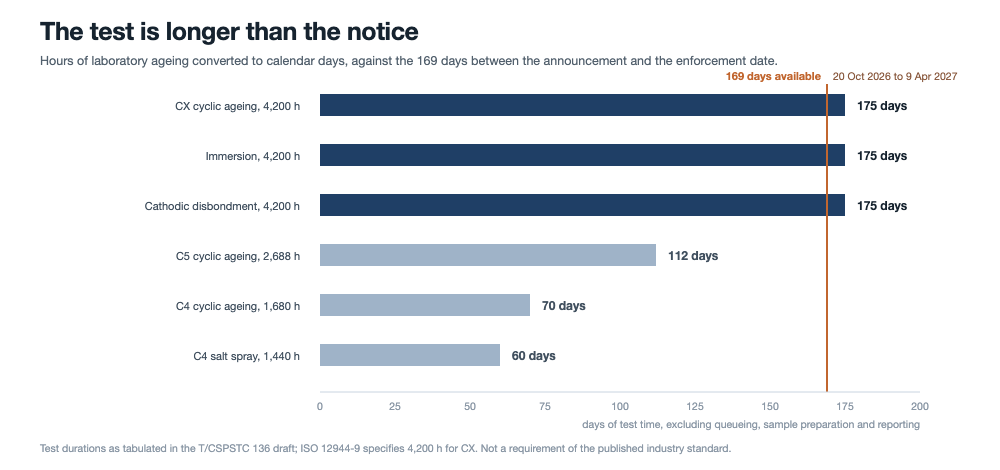
Six test regimes, converted from hours to days. The three CX and immersed-zone regimes take 175 days; the notice allowed 169.
Here is the part that should worry the supply chain more than the standard text does. For the CX atmosphere and the immersed zones, ISO 12944-9 asks for 4,200 hours of cyclic aging. The draft group standard asks for the same, and for non-atmospheric zones adds 4,200 hours of seawater immersion and 4,200 hours of cathodic disbondment. At 24 hours a day that is 175 days of test time before anyone writes a report.
The notice gave 169. A coating system that has no CX-grade test report in hand today cannot have one by 9 April, no matter how fast the line runs, because the constraint is a chamber and a queue, not a spray booth. The shorter regimes do fit: 2,688 hours of C5 cyclic aging is 112 days, C4 cyclic aging is 70 days, C4 neutral salt spray is 60. That is fine for an onshore project and beside the point for an offshore one, where the requirement is the CX line.
If you assemble modules, not structures
This standard is about steel, and the fastest way to lose a tender is to answer a structural corrosion question with a module test report. The module’s own environmental evidence is salt mist testing to IEC 61701, on a different sample, for a different failure mode, against a different acceptance criterion. Both belong in a bid, and they belong in separate sections of it, labelled with what each one proves. The map of how IEC, UL, GB/T, industry and group standards relate is worth keeping open while that table is written, because NB/T sitting between a GB/T and a group standard is not obvious from the numbering.
For modules destined for IEC 61701 salt mist testing, we set our laminators to maintain balanced thermal plates and controlled pressure profiles, ensuring complete encapsulation that prevents moisture ingress along the glass edges.
Three module-side decisions still land on the structural specification, and they are worth raising early rather than at the interface meeting.
- The frame surface. An anodized aluminum frame is the default everywhere, and the anodizing layer is a controlled oxide, not a paint film. On an offshore rack it is also the cathode in a galvanic couple with the steel clamp unless something insulates the joint. Ask who owns that washer.
- The junction box and cable entry. Salt mist enters a module through the box and the cable gland long before it reaches the cell, and the joint quality inside the box decides how fast the corrosion has something to work on. This is assembly-line work, so it is ours.
- The laminate edge. Water that reaches the edge seal works inward along the encapsulant and ribbon interface. Immersion and wet-dry cycling offshore accelerate exactly that path, and the reliability test list is where the evidence sits.
One more boundary worth stating in any bid: a change of frame alloy, coating supplier or junction box model is a change to a qualified product, and the retest logic of IEC TS 62915 applies to it. Structural coating changes have their own version of the same rule, which is the 4,200-hour clock again.
When adapting lamination recipes to meet IEC TS 62915 qualification for alternative encapsulants, we calibrate our electric heating plates to preserve uniform temperature across the active area, preventing delamination during subsequent thermal and humidity aging.
What to do with 169 days
The source article sorts the work by who has to do it, and the sorting is sound.
- Coaters and powder makers: inventory the reports you already hold, map each one to a corrosion class, and put the CX and Im4 long-cycle tests at the front of the queue today.
- Anode and cathodic protection suppliers: collect chemistry and electrochemical reports to GB/T 4948 and GB/T 4950, prepare a low-zinc aluminum option, and template the CP design calculation.
- Rack and fastener makers: document the coating system, match it to the fastener, and produce galvanic couple and salt spray data rather than a claim.
- Contractors: confirm coating qualifications and operator certificates, and build the records templates for dew point, film thickness and holiday testing now, not on site.
- Owners and designers: write the specification against the group standard and the wind proxies, with a switch clause that hands over to the published NB/T text on the day it appears.
Where these numbers come from
This article is built on a Chinese-language analysis published on 22 October 2026, which itself declares its sources. The approval facts come from the National Energy Administration announcement No. 4 of 2026 and its catalogue. The zone mapping, coating thicknesses, test durations, contact resistance, potential window, dew point rule and VOC limit come from the T/CSPSTC 136 draft and its drafting notes, both published on the national group standard platform in July 2024. The impressed-current example comes from a 2026 paper in the Journal of Shandong University (Engineering Science). The class society reference comes from CCS material on the Huanghai No. 1 platform and its GD010-2025 guidance for offshore wind.
What we did not do: see the text of NB/T 12126, which is not available. Everything attributed to it here is limited to title, number, dates, publisher and the absence of a superseded standard. The two figures are redrawn in English from the source for this page; the zone diagram and the bar chart carry the same numbers as the originals. The 182-day and 169-day counts are arithmetic from the two publication dates, and the 175-day figure is 4,200 hours divided by 24.
Frequently asked questions
Is NB/T 12126 mandatory?
It is a recommended industry standard, so it binds through contracts rather than through law. In practice the enforcement date is what matters: once an owner or an EPC writes the number into a specification, the recommendation becomes a requirement for that project.
Can I cite T/CSPSTC 136 numbers as NB/T 12126 requirements?
No, and doing it in a bid is a real risk. The group standard values quoted here are a proxy for what the industry standard is likely to say. Attribute them to the group standard and add the switch clause until the text is published.
Does the standard cover the modules themselves?
It addresses offshore photovoltaic structures: piles, racks, floats. Module environmental performance is tested to IEC 61701 for salt mist and is a separate evidence chain. Mixing the two in one certificate table is the most common documentation error on offshore bids.
Why is the splash zone treated so seriously?
It has oxygen, wet and dry cycling, wave impingement and the highest corrosion rate on the pile, and it sits above the waterline where cathodic protection cannot reach. It is the one zone where coating thickness and steel corrosion allowance both have to be right.
What dry film thickness should a specification ask for?
The draft group standard gives 320 µm for C5 atmosphere, 360 µm for CX, 860 µm for non-atmospheric zones with cathodic protection and 1,060 µm without it. Treat those as the shape of the requirement and confirm against the published standard.
Why does the test take 4,200 hours?
That is the cyclic aging duration in ISO 12944-9 for CX and Im4 service, and the group standard mirrors it while adding immersion and cathodic disbondment for the submerged zones. The duration is set by the standard, not by the laboratory.
Do I need class society certification?
Not by default. Fixed pile structures are certified against the coating and cathodic protection documents. Floating platforms move toward marine equipment practice, where a class society survey is normal, and CCS has already surveyed a floating photovoltaic platform in China.
My system is only C4. Does the deadline apply to me?
The shorter regimes fit inside 169 days, so the calendar pressure is lower. The complication is that offshore atmosphere is CX, not C4, so a C4 report may not be accepted for an offshore project even if it arrives in time.
Final thoughts
An unpublished standard is an uncomfortable object: enough to change a specification, not enough to design against. The useful response is not to wait for the text and not to pretend the group standard is the text. It is to fix the bill of materials by zone, put the long-cycle tests in a chamber this month, and write the switch clause that lets the specification change when the real document appears. The date on the announcement is the only part of NB/T 12126 that is already enforceable, and it is 169 days out.
We supply single and double chamber solar panel laminator machines with oil-heated or electric configurations designed for durable offshore module packaging. To verify process stability and encapsulant curing across your bill of materials, explore our solar panel laminator machines and send your module stack, drawings, or test samples to our engineering team for evaluation.