Editorial responsibility for this article rests with Wuhan Ooi Photoelectric Technology Co., Ltd. Written and reviewed by the Ooitech editorial team. See our editorial policy for how we write, where AI tools are used, and how to request a correction.
EVA, POE or EPE: Choosing Encapsulant by Failure Mode
Table of Contents
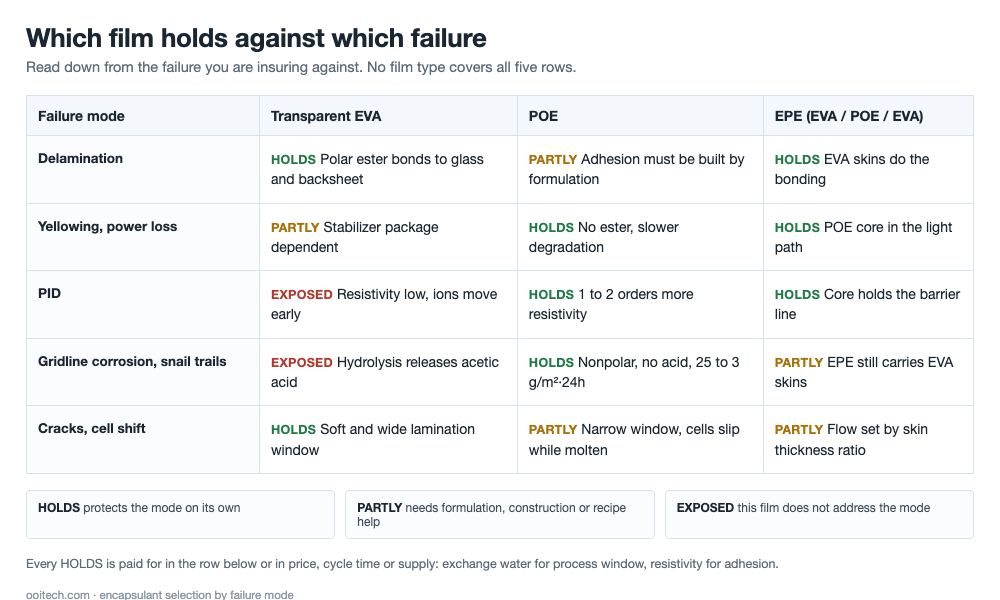
Quick answer: No encapsulant does all five of its jobs well, and that is the whole decision. Transparent EVA bonds easily and laminates across a wide window, then hydrolyzes into acetic acid under damp heat and passes about 25 g/m²·24h of water vapor at 38 °C and 90 % RH. POE passes roughly 3 g/m²·24h, holds one to two orders of magnitude more volume resistivity and forms no acid, but it is nonpolar, so adhesion and additive stability lean on formulation, and its lamination window is narrow. EPE stacks EVA skins on a POE core and lands between the two without being their sum. So name the failure you are insuring against before you name a resin: delamination, yellowing and power loss, PID, gridline corrosion and snail trails, or cracks and cell shift. Each film type buys protection from one of those and pays for it somewhere else. The tables below map failure modes onto film types and put a price on each trade.
Two modules leave the same line on the same day, one on POE and one on EVA. Five years later one has delaminated along the ribbon rows and the other has not.
Five jobs in the laminate, five ways it fails
A 2382×1134 mm module carries about 2.70 m² of film per side, so the two layers come to roughly 5.4 m² and 2.2 to 2.7 kg at common gram weights, against an industry figure of about 10 million m² per GW. It does five jobs at once, and each has a failure that appears years later, when the laminate is no longer repairable.
Film touches glass, silicon, ribbon and backsheet at once and cannot be replaced. Its failures read as module failures, which is why the useful question is never which film is best.
- Bonding sets peel strength at the glass and backsheet interfaces, and what counts is retention after damp heat and UV not the day-zero value. Failure is delamination, a door for water before it is a power loss.
- Transmission covers transmittance, UV cut-off and yellowness index. Failure is yellowing and the power loss behind it, plus interface reflection wherever a void replaces polymer with air.
- Insulation is volume resistivity and dielectric withstand. Failure is PID and wet leakage current at system voltage.
- Barrier is water vapor transmission rate plus acid release. Failure is gridline and ribbon corrosion, rising series resistance, and the dark tracks the field calls snail trails.
- Buffering is degree of cure, modulus and shrinkage. Failure is microcracks, breakage, and cells that shift while the film is still molten.
All five run off one switch: degree of cure. Under-cured film creeps when hot, and adhesion and cushioning drop with it. Over-cured film turns brittle and adhesion drops again. That is why gel content sits in incoming inspection and in recipe control at once, and why a film that passes a peel test at day zero can delaminate in year four.
The reverse lookup table
Read the table from the failure you are insuring against, backward to the material: the order a reliability engineer thinks in, and the reverse of a catalog.
| Failure mode | What the field sees | Which film buys protection | What you pay for it |
|---|---|---|---|
| Delamination | Lifting at the glass interface, white lines along the ribbons | EVA skins in EPE, or POE with a bonding package built for glass | POE needs a longer cycle and closer adhesion control |
| Yellowing, power loss | Yellowness index rising, transmittance falling after damp heat | POE core in the light path, or a high cut-off front film | Resin cost, and blocked UV is energy not generated |
| PID | Power loss at system voltage that partly recovers overnight | POE or EPE, at one to two orders of magnitude more resistivity | Price, and a concentrated resin supply |
| Gridline corrosion, snail trails | Discolored silver fingers, dark tracks from the edge inward | POE core, no ester groups, low transmission rate | Adhesion depends on formulation, and nonpolar hosts let additives bloom |
| Cracks, cell shift | Microcracks after lamination, breakage in handling, strings that moved | Whatever modulus and flow match the cell and the string | Flow and modulus pull against each other |
Two rows deserve a caveat. Cracks respond to a contradiction: a film soft enough to cushion a 130 µm cell, with silicon at 3 ppm/K against copper at 17 ppm/K, is also soft enough to let the string drift while molten. And the delamination row is where the film gets blamed for the machine, because a void along the ribbon row can start at a ramp rate, a vacuum level or a glass surface as easily as at the film.
No column is filled. Every film type protects two or three of the five failure modes and leaves the rest to the recipe, the construction or the site.
The two soft spots in EVA: acid and water vapor
Photovoltaic-grade EVA carries 28 to 33 % vinyl acetate by weight. That polar group is why it bonds to glass and backsheet with little help and accepts crosslinker, silane and stabilizers so easily. It is also the origin of both weaknesses, and both are chemistry rather than workmanship.
The first is water. Published figures put EVA at about 25 g/m²·24h at 38 °C and 90 % RH against about 3 g/m²·24h for POE, a factor of roughly eight. No encapsulant stops water; the question is how fast it arrives, and through which edge it comes in.
The second is acid. The ester group hydrolyzes slowly under damp heat and releases acetic acid, which attacks the silver gridlines and the ribbon surface. Series resistance climbs, the module loses power, and every visual inspection still passes. Note what it does not say: EVA does not fail, it spends margin on a reaction a nonpolar resin never starts, invisible in qualification and expensive by year fifteen.
POE: three wins and three bills
POE is a copolymer of ethylene and an alpha-olefin, usually octene, and its chain carries no ester group. Everything else follows from that.
The wins are direct. No ester means no acetic acid, so gridline corrosion loses its fuel. Water vapor transmission lands near 3 g/m²·24h. Volume resistivity runs one to two orders of magnitude above EVA, which is how it holds PID back: the field drives sodium ions out of the glass toward the cell, and a better insulator slows that drift, so the loss arrives later and shallower. A quieter fourth win is low-temperature elasticity. EVA stiffens noticeably around minus 20 °C while POE keeps more of its cushioning.
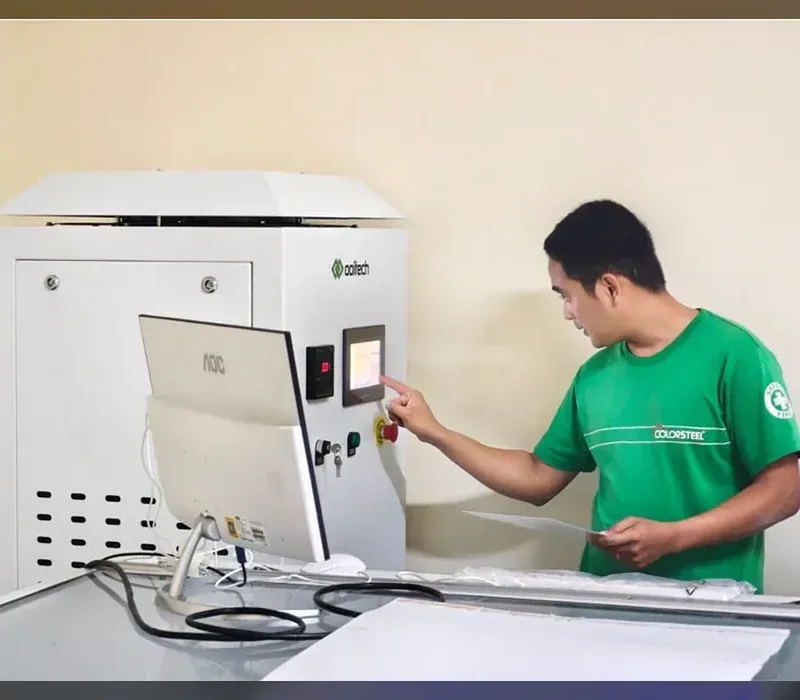
We verify this isolation margin on assembled modules by measuring insulation resistance and leakage current under voltage, checking whether that one to two orders of magnitude difference prevents current flow across the glass-cell interface.
The bills land on the line. Being nonpolar makes POE a poor host for the additives a film needs, so they are less compatible and more prone to bloom to the surface. Adhesion to glass has to be rebuilt through formulation rather than inherited from the resin. Lamination takes longer and the window is narrower, which means more cell shift and slip before the film gels, and resin supply has been concentrated among a few overseas producers.
That profile points at glass-glass n-type products, where the PID, water and corrosion limits are tightest, and away from the low-cost single-glass module.
Why EPE is a compromise, not a sum
EPE is a coextruded three-layer film: EVA skins, POE core. The skins bond and flow, the core blocks water and ions. It is the obvious answer to "EVA laminates well and POE blocks well", and that sentence is where the reasoning usually stops.
A three-layer film is not two films added together. Three things exist in it that exist in neither single-layer product: the bond between skin and core, the thickness ratio between the layers, and the migration of additives across that boundary. Get the ratio wrong and the core is thinner than the barrier you thought you bought. Get the interlayer bond wrong and you have manufactured a delamination plane, which shows up as a recognizable field failure: line-shaped voids that follow the ribbon rows. And the skins are still EVA, so EPE still releases some acid, less than a full EVA film and more than pure POE.
What it buys is POE performance at a fraction of the POE content, which is why it reached TOPCon glass-glass modules faster than pure POE did: a supply and cost argument as much as a physics one.
| Property | Transparent EVA | POE | EPE, EVA/POE/EVA |
|---|---|---|---|
| Water vapor transmission at 38 °C, 90 % RH | about 25 g/m²·24h | about 3 g/m²·24h | set by the core and its share of the thickness |
| Volume resistivity | reference | one to two orders of magnitude higher | between the two, by core ratio |
| Acetic acid on hydrolysis | yes | no ester groups | yes, from the two skins |
| Lamination window | wide | narrow, longer cycle, cell shift risk | intermediate |
| Typical position | front and rear of single-glass modules | glass-glass n-type, both faces | mainstream front film on TOPCon glass-glass |
White EVA solves exactly one problem
White EVA is EVA loaded with a white filler, usually titanium dioxide, and it belongs on the rear face only. Light passing between cells, or between the cell edge and the frame, would otherwise reach the backsheet and be lost. A white film scatters it back, part of it reflects off the inner glass, and some returns to the cell. Front-side power rises, by an amount set by the gap area rather than by the film.
The cost is structural rather than chemical. White film is opaque, so a bifacial module cannot use it on the rear. Then there is overflow: during lamination the white film flows and can climb over the cell edge, in bad cases onto the front face, which is shading and a cosmetic reject at once. The industry answer is a pre-crosslinked white film, partly cured at the film plant so it flows less in the laminator, which trades flow for position.
Conversion film answers a different question
Everything above is about water, ions, acid and stress. Ultraviolet light is a separate axis, and the front of an n-type TOPCon cell is more sensitive to it than the p-type product it replaced. The older answer was a UV absorber that cuts the UV off before it reaches the cell, protecting the cell and discarding photons the module could have converted.
A conversion film takes the other route: absorb the UV and re-emit it in the visible range where the cell responds. Whether that is a good trade is a reliability question before it is an efficiency question, because the agent has to survive the same 25 years of light and damp heat as the resin around it, and its decay is a failure mode that did not exist before.
Bifaciality decides which side gets which film
A bifacial module needs a transparent rear, so the rear film cannot be white, and that removes the product that exists purely to recover light from the gaps. What remains is a choice between EVA, POE and EPE on barrier and PID grounds. That is the mechanism behind the market shift: on CPIA-based figures the POE family went from about 23 % of the Chinese market in 2021 to about 35 % in 2022 and about 41 % in 2024.
Construction changes the water path too, and it is easy to miss when a bill of materials is copied over. A single-glass module takes most of its water through the backsheet, so film and backsheet share the barrier job. With glass on both faces the edge seal becomes the front line, which puts the frame adhesive in the same conversation as the encapsulant.
Five questions for the film supplier
The specification conversation is usually about a datasheet number and rarely about the test behind it. These are the five we would put in writing.
In our testing protocols, we require hipot, insulation resistance, and wet leakage measurements on finished laminates to confirm that the selected encapsulant prevents dielectric breakdown under operational system voltages.
- Water vapor transmission rate: at what temperature, humidity and thickness, and is the value normalized to a reference gauge or quoted at the as-supplied one.
- Volume resistivity: at what temperature and field, because the value moves by orders of magnitude across the range a module sees.
- Acid release: whether the supplier reports acetate evolution or only a pH shift, and after how many hours of damp heat.
- Peel strength retention: initial value plus retention after damp heat and after UV, reported separately, because a film can pass one and fail the other.
- Lamination window: its width in seconds and degrees, the recommended cure target, and whether the film tolerates the second pass that rework demands.
Then one question outside the datasheet. Changing film type, thickness or supplier makes the module a changed product in the eyes of the qualification standards, and unchanged cells are not an argument; IEC TS 62915 sets out what a material change forces you to re-test, and it is cheaper to read before the change than after. Whether the film runs on your existing laminator is the second question.
Where these numbers come from
The five jobs and their failure signatures, the 2382 by 1134 mm module with about 5.4 m² of film across two layers and 2.2 to 2.7 kg, the 10 million m² per GW figure, the 3 to 4 % share of module cost, the 25 and 3 g/m²·24h rates, the one to two order resistivity gap, the 28 to 33 % vinyl acetate content, the expansion values for glass at about 9, copper at about 17 and silicon at about 3 ppm/K, the 130 µm cell, and every market share here come from two Chinese-language articles in a photovoltaic materials series, one on what the film does and one on the film family. Both are practitioner material, and both label their figures as common published values rather than measurements of a named product.
Three figures need a flag. The cost share is 3 to 4 % in the first article and 4 to 7 % on other counts, so treat it as a range that depends on period and on what is counted. The 2024 market structure is reported twice and the two do not agree: one puts transparent EVA near four tenths, EPE close to three tenths, and white EVA and POE each just over one tenth, while another puts transparent EVA at 41.6 %, EPE at 37.0 % and pure POE near 13.2 %. Two institutions, two definitions, so carry the trend and not the level: the EVA share is falling and the POE family is not. And the 2.70 m² per side is arithmetic on the module size, not a measured film.
The reverse lookup table is our construction, not a published result. Pairing a failure mode with a film type follows from the mechanisms the sources describe, but ranking which failure you should fear first is a judgment about your product, your climate and your system voltage, and nobody measured it. The lamination window and supply observations come from line experience; the transmission, resistivity, expansion and market numbers are the sources'.
Frequently asked questions
Q: Does POE always beat EVA on reliability?
No. It wins on water, ions and acid and gives back process window and adhesion margin. On a single-glass module in a mild climate, with peel retention holding after damp heat, the EVA weaknesses may never be exercised.
Q: Why is water vapor transmission the number people quote first?
Because it predicts two failures at once: how fast water arrives to drive hydrolysis, and how readily ions move under field. No encapsulant stops water; it only sets the rate.
Q: Is an eightfold difference in transmission an eightfold difference in lifetime?
No. Arrival rate is one term in a chain that also includes temperature, system voltage, edge sealing and the acid the film itself releases. Treat it as a ranking, not a multiplier on years.
Q: Can EPE be specified as if it were POE?
Only if you specify the core. Ask for the layer ratio, interlayer peel strength and additive migration data. Two EPE films of equal total thickness with different cores are different products.
Q: What does PID have to do with volume resistivity?
The field drives sodium ions from the glass toward the cell, and a better insulator slows that drift, so the loss arrives later and shallower. Leakage current at voltage plus damp heat under bias is how you check it after aging.
Q: When is white EVA worth the process trouble?
On a single-face module where front-side power is the number you sell. The gain is real and bounded by the gap area, so it shrinks as cells grow and gaps narrow.
Q: Does a conversion film change the failure modes above?
It adds one and removes part of another. The stability of the conversion agent becomes a new aging path with its own decay curve, and UV load on cell and front film drops, which is why it is discussed on n-type cells.
Q: What do we check first if modules delaminate along the ribbons?
Whether film or process. Voids that follow the ribbon rows can come from moisture in the film, a ramp rate that gels the edge before the center, or a vacuum level that leaves air at the busbar. Film type sets the risk; the recipe decides the day.
Final thoughts
An encapsulant is a set of trades, and a film name is a poor way to remember them. Write down the failures your product and your site can survive, rank them, buy the film that covers the top two, and price the rest into the warranty. The material is 3 to 4 % of module cost, the warranty runs 25 years, and the laminate cannot be repaired. That ratio is why the decision deserves a table rather than a habit.
OOITech supplies the CHT9980A and CHT9981A PV safety comprehensive tester series, integrating hipot, insulation resistance, ground continuity, and wet leakage testing into one station for module qualification and inline quality control. Send your module stack, bill of materials, or test samples to our engineering team to evaluate your encapsulant isolation performance and recipe margins.