Editorial responsibility for this article rests with Wuhan Ooi Photoelectric Technology Co., Ltd. Written and reviewed by the Ooitech editorial team. See our editorial policy for how we write, where AI tools are used, and how to request a correction.
Same Pellets, Different Film: Inside an Encapsulant Formula
Table of Contents
Quick answer: Two film makers buy the same EVA pellets from the same plant, run the same gram weight on the same laminator, and load the same damp heat chamber. One laminate passes; the other delaminates. The pellets did not change, so what is left is the additive package, the few percent that decides whether the film crosslinks, bonds to glass, and holds for twenty-five years of ultraviolet and humidity. Read a formula as two layers. The resin sets the base: transparency, softness, polarity, water barrier. The additives set what the film can do, and their design target is not maximum performance. It is a crosslinker inert at the extrusion die and fast in the laminator, additives that stay inside the film instead of migrating to its surface, and doses that are exactly sufficient. Here is how both layers are built.
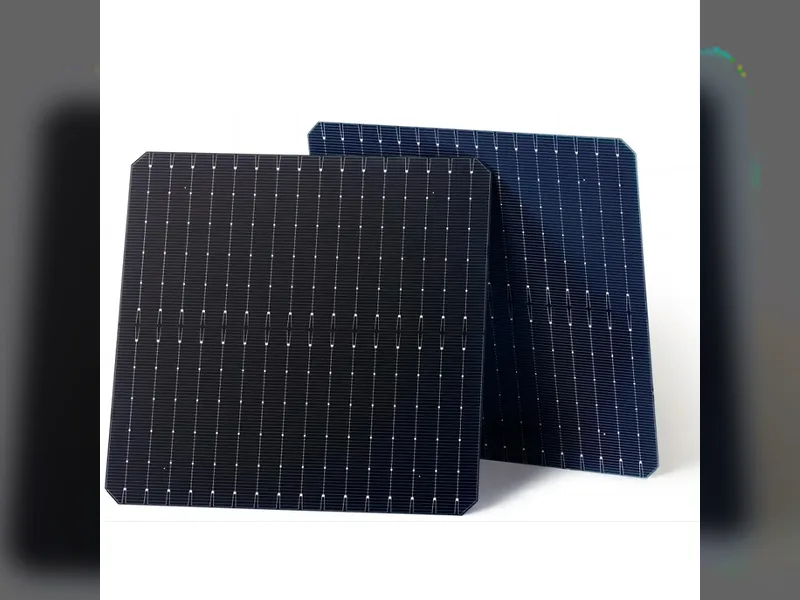
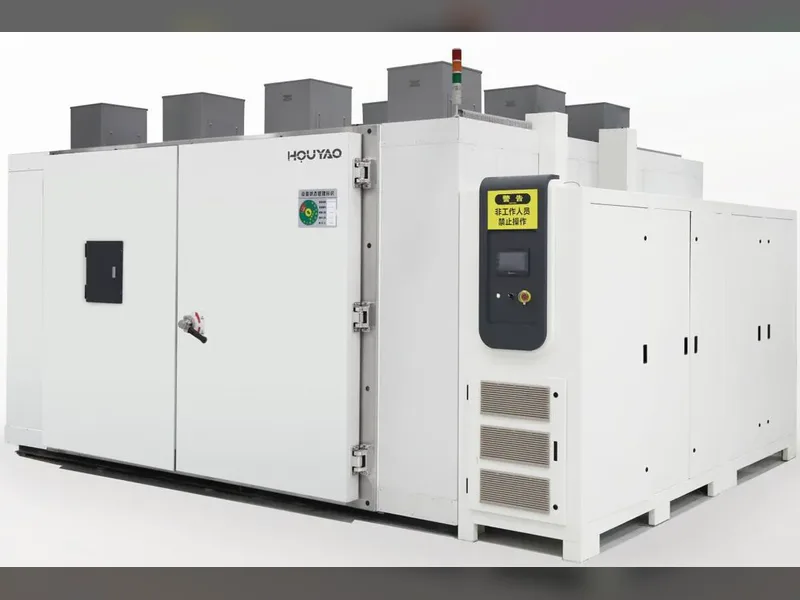
Same pellets, same gram weight, same line. Two films, two outcomes in one chamber. What is left as a variable is the recipe: which additives, at what level, and how they behave as the temperature changes.
Two halves of one film
A photovoltaic encapsulant is a resin plus a package. The resin is EVA or POE pellet and most of the mass; it sets what a datasheet can tell you: transparency, softness, polarity, and how much water vapor the film passes across twenty-five years.
The package is everything else, a few percent of the mass and sometimes less. It decides whether the film crosslinks at all, whether it adheres chemically to glass, and whether it survives ultraviolet and damp heat. Four families do that work.
Four additive families, and the job each one owns
Read the table by the failure each family prevents. The last column is the one to study, because the two failures are not symmetric.
| Family | What it does | Typical level | What you see when it is wrong |
|---|---|---|---|
| Organic peroxide crosslinker | Decomposes at lamination temperature, builds the network | 0.1 % to 0.5 % by mass (illustrative, patent examples) | Low: creep, low peel strength. High: pre-cure gels, bubbles, brittleness |
| Co-agent, a multifunctional monomer | Raises effective crosslinks per decomposed peroxide molecule | A fraction of the peroxide level | Low: slow or incomplete cure, most visible on POE. High: over-cure, cost |
| Silane coupling agent | Condenses onto glass hydroxyls, copolymerizes into the resin network | About 0.3 % by mass (illustrative, patent examples) | Low: delamination after damp heat. High: surface bloom, rising haze |
| UV absorber, HALS, antioxidant | Block ultraviolet, trap radicals, protect the melt and the long-term film | Low single digits in total | Low: yellowing, backsheet aging. High: transmittance loss, cure competition |
| Anti-PID, white filler, light conversion | One product feature each, not general stabilization | Product specific | Passes the first measurement, fails the reliability sequence |
Too little of an additive usually appears as a slow failure in the field; too much appears as a fast one on your line. Every level in the third column is illustrative: the peroxide and silane figures come from example formulas in a public patent and specify no product.
The crosslinker: a temperature window, not a dose
An organic peroxide does one thing. Above a temperature it breaks into radicals, the radicals take hydrogen from the resin backbone, and neighboring chains join into a network. That is what turns a meltable film into an elastomer.
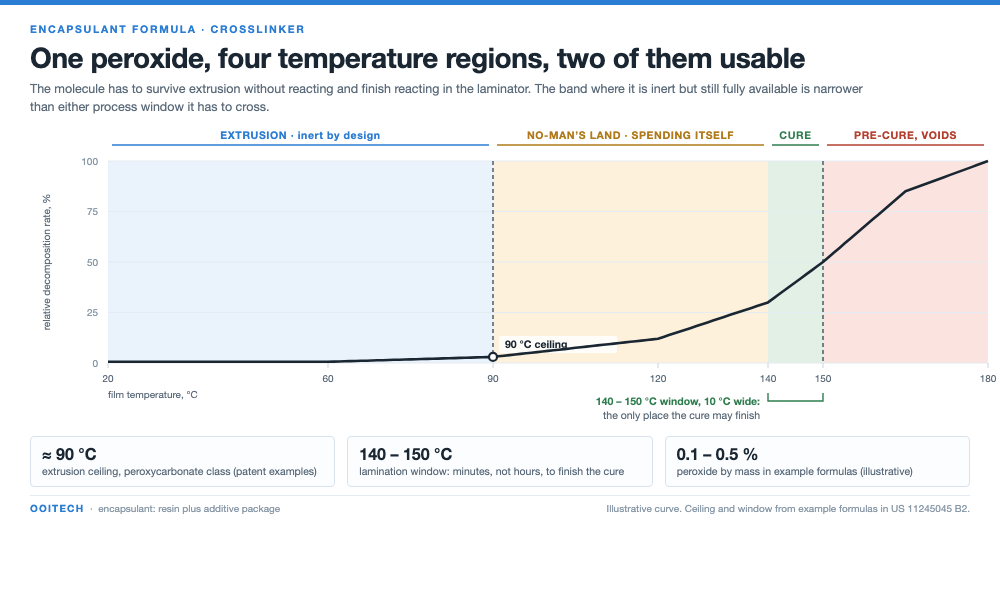
Because the reaction is thermal, the criterion is the temperature window, not the dose, and the chart below plots where its edges fall. The same molecule has to be inert through extrusion and fast through lamination, and the two processes are about fifty degrees apart.
Extrusion, where the ceiling is about 90 °C
At the film plant the melt stays below the temperature where decomposition becomes significant. Run hotter and the film is partly crosslinked before it reaches a module: gels form, flow drops, and the film cannot fill the space around ribbons. For the peroxycarbonate class in the patent examples the ceiling is about 90 °C, and below that line the peroxide is a passenger.
Lamination, where 140 to 150 °C has to be enough
In the laminator the same peroxide has a few minutes at 140 to 150 °C to build the crosslink density the film is sold on. Too stable a peroxide under-cures at the cold edge of your recipe, too eager a one pre-cures at the hot edge, and neither shows in a datasheet. Both show as a peel strength that depends on which end of the machine the module came out of, which is how a recipe problem gets misread as a machine problem: know what the vacuum stage actually does before you blame the press.
We hold platen temperature between 140 and 150 °C across all heating zones, giving the peroxide enough dwell time to crosslink uniformly without creating under-cured margins or localized pre-cure defects.
One molecule, four temperature regions. The band where the peroxide is inert but still available is narrower than either window it has to cross. Illustrative curve; ceiling and lamination window from the patent examples cited below.
Overdosing does not buy margin. Decomposed peroxide leaves fragments, and fragments that stay in the film become volatile at lamination temperature or later in the field, one route to the voids that look like an encapsulant fault and often are not. The target is complete decomposition at the dose you need, with nothing left over.
We extend the deep vacuum stage before applying diaphragm pressure to evacuate volatile peroxide fragments from the chamber before crosslinking locks them into the module as permanent voids.
Why the co-agent matters more for POE
A co-agent is a multifunctional monomer that joins the network at more than one point, so each decomposed peroxide molecule yields more effective crosslinks. You reach the same density with less peroxide, and less peroxide means fewer fragments and a wider margin against voids.
On EVA that is an economy; on POE it is close to a requirement. POE is a saturated, non-polar ethylene and alpha-olefin copolymer, and the same peroxide dose builds less crosslink density in it than in EVA. Without a co-agent the film either under-cures inside the window you have, or needs a peroxide level that brings the bubble risk back. A POE formula is not an EVA package poured into a different resin.
The coupling agent: one bridge, two ends
Adhesion to glass is chemical, and the molecule that carries it is a silane. The patent examples use a methacryloxy trimethoxy silane at about 0.3 % by mass, illustrative again. Its two ends have separate jobs, and both have to arrive at the interface intact.
The methoxy groups hydrolyze to silanols and condense with the hydroxyls on the glass into Si-O-Si bonds. The methacrylate double bond copolymerizes into the resin network while the peroxide works. One small molecule holds an inorganic surface and an organic network at once, which is why the film releases from a liner but not from a sheet of glass.
Where the bridge fails first
Silanes are moisture sensitive. A roll stored in a humid warehouse hydrolyzes before lamination, and nothing shows at goods-in: the film looks and handles normally, then peel strength after damp heat comes in low and the module delaminates from an edge inward. Sealed packaging and a use-by date after opening belong to the formula, and loose incoming control degrades an excellent recipe before it reaches your laminator.
Stabilizers, and the additives that do one job each
Three stabilizers share the aging work and they are not interchangeable. A UV absorber, a benzophenone or a benzotriazole, absorbs ultraviolet and dissipates it as heat; its type and dose set the wavelength at which the film stops transmitting, protecting the backsheet behind it. A hindered amine light stabilizer absorbs no ultraviolet. It traps the radicals aging produces, and because it can cycle it works at low dose. An antioxidant protects the resin in the extruder and in long-term thermal oxidation.
The three also fight each other and fight the cure. A hindered amine is a radical scavenger by profession, so an overdose competes with the crosslinker for the same radicals and costs crosslink density, and some antioxidant conversion products yellow. The system is a three-way balance between cure efficiency, transmittance and color, and the balance point moves when the resin changes.
Functional additives sit on top and each buys one feature. An anti-PID package traps ions or scavenges acid to slow sodium migration and acetic acid accumulation. A white filler such as titanium dioxide makes a reflective film. A light conversion material absorbs ultraviolet and re-emits visible light, which is an optical decision rather than a stabilization one.
Why 33 % VA is the number
EVA is ethylene copolymerized with vinyl acetate. The ethylene segments are non-polar and crystallizable, the acetate side groups are polar, and VA content is the dial on that ratio. The photovoltaic range is normally quoted at 28 % to 33 %.
At 33 % the copolymer behaves as an amphiphile. The ethylene part is compatible with non-polar species such as PE and POE; the acetate part interacts with polar surfaces and polar additives, meaning the hydroxyls on glass and the stabilizers that have to stay dissolved. On the solubility parameter scale PE sits near 16 MPa^0.5, strongly polar materials at 20 to 25, and EVA at 33 % VA between them.
Crystallinity explains the rest. Ethylene sequences crystallize, and crystals give strength while resisting mixing. Acetate groups interrupt the lattice, so at 33 % you keep partial crystallinity for strength and give up a large amorphous fraction that provides flow at lamination temperature, wetting of cell and glass, and even dispersion of additives present at a fraction of a percent. That is why 33 % reads as a compromise rather than an optimum.
| VA content | What the material is | What it gives a module | What it costs |
|---|---|---|---|
| Below 18 % | Close to polyethylene, non-polar | Low water uptake, good electrical insulation | Poor compatibility with polar additives, hard, low adhesion without help |
| 28 % to 33 % | Polar and non-polar balanced, the photovoltaic grade | Adhesion to glass, additive solubility, flow at lamination, usable crystallinity | The compromise itself: tacky pellets and film, acetate available for hydrolysis |
| Above 40 % | Polar, closer to a rubber than to a plastic | Flexibility and fast wetting of rough surfaces | Low crystallinity, strength loss, water uptake, insulation loss, cost; PID risk and faster aging |
Above 40 %, the bill arrives somewhere else
Push VA past 40 % and four costs arrive together: crystallinity falls far enough that strength drops, water uptake rises, insulation falls and the resin costs more. In a module those four collapse into two, a higher risk of potential induced degradation and faster aging, because water and ionic transport are what the PID mechanism runs on. Higher VA also lowers the melting point, so pellets and film get tacky and stick to rolls, and more acetate can hydrolyze into acetic acid.
Migration and bloom: the non-polar problem
Every component of the package is a minor species held near its solubility limit, and a film has two surfaces where that constraint disappears. If compatibility is marginal the additive diffuses out and stays there. That is bloom, a transport failure rather than a chemical one, which is why a formula can pass every chemistry check and still fail in the chamber.
POE is more exposed. It is non-polar, so polar additives, silanes, some stabilizers and most anti-PID packages are poorly compatible in it and migrate more readily. The symptoms arrive as a group: the film feels tacky, haze climbs, and adhesion falls because the coupling agent is no longer at the interface. Any one of the three alone is ambiguous; all three together point at the package rather than at the laminator.
Bloom is a surface phenomenon, so it shows in haze, in tack and in a surface spectrum, not in a bulk property. Delamination that follows it rarely spreads evenly, because it tracks the geometry where stress concentrates, which is why line-shaped voids along the cell ribbons are a pattern to read rather than a defect to attribute to the press. It is also why you ask for damp heat peel strength rather than a composition table: a composition does not say whether the additive stays put.
Six questions to ask when you qualify a new film
If the package is the design, a conversation about resin grade is about the wrong half. These six separate two films made from the same pellets, in the order that saves the most money.
- What is the decomposition window of your crosslinker, and which extrusion profile does it assume? Compare the onset temperature with the profile your line runs.
- What crosslink density do you guarantee after your recommended cycle, and how does it move at 140 °C and at 150 °C? A number at one point is a sales figure; a curve is a design.
- Which co-agent, at what level, and what happens to the cure if the line runs ten degrees cold? On POE this decides whether the film tolerates your laminator or only the one it was developed on.
- How much silane, and what is the shelf life sealed and after opening at your warehouse humidity? Check whether your store can meet the number you were given.
- Which stabilizers at what dose, what is the ultraviolet cut-off wavelength, and what is the yellowing index after damp heat?
- Which functional additives, and what evidence that they survive the reliability sequence rather than the first measurement?
The sixth has a formal answer. A different encapsulant is a change to the bill of materials, and that class of change normally forces a partial requalification under IEC TS 62915 rather than a fresh design qualification, so budget the retest before you approve the sample. Qualify on the process window you will run in production, not on the one the sample arrived with.
Where these numbers come from
The additive levels are illustrative, taken from example formulas in a public patent (US 11245045 B2) as summarized in the Chinese source articles: peroxide at 0.1 % to 0.5 % by mass, silane at about 0.3 %, an extrusion ceiling of about 90 °C for the peroxycarbonate class, and a lamination window of 140 to 150 °C. They fix an order of magnitude and describe no commercial film.
The VA bands, the photovoltaic range, the solubility parameter comparison and the costs above 40 % come from the same source, a materials discussion rather than a measurement; the solubility parameters are handbook orders of magnitude, not measurements on your film. The market context is quoted from the same articles: photovoltaic is EVA’s largest single downstream, 2024 domestic apparent consumption exceeded 3 million tonnes with about 43 % from photovoltaic, attributed in the source to a Chinese industry research compilation. The line on POE import dependence above 90 % through the first three quarters of 2025 is background, not developed here.
Our own reasoning is the framing, not the figures: the peroxide read as a window rather than a dose, complete decomposition as the design target rather than maximum crosslinking, the transport reading of bloom, and the six qualification questions. Test them on your line before any enters a specification.
Frequently asked questions
Q: Why can two films made from the same pellets behave differently in damp heat?
The pellets set the base polymer. Crosslink density, adhesion to glass, ultraviolet cut-off and additive retention are set by the package, a few percent of the mass. Two films can share a resin lot and differ in peroxide window, silane level, stabilizer balance and functional additives.
Q: How much crosslinker does an encapsulant contain?
Public patent example formulas quote organic peroxide at 0.1 % to 0.5 % by mass, illustrative. What matters is not the dose but the fraction decomposed by the end of your cycle, which depends on dwell and on the temperature reached.
Q: Why does the extruder stay near 90 °C when lamination runs at 145 °C?
Because the same peroxide has to be inert at one temperature and fast at the other. At the film plant, decomposition means pre-cure: gels, lost flow, poor fill around ribbons. In the laminator it means the network. The gap is the design space.
Q: What makes bubbles when the crosslinker dose is too high?
Decomposed peroxide leaves fragments. At a normal dose they are minor and mostly leave during lamination; at an excessive dose, or with incomplete decomposition, they stay trapped and appear as voids during lamination or later in the field.
Q: Why does POE need a co-agent more than EVA does?
POE is saturated and non-polar, and the same peroxide dose builds less crosslink density in it. A multifunctional co-agent raises the crosslink count per peroxide molecule, so the film reaches the required density without pushing the peroxide into the void-forming range.
Q: Is a higher VA content always better for adhesion?
No. Adhesion improves with polarity, and so does water uptake. Above 40 % VA the crystallinity is too low for strength, insulation falls and cost rises, and in a module that shows as PID risk and faster aging.
Q: Can additives really leave the film?
Yes, when compatibility is marginal. Additives sit near their solubility limit, so a small driving force moves them to a surface. That is bloom: tack, rising haze, falling adhesion. POE is more exposed because most functional additives are polar and POE is not.
Q: Does switching encapsulant supplier require a module retest?
Usually yes, at least partially. A different encapsulant is a change to the bill of materials, and change control under IEC TS 62915 exists because a film change can alter adhesion, cure and optical behavior without altering the datasheet.
Final thoughts
Two films from one silo end in two different chambers because the resin only sets the base. What separates them is a crosslinker that waits for the laminator, a silane that survives the warehouse, stabilizers that do not fight the cure, and a dose of each that is sufficient rather than generous. Ask for the window, the retention and the damp heat data.
OOITech manufactures single and double chamber solar panel laminator machines with oil-heated and electric configurations designed to maintain uniform thermal control through every curing cycle. If you are refining your encapsulant process window, send your module drawings, layer stack, or test samples to our team for process evaluation and chamber matching.