Editorial responsibility for this article rests with Wuhan Ooi Photoelectric Technology Co., Ltd. Written and reviewed by the Ooitech editorial team. See our editorial policy for how we write, where AI tools are used, and how to request a correction.
Solar Module Frames in GFRP: The 25-Year Clamp Problem
Table of Contents
Quick answer: A composite frame’s weak point on an offshore module is not its surface. It is the slot that grips the laminate. A pultruded profile is strong along the fiber and the flange that clamps the glass is pried outward across it, where the matrix and the fiber–resin interface decide the answer. Water attacks that interface: one glass/polyester comparison measured around six times the moisture uptake at 40 °C immersion as at 20 °C and 50 % relative humidity, and a literature review reports roughly 75 % loss of interfacial shear strength after about 1,300 h in seawater at 60 °C against about 69 % at 40 °C. T/CPIA 0081–2024 sets corner-cleat pull-out at 300 N falling to 200 N after aging, interlaminar shear from 45 to 40 MPa, flexural strength from 850 to 600 MPa, and every one of those aging programs runs with the sample unloaded. Four gaps follow, and all four land on the one place you control: what the clamp looks like on day zero, and whether anybody recorded it.
A frame that fails offshore does not crack. It loosens: the flange opens a fraction of a millimeter, the adhesive unloads, water finds the seam, and a module that passed mechanical load testing is holding its glass by friction.
The case for composite is real, and so is the sentence people skip
Offshore photovoltaic sites are sold as three high and three strong: high temperature, high humidity, high salt spray, strong wind, strong waves, strong rainfall. Aluminum has two problems there. Salt spray attacks it, and where it meets a dissimilar metal it corrodes galvanically. The layer that usually buys the years back is anodizing, which is a surface answer to a surface problem. It also has to be grounded, and under system negative bias it carries a higher potential-induced degradation risk.
A glass-fiber reinforced polymer frame answers both: the resin matrix does not conduct, so no grounding and less PID exposure, and there is no metal to corrode, which is why salt spray results for these profiles look so good. Polyurethane composite frames from the larger material suppliers are already shipping at gigawatt scale, and the China Photovoltaic Industry Association published a group standard for them, T/CPIA 0081–2024, in 2024.
What usually gets skipped is a materials sentence with a long tail. Aluminum under design load is essentially elastic: you load it, you unload it, it comes back. A polymer is viscoelastic. The longer the load sits, the hotter it is and the wetter it is, the further it moves, and part of that movement never comes back. An offshore site supplies all three conditions at once, for twenty-five years.
Water does three things, none of them at the surface
Uptake follows Fickian diffusion closely enough to plan around: fast at first, then slow, then saturated. Temperature dominates the rate. One comparison of glass/polyester systems put uptake at 40 °C immersion above six times the value at 20 °C and 50 % relative humidity. Once the water is in, it does three things that matter to a clamp.
It plasticizes. Water molecules sit inside the polymer network, the glass transition temperature drops and the matrix softens. The back of a module on a summer afternoon is not a cool place, so the margin that kept the resin stiff is partly gone at exactly the hour the load is highest.
It swells one phase and not the other. The resin expands as it takes water; the glass does not. The mismatch shows up as a standing shear stress on the interface, and wet-dry cycling loads and unloads that stress, which is fatigue by another name.
It hydrolyzes the interface. Coupling agents on the glass, and ester or urethane bonds in the resin, can break down at the boundary, producing micro-debonding and porosity. Those voids then become the fast path for the next liter of water.
Salt is where reading gets sloppy. Several studies find the saturated moisture content in seawater is actually lower than in pure water, in one GFRP test about 1.5 % against 1.8 %, while the mechanical loss at the same water content is comparable. Heat is what makes seawater worse: the same review reports around 75 % interfacial shear strength loss after roughly 1,300 h at 60 °C, against about 69 % at 40 °C. A class 7 salt spray result and a wet-heat interface result are measuring different things, and T/CPIA 0081 leans on the former.
A pultrusion is a good shape for pulling and a poor one for prying
The frame holds the laminate through the slot: the flange on the A-face side and the adhesive bead press on the glass edge. Wind load, snow load and the platform motion of a floating array bend the module, the glass edge rotates inside the slot, and the flange is levered outward. Thermal expansion that does not match between laminate and frame adds a cycle on top.
Pultrusion puts the fibers along the length of the profile, which is why longitudinal tensile and flexural strength are high and why those are the numbers on the datasheet. Opening a flange is a transverse and interlaminar shear event. That is the matrix-dominated, interface-dominated direction, and it is the one water attacks first.
From there the failure feeds itself. Micro-debonding at the interface lowers transverse stiffness, so the same prying load produces more opening, which loosens the adhesive and drops the clamping force, which lets water further into the seam, which degrades the interface again. Wet-dry cycling accelerates the creep itself, a behavior usually called mechano-sorptive creep. The observable is an irreversible slot opening that grows with time and a clamping force that decays with it.
Creep of this kind is normally fitted with a Findley power law, strain equal to an instantaneous term plus a coefficient times time to the power n, with the coefficient and exponent fitted to material, temperature, humidity and stress. Work on pultruded GFRP columns and beams reports that a 50-year extrapolation can cost around 30 % of effective modulus. Those are structural members, not frames, and the number should not be transferred across. It does establish that decades of viscoelastic relaxation are not a rounding error.
What the standard tests, and the four things it cannot
T/CPIA 0081–2024 is the most systematic document available for composite frames in China. It covers basic mechanics, several aging environments and whole-module mechanical load. The requirements that matter to a clamp are these.
| Property | Initial | After aging | Aging applied |
|---|---|---|---|
| Corner cleat pull-out force | ≥300 N | ≥200 N | UV; UV-humid 1,000 h; UV wet-freeze 10 cycles; UV thermal cycling 200 cycles; salt spray class 7; ammonia 20 cycles |
| Interlaminar shear strength | ≥45 MPa | ≥40 MPa | Same set |
| Flexural strength | ≥850 MPa | ≥600 MPa | Same set |
| Whole-module mechanical load | Static, dynamic, −20 °C low-temperature load | Static after combined aging | UV-humid or UV wet-freeze followed by static load |
Salt spray here follows IEC 61701 with a single cycle of at least 30 days. As a filter on material quality the document is useful. As evidence that a slot will still grip in year twenty-five, it has four structural gaps, and each one is worth naming in a specification meeting.
Aging is done unloaded, and the load test comes afterwards. Every program in the table above conditions a sample with no sustained prying force on the flange, then pulls it. Real service applies wet heat and sustained load at the same time, and it is that coupling the standard cannot see. Second, the pull-out test measures a corner cleat joined to two short ends, which describes the corner connection and not the force that holds a laminate in the slot. Third, flexural and tensile specimens are taken along the profile; there is no transverse 90° requirement and no retention value measured in the wet state, which is precisely the direction and the condition the flange depends on. Fourth, the time axis is missing: 1,000 hours of damp heat, 30 days of salt spray and 25 years at sea have no stated equivalence. The standard gives you points, not a curve.
When we test composite frame retention, we apply sustained mechanical prying loads during damp heat exposure, ensuring the slot interface undergoes realistic coupled stress rather than separate unloaded conditioning.
So passing T/CPIA 0081 says the material is respectable. It does not say the slot clamps for twenty-five years. Those are two claims and only one of them has a test behind it.
Where this lands on your line: the framing station
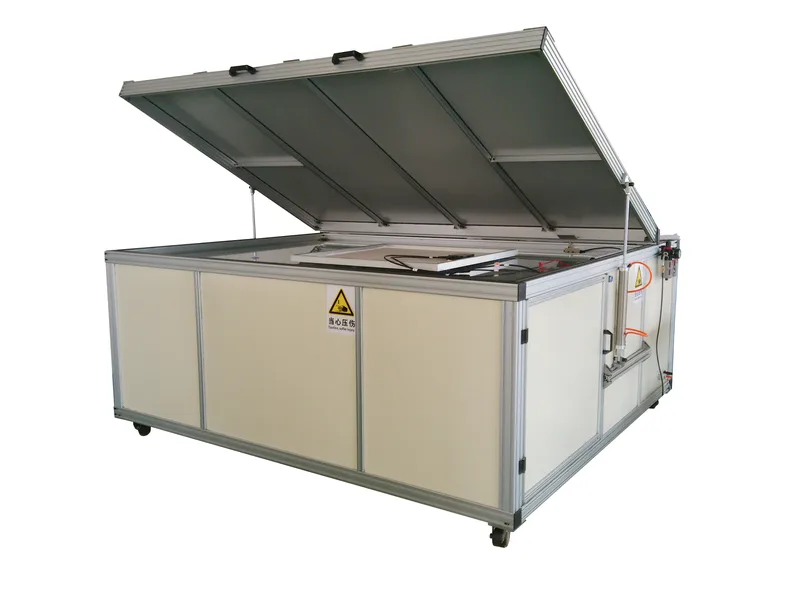
The physics above is a materials problem, and we do not make frame profiles. What we do make is the machine where the clamp is created, and that gives the argument a practical edge: whatever the profile will do over twenty-five years, the initial condition is set in about thirty-five seconds and nobody downstream can recover it.
Day-zero clamp: what the framing station sets, what it can record, and what has to be proven elsewhere.
Framing is where the module becomes mechanically rigid, and on our frame gluing and framing stations it is also where the clamp is first measured. The frame carries the mounting load, protects the glass edge and gives the stack its transport strength, and the seam between frame and glass takes much of that load, and the glass edge it grips was fixed one station earlier at the laminator. On the machines we publish, that means online gluing and framing in one pass, up to 2,000 × 1,000 mm with profiles from 30 to 50 mm, at 35 seconds per panel or less on the OTZK-A framing machine, with a separate hydraulic punching model covering 2,000 × 1,100 × 50 mm at plus or minus 1 mm framing accuracy and plus or minus 1.5 mm on the diagonal.
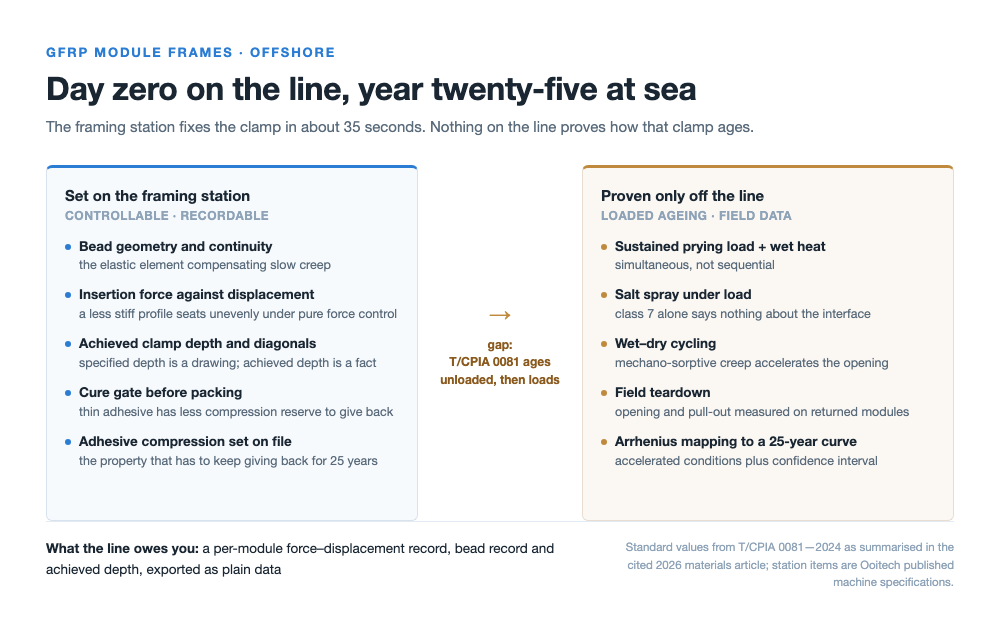
Replace the aluminum profile with a pultruded composite one and four of those parameters change meaning. The profile is less stiff, so force control alone will seat it unevenly and you want displacement control with a force envelope. Its dimensional tolerance is a different animal from extruded aluminum, so the corner and the punching station need re-validation. Its thermal expansion and its surface energy differ, which changes what the adhesive does in the first hour. And the slot depth you achieve, not the slot depth you specified, is the number that starts the twenty-five-year clock.
We run this assembly step using displacement control bounded by a programmed force envelope, pressing the composite profile to target depth while preventing excessive stress on the less stiff flange.
| What the station must control | Why it matters with a GFRP slot | What to have on the machine |
|---|---|---|
| Insertion force against displacement | The flange is the compliant part; pushing on force alone can seat unevenly and pre-load one corner. | Force–displacement curve logged per module with a pass window, not a single force setpoint. |
| Adhesive bead geometry and continuity | The bead is the elastic element that has to keep compensating as the slot creeps open. | Vision check on bead width and breaks, plus glue weight per module. |
| Achieved clamp depth and squareness | Specified depth is a drawing; achieved depth is a fact. Diagonals move when a frame is seated crooked. | Depth measurement after pressing and diagonal check, recorded, not sampled. |
| Cure and handling before packing | A bead that is still flowing when the module is stacked ends up thinner than designed, and thin adhesive has less compression reserve. | Time and temperature gate between framing and packing. |
What the station can prove, and what it cannot
A framing line is not a lifetime test, and no configuration of it becomes one. What it can do is make the day-zero clamp repeatable and traceable: every module gets a force–displacement record, a bead record and an achieved depth, tied to a serial number. When a utility tears down a module in year six and measures the opening, that archive is the only way to separate a material that moved from a module that was built wrong.
What it cannot do is tell you the retention curve. That requires loaded aging and field sampling, described in five steps in the source material: define failure as an opening limit or a pull-out retention against the mechanical design load; characterize absorption at three temperatures in pure water and artificial seawater, following ASTM D5229, to get diffusion coefficient, saturation and activation energy; run short-term prying creep across temperature, humidity and stress on a dedicated fixture, in the spirit of ASTM D2990, and build a time–temperature–humidity master curve; age under sustained prying load with wet heat, salt spray and wet-dry cycling, sampling pull-out force and opening to get a retention R(t); then map accelerated conditions onto an offshore spectrum with an Arrhenius relation and calibrate against modules pulled from a plant.
Two honesty notes on the published curve. The decay curve in that source is a schematic drawn from literature behavior with assumed parameters, not a measurement of any product. And its 67 % reference line is simply the standard’s 200 N over 300 N, offered as a visual benchmark rather than a life criterion.
Specifying a framing line that has to run composite frames
If you are buying a line that will frame composite modules for an offshore or floating project, five items belong in the technical agreement. They are cheap to add and expensive to retrofit.
- A force–displacement window per profile, with rejection, not just monitoring.
- Bead continuity by vision plus glue weight per module, archived against the module serial.
- A documented changeover between aluminum and pultruded profiles, including corner, punch and depth re-validation.
- Adhesive cure and handling gate before the packer, with the cure schedule signed off by the adhesive supplier.
- Export of the day-zero record in a format the project owner can keep for twenty-five years, which in practice means a plain CSV and not a vendor database.
That last item sounds bureaucratic until a warranty claim arrives. Then it is the difference between an argument and a table.
Five questions for the frame supplier
The frame is not our product, so here is what we would ask if we were buying one.
- What are your transverse flexural and short-beam shear values, and the retention after saturation rather than after a dry test?
- Which resin system, and what evidence do you have for interface density and hydrolysis resistance?
- How much margin is in the slot: clamp depth, flange thickness, and is there any mechanical interlock behind the flange?
- What is your adhesive’s compression set and rebound, since that is the property absorbing the creep?
- Do you have loaded aging data, sustained prying under wet heat and salt, and can I see a field teardown record?
A supplier who answers the first three with numbers and the last two with a plan is worth a pilot. A supplier who answers with salt spray class and a UV certificate has told you about the surface, and the surface was never the issue.
Where these numbers come from
The mechanism, the standard’s requirements and the five-step evaluation come from a Chinese-language technical article by a photovoltaic materials research group, published in October 2026, which cites T/CPIA 0081–2024, a 2026 offshore module white paper, and eleven materials and test-method references including ASTM D5229, ASTM D2990, IEC 61215-2 and IEC 61701. The sixfold uptake figure, the 1.5 % against 1.8 % saturation, the 75 % and 69 % interfacial losses and the 30 % modulus figure all come from glass-fiber work on civil and marine structures, in resin systems that are not identical to any frame on the market, and are quoted here for magnitude and trend. We do not manufacture frames, we have not tested any frame, and we have not measured slot opening on any module. The machine figures are our own published specifications.
Frequently asked questions
Is a composite frame better than aluminum for offshore modules?
For insulation, grounding and metal corrosion, yes, and that is why the category exists. For long-term clamping of the laminate, the evidence is thinner than the salt spray reports suggest. If your project is offshore or floating, ask for loaded aging data before you treat the frame as solved.
What does T/CPIA 0081–2024 actually guarantee?
That a profile met the mechanical and aging requirements in its tables: corner-cleat pull-out, interlaminar shear, flexural strength and whole-module load after combined aging. It does not establish a 25-year slot retention, because none of its aging runs is done under sustained load.
Why is the slot the weak point rather than the profile body?
A pultrusion is strong along its fibers. Opening the flange is a transverse and interlaminar shear action, carried by the matrix and the interface, which are the two things moisture degrades first. The body can pass every longitudinal test while the flange is the part that gives.
Does a class 7 salt spray result cover seawater exposure?
No. Saturated uptake in seawater can be lower than in pure water, around 1.5 % against 1.8 % in one GFRP test, while the mechanical loss at equal water content is comparable. Heat is the amplifier: the same review reports heavier interfacial loss at 60 °C than at 40 °C.
Can a framing machine measure the clamping force?
It can record insertion force against displacement and the depth achieved, which is the best proxy available on the line. It cannot measure long-term retention; that needs loaded aging and field teardown.
Which adhesive should be used with a composite frame?
One with low compression set and good rebound, because the adhesive is the elastic element compensating a slowly opening slot. Surface energy and chemistry of the pultruded profile differ from anodised aluminum, so compatibility has to be confirmed rather than assumed.
Do I need a different framing line to switch from aluminum to composite?
Not a different line, but a re-validated one. The press needs displacement control with a force envelope, the corner and punch tooling need checking against a less stiff profile, and the depth actually achieved has to be measured rather than assumed.
What is the 67 % reference line in the decay curve?
It is 200 N divided by 300 N from the standard’s corner-cleat requirement, used in the source as a visual benchmark. It is not a defined life criterion, and the curve around it is schematic rather than measured.
Final thoughts
Composite frames are a real answer to salt, grounding and PID, and a weak answer to creep. The slot will open a little over twenty-five years; the question is whether it opens past your sealing and pull-out limits. That is settled by loaded aging data and by a day-zero clamp you can prove. The framing station is where the second half of that sentence gets decided.
Before modules reach the framing station, uniform lamination establishes structural stability across the glass perimeter. OOITech supplies solar panel laminator machines in single and double chamber designs, available with oil-heated or electric platens. To evaluate lamination parameters for your composite frame configurations, send your drawings, module stack, or material samples to our engineering team.