Editorial responsibility for this article rests with Wuhan Ooi Photoelectric Technology Co., Ltd. Written and reviewed by the Ooitech editorial team. See our editorial policy for how we write, where AI tools are used, and how to request a correction.
HJT in 2026: Who Ships, and What It Changes on Your Line
Table of Contents
Quick answer: HJT did not disappear in 2026. It split. Huasun publishes 20 GW of nameplate capacity and 14 GW shipped cumulatively; Risen reports 26.40 % average cell efficiency on its Jintan phase-two 4 GW line, with 90 µm wafers in mass production and 70 µm in small-batch delivery; Liansheng has delivered 765 W modules at 24.63 % module efficiency. Beside them, Jingang discloses 2.8 GW of HJT capacity against 84.97 MW produced in the first half, which works out at about 6 % of half-year nameplate on our own division and is not a figure the company published, and Quanwei, with 4 GW of module capacity, produced 0.14 MW while in pre-restructuring. Any supplier list that mixes those groups will overstate what you can buy. For a module line the useful questions are narrower than the route name: what temperature the cell tolerates after metallisation, how thick the wafer is, and whether the joint is ribbon, wire or adhesive.
Most module lines get specified before the cells are chosen. HJT makes that order risky: the cell is finished below 200 °C, and everything downstream inherits the ceiling.
One word, four kinds of company
The Chinese industry review this piece works from sorted fourteen HJT players into five states. Five states is honest, and also hard to use, so we regrouped them into four: companies with products and batch deliveries, companies that run a line under financial pressure, companies using HJT as a platform for something else, and companies whose capacity exists on paper or in a plan. The difference decides whether a cell is a purchase order or a slide.
| State | Companies named in the source | What the public record shows |
|---|---|---|
| Shipping product | Huasun, Risen, Liansheng | Named module or cell products, published efficiency figures, batch delivery. |
| Line running, balance sheet strained | Jingang, Guosheng | HJT still inside the reported segment, with output, margin or utilisation under pressure. |
| Differentiating on something other than the standard module | CNBM Junxin, SPIC, Canadian Solar | Copper grid, space applications, or manufacturing outside China; capacity in ramp. |
| Multi-route development | Tongwei, Shanghai Electric Hengxi, Mingyang | HJT carried alongside TOPCon, BC, tandem or flexible substrates, not as the main output. |
| Plan or idle capacity | Hongjun, Runhai, Guangsheng, Quanwei | Announced build-outs or historical lines; current output either negligible or undisclosed. |
Only the first row is a supply source you can qualify against a delivery schedule. The second row can be one, if the line you buy from is the line that is running, and if the warranty survives whatever restructuring comes next. The last row is a name to check, not a vendor to plan around.
What the three that ship actually publish
Read the numbers below as what each company puts in public, in the first three quarters of 2026. They are not comparable line for line, and two of them are not output figures at all.
| Company | Published figure | What kind of number it is |
|---|---|---|
| Huasun | 20 GW HJT capacity, 14 GW cumulative shipments. September: Himalaya PLUS at 750 W mass-production power, 760 W maximum, 24.5 % module efficiency. | Nameplate capacity and a cumulative total. Neither tells you this year’s monthly output. |
| Risen | Jintan phase-two 4 GW line at 26.40 % average cell efficiency; Nanbin line at 26.42 %. 90 µm cells in mass production, 70 µm in small-batch delivery. | Line averages, company-reported. The 70 µm figure is a delivery, not a volume. |
| Liansheng | HJT cell mass-production average above 26 %. 765 W modules delivered in batches at 24.63 % module efficiency. 33.45 % certified perovskite/HJT tandem. | Cell and module figures from production. The tandem number is a certified research result, not a product. |
Huasun is the scale case: the widest published capacity base, and a product cycle that keeps producing new module models, which is the cheapest available evidence that a line is running. Risen is the manufacturing-system case, and the more interesting one for anyone specifying equipment, because its published work is about wafer thickness and silver consumption rather than about watts. Liansheng is the specialist case, and the only one of the three that has put a tandem efficiency on the record.
None of the three publishes a monthly cell output you could plan a module line against. Ask for it directly, and ask for the EL images from the week before your visit rather than the ones in the brochure.
Nameplate minus output, the arithmetic that changes a supply plan
Jingang’s first-half report still lists HJT cells and modules as its main business. It also discloses about 2.8 GW of capacity, 84.97 MW of output, 121.85 MW of sales and RMB 45.16 million of cell-and-module revenue, with a segment gross margin of minus 116.87 %. Divide 84.97 MW by half of 2.8 GW and you get 6.07 %. That is our division of two disclosed numbers, not the company’s utilisation rate, and the company does not publish one. It is still the clearest single figure in the whole 2026 picture: a line can exist, be listed as main business, and produce almost nothing.
Quanwei is the extreme version. Four gigawatts of module design capacity, 0.14 MW produced in six months, 26.99 MW sold, module gross margin minus 41.17 %, company in pre-restructuring. Selling 190 times what you produce means the sales came out of inventory. Guosheng sits between: RMB 343 million of revenue, a net loss of RMB 86.35 million, and a photovoltaic segment whose revenue of RMB 297 million came with RMB 320 million of cost. It does not split HJT out, so we cannot say what the HJT share of that is, and neither can anyone reading the same report.
Three of those four facts matter to a buyer. Which physical line the cells come from. What that line actually outputs per month. Who honours the warranty if the entity that made the cell stops being a going concern. A route name answers none of them.
Silver per watt is the number to watch, not module watts
HJT metallises both faces with low-temperature paste, and it needs a transparent conductive oxide on top of the doped layers. That combination is why silver sits higher in an HJT bill of materials than in a TOPCon one, and why every credible HJT roadmap in 2026 is a silver roadmap wearing a different title.
Risen’s published plan is to bring silver consumption down to 2.5 mg/W. That is a target, and the company states it as a target. SPIC has taken a copper-grid HJT pilot platform through environmental acceptance at Suining, which is the plating route to the same goal. Tongwei lists copper interconnection, 0BB and silver-free metallisation together, which is the honest way to list them, because they are one programme and not three.
This is where a cell-cost story becomes an equipment decision. Cutting silver means changing the joint: fewer busbars, then no busbars, then round wire or foil instead of flat ribbon, with the electrical connection consolidated during lamination rather than made on a stringer. The shift away from busbars is not a detail of cell design. It moves work from one machine to another and it changes which machine has to hold the tolerance.
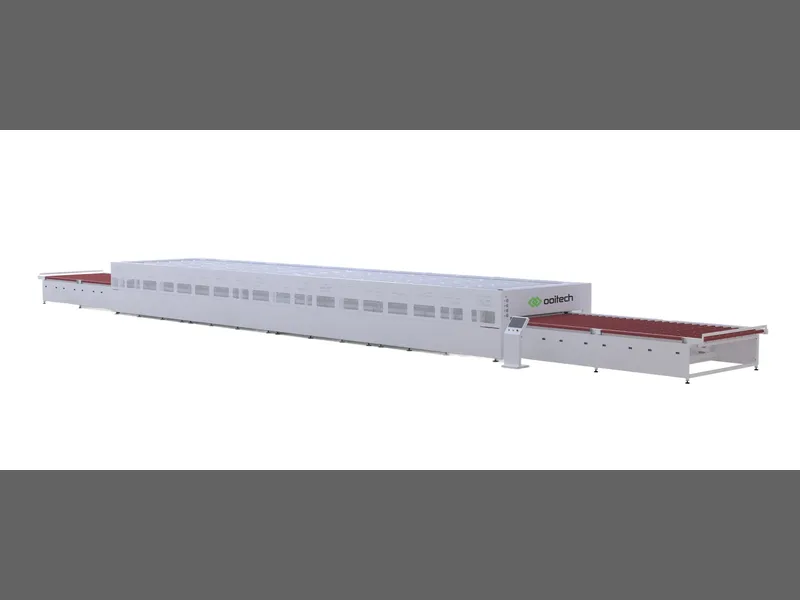
To consolidate busbar-free connections during lamination without damaging sensitive layers, we run multi-stage heating profiles below 200 °C that cure the encapsulant and set electrical contact in a single thermal cycle.
Ninety micrometres is a handling problem before it is a cost problem
Thin wafers are HJT’s structural advantage, because a low-temperature process does not punish you for removing silicon the way a firing step does. In 2026 that advantage is in production at 90 µm at one major maker, with 70 µm in small-batch delivery and GW-scale 70 µm described as a plan.
A 90 µm cell is not a 130 µm cell that weighs less. It bends further under the same suction, it stores more elastic energy before it breaks, and it fails at the edge and at the busbar-free joint rather than in the middle. The breakage you get is set by how the cell is picked, flattened and released, which is the stringer and the layup machine, not the cell line. If a supplier quotes you a cell price at 90 µm without a breakage figure measured on a stringer, the price is missing its largest downstream term.
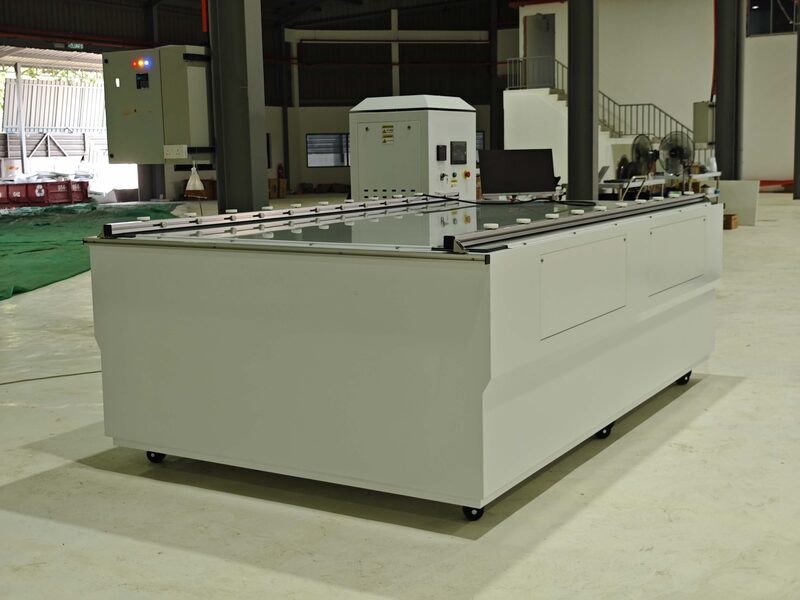
When flattening module stacks with 90 µm cells, we regulate vacuum draw rates and membrane descent speed to distribute mechanical loading evenly across the laminate and prevent edge fractures.
EL is how you see it. Cracks in a thin cell often survive visual inspection and show up as dark fingers or a darkened corner under forward bias, which is why an in-line string EL check earns its place on an HJT line earlier than it does on a TOPCon one.
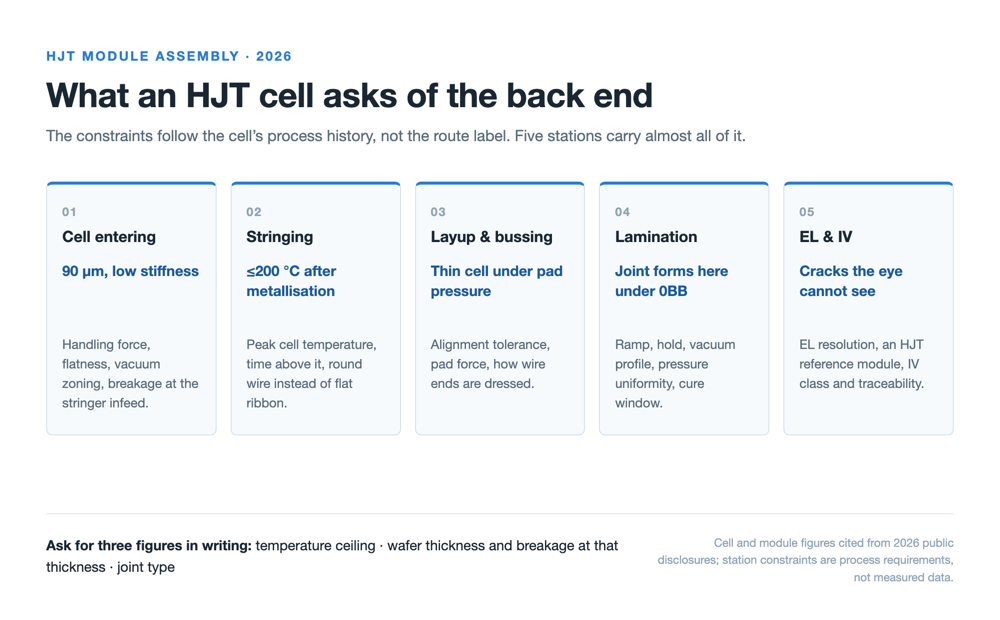
What an HJT cell asks of the back end
The constraints follow the cell’s process history, not the marketing label. Five stations carry almost all of it, and each one has a specification you can write down before you talk to any vendor.
What an HJT cell asks of the back end: the constraint at each station, and the figure to put in the specification.
| Step | What the HJT cell changes | What to put in the specification |
|---|---|---|
| Cell receiving and handling | 90 µm and thinner; lower stiffness; warpage from the TCO stack. | Maximum handling force, flatness tolerance, vacuum zoning, and a breakage target measured at the stringer infeed. |
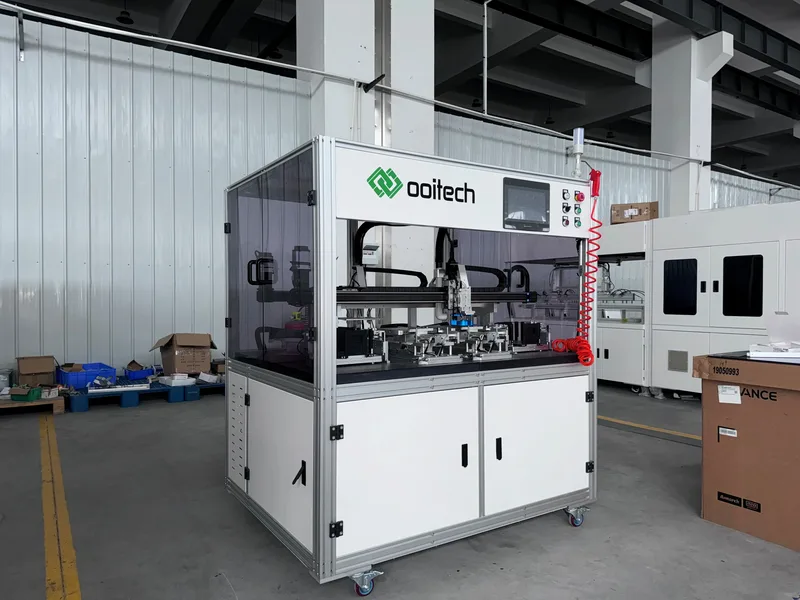
| Stringing | A post-metallisation temperature ceiling near 200 °C; ribbon may be replaced by round wire or foil. | Peak cell temperature and time above it, wire count and diameter, placement accuracy, and the pull strength you will accept per joint. |
| Layup and bussing | Thin cells under pad pressure; more joints, each carrying less current. | Alignment tolerance, pad force, and how the wire ends are dressed before lamination. |
| Lamination | With 0BB the electrical joint is consolidated here, so the recipe becomes a process step. | Ramp rate, hold temperature, vacuum profile and pressure uniformity, plus the cure window you will accept for the encapsulant. |
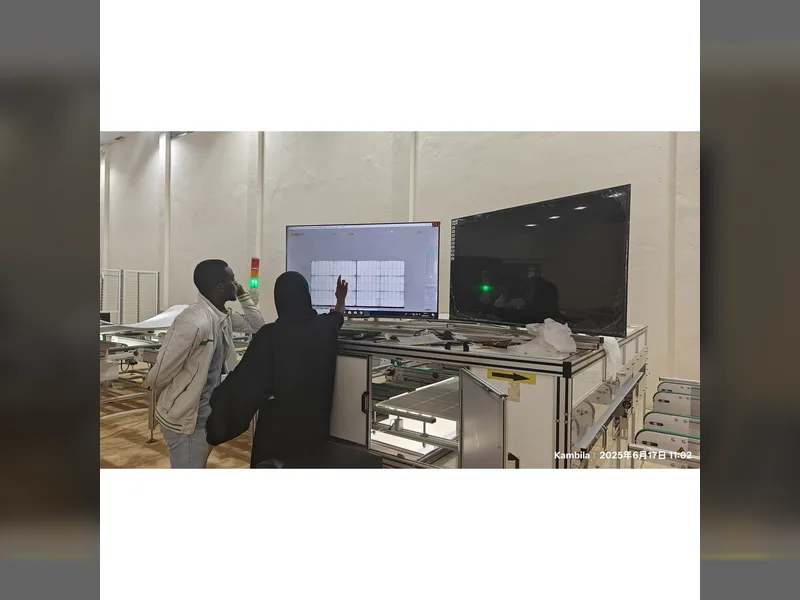
| EL and IV | Microcracks and joint voids that visual inspection misses; HJT needs its own reference module. | EL resolution and exposure, IV class and calibration traceability, and a reference module of the same cell type. |
A stringer does not become an HJT stringer because of its nameplate. On our SS-2500B platform, the 3–20BB range and the placement accuracy are the parts that matter for an HJT cell; the temperature profile and the wire handling are what you configure for it. If the joint moves into the laminator, the honest answer is that a laminator with a controllable ramp and uniform pressure stops being a utility machine and becomes part of the electrical process.
Where HJT is being pushed instead of the standard line
Three of the fourteen companies are not trying to win the ground-mount module market with HJT, and their reasons are worth understanding before you assume the route is stalled everywhere.
Space is one. Hongjun is working on HJT for space applications with Qianzhao Optoelectronics, on top of a Zhuhai plan of 8 GW of cells and 5 GW of modules and a Qidong phase one of 4 GW and 2 GW. Space photovoltaics pays for specific power and radiation tolerance, not for RMB per watt, which is a different market with different qualification and a much smaller volume.
Tandem is the second. Liansheng’s 33.45 % certified result and Mingyang’s tandem verification both treat the HJT cell as the silicon bottom cell. That is a research roadmap with a real physical basis, and it is not a module you can order.
Manufacturing elsewhere is the third. Canadian Solar’s CS PowerTech phase one in the United States, 2.1 GW of n-type bifacial HJT, started in July 2026, with a 4.2 GW phase two planned. Read that as HJT being used to build local content in a market that pays for it, not as a global pivot by the parent company.
Each of those three changes what the back end has to do. Space modules are small and hand-built. Tandem needs a cell that does not exist at volume. Overseas assembly needs a line that can be replicated and serviced at distance. None of them is the 700 W ground-mount line that most of this site is about.
Five questions to settle before you buy an HJT-qualified line
The route debate is not yours to settle. These five are.
- Which physical line will make my cells, what does it output per month, and can I see the EL station on the day I visit?
- What is the post-metallisation temperature limit, in writing, with the time above it?
- What wafer thickness and tolerance am I buying, and what breakage did the cell maker measure on a stringer at that thickness?
- Is the joint ribbon, wire or adhesive, and who owns the process window when it fails at the customer?
- If this supplier stops, what is my second source, and does its cell fit the same tooling without a change of recipe?
A supplier who can answer the first three in numbers is worth a visit. A supplier who answers the last two with a route name is not.
Where these numbers come from
Every company figure above comes from a Chinese-language industry review published in October 2026, which compiled 2026 half-year reports, company websites and product pages, investor communications and local government disclosures. We did not visit any of these lines, test any cell or module, or receive data from any of the companies named. The 6.07 % utilisation figure is our own division of two disclosed numbers and should be read as an order-of-magnitude check, not as a company statistic. Currency figures are as published in RMB, and “first half” means January to June 2026. Nothing here is a price, a lead time or a delivery commitment, and nothing here claims that Ooitech supplies equipment to any company named.
Frequently asked questions
Is HJT dead in 2026?
No. It has split into companies that ship, companies that run a line at a loss, companies using HJT as a platform for space or tandem work, and companies with capacity on paper. The route is alive; most of the names attached to it are not supply sources.
Can one stringer run both HJT and TOPCon?
Sometimes, and the frame is the easy part. What changes is the temperature profile, the handling force for a thinner cell, and whether you are placing ribbon or round wire. Ask for the changeover list and the time it takes, not for a yes.
Does HJT need a different laminator?
If the joint is 0BB, the electrical connection is consolidated during lamination, so ramp rate, hold temperature and pressure uniformity become electrical parameters. A machine with a repeatable recipe will do the job; one without it will produce joints you cannot inspect.
Why does silver matter more for HJT than for TOPCon?
Both faces are metallised with low-temperature paste, and a transparent conductive oxide sits above the doped layers. Silver is therefore a larger share of cell cost, which is why copper plating, 0BB and thinner wafers are all pursued as one programme.
How thin are HJT wafers in production?
One major maker reports 90 µm in mass production and 70 µm in small-batch delivery in 2026, with GW-scale 70 µm described as a plan. Whether you can use them depends on your breakage, not on the cell.
What module efficiency should I expect?
The two published HJT products quoted here sit at 24.5 % and 24.63 % at module level, on cells averaging above 26 %. Treat the cell number and the module number as separate specifications; they always are.
Should a new line be built for HJT instead of TOPCon?
If your cells come from a supplier with a running line, a published temperature limit and a stated monthly output, HJT is a normal engineering problem. If the supply depends on a nameplate figure and a plan, build for the cell you can actually buy.
Final thoughts
HJT in 2026 is a route with three real suppliers and a long tail of names that mostly do not ship. For a module line, that means the cell specification matters more than the label: temperature ceiling, wafer thickness, joint type. Get those three in writing, measure breakage at your own stringer, and the route argument becomes a purchasing question you can actually answer.
We supply single and double chamber solar panel laminator machines with electric or thermal oil heating to maintain the thermal uniformity HJT requires below 200 °C. Send us your module stack, glass drawings, or cell samples, and our engineering team will evaluate your lamination recipe and cycle parameters.