Editorial responsibility for this article rests with Wuhan Ooi Photoelectric Technology Co., Ltd. Written and reviewed by the Ooitech editorial team. See our editorial policy for how we write, where AI tools are used, and how to request a correction.
POE Localization: What Domestic Particles Change
Table of Contents
Quick answer: Three years ago photovoltaic grade POE quoted above 25,000 CNY per tonne and a film maker without an allocation could not schedule N-type modules. By July 2026 the domestic delivered price was around 12,000 CNY per tonne, nominal Chinese capacity had reached roughly 700,000 tonnes a year, and imports had fallen about 20 percent to 726,000 tonnes in 2025 while import dependence stayed near 75 percent. None of that makes the material interchangeable. What changes for a film or module buyer is that supply risk falls and the qualification burden rises, because the particle is only the first of four layers that have to be evidenced. This article sets out what actually moved, what the remaining gap is, and the order in which to prove a domestic particle in your own bill of materials.
A particle that costs half as much and cures differently is not a cheaper input. It is a different input, and the film formula is where that difference appears first.
What changed in three years
The shortage story and the surplus story are both true, and they arrived within about thirty months of each other. In 2023 photovoltaic grade POE was a rationed material produced by six non-Chinese suppliers. Domestic industrial lines started producing qualified material from December 2023, and by 2025 nominal capacity had reached roughly 700,000 tonnes a year, an increase of about 159 percent in a single year. Imports fell to about 726,000 tonnes in 2025, down about 20 percent, the first clear decline in years, while import dependence remained around 75 percent.
| Producer | Line and status | What it means for a buyer |
|---|---|---|
| Wanhua Chemical | Yantai 200,000 t/y, started June 2024; Penglai phase two 400,000 t/y broke ground March 2025 | First large line on self-developed solution technology; photovoltaic grades under a named series |
| Dingjide | Dalian Changxingdao 200,000 t/y, qualified product October 2025 | Photovoltaic grade focus, with alpha-olefin integration |
| Beiouyi (Chambroad group) | First industrial line December 2023; new 100,000 t/y line in stable output July 2026 | Earliest private industrial producer |
| Eastern Shenghong | Lianyungang 100,000 t/y, started 17 August 2025; first 320 t delivered in September | Own catalyst, supplies both EVA and POE |
| Maoming Petrochemical | 50,000 t/y, trial run April 2025, load raised to about 80 percent | Sinopec solution process; first export to North America in September 2026 |
| Dushanzi Petrochemical | Retrofitted line, about 60,000 t in 2025 | First domestic gas-phase process |
Three barriers, and none of them is a machine
POE is an ethylene and alpha-olefin copolymer made with a metallocene catalyst. The difficulty sits in three places that have to work at the same time, which is why buying a reactor does not produce a photovoltaic grade.
- The catalyst. A single-site catalyst sets the comonomer insertion and the molecular weight distribution. It is the most patented and the hardest of the three.
- The alpha-olefin. 1-octene has been imported, and around 2022 it cost more than twice as much as 1-butene. Without a captive supply, both cost and continuity are outside your control.
- The high temperature solution process and devolatilisation. Heat transfer and mass transfer in a very viscous system, plus solvent and monomer removal, decide the volatiles, the gels and the batch to batch stability of the pellet.
The pilot experience is the honest measure of this. One producer reported more than 70 startups and more than 50 modifications across two years on an 800 tonne per year pilot before the industrial line ran correctly on its first attempt. That is the normal shape of this curve, not an exception.
What POE does differently inside a laminate
The difference starts in the molecule and it is simple to state: POE has no vinyl acetate group. EVA does, and under damp heat that group hydrolyses and releases acetic acid, which then sits next to exactly the two materials that must keep conducting, the silver grid and the ribbon surface.
Everything else follows from the saturated hydrocarbon backbone. Water vapour transmission is a fraction of EVA, in the range of a few tenths down to a tenth depending on the grade and the film. Volume resistivity is typically one to two orders of magnitude higher, so ionic movement is harder and potential induced degradation is easier to resist. Those three properties are why N-type modules use POE or EPE on at least one face, whether the cell is TOPCon, HJT or back contact.
The same three properties are the problem
A saturated, non-polar chain does not like polar additives. Crosslinking agents, silane coupling agents and stabilisers are all somewhat polar, and in POE they migrate and bloom more readily. In production that reads as a tacky surface, a rising haze value and adhesion that does not hold. On the laminator it reads as slip during layup, slower cross-linking and a longer cycle.
That last point is where film choice stops being a procurement decision and becomes an equipment question. A slower cure per millimetre of film either extends the dwell or raises the platen temperature, and both consume capacity. The EVA process window is the reference most lines are set against; a POE or EPE campaign has to be measured again rather than inherited.
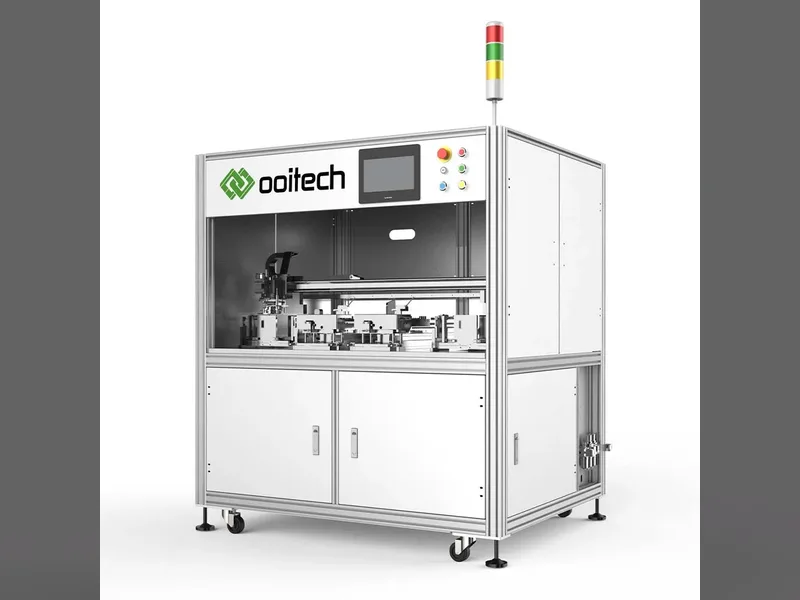
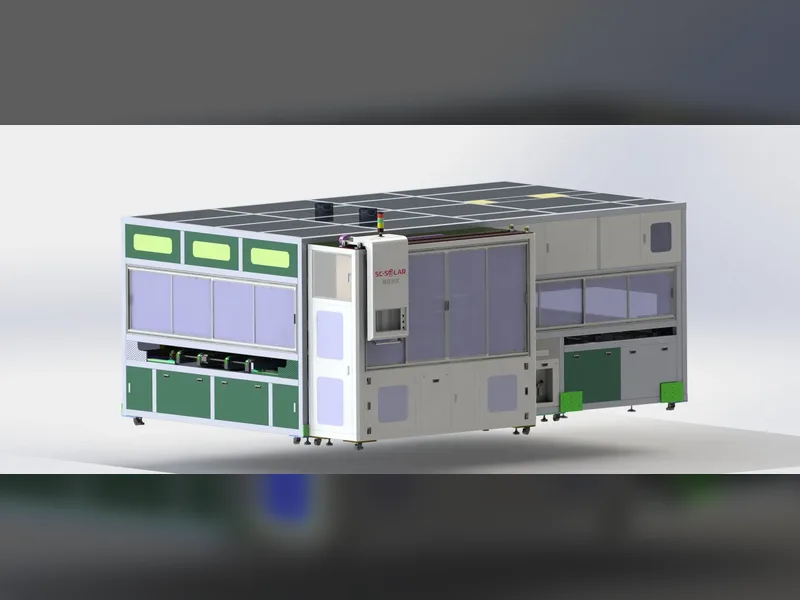
When balancing platen temperature against cycle time for alternative formulations, we separate the thermal profile across two consecutive process stages, using oil-heated platens to maintain uniform heat transfer across the glass during extended crosslinking dwell.
EPE exists because of that trade
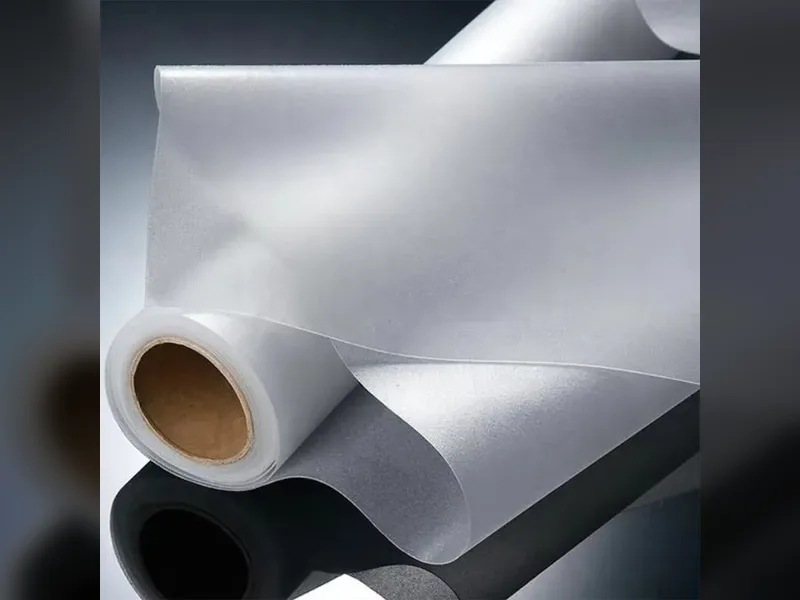
EVA and POE co-extruded as a three layer film is the compromise the market settled on: EVA skins give the surface that bonds and processes, a POE core gives the barrier and the resistivity. It is not a sum of the two materials. It is a structure with its own failure modes, of which interlayer additive migration is the one that shows up last and costs most, because it can appear as voids tracking the ribbon row long after the qualification batch was approved.
Market data explains why this structure is now the default. In 2024 transparent EVA held about 41.6 percent, co-extruded EPE about 37.0 percent and pure POE about 13.2 percent, so films containing POE were already close to half of the encapsulation market. Domestic POE capacity arriving at a lower price tends to shift the balance between EPE and pure POE rather than between POE and EVA.
Why film makers feel it before module makers
A module maker buys a film with a specification and a certificate. A film maker buys a pellet and inherits every variable the pellet brings: the melt index drift, the gel count, the volatiles, and the way a non-polar resin accepts a polar additive package. That is why the first visible effect of a particle change is usually a change in scrap rate at the film line rather than a change in a module test result, and why the film maker is the party that asks for twenty lots of data.
It also explains the negotiating asymmetry. When particles were short, the film maker with an allocation set the terms with the module maker. Now the film maker has a choice of particles and the module maker has a choice of films, so the scarce item has moved from the molecule to the evidence. A film maker who can show dispersion data and a coupon history across three particle sources is selling something the price of the pellet cannot substitute.
For the equipment side the same shift has a practical reading. A film that cures more slowly or slips more during layup changes the cycle, and the cycle is where capacity is counted. The lamination cycle is worth re-measuring at the same time as the material is re-qualified, because the two numbers are quoted separately in most approval files and they should not be.
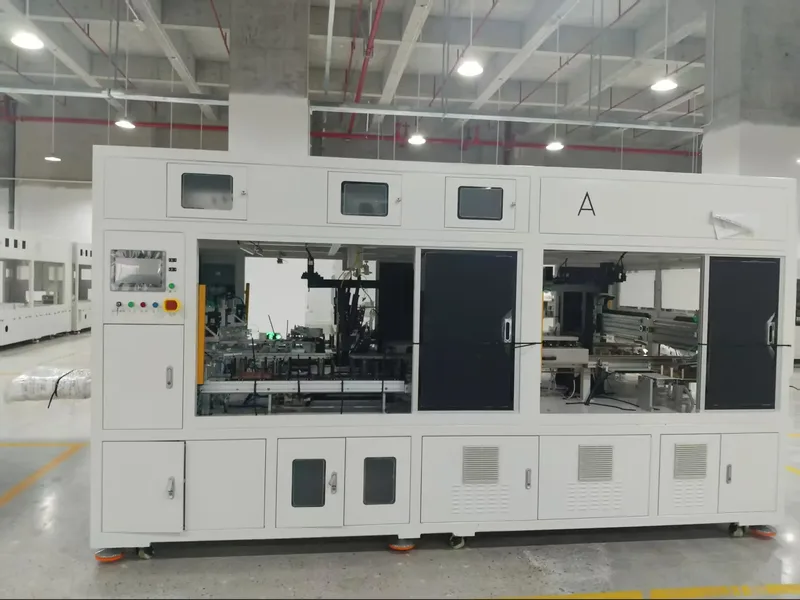
To verify cycle impact during material re-qualification, we measure the evacuation rate and pin drop timing across both chambers, ensuring the recipe accommodates film slip without extending the baseline pump-down time.
The remaining gap is the comonomer
Domestic incremental volume is mostly butene based. Octene grades and, more importantly, stable photovoltaic grade supply are where the difference still sits. For a buyer this turns into one question that has to be asked before any price comparison: which comonomer, at which melt index, on which line, and what is the batch to batch dispersion of both.
Dispersion is the number that matters more than any single result. A supplier whose best batch hits the specification and whose next three do not is a different supplier from one whose batches all land in a narrow band, even when both pass the incoming inspection. Ask for the last twenty lots, not the certificate of analysis for the qualification sample.
Cheaper particles do not make re-qualification cheap
A particle substitution is a bill of materials change, and it enters the same evidence chain as any other material change. The expensive part is not the particle test. It is the module level aging matrix and the certification decision that follows it, because those run on calendar time that you cannot compress by paying more.
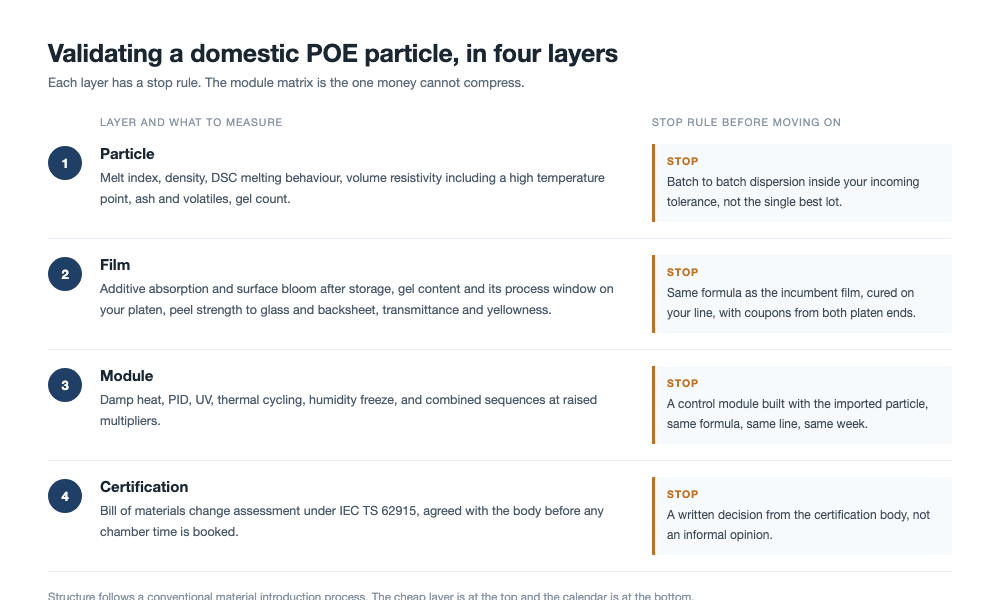
The practical order is from the particle outward, and each layer has a stop rule. If the particle layer shows dispersion you cannot live with, nothing downstream will fix it.
Four layers, four stop rules. The particle test is the cheapest and the module matrix is the one that runs on calendar time.
| Layer | What to measure | Stop rule before moving on |
|---|---|---|
| Particle | Melt index, density, DSC melting behaviour, volume resistivity including a high temperature point, ash and volatiles, gels | Batch to batch dispersion inside your incoming tolerance, not the best lot |
| Film | Additive absorption and surface bloom after storage, gel content and its process window, peel strength to glass and backsheet, transmittance and yellowness | Same recipe as the incumbent film, cured on your line, with coupons from both platen ends |
| Module | Damp heat, PID, UV, thermal cycling, humidity freeze, and combined sequences at tightened multipliers | Run against a control made with the imported particle in the same formula, same week |
| Certification | Bill of materials change assessment under IEC TS 62915, agreed with the certification body in advance | Written decision from the body before the aging matrix is ordered |
The control module is the part that gets skipped. Comparing a domestic particle module to a supplier datasheet is not a comparison. Comparing it to a module built with the incumbent particle on the same line in the same week is. That control is also what makes the retest decision defensible to a certification body, because it isolates the variable you actually changed.
If you want the shortest version of the whole matrix, it is the standard reliability list with the multipliers raised and the control module added. Nothing exotic is required. What is required is booking the chamber time before the price negotiation finishes, because the chamber is the rate limiting step.
What to write into the purchase specification
- The comonomer and the melt index, named per grade, with the test method.
- Dispersion, not minimum: the specification should carry a maximum spread across lots, not only a limit on the mean.
- The carrier of the additive package, because in a non-polar resin the delivery form matters as much as the dose.
- Coupon recipe and method for gel content, so film and module labs compare the same quantity.
- Dual source with one approved formula. Two particles in one formula is a formulation change, not a supply backup.
- A change notification clause, including line, catalyst and comonomer changes, with a re-qualification trigger.
Where these numbers come from
The capacity, import, price and plant status figures come from the source article this piece is based on, which compiles company announcements, a credit rating agency industry review, a market research summary and metal market price assessments, with data cut off in early October 2026. Prices are domestic delivered quotes for photovoltaic grade material, not contract prices. Capacity figures are nominal, and nominal capacity is a statement about nameplate rather than about qualified output.
The market share figures are 2024 shipment estimates, and two research houses in the source disagree by a few points on the split between transparent EVA and EPE, so read them as a trend rather than a census. The source explicitly declines to use the widely repeated claim that domestic material already holds more than half of a leading film maker supply, because no reliable attribution was found, and we do not use it either. The WVTR and resistivity comparisons are the source qualitative ranges, not grade specific measurements.
The four layer validation order and the stop rules are our own structuring of a conventional material introduction process. We have not qualified a domestic POE particle, and nothing here should be read as a measured result from our line.
Q: Is domestic photovoltaic grade POE good enough now?
Qualified material exists and has been used in film. Whether it is good enough for your product is a question about dispersion and about the aging matrix you are willing to sign, not about nationality.
Q: Does a lower particle price change the film price one for one?
No. The particle is the largest single cost in a film but the additive package, the conversion, the yield and the qualification cost do not move with it, and film pricing has lagged particle pricing in both directions.
Q: Should I switch from EPE to pure POE while particles are cheap?
Only if the process window supports it. Pure POE is slower to cross-link and more prone to slip, so the change reaches into the laminator recipe. EPE keeps the EVA skin for exactly that reason.
Q: Why does import dependence stay near 75 percent if capacity is 700,000 tonnes?
Because nominal capacity is not qualified photovoltaic output, and because a large share of that capacity is butene based and serves other applications. The two numbers describe different things and both are correct.
Q: Which comonomer should I specify?
Specify what you have qualified, and require the supplier to declare any change. Octene grades are the remaining gap in domestic supply, so a butene grade is not a drop in replacement for an octene grade even at the same melt index.
Q: How long does the whole four layer process take?
The particle and film layers can run in weeks. The module matrix runs in months of chamber time, and the certification decision adds the body review on top. Budget the chamber before you budget the material.
Q: Can I keep two particle suppliers behind one film formula?
Only if you validate that formula on both particles. Otherwise you have two products sharing one specification, and the first field failure will not tell you which one it came from.
Q: Does a domestic particle change the gel content window?
It can, because cross-linking efficiency depends on the resin and on how the additive is carried. Requalify the window on your own line rather than reusing the recipe from the imported grade.
Final thoughts
The domestic POE story moved from whether the material exists to whether a lot, a film and a module can each be evidenced, and those are three different jobs with three different clocks. Price relief is real and it is already in the market. The part that still costs money is the proof, and the proof is the only thing that lets you sign twenty five years on a substituted particle.
We manufacture single and double chamber solar panel laminator machines in both oil-heated and electric heating configurations, built to handle shifting encapsulation windows. If you are re-qualifying encapsulation films or adjusting cycle parameters, send your module stack drawings and test materials to our engineering team for process evaluation.