Editorial responsibility for this article rests with Wuhan Ooi Photoelectric Technology Co., Ltd. Written and reviewed by the Ooitech editorial team. See our editorial policy for how we write, where AI tools are used, and how to request a correction.
BC Orders Booked to 2027: What It Changes for a Module Line
Table of Contents
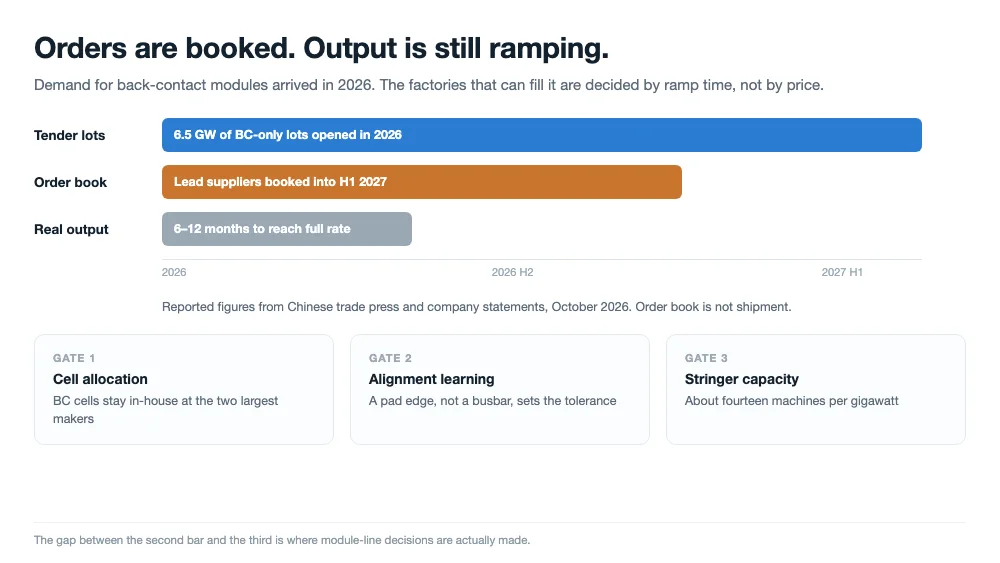
Quick answer: In October 2026, Chinese trade reporting and company disclosures put utility-scale BC tenders above 6.5 GW for the year and described order books from the two leading BC makers running into the first half of 2027. For a module line, that changes the planning sequence rather than the welding recipe: cell allocation, ramp time and stringer capacity now set the delivery date more than module price does.
What changed in 2026
Back-contact cells spent the last five years as a premium rooftop product sold mainly into Europe and Japan, at a price most utility projects would not pay. The reporting from October 2026 describes a different market. State-owned buyers including Datang, Jingneng, CNPC and the South-to-North Water Diversion group opened BC-specific tender lots in 2026, and the combined volume is reported above 6.5 GW. A tender lot is not a purchase order, but a utility that writes a BC-only lot into its procurement schedule has already accepted the premium in its budget.
The numbers attached to the two largest suppliers tell you how tight the queue is. AIKO is reported with roughly 15 GW of ABC module orders in hand, booked into the first half of 2027, plus a 4 GW BC lot in Datang's 2026–2027 programme. LONGi's HPBC 2.0 modules are quoted at 650–670 W in mainstream production, with cumulative BC shipments heading toward 100 GW by the end of 2026. GCL has shipped GPC back-contact modules overseas, TCL Zhonghuan has an Australian utility-scale BC order, and Trina is in sampling and framework discussions.
Treat these as reported figures, not audited ones. The source is Chinese trade press reporting company statements, and we have not independently verified any of it. What matters for a factory is the pattern behind the numbers: demand arrived faster than the ability to make cells, and the gap is being closed by booking capacity rather than by price competition.
| What the October 2026 reporting says | What it changes for a line planner |
|---|---|
| BC tender volume above 6.5 GW in 2026 | A BC capability decision moves from optional to scheduled, because a utility lot cannot be served with TOPCon modules |
| Order books into H1 2027 | Your delivery date depends on cell allocation, so the module line has to be ready before the cells land, not after |
| New BC lines taking 6–12 months to reach full rate | The ramp, not the purchase, is the long pole; equipment lead time and commissioning sit inside that window |
| BC cells largely kept for in-house modules | Merchant cell supply is thin, so a BC line without a cell agreement is a line without a schedule |
| Domestic BC cell capacity possibly above 100 GW in 2026 | Capacity is not output; yield and cell allocation decide what actually leaves the building |
An order book is not output
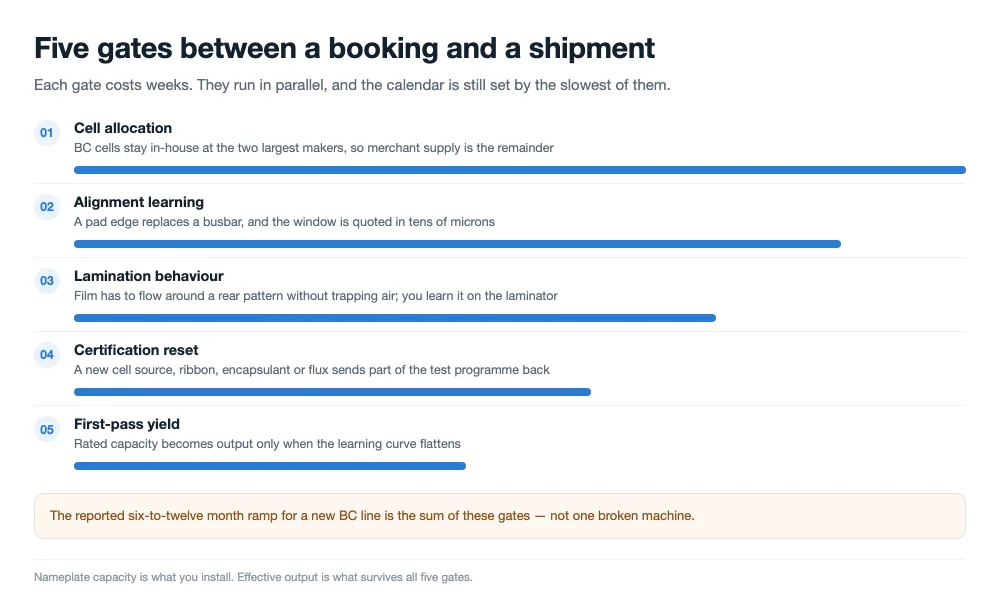
The phrase that does the most work in the reporting is "capacity does not equal effective shipments". A BC line that has been installed and a BC line that ships at rate are separated by five things, and only one of them is equipment.
The first is cell supply. If the two largest BC makers keep their cells for their own modules, a merchant module factory is competing for the remainder, and the remainder moves slowly because every cell it sells is a module it cannot ship itself. The second is process learning. A back-contact cell puts both polarities on one surface, which turns a welding station into an alignment problem with a window measured in tens of microns; the operator learning curve on that station is longer than on a busbar cell, and it shows up in first-pass yield, not in nameplate capacity. The cell side of that problem is worth understanding before you buy anything: the rear pattern is what makes the joint hard, and the cell-making process decides how much tolerance you get.
The third is encapsulation and lamination behaviour. A rear-side pattern with narrow pads and glue lines needs the layup to be flat enough that the film flows around it without trapping air, and that is discovered on the laminator, not on the drawing. The fourth is certification: any change of cell supplier, ribbon, encapsulant or flux resets part of the qualification work. The fifth is the one nobody budgets for, which is that all four of the above overlap, so the line reaches its rated output months after the last machine is signed off.
We run back-contact layups on oil-heated laminators with multi-stage evacuation, controlling temperature uniformity across 130 to 170 μm cells so the encapsulant melts smoothly into the rear pattern without trapping air bubbles.
That is why the reported 6–12 month ramp for a new BC line is not a sales excuse. It is the normal shape of a back-contact ramp, and it is the number to plan against when a tender award puts a delivery date on your desk.
Why the stringing station is the slowest gate
On a front-contact cell, the ribbon lands on a busbar pad several millimetres wide, and an offset still leaves metal under the joint. On a back-contact cell the same offset can place a strip between two fingers of opposite polarity, which is not a weak joint but a short. The placement tolerance therefore stops being a machine calibration question and becomes a measurement question: you have to know where the pad edge is, on every cell, through the shift. If the mechanics of the station are new to you, the string soldering sequence for BC cells walks through it station by station.
Three consequences follow, and they are mechanical rather than metallurgical. Alignment has to be vision-based, because a mechanical stop cannot see the pad. Hold-down force has to be low and even, because a 130–170 μm cell with a full rear interconnect pattern cracks rather than flexes. And the ribbon has to be flat, because a round wire touches a flat pad along a line instead of an area. The welding metallurgy itself — wetting, intermetallic growth, solidification — does not change much; it is the same tin-based alloy doing the same three things.
This is also why the 0BB variants matter here. Point-glue, tape and full-film interconnection all move part of the connection later in the process, which shortens the time the cell spends hot and widens the process window, but it moves the discovery of a bad joint downstream too. A defect that used to be caught at the stringer now appears after lamination, when the module is worth far more. For a line planning a BC ramp, that trade is worth understanding before the equipment arrives, not after.
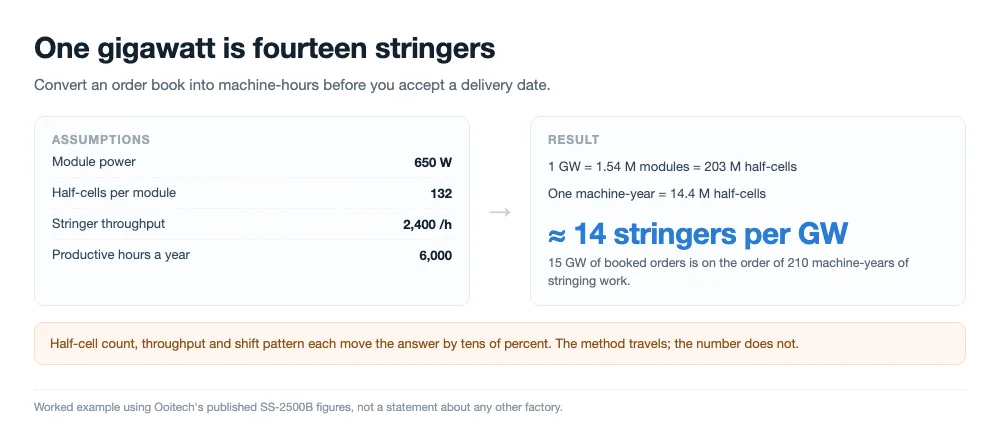
The right way to read a BC capacity plan is therefore to convert gigawatts into stringer-years. Take a 650 W module, 132 half-cells in it, 2,400 half-cells per hour on a machine of the SS-2500B class and about 6,000 productive hours a year: one stringer covers roughly 71 MW of module output a year, so a gigawatt is about fourteen machines. Fifteen gigawatts of booked orders is on the order of two hundred stringer-years of work. Put that against a six-to-twelve month ramp and the queue stops looking like a marketing story and starts looking like arithmetic.
These are our own published figures used as a worked example, not a claim about anyone else's factory. Half-cell count, throughput and available hours all move the answer by tens of percent. The method is what travels: size the stringing capacity first, then the rest of the line.
What you can prepare before the cells arrive
If your line is waiting for BC cells, most of the ramp work can be done in advance. Weld a qualification batch from each intended cell source on the machine you actually own, not on a demonstration unit, and record what the joint does at the edges of the window. That single exercise converts an unknown into a recipe library, and it is the difference between a line that starts at 90% and a line that starts at 60%.
The second preparation is to keep the platform able to change product without a mechanical rebuild. A line that needs a hardware change between a TOPCon batch and a BC batch loses days per switch, and a line with a switchable recipe and a common carrier loses hours. If you expect to run both technologies for a couple of years while the market decides, that difference is the whole business case.
| Preparation item | Why it matters more for BC | Evidence to ask for |
|---|---|---|
| Qualification batch per cell source | Paste, finger geometry and pad width differ by maker, and the recipe follows the cell | First-pass yield and peel strength per source, on your machine |
| Placement tolerance in microns | A misplaced strip can bridge opposite polarities instead of merely under-lapping | Measured offset distribution across a full shift, not a single good run |
| Force and flatness setup | Thin cells with a dense rear pattern crack under force a busbar cell tolerates | Breakage rate after welding, by cell thickness |
| Post-weld inspection | Micro-cracks near the pad may not show in a pull test that the joint survives | EL images compared before and after stringing |
| Product switch time | A mixed order book means switching between technologies in the same week | Documented changeover with a timed trial, not an estimate |
The procurement side has already changed
Developers and EPCs quoted in the same reporting describe a different negotiation than the one they ran two years ago. The question is no longer what the module costs; it is which production slot is available. Long-term agreements that lock volume, and advance booking of line capacity, are becoming the standard way to buy BC modules in China, and the projects that did not book early are being pushed into next year.
That behaviour travels upstream. If your customers are booking your line capacity, you are booking your cell supply and your equipment the same way. A BC decision that starts when the tender is signed will always be late, because the cell allocation, the machine lead time and the ramp overlap rather than queue.
Reading a BC tender lot before you answer it
A utility BC lot is written by an engineer who has already decided what the module must do, and the document usually says more about the line than about the price. The power bin is the first thing to check against your own capability. A lot that requires a 650 W bin out of cells that produce 670 W in the supplier's hands leaves you a loss budget for stringing, layup and lamination; if your first-pass yield is still learning, that budget is the difference between shipping and reworking.
The second thing to read is how the lot describes inspection. Back-contact modules hide part of their interconnect on the rear, so the EL criteria and the visual criteria have to be read together with the module construction. If the tender assumes a rear-side EL image at a given resolution, your inspection station has to be able to produce it, and that is a purchase decision rather than an operational one.
The third is the bill of materials behind the warranty. Insulating glue, flat ribbon, the encapsulant and the junction box all appear in the qualification file, and a lot that fixes any of them removes your ability to substitute during the ramp. Worth confirming before you sign, because the substitution you planned as a cost lever may already be excluded.
- Power bin and the loss budget it implies for your line
- EL and visual acceptance criteria, including rear-side imaging
- Which materials the warranty and qualification file fix
- Whether the module construction assumes glue, tape or film interconnection
- Delivery schedule against your realistic ramp date, not your nameplate date
None of this is exotic. It is the same list you would read for any tender, applied to a product whose failure modes sit on the side you cannot see from the front.
Three ways to add BC capacity
There is no single right answer, only three structures with different risk profiles. Decide which one you are in before you request quotations, because the equipment, the staffing and the certification work differ.
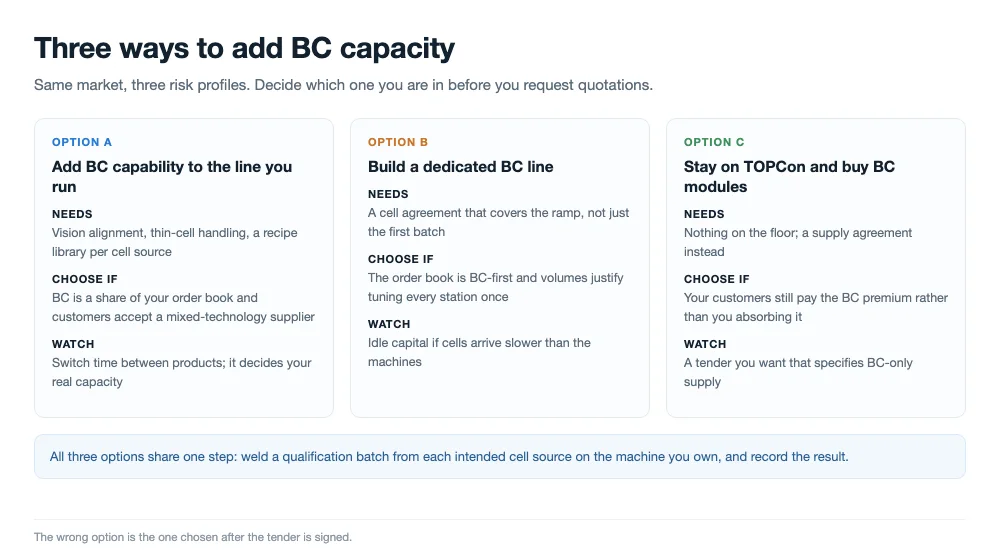
Add BC capability to the line you already run
If your existing platform already handles thin cells and has vision alignment, the marginal cost is a recipe library, a qualification batch per cell source and retraining. Choose this when BC is a share of your order book rather than all of it, and when your customers accept a mixed-technology supplier.
Build a dedicated BC line
If the order book is BC-first and the volumes justify it, a dedicated line removes the switch penalty and lets you tune every station for one product. Choose this when you have a cell agreement that covers the ramp, because a dedicated line with thin cell supply is the most expensive way to idle capital.
Stay on TOPCon and buy BC modules
If your market does not yet require BC and your volumes are small, buying finished BC modules for the projects that ask for them keeps capital free. Choose this when the BC premium is still paid by your customer rather than by you, and revisit the decision when a tender you want requires BC-only supply.
What would change this picture
Five things are worth watching, and each of them moves the picture in a different direction. Merchant cell supply is the first: if the two largest makers begin selling BC cells externally in volume, the module ramp stops being gated by allocation. Silver reduction and process simplification are the second: both lower the cost gap that currently justifies the premium. The third is whether utility tenders keep writing BC-specific lots, which is what turned a rooftop product into a utility product in the first place.
The fourth is the interconnection route. If 0BB-style glue and film methods mature, the stringing station becomes less of a bottleneck and the laminator becomes more of one, which changes where a line should spend its capital. The fifth is simply the yield curve: a supplier that publishes 98% first-pass yield at full rate is telling you something different from one that publishes nameplate capacity.
To keep the lamination stage from constraining line pace, we pair double chamber laminators with split heating and cooling stages, maintaining steady thermal transfer across 132 half-cell modules during the longer curing cycles.
Frequently asked questions
Is the BC order backlog real or is it announced capacity?
Both exist, and the reporting mixes them. Orders in hand and installed capacity are different numbers; what matters for a delivery date is the yield-adjusted output, which is rarely disclosed. Ask for shipment or revenue figures, not nameplate gigawatts.
Can an existing TOPCon line be converted to BC?
Partly. The stringer needs vision alignment and a lower, flatter hold-down force, and the layup and lamination stations need to handle a rear-side pattern. Much of the line is unchanged, which is why adding BC capability to an existing platform is usually cheaper than a new building.
Why does a BC line take six to twelve months to reach full rate?
Because the constraints stack rather than queue: cell allocation, alignment learning, lamination behaviour, certification of every changed material, and first-pass yield improvement all run at the same time. None of them is slow on its own; together they set the calendar.
How many stringers does one gigawatt need?
With 650 W modules, 132 half-cells each, 2,400 half-cells per hour and 6,000 productive hours, about fourteen. Change any of those assumptions and the answer moves by tens of percent, so run the arithmetic with your own cell format and shift pattern.
Does BC need a different ribbon?
Usually flat ribbon rather than round, because the rear pad is a flat surface with a defined width and a round wire only touches it along a line. Coating thickness and hardness stay in the normal range, though the stiffness has to suit a thinner cell.
What about HJT and TOPCon while BC ramps?
A platform that holds a recipe library can run all three. HJT sets the ceiling on process temperature, TOPCon and BC sit in a similar range, and the machine hardware does not need to change between them if the carrier and the alignment system are common.
Do I need new certification to make BC modules?
Yes for anything that changes the bill of materials or the cell construction. IEC qualification is tied to the design and the materials tested, so a new cell type or a new encapsulant means part of the test programme runs again. Plan it inside the ramp, not after it.
If BC is sold out, does that raise module prices?
It supports a premium rather than a spot price spike, because the buyers are utilities on long-term agreements. The visible effect is lead time and allocation, with price moving more slowly than availability.
Final thoughts
The BC story in October 2026 is really a scheduling story. Demand is booked, cells are allocated, and the factories that win the next two years are the ones that treat the ramp as the product rather than the delay. If you are planning a BC line, size the stringing capacity first, prove the joint on a qualification batch from each cell source, and keep the platform able to switch back. The market will decide how much BC it wants; the calendar will decide who can deliver it.
Related reading:
- BC Cell Compatibility: Six Makers, One Tabber Stringer
- Why BC Cells Are Hard to Make: AIKO's Self-Masked Two-Step Process
- BC Solar Cells Explained: Structure and String Soldering
- 0BB on Back-Contact Solar Cells: Gains and Yield Limits
- Why Do BC Solar Cells Need Insulating Glue on the Back?
- Tabber and Stringer Machine: How It Works, How to Choose
- SS-2500B Full-Automatic Solar Cell Tabber Stringer
- SS-1500B Automatic Solar Cell Welding Machine
OOITech supplies single and double chamber solar panel laminator machines with electric or thermal oil heating for back-contact and hybrid module lines. If you are adapting your process for narrow rear-contact margins, send your drawings, a module stack, or sample cells to our engineering team for lamination testing and thermal profile evaluation.