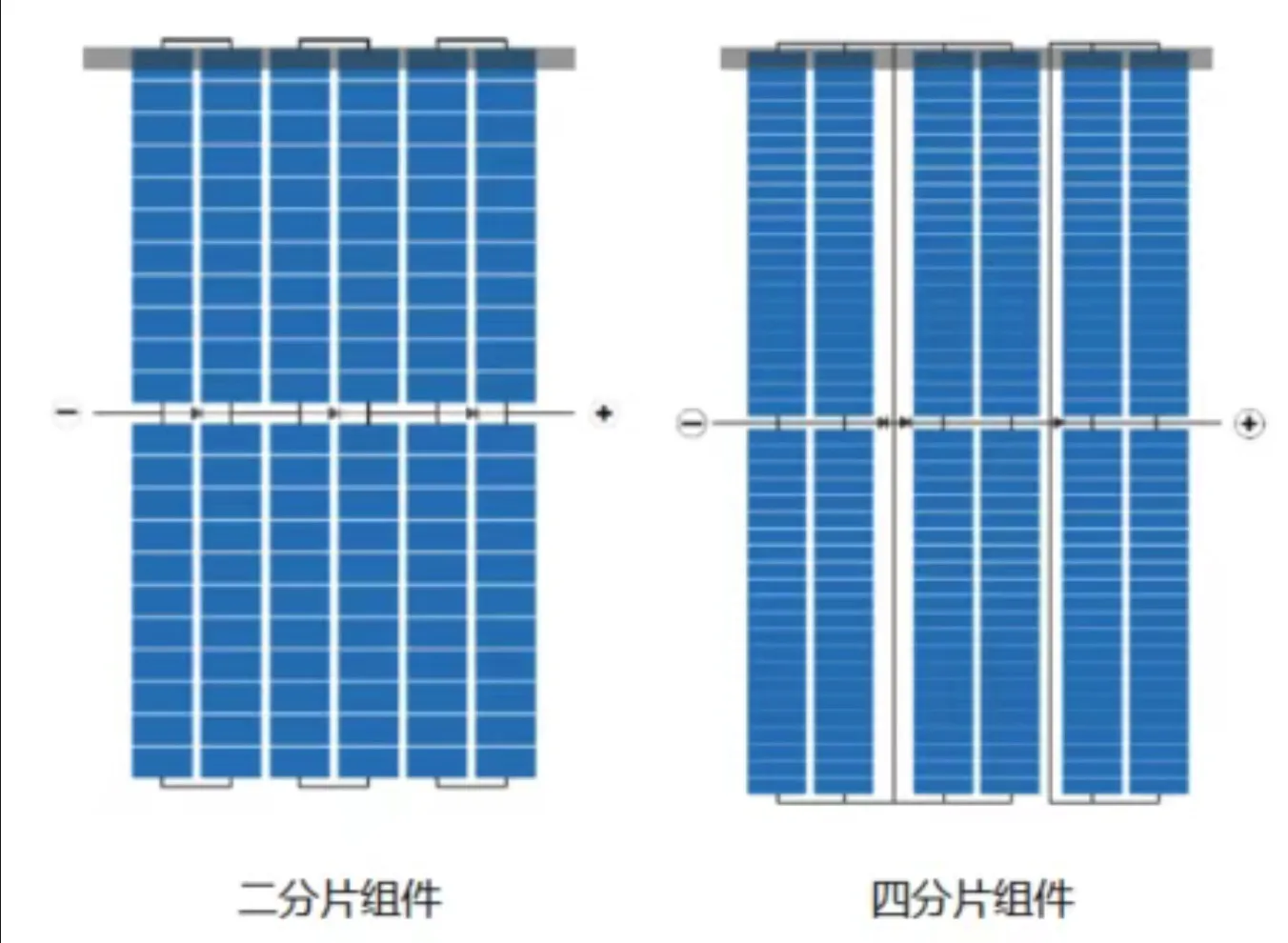
TOPCon Four-Cut Cells: How Cutting
Table of Contents
Quick answer: TOPCon manufacturers moved to four-cut cells through 2026, and the result is a module that gets more powerful while the cell gets smaller. A four-cut layout splits a full cell into four strips, cutting the current per strip and reducing resistive loss in the ribbon, which is why a four-cut module can reach the 760 W to 770 W class against roughly 670 W for a comparable three-cut design. Module dimensions in that class run around 1303 mm by 1134 mm on a 210 mm wafer platform. The engineering cost sits in the cutting and stringing stations: four times as many cuts per cell means four times the chance of edge damage, and the strips need tighter placement accuracy at the stringer. Thin strips also bow more easily during soldering, which is why the four-cut transition has driven changes in stringer tooling and in rear-side inspection.
PV Module Manufacturing · by Jerry, Ooitech
Introduction
In 2026, mainstream TOPCon manufacturers are cutting cells "smaller and smaller," yet module power keeps climbing. Tongwei 770W, Trina 760W, Jinko 670W—each number bigger than the last. But if you only look at power without looking at the module format, it's like judging engine horsepower without considering the size of the car body. Tongwei's 770W uses a G12 large format (2384×1303mm), while Jinko's 670W uses a G12R medium format (2382×1134mm). The format areas differ by nearly 30%, so how could the power be the same? Today we break down the four-cut story: why cutting physically improves efficiency, how each company's products actually compare, and whether to choose three-cut or four-cut.
The Physical Origin: One Cut, Three-Quarters Less Loss
A single G12 cell (210×210mm) has an area of about 441cm² and a short-circuit current exceeding 18A. Joule's law states: power loss = current² × resistance. An 18A current flowing through the cell's internal resistance and ribbons generates enormous heat loss. Even more troublesome, the MPPT input limit of mainstream inverters is around 15A—an 18A+ current is simply more than the inverter can "swallow."
The evolution of cutting technology all feeds on the same physical dividend: halve the current, and the loss drops to a quarter.
Half-Cut (1/2-Cut): The current is halved, and resistive loss drops to 25% of the full cell. The industry's shift from full cells to half cells around 2018 was driven by exactly this.
Three-Cut (1/3-Cut): What allowed Trina to bring the 210 cell to market was cutting three pieces—pushing the current down to about 12A, fitting into the working window of mainstream inverters, with loss dropping to about 11% of the full cell.
Four-Cut (1/4-Cut): The current drops to a quarter of the full cell, about 4-5A, with a theoretical resistive loss of about 6.25%. From half-cut to four-cut, internal loss drops another 75%.
But there's a catch after cutting: edge damage. Laser scribing is thermal destruction, leaving hundreds of millions of dangling bonds on the cut surface—broken Si-Si covalent bonds. Carriers recombine when they reach these points, causing Voc to drop and FF to deteriorate. The finer the cut, the more edges, and the more severe the recombination.
Cutting Is Easy, But Repairing the Cut Is the Real Skill
Edge passivation technology is the key that brings four-cut from theory to product. By depositing a nanoscale AlOx/SiNx dielectric thin film on the cut surface, it "repairs" the broken dangling bonds and suppresses the recombination probability.
SC New Energy clearly stated in 2025: "Multi-cutting greatly improves the power of TOPCon modules, but multi-cutting must be combined with edge passivation technology." When paired with edge passivation, four-cut module power can be increased by 7-10W compared to half-cut.
Data from Leadmicro further confirms this: leading companies have already achieved mass production of the "four-cut + edge passivation + 0BB" combined solution, with module power reaching 670-745W.
Cutting is the physical surgery of reducing current and loss; edge passivation is the materials science of cutting without damage. Neither knife can be missing.
The 2026 Four-Cut Product Matrix: Different Formats, Don't Compare Power Directly
From late 2025 to early 2026, mainstream TOPCon manufacturers densely released four-cut products. But looking only at power numbers is meaningless—you must put the formats side by side:
| Company | Product Series | Max Power | Module Efficiency | Wafer Size | Cell Count | Module Format | Release Date |
|---|---|---|---|---|---|---|---|
| Tongwei | TNC 3.0 | 770W | 24.8% | G12 (210×210mm) | 66 | G12-66 (2384×1303mm) | Jan 2026 |
| Trina | Vertex S+ Gen 3 | 760W | — | G12 (210×210mm) | 66 | Large format | Mar 2026 |
| Tongwei | TNC 3.0 | 670W | 24.8% | G12R (210×182mm) | 66 | G12R-66 | Jan 2026 |
| Jinko | Tiger Neo 3.0 | 670W | 24.8% | G12R (210×182mm) | 264 (6×44) | 66-piece format (2382×1134mm) | Jul 2025 |
| Chint New Energy | ASTRO N7 Pro | 670W+ | 24.8%+ | 210R | 264 (6×44) | — | Jan 2026 |
| Sumec/Suntech | Ultra T 3.0 | — | — | 182/210 dual platform | — | — | Mar 2026 |
Once the formats are unified, several judgments become clear:
First, 770W and 670W are not the same class. Tongwei's 770W uses the G12 large format, while Jinko's 670W uses the G12R medium format. The format areas differ by about 30%, so the power is naturally not in the same league. Tongwei's G12R version is also 670W, directly benchmarking against Jinko and Chint—under the same format, the power levels of each company are actually quite close.
Second, 264-piece four-cut is the industry's common choice. Both Jinko and Chint use 264-piece four-cut with a 6×44 circuit layout. After four-cut pushes the current to an extremely low level, more cells can be connected in series per string—half-cut modules typically have 20-24 cells per string, while four-cut can reach 44 cells per string, with a shorter current path and a smaller affected area from shading.
Third, wafer sizes split into two camps. Tongwei and Trina take the G12 route on the large format, while Jinko and Chint take the G12R route on the medium format. G12R has better compatibility with existing inverters and mounting systems; the G12 large format pursues ultimate power but has higher downstream adaptation costs. This is not about who replaces whom—it's a choice for different scenarios.
Four-Cut Is Not an Isolated Event: 0BB + High-Density Packaging + Thin Wafers
The explosion of four-cut is backed by the coordination of a complete technology matrix:
0BB (busbar-free) is four-cut's closest partner. 0BB eliminates the main busbar and uses ultra-fine ribbons to collect current directly, reducing silver paste usage and shading area. After four-cut reduces the current to an extremely low level, 0BB's ultra-fine ribbon solution becomes even more capable. Chint data: the "multi-cut + SMBB/ZBB" combined solution reduces single-string current by 12% and optimizes LCOE by 4.2%.
High-density packaging (zero-gap/negative-gap). Traditional modules leave a 1.5-2mm gap between cells—that is invalid area. After multi-cutting reduces the single-cell size, combined with the negative-gap interconnection process, the panel coverage ratio can be increased to over 98%. JA Solar DeepBlue 5.0 data: multi-cut + traceless seamless panel + GFI zero-gap flexible interconnection improves module efficiency by about 0.56%.
Thin wafers solve cost anxiety. Four-cut adds cutting and passivation steps, and the incremental cost can be offset by thinning the wafer. Scribing of ≤120μm thin wafers has become mainstream, with scribing yield stable above 99.2%.
Four-cut is not the victory of a single technology—it is the victory of system optimization.
Three-Cut vs. Four-Cut: Not Replacement, But Division of Labor
There is a popular view that four-cut will replace three-cut as the new standard. From the perspective of industry patterns, this judgment is too linear.
| Dimension | Three-Cut | Four-Cut |
|---|---|---|
| Single-cell current | ~12A | ~4-5A |
| Resistive loss (theoretical) | ~11% | ~6.25% |
| Representative module power | 645-670W | 670-770W |
| Inverter compatibility | Excellent (plug-and-play) | Requires adaptation (high voltage, low current) |
| Manufacturing complexity | Medium | High |
| Edge passivation dependency | Medium | Extremely high |
The core advantage of three-cut lies in electrical compatibility—the 12A working current perfectly matches the global stock inverter ecosystem. TCL Zhonghuan T5 Pro adopts three-cut + zero-gap high-density packaging, with power generation increased by 17% in shaded scenarios.
The relationship between the two is closer to an application-scenario-driven division of labor: three-cut suits cost-sensitive large power stations and stock inverter adaptation; four-cut suits high-efficiency flagship products, complex environments requiring high reliability, and next-generation system designs.
JA Solar's "optimal-cut" philosophy is worth noting—it doesn't take sides but pursues the optimal balance point of "cutting loss—resistance—yield." DeepBlue 5.0 uses a three-cut design and also achieves 670W and 24.8% efficiency. True competitiveness is not about "how many cuts," but about that balance point.
Cutting Yield, BOM Cost and Zero-Gap Difficulty: The Practical Differences
The comparison above is electrical. Three further differences decide whether a format is easy to run at volume, and they show up on the line rather than in the datasheet, as we set out in multi-cut solar modules: a practical analysis.
| Dimension | Three-cut | Four-cut |
|---|---|---|
| Laser cutting steps per cell | Two cuts, two new edge faces | Three cuts, more new edge area |
| Breakage and micro-crack risk | Lower mechanical damage; breakage rate easier to control | One additional cutting pass; micro-crack probability rises |
| Retrofit from a half-cell line | Minor modification; debugging effort is low | Additional cutting and handling stations required |
| Ribbon and busbar consumption | Limited increase | Cell count per module rises, so ribbon and busbar use rises with it |
| Zero-gap (negative spacing) soldering | Larger pieces, moderate difficulty | Smaller pieces, narrower process window |
| Shading response | Simpler branch structure; a shaded area affects fewer parallel branches, so power falls more gently | More parallel branches; stronger low-current and high-temperature behaviour, but less forgiving under partial shade |
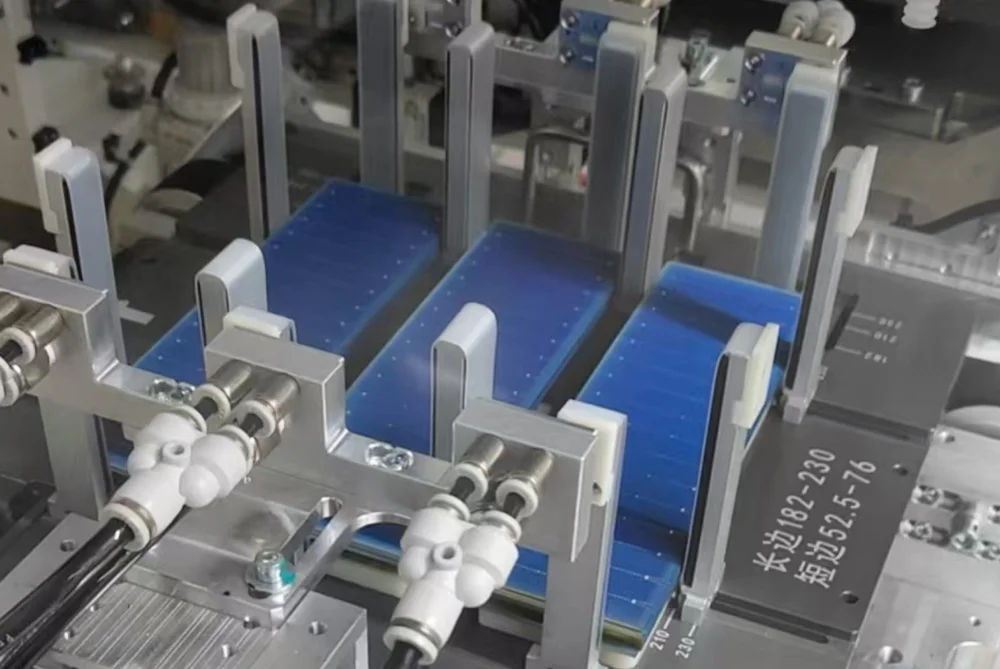
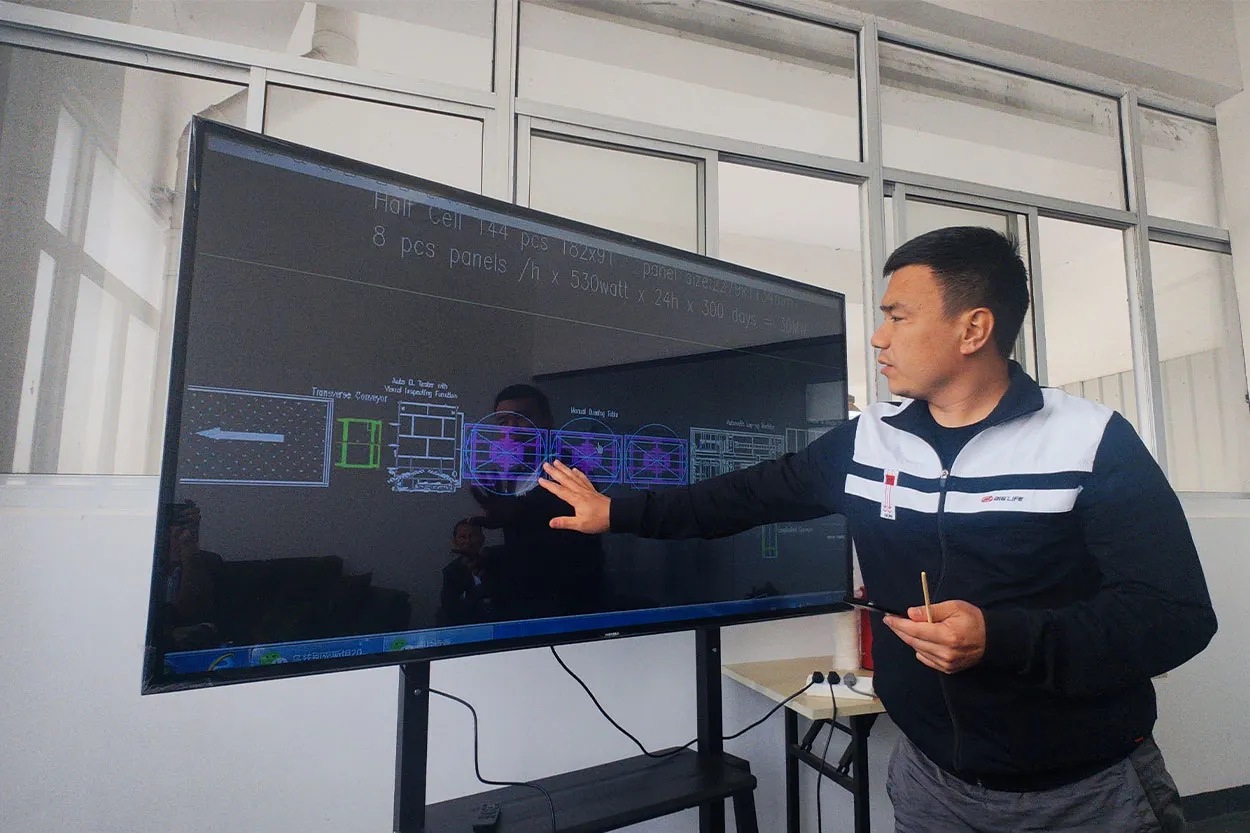
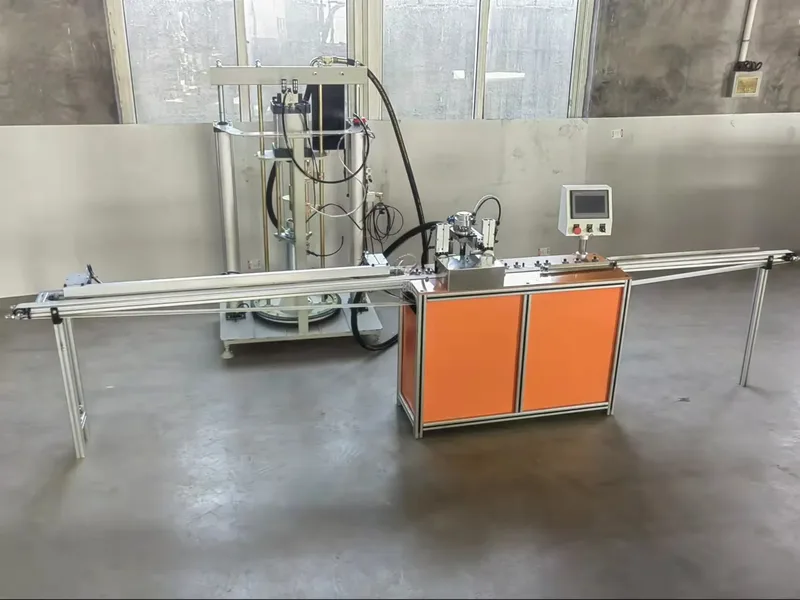
Fig. 1: A stringer handling multi-cut cells. Once a cell is divided, every downstream station sees more, smaller pieces, and the handling and soldering window narrows with each additional cut.
Read the table as a cost-of-consistency statement rather than a ranking. Three-cut is the lower-risk route to a multi-cut format: fewer cutting passes, less new edge to passivate, a small bill-of-materials increase and a modest retrofit from an existing half-cell line. The cutting process itself is covered in how to cut multi-piece solar cells better, and the format economics in four-cut cell technology. Four-cut buys lower line current and better high-temperature behaviour, and pays for it in cutting yield, auxiliary material consumption and a narrower zero-gap soldering window.
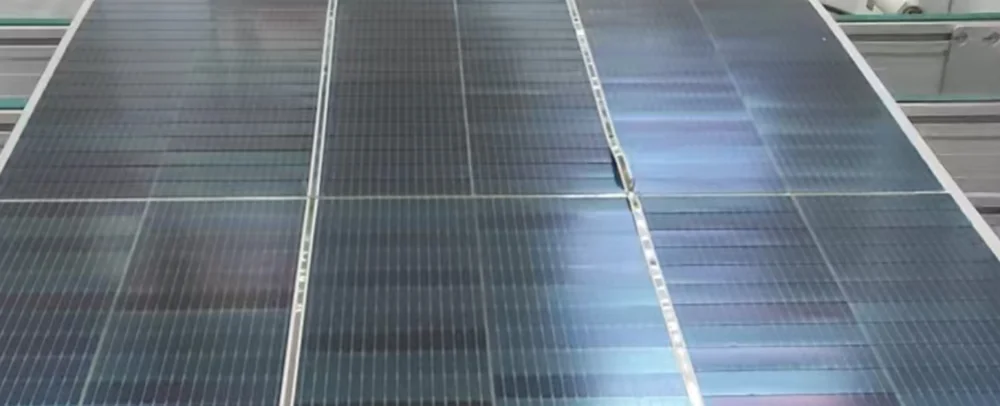
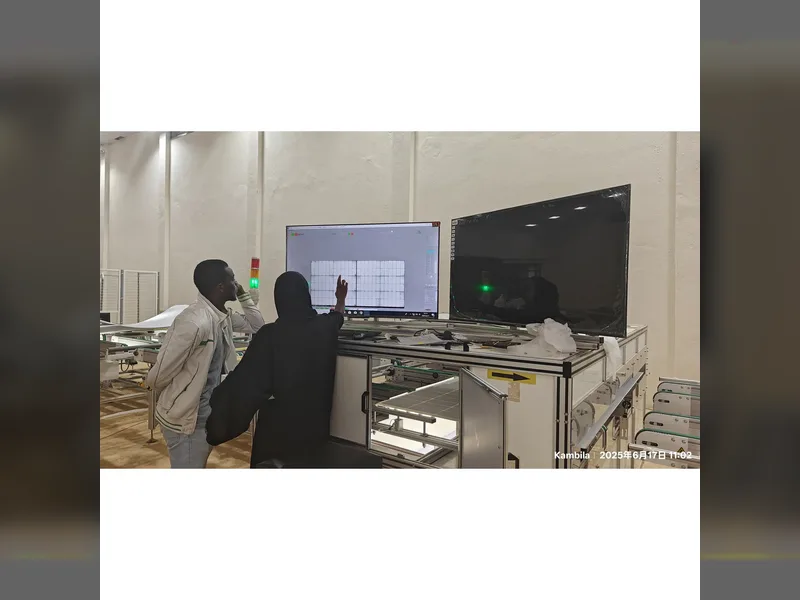
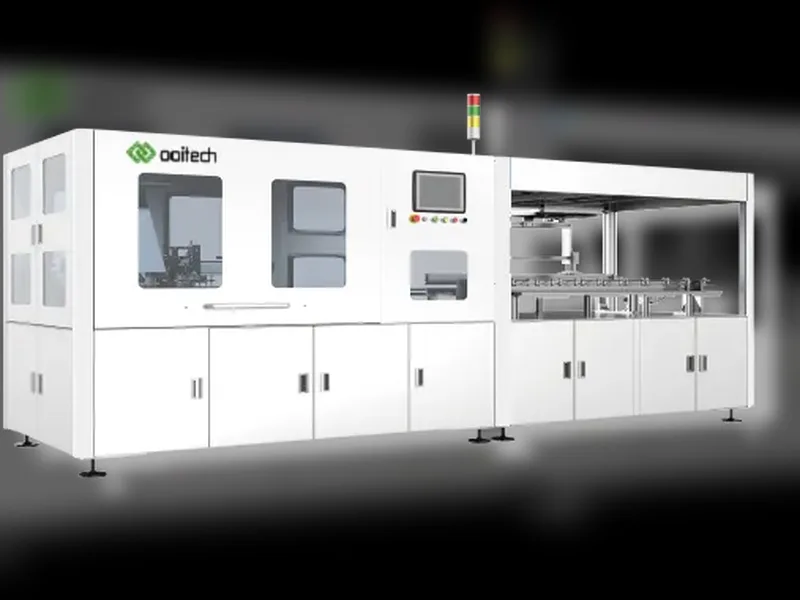
Fig. 2: A multi-cut module on the line, with cell pieces brought close together. Zero-gap packaging is what converts smaller pieces into higher power density, and it is the step that makes the cut count a manufacturing decision rather than an electrical one.
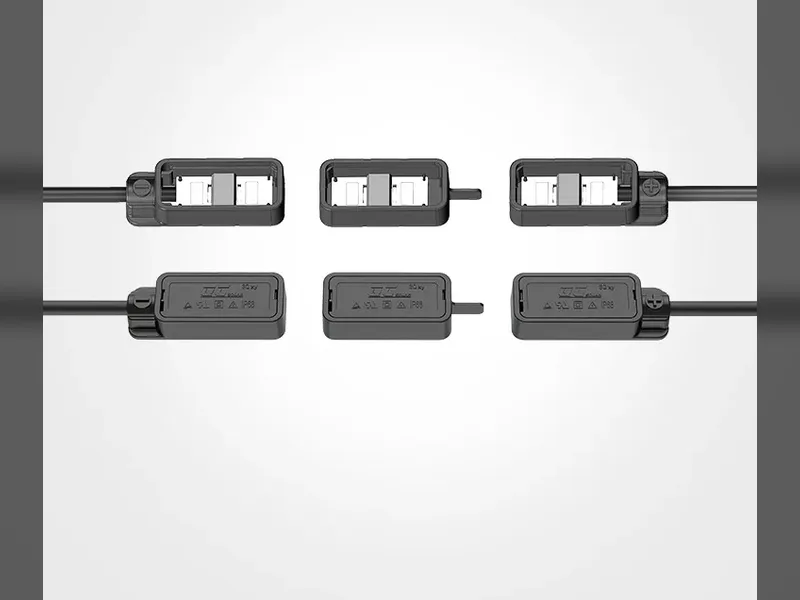
The application logic follows from the same mechanism. Because three-cut keeps a simpler branch structure, it tolerates the partial shading that distributed rooftops actually produce: poles, parapets, vents, bottom-edge soiling and low vegetation. Four-cut, with its lower string current, is at its best where shading is rare and uninterrupted irradiance is the norm, such as open ground-mounted plants and desert bases, where its line-loss and temperature advantages can be fully realised. At module level that format change also drives the junction box, as explained in why TOPCon four-cut modules need two-part junction boxes. Put a four-cut module in a heavily shaded residential array and the format is working against its own strengths.
Four Judgments (For Reference)
Judgment One: Four-cut is a technology platform, not an endpoint. The prerequisites—mass production of edge passivation, scaling of 0BB, and maturity of high-density packaging—all fell into place simultaneously in 2025-2026. What's worth watching going forward is its integration with perovskite tandems and BC.
Judgment Two: Hotspot safety is an underestimated benefit of four-cut. With a single-string current of only 4-5A in four-cut, the hotspot peak temperature can be about 45°C lower than half-cut. On rooftop projects, this gap could be the difference between "burning or not."
Judgment Three: Look at the product, look at the format, then compare power. Tongwei's 770W is G12 large format, Jinko's 670W is G12R medium format—different formats, comparing power directly is meaningless. Under the same format, each company's power level is actually quite close; the real difference lies in yield, cost, and reliability.
Judgment Four: Four-cut is a bargaining chip for extending TOPCon's life cycle—the moat is not deep, but it's enough. Without changing the cell's core structure, it achieves 10-20W of extra power gain through module design. The threshold is not low (yield, cost, and reliability as a trinity), but the ceiling is visible. Once BC or HJT breaks through in mass-production cost, four-cut may degrade from a "differentiated premium" to an "industry standard." But at the current node, it is the most cost-effective efficiency-boosting path for the TOPCon camp.
Summary
The essence of four-cut is using innovation in module structural design to extend the life cycle of TOPCon technology—continuing to extract value from the module end after cell efficiency approaches its physical limit. Next time you see a number like "770W," ask first: what format? G12 or G12R? 66 cells or 72? Unify the format before comparing power.
Interactive Topic
What cut count is your production line currently using? What format?
Ooitech's View
Ooitech believes: four-cut is not about how many times you cut the cell, but about finding the optimal balance among cutting loss, resistance, and yield through systematic module-design innovation.