TOPCon Solar Cell: Full Form, Structure and How It Works
Table of Contents
Quick answer: TOPCon stands for Tunnel Oxide Passivated Contact. It is an N-type silicon solar cell technology that places an ultra-thin tunnel oxide layer, around 1 to 2 nanometres, beneath a doped polysilicon layer on the rear surface. That stack does two things: it passivates the rear surface so fewer charge carriers recombine there, and it lets majority carriers tunnel through while blocking the opposite polarity. The result is a higher open-circuit voltage than PERC, and therefore higher efficiency — the reason TOPCon displaced PERC as the dominant industrial cell technology. Critically for manufacturers, TOPCon is largely line-compatible with existing PERC equipment, needing mainly added boron diffusion, tunnel oxide and polysilicon deposition steps. It is also the foundation of the back-contact family: IBC, TBC, HBC and HIBC cells all build on the TOPCon passivating contact.
PV Module Manufacturing · by Jerry, Ooitech
Introduction to TOPCon Solar Cells
TOPCon is the first step in a longer back-contact sequence. How IBC, TBC, HBC and HIBC build on it is set out in the BC cell technology roadmap: from structure to process.
TOPCon (Tunnel Oxide Passivating Contact) is an N-type wafer cell technology that first emerged in 2013. A TOPCon solar cell is a tunnel oxide passivated contact solar cell built on an N-type substrate.
Compared with PERC cells, TOPCon cells use a tunnel oxide layer with excellent charge transport properties as the charge transport layer on the back of the cell. On top of this, a doped polysilicon film of about 20nm is deposited to form a passivated contact structure on the rear side. This effectively reduces surface recombination and metal contact recombination, raises the open-circuit voltage, and improves energy conversion efficiency.
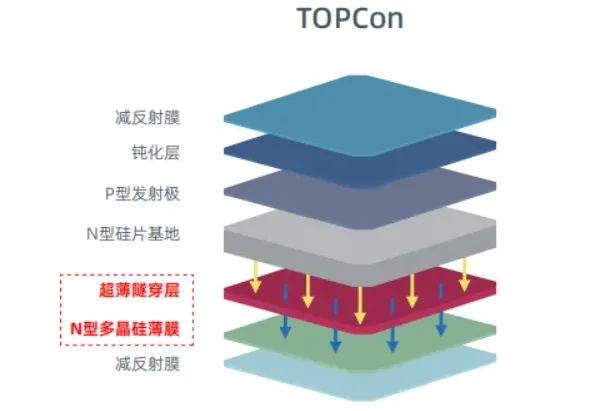
TOPCon is a tunnel oxide passivated contact solar cell technology based on the principle of selective carriers, achieving a superior passivation effect.
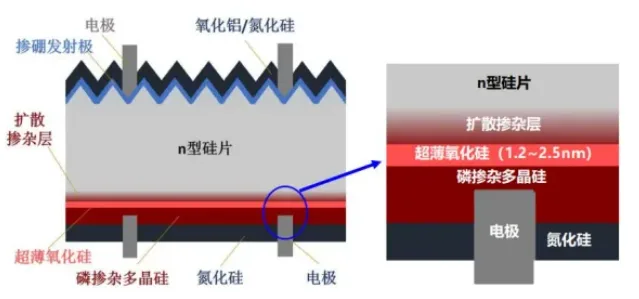
The TOPCon cell uses an N-type substrate. A thin oxide layer is prepared on the back of the cell, followed by a doped thin film. Together these two form a passivated contact structure that effectively reduces surface recombination and metal contact recombination, providing greater room to further improve the conversion efficiency of N-PERT cells.
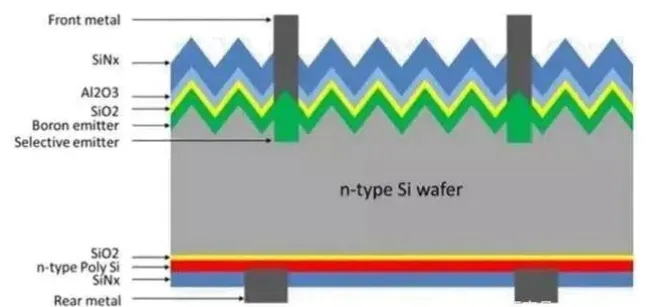
TOPCon technology preserves and reuses existing conventional P-type cell equipment and processes to the greatest extent. It only requires the addition of boron diffusion and thin film deposition equipment, with no need for rear-side opening or alignment. This greatly simplifies the cell production process and keeps the difficulty of mass production low. The process line offers high compatibility and can run alongside the high-temperature manufacturing lines used for PERC and N-PERT bifacial cells.
TOPCon cells offer the advantages of low degradation, high bifaciality, and a low temperature coefficient, delivering clear power generation gains at the terminal power station level.
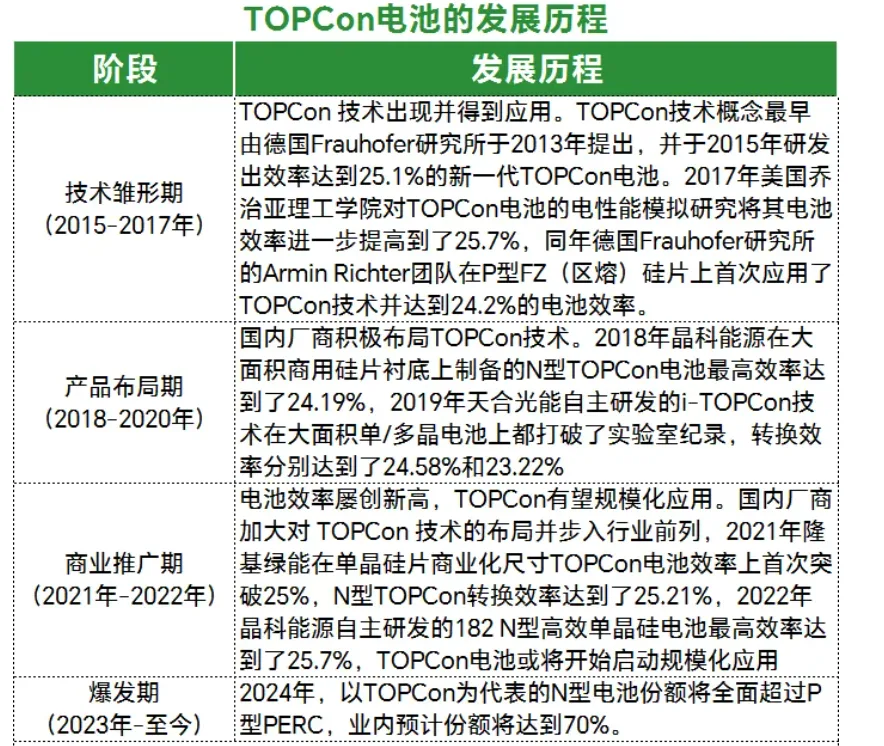
Development Stages of TOPCon Cells
The development history of TOPCon cells can be divided into four stages: the technology prototype period, product layout period, commercial promotion period, and explosive growth period.
Advantages of TOPCon Cells
Performance Advantages
High conversion efficiency. Thanks to the unique passivated contact design of TOPCon cells, the theoretical efficiency limit reaches up to 28.7%. Leading TOPCon manufacturers have already achieved mass production efficiencies above 25.5%, a significant improvement over mainstream PERC cells (current mass production conversion efficiency around 23.5%, theoretical limit 24.5%).
High bifaciality. TOPCon bifacial cells produce around 3% more power per watt than bifacial PERC cells. In the same ground-mounted power station scenario, this delivers higher power generation gains.
Low temperature coefficient. The temperature coefficient of N-type TOPCon modules is as low as -0.30%/℃, better than the -0.35%/℃ of P-type modules, showing excellent stability in high-temperature environments.
Low degradation. Phosphorus-doped N-type crystalline silicon contains extremely low boron content, so there is essentially no boron-oxygen recombination, giving it an advantage in degradation rate. Some TOPCon modules show a first-year degradation of 1% and a linear annual degradation of 0.4%, compared with 2% first-year and 0.45% linear for PERC modules, bringing a per-watt power generation gain over the module's life cycle.
Strong low-light performance. TOPCon cells respond well to both short and long wavelengths, maintaining excellent power generation capability under low-light conditions such as early morning, evening, and overcast weather.
Economic Advantages
High compatibility with PERC manufacturing, lowering the difficulty of technology upgrades. TOPCon can be extended from PERC process technology, requiring only four additional steps: preparing the boron emitter, growing the tunnel oxide layer, depositing and doping polysilicon, and post-diffusion cleaning. This lowers the difficulty of upgrading and accelerates the adoption of TOPCon technology.
Smooth line conversion with low equipment investment cost. Building a new TOPCon line requires equipment investment of about 200-250 million, while a new HJT line requires 350-400 million. Because TOPCon offers good equipment compatibility with existing PERC lines, only boron diffusion and polysilicon/amorphous silicon deposition equipment (LPCVD / PECVD / PVD) needs to be added, with equipment investment of about 50-70 million. This avoids large-scale investment in new equipment and major line retrofits, making it highly economical.
Significant price premium potential. Compared with PERC modules, TOPCon modules offer higher power generation per watt, higher generation gains, and lower system costs, creating substantial room for a price premium.
TOPCon Cell Manufacturing Process
Compared with monocrystalline PERC processes, the TOPCon cell production process adds 2 to 3 extra steps: depositing the tunnel oxide layer (ultra-thin SiO2, 1-2nm), depositing the intrinsic polysilicon passivation layer (60-100nm), and phosphorus implantation.
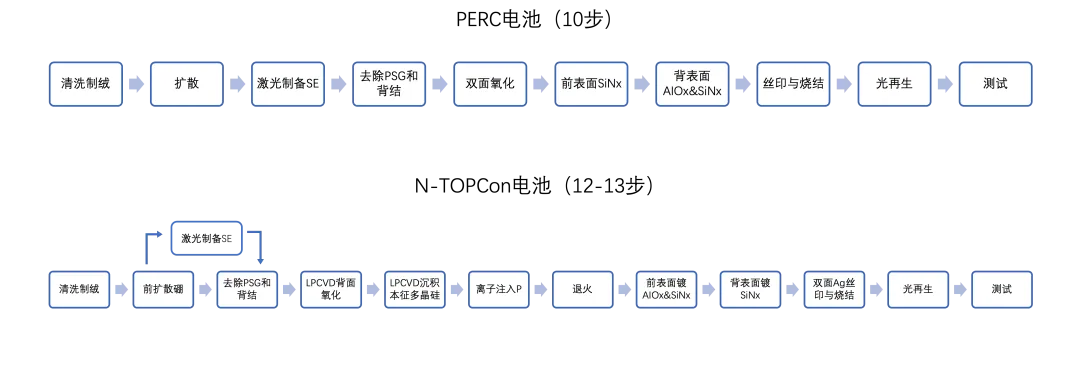
Main Process Steps and Their Functions
1. Cleaning and Texturing
Purpose: After wafer cutting, the edges are damaged, the crystal lattice structure is broken, and surface recombination is severe. Cleaning and texturing mainly aim to remove surface damage and form a pyramid light-trapping structure on the surface. Light reflects multiple times across the wafer surface, reducing the reflectance.
2. Boron Diffusion
Purpose: The main function is to form the PN junction. Because boron has a low solid solubility in silicon, high temperatures and longer times are required for diffusion. The choice of diffusion source also affects production: chlorides are corrosive, while bromides are viscous, making cleaning cumbersome and increasing maintenance costs.
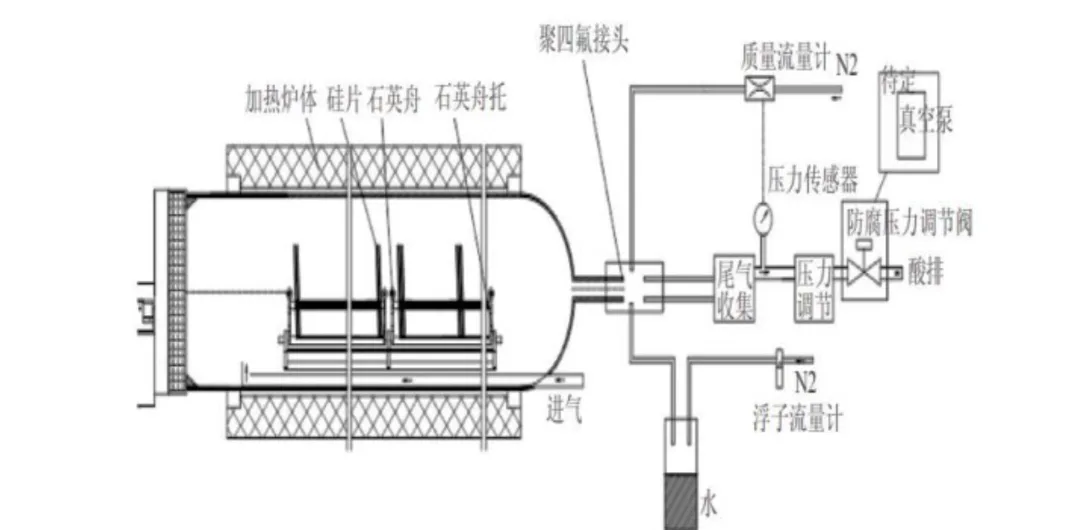
Boron diffusion is usually completed at higher temperatures—above 1000℃—and compared with the 102-minute cycle required for phosphorus diffusion, the boron diffusion cycle takes 150 minutes.
Principle:
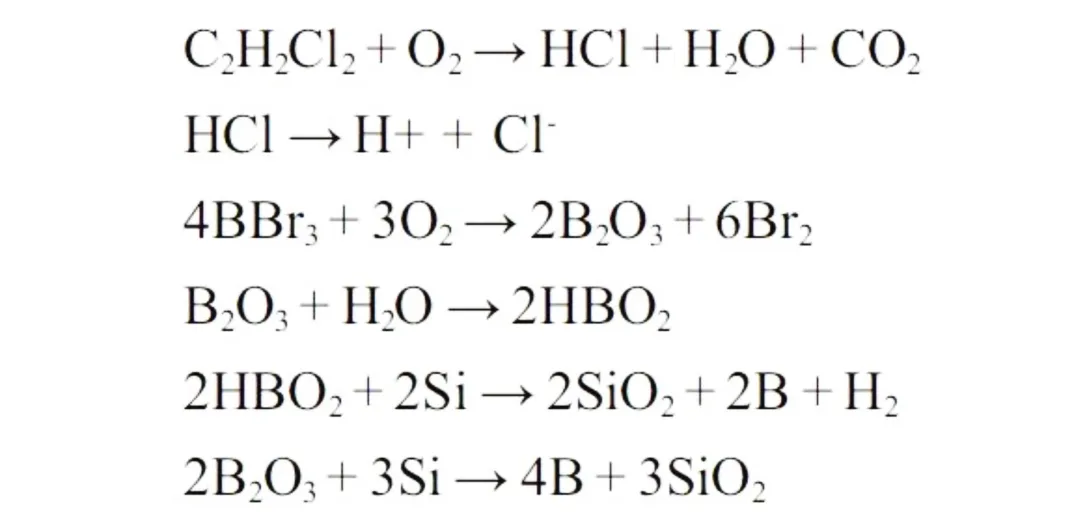
The gaseous HCl and H2O generated by reactions inside the furnace tube are carried by N2 and distributed evenly throughout the tube. H2O also reacts with BBr3 and O2 to form B2O3, which further reacts to form gaseous HBO2; at high temperatures HBO2 decomposes back into B2O3, allowing B2O3 to distribute evenly across the solar cell surface. In addition, H2O reacts with B2O3 deposited inside the furnace tube, preventing B2O3 buildup on the diffusion tube walls, extending the life of the quartz components, and increasing the effective boron source. HCl can also react with metal impurities on the cell surface and inside the tube to form gaseous metal chlorides that exit with the exhaust gas, preventing metal impurities from diffusing into the solar cell during the high-temperature process.
3. SE Laser Doping
Purpose: To form a selective emitter. High-concentration doping is applied at and near the contact areas between the metal gridlines and the wafer to reduce the contact resistance between the front metal electrode and the wafer, while low-concentration doping outside the electrode areas reduces recombination in the diffusion layer. Optimizing the emitter increases the output current and voltage of the solar cell, thereby improving the photoelectric conversion efficiency.
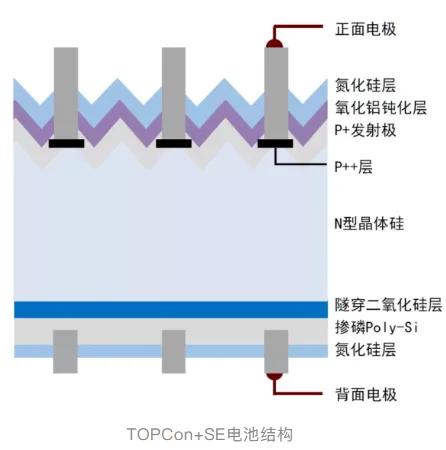
Where the laser sits in the TOPCon flow: PERC SE uses phosphorus doping, while TOPCon SE uses boron doping. Because boron and phosphorus have different segregation coefficients, phosphorus diffuses more easily from silicon dioxide into silicon, while boron is harder to push in and requires more energy. Yet excessive laser energy easily damages the wafer, making boron doping more challenging. Compared with traditional boron diffusion, adding SE technology to TOPCon cells can theoretically improve efficiency by 0.5%, and in actual mass production can achieve an efficiency gain of 0.2-0.4%.
4. Etching
Purpose: The main function of etching is to remove the BSG and the back junction. The diffusion process forms diffusion layers on both the wafer surface and its edges; the edge diffusion layer easily causes short circuits, and the surface diffusion layer affects subsequent passivation, so both must be removed. Etching is currently mainly done with wet methods, removing the rear and edge diffusion layers in chain-type equipment before processing the front side.
5. Preparing the Tunnel Oxide Layer and Polysilicon Layer
Purpose: Deposit a 1-2nm tunnel oxide layer on the back, then deposit a 60-100nm polysilicon layer to form the passivation structure. There are several methods for preparing the TOPCon passivation layer, mainly LPCVD, PECVD, and PVD routes. LPCVD is currently the mainstream, but wrap-around deposition is severe, while PECVD offers strong potential in overall performance.
6. Preparing the Rear Anti-Reflection Film
Purpose: Prepare an anti-reflection passivation film on the rear of the cell to increase light absorption. At the same time, the hydrogen atoms generated during the SiNx film formation process passivate the wafer.
7. Front-Side Aluminum Oxide Deposition
Purpose: Deposit a layer of aluminum oxide film on the front of the wafer, which together with other films forms the front passivation effect.
8. Preparing the Front Anti-Reflection Film
Purpose: The front anti-reflection film works essentially the same way as the rear one. In addition, the aluminum oxide film deposited on the front is very thin and easily damaged during subsequent cell and module manufacturing, so the front SiNx also protects the aluminum oxide.
9. Screen Printing - Laser Pattern Transfer
At present, most cell printing still uses screen printing. In the future, in terms of reducing silver paste consumption for N-type cells, Pattern Transfer Printing may have the advantage. Laser transfer is a new type of non-contact printing technology: the required paste is coated onto a specific flexible transparent material, and a high-power laser beam performs high-speed patterned scanning to transfer the paste from the flexible transparent material to the cell surface, forming the gridlines and preparing the front and rear electrodes.
10. Sintering
Good ohmic contact is formed through high-temperature sintering.
11. Automatic Sorting
Cells are sorted into bins according to their different conversion efficiencies.
Future Development Trends of TOPCon Cells
In 2023, the average conversion efficiency of N-type TOPCon cells reached 25.0%, and the average conversion efficiency of heterojunction cells reached 25.2%, both showing significant improvements over 2022.
In 2023, newly commissioned mass production lines were mainly N-type cell lines. As N-type cell capacity was gradually released, the PERC cell market share was compressed to 73.0%. N-type cells accounted for a combined total of about 26.5%, with N-type TOPCon cells at about 23.0%, heterojunction cells at about 2.6%, and XBC cells at about 0.9%—all substantial increases over 2022.
From 2024 onward, the share of N-type cells represented by TOPCon will comprehensively surpass P-type PERC, with the industry expecting the share to reach and exceed 70%.
Ooitech's Perspective
Ooitech believes: TOPCon, an N-type tunnel oxide passivated contact cell technology that builds on existing PERC lines, delivers higher efficiency, lower degradation, and stronger power generation gains, and is now becoming the mainstream of the solar industry.