Editorial responsibility for this article rests with Wuhan Ooi Photoelectric Technology Co., Ltd. Written and reviewed by the Ooitech editorial team. See our editorial policy for how we write, where AI tools are used, and how to request a correction.
EU WEEE Revision: Recyclable Encapsulants and Backsheets
Table of Contents
Quick answer: Europe's WEEE rules are about to turn recyclability into a design requirement, and the two materials that make a solar module durable are the two that make it hard to recover. A crosslinked encapsulant locks glass, cells and ribbon into one cured layer that will not melt or dissolve. A fluoropolymer backsheet releases hydrogen fluoride if it is burned. The revision being discussed now would set a separate category for modules, count collection by collectable waste rather than shipped volume, and push a recyclability index into the ecodesign rules. The tension is real: reliability wants the encapsulant to hold at 90 to 110 degrees Celsius, recycling wants it to melt near 150 to 200. Thermoplastic TPO encapsulants sit right in that gap, easy to peel but prone to creep. The near-term move for a manufacturer is to lock the bill of materials, disclose fluorine and silver content, and test TPO for creep and peel together.
Recyclability was once a footnote in a module datasheet. The WEEE revision under discussion turns it into a design spec, and the two layers that keep a module alive for 25 years are the first obstacles.
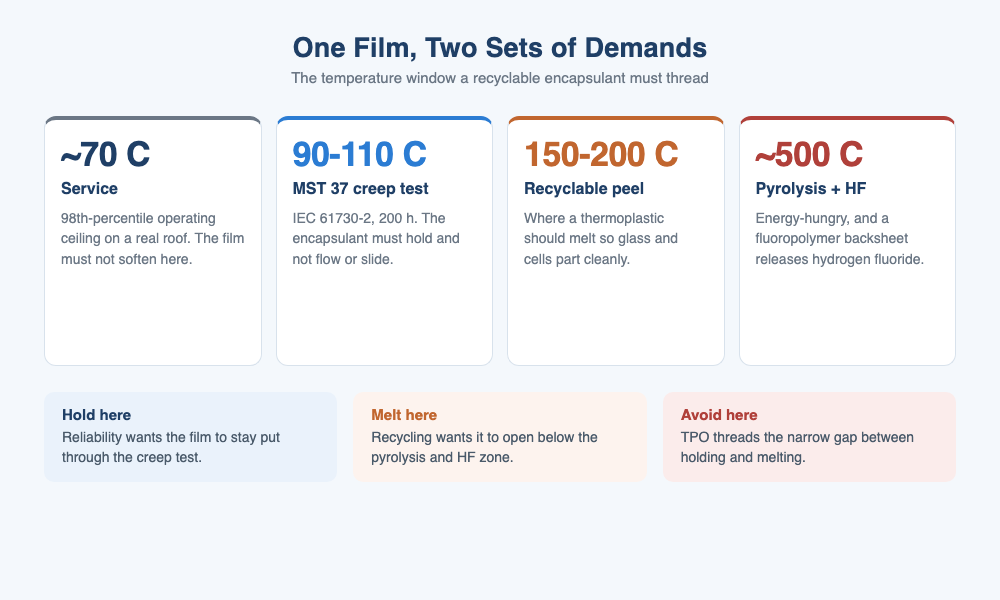
One film, two sets of demands: hold at the MST 37 creep temperature, melt at the recycling peel temperature.
What the WEEE Revision Actually Changes
PV modules entered the EU waste rules through Directive 2012/19/EU, the WEEE directive, in 2012. They sit in category 4, large equipment, alongside other electronics. The directive asks producers to hit two targets: 85 percent recovery and 80 percent reuse plus recycling, and both targets are measured by weight.
The 2024 amendment, Regulation (EU) 2024/884, added a review clause. The Commission must decide by December 31, 2026 whether to revise WEEE for solar. The clause names three questions: give PV modules their own category, set collection targets against the volume of collectable waste rather than the volume placed on the market, and stop a bankrupt producer from walking away from its recycling duty. Placed-on-market counts every module shipped, including ones still running on a roof 25 years later; collectable waste counts only what actually reaches end of life.
That revision now sits inside the Circular Economy Act, often shortened to CEA. Industry media reported in late October 2026 that the proposal is tentatively scheduled for November 11, 2026. A supplier that waits for the final text will be late; the direction is already visible.
A Loophole Measured in Weight
Both targets are weight-based, and a typical crystalline silicon module is mostly glass. Glass is about 76 percent of a glass-backsheet module and the aluminum frame about 8 percent, for roughly 84 percent together. Remove the frame and crush the glass and a recycler is already close to the 85 percent recovery target. Silver and high-purity silicon, the valuable materials that are hardest to extract, never enter the arithmetic. The revision is an attempt to close that gap.
Recycling Stalls at the Encapsulant
Module recycling runs in three steps: remove the frame and junction box, separate the layers, and extract materials. Steps one and three are mature. The bottleneck is step two, and the reason sits inside the laminate.
The encapsulant is the film that bonds glass, cells, ribbon and backsheet into one sealed package during lamination. When it refuses to let go, everything behind it stays locked. The industry word for that layer separation is delamination, and it is the step that decides whether a module becomes a clean glass sheet and a clean cell, or a pile of mixed fragments. A recycler can strip a frame in minutes and sell the aluminum; opening the laminate is measured in hours and never comes out clean.
The Crosslinked Encapsulant Locks the Stack
EVA and most POE films are crosslinked by peroxide inside the laminator. Crosslinking builds a three-dimensional network. A crosslinked film will not melt and will not dissolve; it holds glass, cells, ribbon and backsheet together for 25 years, and it refuses to release them at end of life.
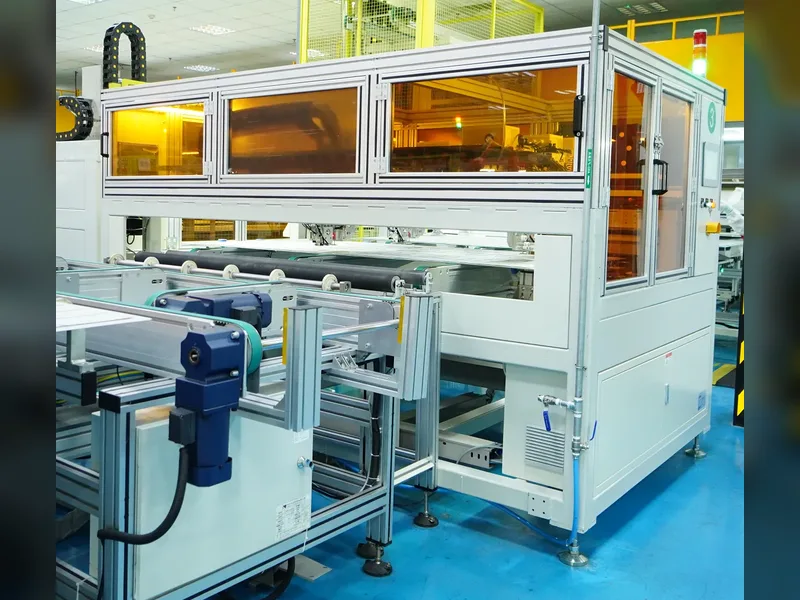
In our laminators, we balance heating rates and dwell times to ensure uniform crosslinking without overbaking, allowing the peroxide to complete its three-dimensional network across the full area for the intended 25 years.
That is the core trade. The same chemical bond that gives a module its long mechanical and electrical life is the one a recycler must break. Four routes have been tried to separate the layers, and each pays a different price.
| Separation route | How it works | Main limitation |
|---|---|---|
| Mechanical crushing | Grind the whole laminate into mixed fragments | Cheapest, but glass, silicon, silver and polymer mix together and the glass is downgraded |
| Pyrolysis around 500 C | Burn off most of the encapsulant so the layers part | Energy cost, and a fluoropolymer backsheet releases hydrogen fluoride |
| Solvent swelling | Soften the film so an intact cell lifts out | Long cycle time and solvent recovery pressure |
| Thermoplastic heat-peel | Heat the film until it melts, then peel glass from cells | Low-temperature separation, but it must balance creep resistance |
Fluoropolymer Backsheets and the HF Trap
KPK is PVDF/PET/PVDF and TPT is PVF/PET/PVF. Both are fluoropolymers, and the carbon-fluorine bond is strong: about 490 kJ/mol against about 420 kJ/mol for carbon-hydrogen. That bond is why the backsheet survives weather, and why it is hard to destroy cleanly.
A Fraunhofer UMSICHT life-cycle study found that pyrolyzing PVDF and PVF backsheets produces large amounts of hydrogen fluoride, a corrosive gas that attacks glass, steel and lung tissue and has to be scrubbed rather than vented, and the pyrolysis oil carries fluorinated hydrocarbons. Pyrolysis is not a workable end-of-life route for a fluoropolymer backsheet. A fluorine-free PET backsheet does better in both incineration and pyrolysis. A 2026 Chinese molecular-dynamics study found that co-pyrolyzing EVA with PVDF intensifies hydrogen fluoride release, and the effect grows as temperature rises.
The backsheet is only about 3 percent of module weight, around 0.4 kg per square meter. It is a small share by mass, but it decides whether the whole module can be burned without an acid problem.
Why the Fluorine Question Is Not Just Recycling
Fluoropolymers also sit inside the PFAS restriction debate. They are in scope with time-limited exemptions. The ECHA Risk Assessment Committee delivered its final opinion in March 2026, the Socio-Economic Analysis Committee is expected by the end of 2026, and a Commission proposal follows. A fluorine-free backsheet or a dual-glass build is a hedge on recycling and PFAS at the same time, which is why the material choice now carries two separate risk columns.
TPO: Melt Instead of Burn
A thermoplastic polyolefin, or TPO, encapsulant is not crosslinked. Heat softens and melts it at one to two hundred degrees, which lets a recycler peel the glass from the cells without sending the module into a 500-degree pyrolysis furnace. In a hot-knife comparison by Spain's UPNA and CENER, TPO was the easiest film to peel from glass, which is exactly what a recycler wants when the goal is an intact cell instead of crushed scrap.
When running thermoplastic formulations, we set heating profiles between one and two hundred degrees to achieve thorough bonding without thermal degradation, avoiding the high temperatures that complicate end-of-life recycling.
The same property has a downside, and its name is creep.
The Creep Test That Holds TPO Back
Creep is the slow flow of a material under load at temperature. On a tilted array, the weight of the glass makes the front sheet want to slide over the backsheet. If the encapsulant flows, cell strings shift and insulation distances shrink, which can put a live cell path closer to the frame than the design allows. That is a safety problem and a reliability test that a crosslinked film passes almost for free.
IEC 61730-2 defines a material creep test, MST 37. A module sits at a set high temperature for 200 hours while the test checks interlayer displacement and insulation. The early version tested at 105 degrees Celsius. The newer edition ties the test temperature to the module's 98th-percentile operating temperature; the India BIS edition of IEC 61730-2:2023 reports MST 37 at 90 degrees, and a module that claims IEC TS 63126 high-temperature Level 1 or 2 is tested higher.
NREL field data is encouraging for thermoplastic films: most creep little outdoors, because melt viscosity is high, the edge of a module runs cooler, and aging can crosslink the film on its own. The film that showed clear creep was EVA without peroxide. But in a 200-hour stepped-temperature test, a TPO with a low flow-transition temperature shows measurable displacement near 100 degrees.
Not Every TPO Is the Same
TPO is a family name, not a grade. Flow-transition temperature varies by more than 30 degrees between products. A film that passes the creep test at one temperature can fail the same test at another, which is why the grade and formulation, not the three-letter label, are what actually matter.
Service and Recycling Pull Opposite Directions
The two sides want different things from the same film. Reliability wants the encapsulant to hold still at the temperatures a module actually sees. Recycling wants it to melt so the layers can part. The two temperature windows sit on one axis, and TPO has to thread them both.
| Zone | Temperature | What it means |
|---|---|---|
| Service, 98th percentile | about 70 C | The module's real operating ceiling |
| MST 37 creep test | 90 to 110 C | The encapsulant must hold and not flow |
| Recyclable peel | 150 to 200 C | Where a thermoplastic should melt open |
| Pyrolysis and HF zone | about 500 C | Energy-hungry, and dangerous with fluorine |
TPO has to thread a narrow window: its flow-transition must sit high enough to pass the creep test with margin, and low enough that recyclers can still peel it below the pyrolysis and hydrogen-fluoride zone. That is a high and narrow target, and it is why a grade number matters more than the word TPO.
Three Directions Materials Are Taking
Materials work is moving along three lines, each aimed at the same goal: a film that behaves like a network in service and like a thermoplastic at end of life. None of the three is a drop-in today, and each trades a different risk.
- High-melt TPO: push the flow-transition temperature above 110 degrees so the film passes the high-temperature creep level while staying peelable.
- Reversible or breakable crosslinking: give the film a network in service, then break it with heat or chemistry at end of life, using dynamic covalent bonds or a breakable epoxy. Mostly still in the lab.
- Structural restraint: use dual glass, a frame and edge sealing to limit interlayer slip. NREL has shown that backsheet restraint suppresses creep.
One Spec That Answers Both Questions
Today the reliability standard asks only whether the film will flow, and the recycling rules ask only how easy it is to take apart, and the two do not speak the same language. A single 200-hour creep temperature is a weak stand-in for 25 years of accumulation, and the recyclability index is still being calibrated, with no clear rule on whether an encapsulant type earns its own score. Whoever puts both datasets into one material specification first wins the next round of rule-making.
What the BOM Must Disclose Next
The near-term moves are concrete. First, state the bill of materials: where the fluorine, lead, silver and silicon sit and in what share, in the shape a critical-raw-material disclosure will ask for.
Second, price the fluorine decision twice. A fluorine-free build wins on recycling and PFAS compliance, but it must prove weather resistance and PID behavior against the incumbent fluoropolymer. Those two columns do not move together, and a customer should see both before signing.
Third, when a TPO is on the table, test beyond the default MST 37. Add high-temperature-level creep, a stepped-temperature run, and creep after aging, and on the recycling side measure peel temperature and peel force. The two datasets have to live in one file, because that file is what the next WEEE revision will read.
Where These Numbers Come From
The mass split of glass at about 76 percent and frame at about 8 percent is a typical glass-backsheet module from IRENA and IEA-PVPS 2016 figures; dual-glass or thin-glass builds differ. The melt-transition data is from Kempe and colleagues at NREL, measured by DMA on experimental encapsulants rather than current commercial grades. The recycling peel window and the hydrogen-fluoride release window are literature ranges, not standard limits. The November 11, 2026 Circular Economy Act date is an industry-media report as of October 30, 2026, and may move. Bond energies and the MST 37 details follow IEC 61730-2:2023 and IEC TS 63126.
Q: What does the WEEE directive actually require of solar modules?
A: PV modules fall under Directive 2012/19/EU category 4, large equipment. Producers must recover 85 percent and reuse plus recycle 80 percent, both by weight. The 2024/884 review clause asks the Commission to decide by December 31, 2026 whether to revise those rules for solar.
Q: Why is measuring by weight the problem?
A: Glass plus frame is already about 84 percent of a module's weight, so removing the frame and crushing the glass nearly meets the 85 percent recovery target on paper. Silver and high-purity silicon, the materials actually worth recovering, are not counted.
Q: Which step of recycling is the bottleneck?
A: Delamination, the layer separation step. Removing the frame and junction box and extracting materials are mature. Separating the layers is where the crosslinked encapsulant holds everything shut.
Q: Why do fluoropolymer backsheets release hydrogen fluoride?
A: The carbon-fluorine bond is about 490 kJ/mol, strong enough to survive weather and hard to break cleanly. Burning a PVDF or PVF backsheet at pyrolysis temperature produces hydrogen fluoride and fluorinated oil.
Q: What is MST 37?
A: IEC 61730-2's material creep test. A module sits at a set high temperature for 200 hours while the test checks interlayer displacement and insulation. The test temperature now follows the 98th-percentile operating temperature.
Q: Is TPO a guaranteed fix for recyclability?
A: No. TPO peels cleanly at low temperature, but it creeps. Flow-transition temperature varies by more than 30 degrees between grades, so the specific formulation matters more than the label.
Q: What does the recyclability index measure?
A: The ecodesign discussion points at an index that scores service life, disassembly and materials in one number. It is still being calibrated, the weighting is not fixed, and whether an encapsulant type earns its own score is unresolved.
Q: What should a module maker do right now?
A: Lock the bill of materials and disclose fluorine, lead, silver and silicon content; price the fluorine decision on both recycling and PFAS; and test any TPO for creep and peel together.
Final Thoughts
Recyclability is becoming a number a module has to hit, not a nice-to-have. The materials that make a module last, a crosslinked encapsulant and a fluoropolymer backsheet, are the same ones that make it hard to recover. TPO points at a way through, but only if it passes the creep test and the peel test in the same file. Lock the BOM now, and test both sides before the rules lock in for you.
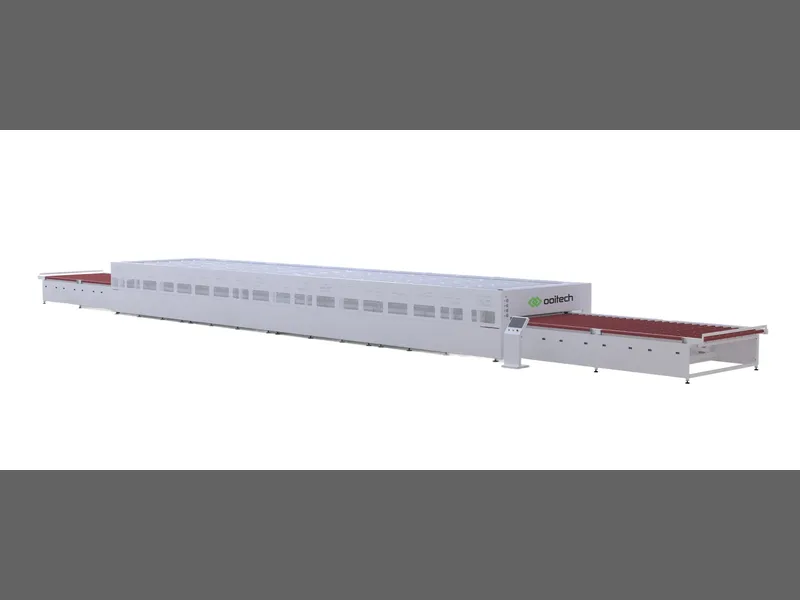
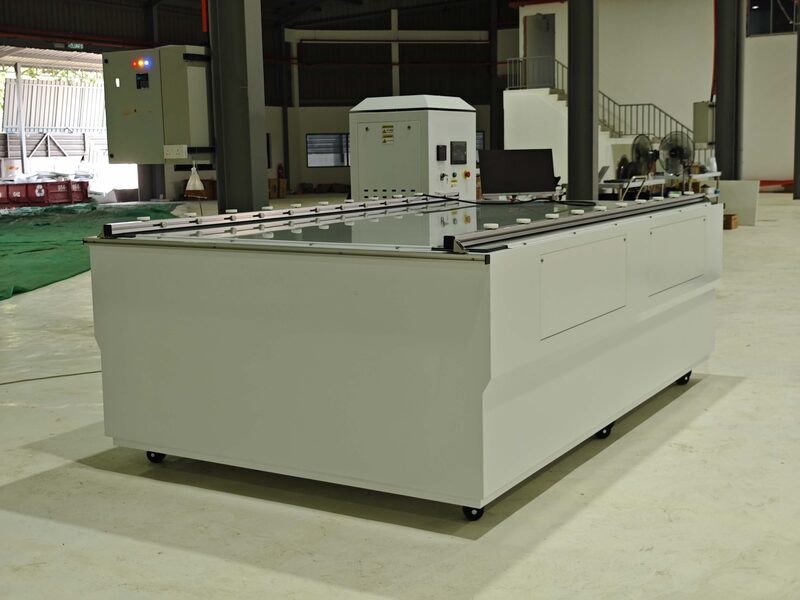
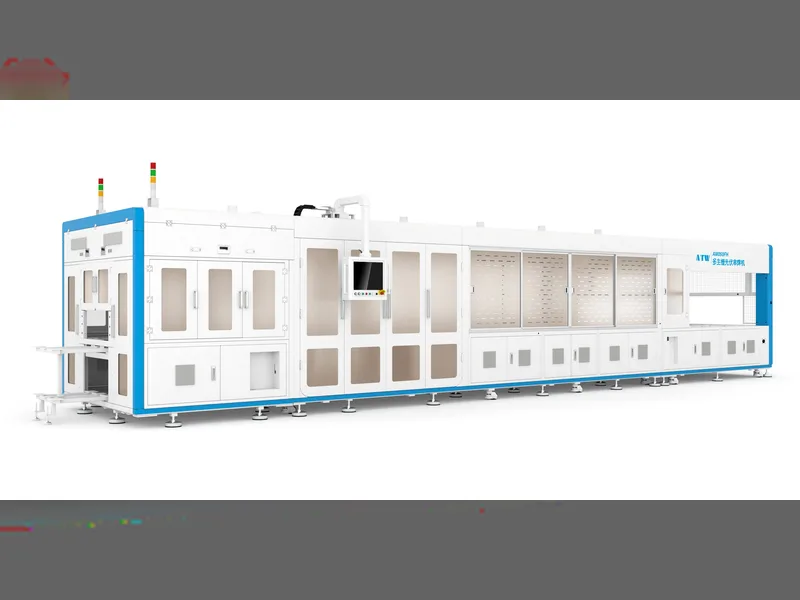
We manufacture single and double chamber solar panel laminator machines in both oil-heated and electric configurations, designed to process crosslinked films as well as emerging thermoplastic encapsulants. Send your module stack drawings, component layers, or laminate samples to our engineering team for recipe evaluation and trial bonding.