LONGi BC Technology Powers Two European Teams
Table of Contents
Quick answer: LONGi back-contact technology powered two European university teams to first and second place at the 2026 American Solar Challenge, a long-distance solar vehicle competition. The result is a credibility marker rather than a manufacturing data point: a solar car imposes a different constraint set from a rooftop array, favouring the highest possible power per unit area and per kilogram, which is precisely where back-contact cells have their advantage over a conventional front-contact design. For the module industry, the significance is that the technology is being validated in a demanding real-world application while the manufacturing cost barrier keeps it out of the volume market. The competition runs over multiple days under varying irradiance, so the cell's low-light and temperature behaviour also matters to the outcome.
PV Module Manufacturing · by Jerry, Ooitech
LONGi BC Technology Helps European Teams Claim First and Second Place
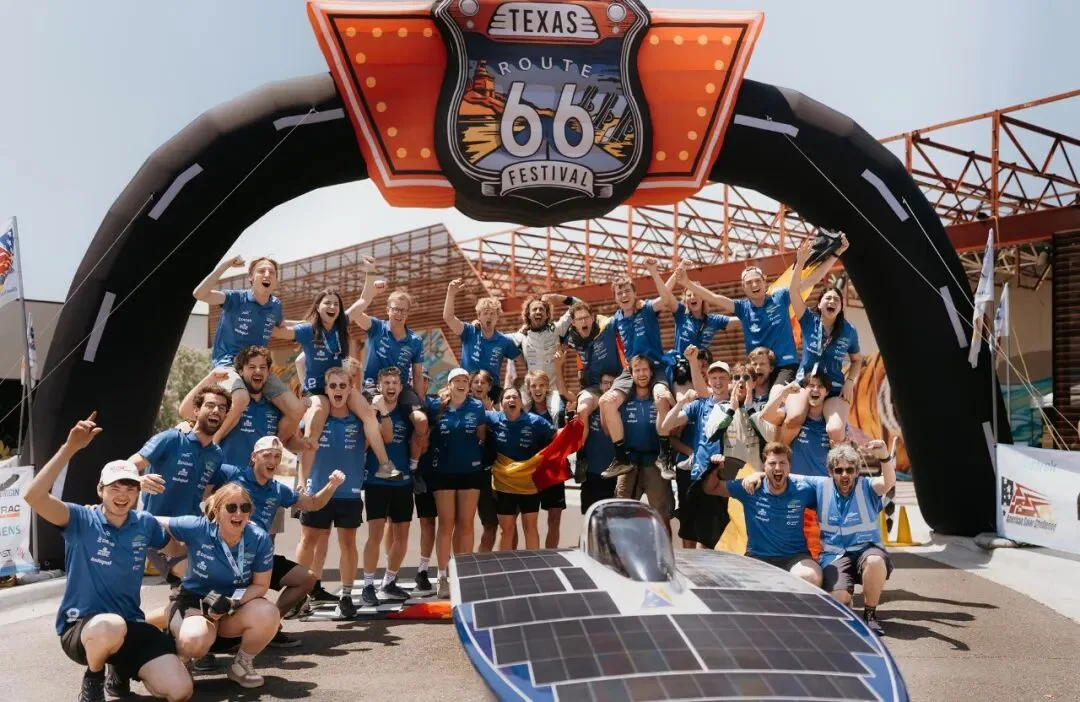
The 2026 American Solar Challenge, also known as the Electrek American Solar Challenge or ASC, has officially concluded. After an eight-day journey across the United States, Belgium's Innoptus Solar Team and the Netherlands' Delft Solar Team broke away from an international field to secure first and second place. Both teams were supported by LONGi BC technology.
Belgium's Innoptus Solar Team, wearing blue, and the Netherlands' Delft Solar Team, wearing orange, finished first and second at the 2026 American Solar Challenge.
Eight Days Across the United States
ASC is one of the world's most influential solar car competitions. It is known for its long route, complex road conditions, and unpredictable weather. The event tests the energy system, aerodynamic design, reliability, and strategic planning of every participating solar vehicle.
This year's competition attracted dozens of leading teams from around the world, making the contest especially demanding.
The race began in Minnesota on July 25, local time, and followed Route 66 south toward the finish in Texas. Unlike a conventional speed race, ASC determines the winner by the total distance completed over eight days.
The route crossed plains, hills, deserts, and several climate zones. Large changes in temperature and sunlight placed heavy demands on vehicle energy management, race strategy, and overall system reliability. Under these conditions, simply completing the event was difficult. Reaching the front required near-perfect execution across almost every part of the vehicle and team operation.
Belgium's Innoptus Solar Team and the Netherlands' Delft Solar Team compete in the 2026 American Solar Challenge.
Innoptus Makes History with a 4,298.9-Kilometer Victory
Innoptus Solar Team completed a cumulative distance of 4,298.9 kilometers to win the championship. The result also made Innoptus the first European team in ASC history to take the title. No European team had previously won the event, making the victory a new milestone for the competition.
Delft Solar Team completed 4,080.5 kilometers and finished second.
Both vehicles used products based on LONGi BC technology as their energy source. During the demanding race, the solar systems delivered stable power output and strong conversion efficiency. Their efficient, reliable, and application-specific designs helped provide consistent energy throughout the long-distance challenge.
At the 2026 American Solar Challenge, Innoptus Solar Team, in blue, won the championship, while Delft Solar Team, in orange, took second place.
From One-Team Cooperation to Dual Technical Support
This marked the second consecutive year that LONGi had been deeply involved in the world's top solar racing ecosystem.
In 2025, LONGi first partnered with Innoptus Solar Team for the World Solar Challenge. The cooperation expanded in 2026, with LONGi becoming a core technology partner of both Innoptus Solar Team and Delft Solar Team.
Both teams ranked among the world's top three in the 2025 Bridgestone World Solar Challenge, or BWSC. They were also the only two European teams participating in this edition of ASC.
From speed-focused racing to long-distance endurance, and from supporting one team to working with two, LONGi has continued to deepen its role in solar motorsport. Its BC technology has become a shared choice among leading teams facing extreme performance requirements.
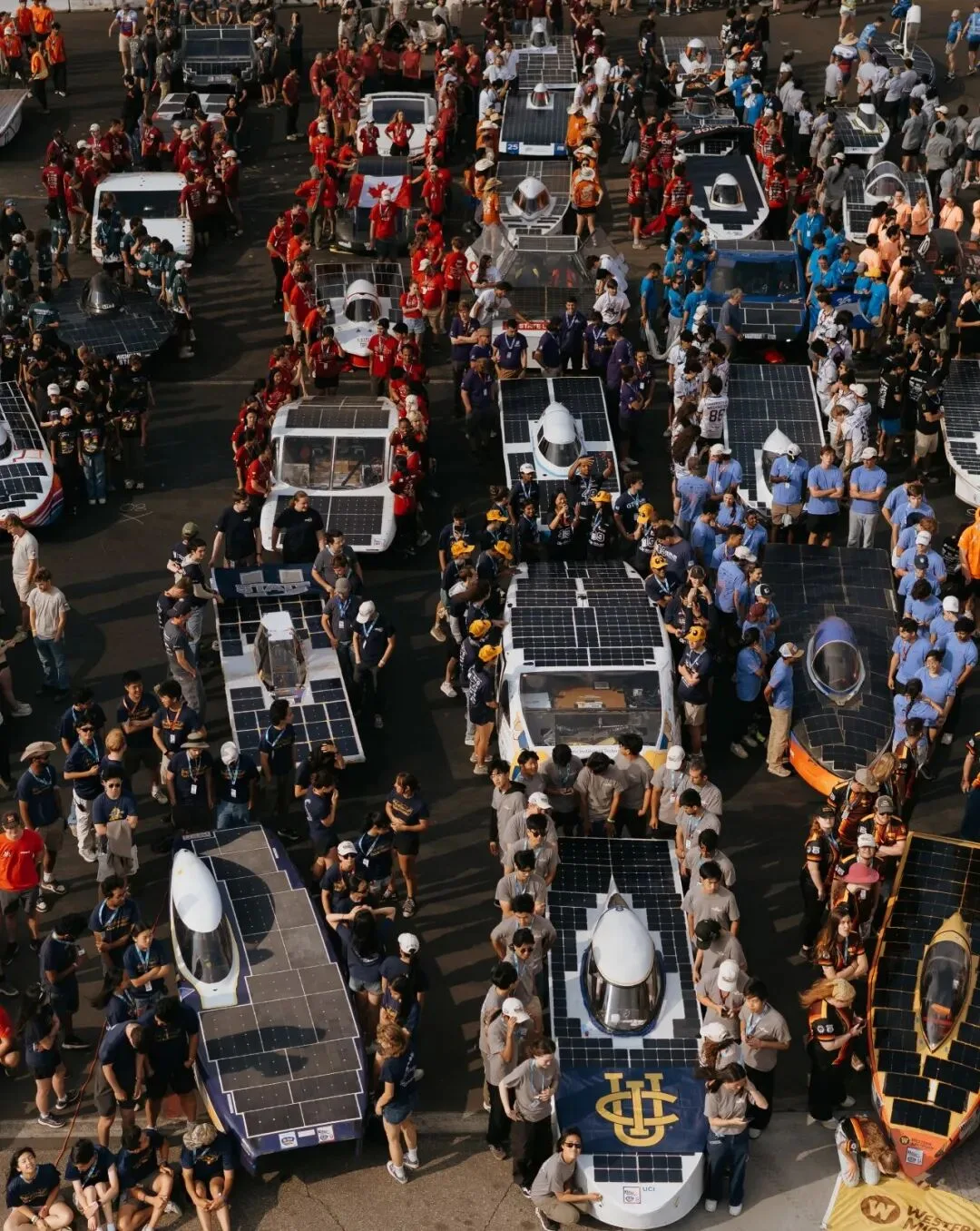
The 2026 American Solar Challenge brought together leading solar racing teams from around the world.
A Real-World Test for High-Efficiency BC Technology
LONGi's connection with solar racing teams is not based on financial sponsorship. The cooperation has consistently focused on joint technical development.
A solar racing car is limited to just six square meters of exposed solar cell area on its roof. Within this restricted space, the photovoltaic system must combine very high conversion efficiency, low weight, flexible integration, and dependable performance over long distances. Each requirement goes far beyond what is normally expected in conventional applications.
The Belgian team's customized flexible modules and the Dutch team's high-efficiency cell solution were differentiated answers developed around the two teams' vehicle designs and technical routes. The decision by both world-class teams to use LONGi technology served as a demanding practical test of BC technology in conversion efficiency, product stability, and adaptability across different operating conditions.
For LONGi, the ASC course is both a testing ground and a starting point for further development. Verifying BC product performance in real and demanding conditions, while working with leading international engineering teams to expand the boundaries of solar energy applications, remains a central goal of its involvement in the solar racing ecosystem.
Ooitech's View
The six-square-meter solar area limit makes every watt, gram, and interconnection decision matter. Results like these show that high cell efficiency alone is not enough; flexible packaging, low-loss electrical design, mechanical reliability, and consistent output under changing irradiance must work as one system. Solar racing remains a valuable proving ground for technologies that may later influence lightweight and specialized photovoltaic module manufacturing.