TOPCon Cells Under Damp Heat: Why
Table of Contents
Quick answer: TOPCon has taken most of the high-efficiency crystalline silicon market, and the open question is no longer efficiency but how the cell behaves after years in the field under damp heat. The standard accelerated test runs at 85 °C and 85% relative humidity — DH85 — which is designed to drive moisture into the encapsulant and the cell stack faster than field conditions would. The layered structure matters here: a tunnel oxide around 10 nm under a doped polysilicon layer is thin enough that interface chemistry, not bulk material, decides reliability. Lamination temperatures near 150 °C and the encapsulant's own moisture permeability both feed into the same failure path. Characterisation tools in the QL200 class are used to track what the damp-heat exposure does to the passivation rather than only whether power dropped.
PV Module Manufacturing · by Jerry, Ooitech
Introduction
TOPCon has taken over most of the high-efficiency c-Si market, but long-term field reliability is still a moving target. One weak spot keeps showing up in damp-heat studies: the rear passivation stack. A recent study (Tong et al., Sol. Energy Mater. Sol. Cells, DOI: 10.1016/j.solmat.2024.113188) pinned down what actually goes wrong when sodium salts land on the cell surface and sit under 85°C/85% RH. The short version — the rear SiNₓ layer is the soft spot, and a thin ALD AlOₓ film fixes most of it.
Key findings up front
The rear SiNₓ layer is the damp-heat weak point. Sodium acetate (CH₃COONa) drove rear open-circuit voltage (Voc) down 5.8% and pushed series resistance (Rₛ) up by 450%.
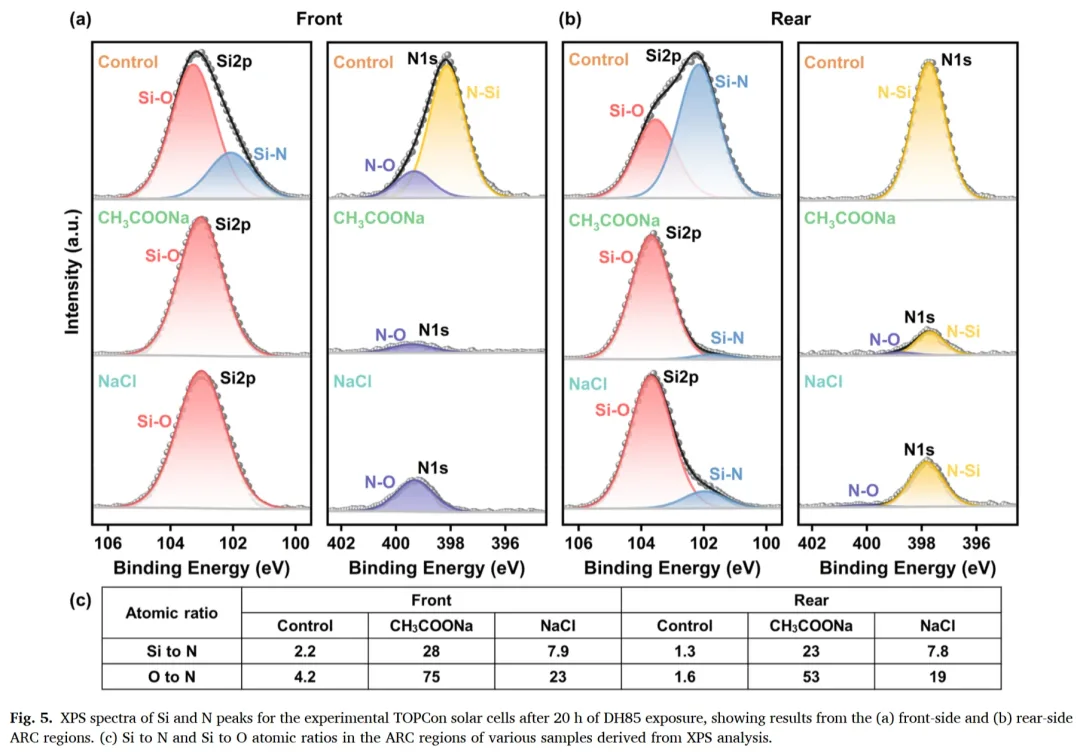
Sodium salts speed up surface oxidation and nitrogen loss. XPS showed the rear Si/N atomic ratio jumping from 1.3 to 23, and O/N from 1.6 to 53.
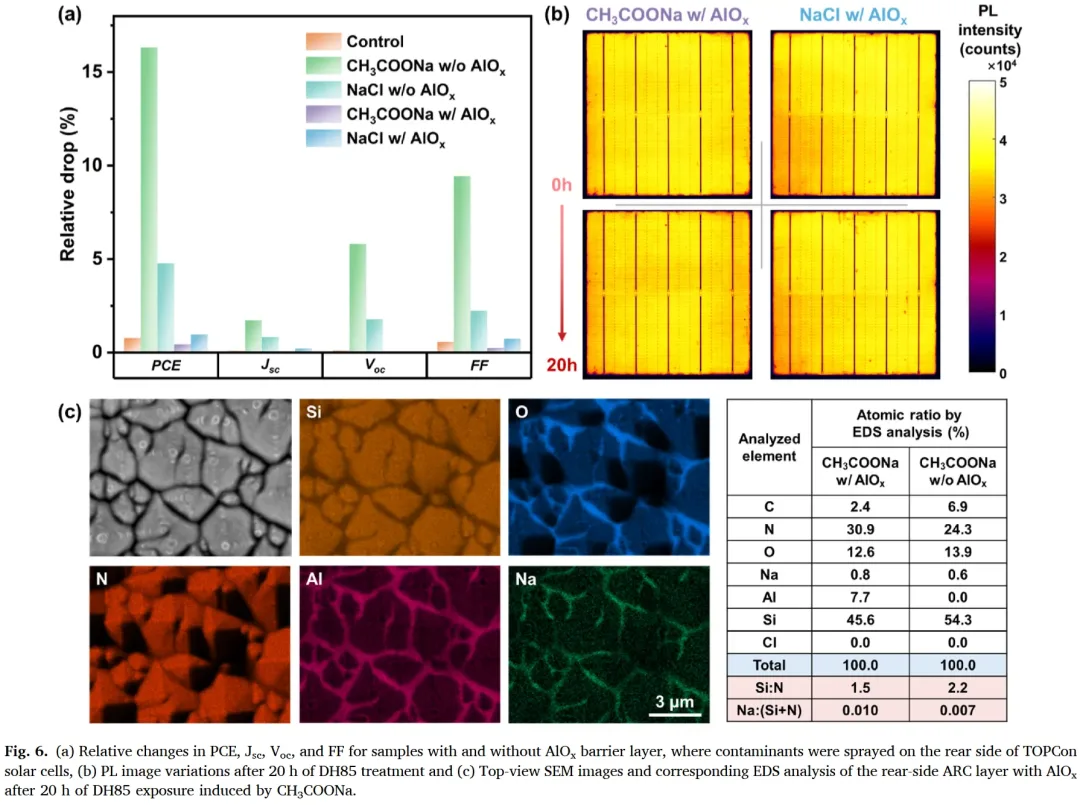
A 10nm ALD Al₂O₃ barrier made a big difference — PCE loss under CH₃COONa contamination dropped from 16% to just 0.4%.
The front passivation is much tougher. The AlOₓ/SiOᵧNᵣ multilayer blocks sodium diffusion, so contamination there cost only 0.87% PCE.
The two contaminants act differently: sodium acetate attacks the metal contact, while sodium chloride (NaCl) mainly oxidizes the passivation layer.
Background
The core question is simple to state, harder to answer: why do TOPCon cells lose performance under damp heat when sodium salts are around, and why is the rear passivation hit worse (Kyranaki et al., 2022)?
Where the gaps are
Most prior work focused on metal contact corrosion (Iqbal et al., 2023), but nobody had systematically looked at the chemical breakdown of the passivation layer itself. The front and rear stacks are built differently — front is AlOₓ/SiNₓ/SiOᵧNᵣ, rear is SiNₓ over doped poly-Si — and their corrosion resistance had never been directly compared (Feldmann et al., 2014). On top of that, the two common contaminants (CH₃COONa vs. NaCl) were thought to behave the same, and they don't (Li et al., 2021).
Getting this right matters for real money. PV plants are sold on a 25-year lifetime promise (Peters et al., 2021), and a rear-side failure mode that shows up under humidity is exactly the kind of thing that eats into that.
Approach
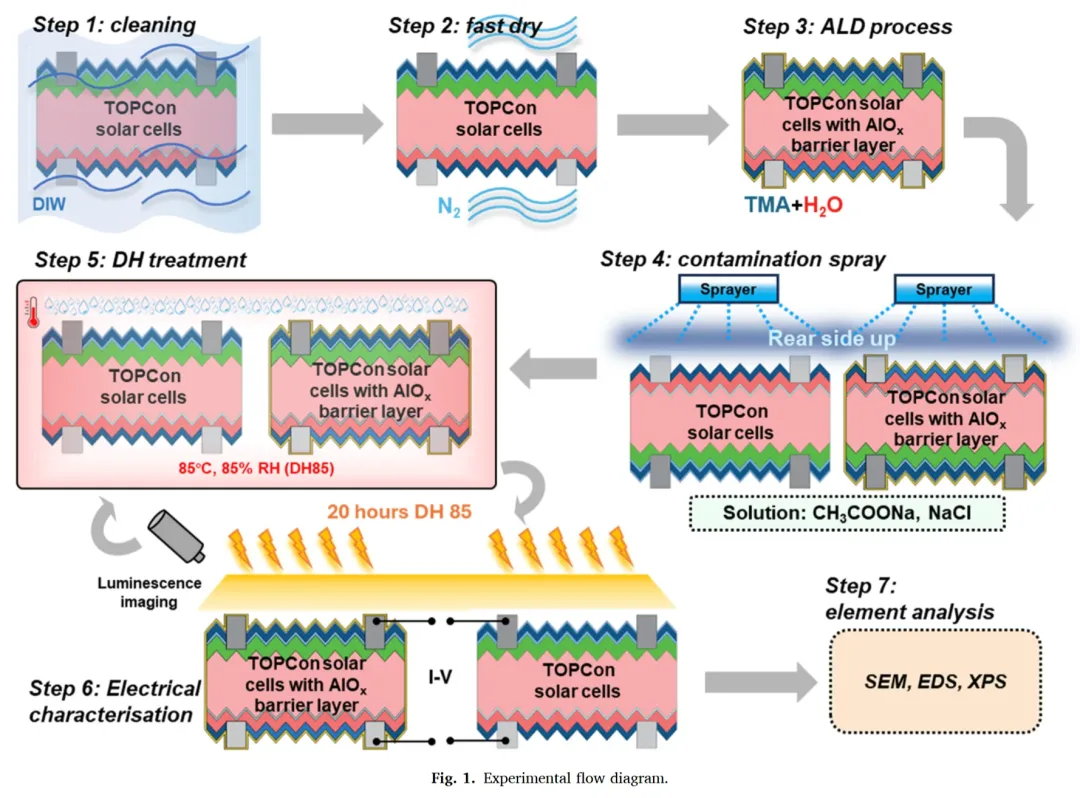
The workflow was kept close to a real production flow: industrial TOPCon cells → local spray of sodium salt on the front or rear surface → accelerated damp heat (85°C/85% RH) → electrical and chemical characterization → test an ALD AlOₓ barrier → work out the protection mechanism.
What's new here
On the theory side, this is the first study to point at nitrogen loss in the rear SiNₓ layer as the main driver of Voc drop. On the practical side, the 10nm AlOₓ layer runs on standard industrial ALD tooling and only costs about 0.01% in absolute efficiency. And methodologically, the team built a cell-level DH test where 20 hours stands in for several years of outdoor aging (Sen et al., 2023).
The logic chain is easy to follow: rear contamination causes a sharp Voc drop, which points straight at passivation failure. XPS then confirms the SiNₓ oxidation reaction and the sodium diffusion path it opens up. Add the AlOₓ layer, block the sodium, and PL imaging confirms the defects are suppressed.
Methods
Sample prep
| Item | Detail |
|---|---|
| Cell structure | n-type TOPCon. Front: boron-diffused emitter + AlOₓ/SiNₓ/SiOᵧNᵣ, ARC. Rear: SiO₂/phosphorus-doped poly-Si + SiNₓ, ARC |
| Contaminant | 0.155 mol/L CH₃COONa or NaCl solution, 0.3 g per sample, local spray |
| ALD barrier | 10nm AlOₓ, deposited at 150°C (Leadmicro QL200) |
| Damp heat | 85°C/85% RH, 20 hours (ASLi environmental chamber) |
How it was measured
I-V parameters (Pmax, Voc, FF, Jsc) via the LOANA system (pv-tools).
Passivation quality through effective minority carrier lifetime (τ_eff).
Surface chemistry through XPS and SEM-EDS.
Results and discussion
Electrical degradation

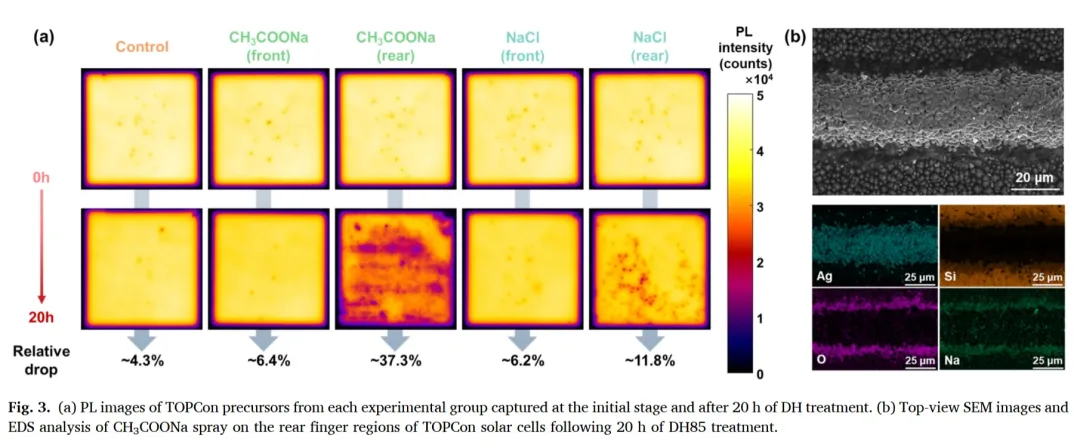
The rear side is clearly the sensitive one. CH₃COONa on the rear dropped Voc by 5.8%, sent Rₛ up 450% (Table 1), and cut PL intensity by 37.3% (Fig. 3a). The same treatment on the front cost only 0.87% PCE. Same salt, very different outcome depending on which face it hits.
Chemical breakdown of the passivation
XPS on the rear surface showed the Si-O bond fraction shooting up (Fig. 5b), with the O/N atomic ratio going from 1.6 in the control to 53 in the CH₃COONa group. The mechanism is nitrogen loss — damp heat hydrolyzes the SiNₓ and wrecks the surface passivation.
What the AlOₓ barrier does
With the 10nm ALD AlOₓ in place, PCE loss under rear CH₃COONa contamination fell from 16% to 0.4%, and Voc stayed put (Fig. 6a). SEM-EDS showed sodium content down 86% in the AlOₓ samples (Fig. 6c), and PL showed no defect activation (Fig. 6b). The barrier is doing exactly what you'd want — keeping the sodium out.
Conclusion
Main takeaways
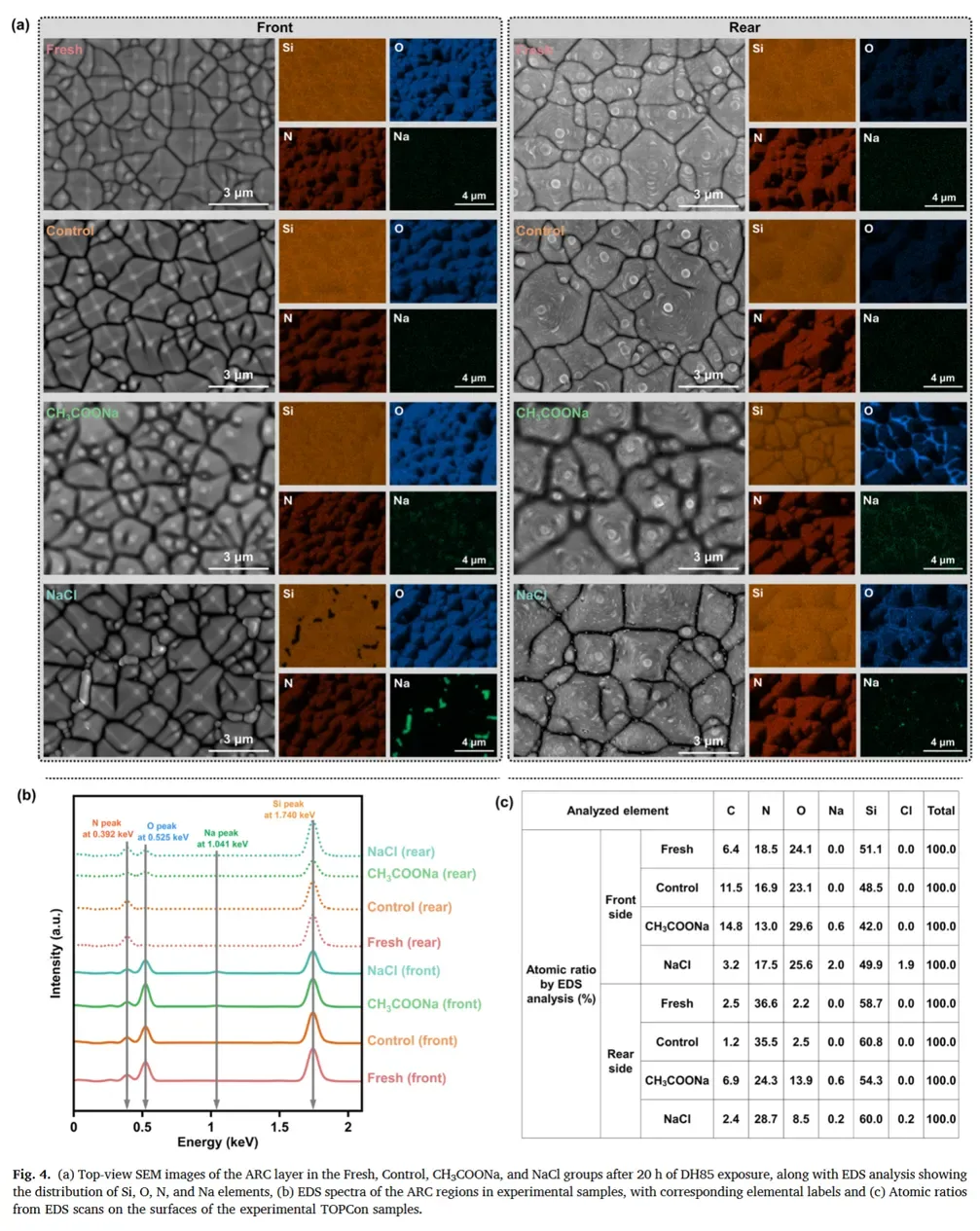
The rear SiNₓ layer hydrolyzes and oxidizes under damp heat plus sodium salt, which drives Voc down and Rₛ up (backed by XPS/EDS, Fig. 4-5). A 10nm AlOₓ layer blocks the sodium diffusion and keeps DH85 PCE loss below 1% (Fig. 6a). And the front AlOₓ/SiOᵧNᵣ multilayer is intrinsically corrosion-resistant, so contamination there barely registers.
Why it's useful
The AlOₓ barrier can go straight into TOPCon mass production on tools like the Leadmicro QL200. Looking further out, pairing AlOₓ with SiNₓ in double-glass module encapsulation could stretch plant lifetimes in humid regions.
A bit of background
TOPCon structure: a tunnel oxide (SiO₂) plus doped poly-Si passivating contact, which cuts recombination at the metal (Feldmann et al., 2014).
ALD: layer-by-layer nano-film growth, giving uniform nanometer-scale AlOₓ coverage.
DH testing: 85°C/85% RH accelerated aging to mimic module degradation in humid climates.
SiNₓ passivation: hydrogenated silicon nitride, good for anti-reflection and surface passivation, but it carries dangling bonds and hydrolyzes easily.
References
Tong H. et al., Mitigating contaminant-induced degradation in TOPCon solar cells via ALD AlOₓ barrier, DOI: 10.1016/j.solmat.2024.113188
Feldmann F. et al., Passivated rear contacts for high-efficiency n-type Si solar cells, Solar Energy Materials and Solar Cells 120 (2014) 270–274.
Li X. et al., Accelerated damp-heat testing of TOPCon cells using NaCl, Solar Energy Materials and Solar Cells 262 (2023) 112554.
Peters I.M. et al., The value of stability in photovoltaics, Joule 5 (2021) 3137–3153.
Ooitech's View
What stands out here is how much of the reliability story lives in the rear passivation stack, not the cell design headline. On a real line, an extra 10nm ALD AlOₓ step is cheap insurance for humid-climate projects, and it slots into standard module production without much fuss. We build turnkey module lines end to end, so we watch findings like this closely — small process tweaks upstream often decide whether a plant holds up for 25 years. If you want more from the factory floor, the Ooitech YouTube channel (www.youtube.com/ooitech) is worth a follow.