The Silver-Free Debate Returns: Less Silver, Copper
Table of Contents
Quick answer: The silver-free debate has returned to the top of the photovoltaic agenda after a major product launch put back-contact metallisation and copper into the same conversation. Silver paste is the largest non-silicon cost in a high-efficiency cell, and the industry has spent years reducing silver per cell rather than replacing it, because copper brings adhesion and diffusion problems that silver does not. The interest now is in whether plating routes have matured enough to be manufacturable at volume. Capacity figures discussed around the launch run to the gigawatt scale, with 6.5 GW and 20 GW figures appearing in planning, and the discussion carried into the 2026 exhibition season. For a module manufacturer the question is not whether copper plating works in a laboratory but whether a line can hold yield with it across shifts.
PV Module Manufacturing · by Jerry, Ooitech
The Silver-Free Debate Returns
LONGi's latest product launch has once again shifted the photovoltaic industry's attention toward solar-cell metallization. Compared with the other technologies in its so-called "technology forest," ACM stood out as the central focus because of its potential to reduce dependence on silver.
Over the past few years, most industry discussions have centered on the choice between TOPCon, HJT, and BC technologies. Conversion efficiency, module power, and bifaciality occupied the main stage at product launches. Silver paste has always been an important solar-cell cost item, but it rarely received this level of attention.
Sharp fluctuations in silver prices at the beginning of the year changed the conversation. Once silver paste accounted for a higher share of photovoltaic manufacturing costs than polysilicon, reducing silver consumption became a long-term issue that the industry could no longer avoid.
As N-type cell capacity expands, the cost of silver paste is becoming increasingly difficult to ignore. BC and HJT technologies place higher demands on metallization, while traditional silver-reduction methods are gradually approaching their process limits. Cell manufacturers have therefore started redesigning grid materials, contact structures, and module interconnection systems.
Why Does the Photovoltaic Industry Need to Reduce Silver Consumption?
For decades, silver has been widely accepted as one of the best materials for photovoltaic electrodes.
It offers excellent electrical conductivity, printability, and chemical stability. The screen-printing, firing, and soldering processes built around silver paste have also been proven through years of mass production. Since photovoltaic modules are expected to operate outdoors for 25 to 30 years, process maturity matters just as much as initial performance.
The problem is scale and price.
Reducing silver consumption by a few milligrams per cell may appear insignificant. Multiply that amount by several hundred gigawatts of annual production, however, and the financial impact becomes substantial. Silver is both an industrial commodity and a financial asset. Its price is affected by mine supply, investment demand, electronics demand, and several other factors over which photovoltaic manufacturers have little control.
Silver is also mainly produced as a by-product of other mining activities. Its limited annual supply is one reason it retains precious-metal status. If silver consumption per cell remains unchanged, continued growth in photovoltaic production could eventually create a situation in which the industry simply cannot secure enough silver.
TOPCon cells require metallization on both sides. HJT's low-temperature process needs specialized paste formulations. BC cells move all electrodes to the rear, making the electrode pattern more complex. Silver-consumption figures for different cell sizes cannot be compared directly, so the industry's concept of "de-silvering" actually covers several distinct technical levels:
Continued use of silver: Fine fingers, ultra-fine fingers, MBB, SMBB, and 0BB are used to reduce silver consumption.
Silver-coated copper or silver-copper composite paste: Copper performs most of the conductive function, while the outer silver layer improves oxidation resistance, electrical contact, and solderability.
Copper paste or copper-based alloys: Copper replaces most of the conventional silver paste.
Copper electroplating: Copper electrodes are formed directly on the cell surface, bypassing conventional silver-paste printing.
Aluminum replacing silver: The material cost is lower, but electrical conductivity and contact performance are more difficult to manage.
From conservative adjustments to radical process changes, every route is trying to answer the same questions: How much silver can be saved? How much equipment must be modified? Will efficiency suffer? Can production yield remain stable? And will the module still perform reliably after 25 years?
Conventional Technologies Move Toward Lower Silver Consumption
At present, the most widely adopted solution is still to reduce the amount of silver paste rather than eliminate it completely.
Fine and ultra-fine fingers reduce grid-line width while keeping series resistance under control. MBB and SMBB increase the number of busbars or interconnection wires, shortening the lateral distance that current must travel. 0BB removes conventional busbars and allows wires or composite films to collect current directly from the fingers.
These options are suitable for gradual production-line upgrades. Manufacturers can continue using mature screen-printing and module-production equipment, keeping process risk relatively manageable. TOPCon producers such as JinkoSolar have continued to advance 0BB, while HJT manufacturers often combine fine fingers, 0BB, and silver-coated copper paste.
Silver-coated copper is another important route.
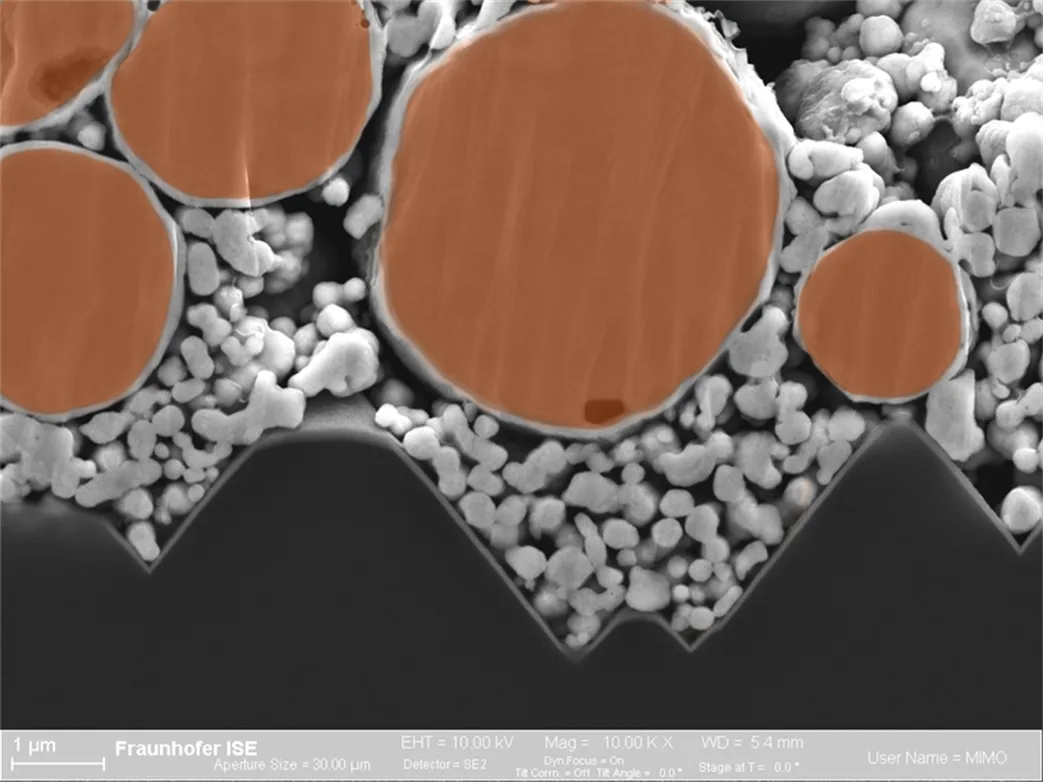
Copper powder carries the current, while the silver coating protects the copper and improves soldering performance. As the copper content rises, silver consumption per grid line gradually falls. Huasun has introduced silver-coated copper paste into HJT mass production and continues to develop formulations with higher copper content. HJT manufacturers such as Risen Energy are also advancing low-silver paste technologies.
The advantage of this route is that it requires relatively limited production-line modification and offers a clear path toward lower material costs. The main challenges include coating uniformity, copper diffusion, paste storage stability, printability, and solder-joint reliability. These issues become more pronounced as the silver content decreases.
Figure 1. Color scanning electron microscope image of a silver-coated copper paste contact
There are also disagreements within the low-silver camp.
On April 23, JA Solar published an article titled "Ensuring Silver Content, JA Solar Continues to Provide a Reliable Choice." It argued that the silver content of a module affects its underlying quality and clearly stated that the company would continue using silver paste. JA Solar's core position is that silver grid lines have already passed long-term validation, while copper and aluminum still face unresolved questions involving oxidation, corrosion, and interface stability.
Tongwei has described silver as the "ballast stone" supporting long-term module reliability. Trina Solar has also said that silver reduction is a clear trend, but its implementation must consider customers' long-term returns. It is important to note that these companies are also developing silver-coated copper or pure-copper solutions. Their attitude toward immediate mass deployment may be cautious, but they have not abandoned research into silver-free technologies.
The limitation of silver-reduction strategies is clear. No matter how low silver consumption becomes, photovoltaic manufacturing remains tied to a precious metal and continues to face price fluctuations beyond its control. Like TOPCon itself, conventional silver-reduction methods may deliver diminishing returns as they move closer to their technical ceiling. In an intensely competitive market, choosing a conservative route may sometimes be less about preference and more about survival.
ACM: Disruption or a Transitional Technology?
One week after LONGi's launch, Tongwei published an article titled "Silver-Free Modules: A Trap or the Real Deal? Read This Before You Decide." Its opening warning was direct: "Do not install silver-free modules blindly. If these three issues are not understood in advance, it may be too late to regret it after three to five years." The statement highlighted the sharp difference between the industry's technical camps.
Unlike the gradual reduction strategy favored by conventional manufacturers, BC companies are actively replacing traditional grid materials.
Silver itself has excellent conductivity. Solar-cell grids, however, use silver paste rather than pure silver. Copper can provide better conductivity than silver paste containing glass and other additives, while costing much less. The problem is that copper entering the silicon wafer may create deep-level defects and reduce minority-carrier lifetime. During long-term module operation, copper must also withstand oxidation, diffusion, damp heat, and interface aging. Addressing these risks requires coordinated development of barrier layers, contact structures, paste formulations, firing windows, and encapsulation systems.
LONGi's ACM technology attempts to solve these conflicts through a nano-alloy system and matrix contact structure.
According to LONGi's public information, ACM is a new-generation copper-alloy metallization solution developed for HPBC and HIBC back-contact cells. It combines three elements: a nano-scale barrier layer, copper-alloy conduction, and matrix point contacts. LONGi states that this structure can improve cell efficiency, substantially reduce silver consumption, and strengthen long-term module reliability without reducing production yield.
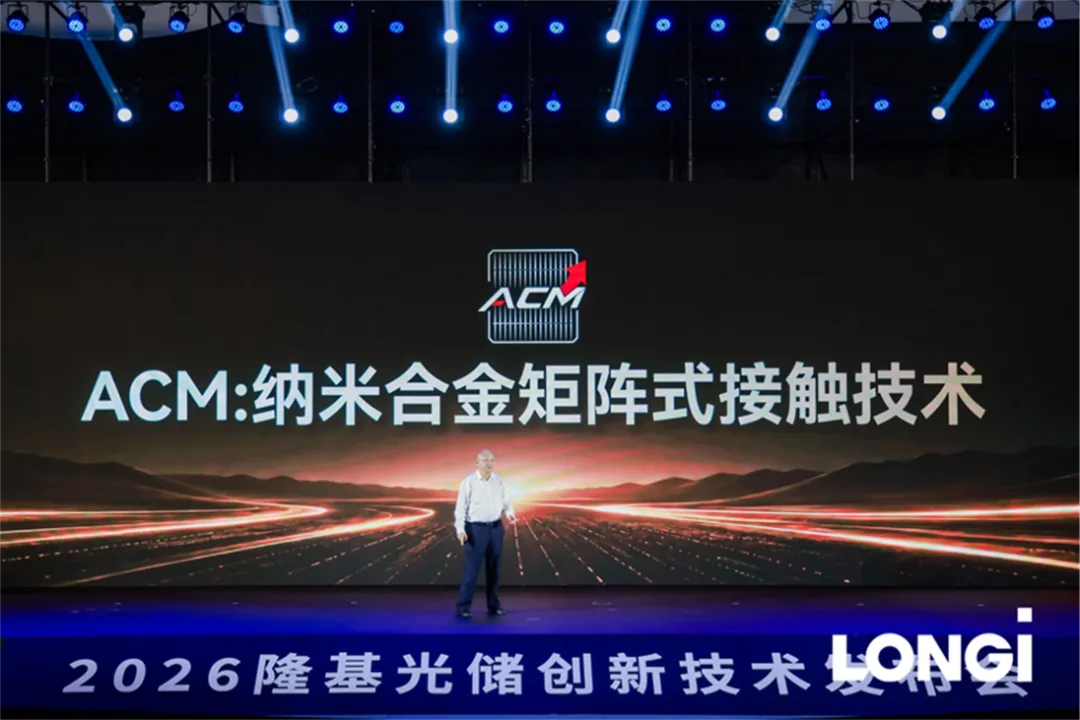
Figure 2. Launch event for LONGi's ACM nano-alloy matrix contact technology
From a technical classification standpoint, ACM belongs to the copper-based paste or copper-alloy metallization family. It retains a strong connection to printing processes and is therefore more compatible with existing cell-production equipment. For manufacturers operating large amounts of installed production capacity, this compatibility has practical value. A new material can only create meaningful cost benefits after it enters large-scale manufacturing.
LONGi's public communication emphasizes the replacement of conventional silver paste and a substantial reduction in silver consumption. It has not, however, disclosed the complete alloy composition or the proportion of each metal. Based on currently available industry information, ACM appears to use a copper-dominant alloy system and may still retain a small amount of silver, possibly in a seed or contact layer. It may therefore be more accurate to classify ACM as a deep silver-reduction technology or a route that eliminates conventional silver paste. Claims describing it as "pure copper" or "absolutely silver-free" may still require closer examination.
Even so, photovoltaic manufacturing is ultimately concerned with the amount of precious metal used per watt, the resulting cost reduction, and the additional equipment investment. If silver consumption falls sharply, ACM still carries clear economic significance even if a small amount of silver remains in the alloy system. As a newly introduced technology, its actual mass-production performance and field results will need time to prove themselves.
Copper Electroplating: Progress Made Away from the Spotlight
After the excitement surrounding recent launches, one point has received less attention: fully silver-free products based on copper electroplating have already been delivered to the market.
Aiko, another company working on BC technology, uses copper electroplating to form cell electrodes. The process generally includes patterning, deposition of a seed or barrier layer, copper plating, and application of an outer protective layer. The seed layer establishes electrical contact and prevents copper from diffusing into the silicon. The copper grid provides conductivity, while the outer metal layer supports oxidation resistance and interconnection.
Copper electroplating and ACM both reduce dependence on silver paste, but their manufacturing routes are very different.
ACM uses copper-based alloy paste, matrix contacts, and printing-related processes. Aiko bypasses silver-paste printing and grows copper electrodes through electroplating. Electroplated grid lines can achieve a relatively high aspect ratio, allowing them to be narrower and thicker. This reduces shading while maintaining a sufficient conductive cross-section.
Unlike ACM and conventional silver-paste metallization, Aiko's copper electroplating technology does not require high-temperature firing. This reduces thermal damage to the silicon wafer during processing and can indirectly raise the efficiency potential of the solar cell.
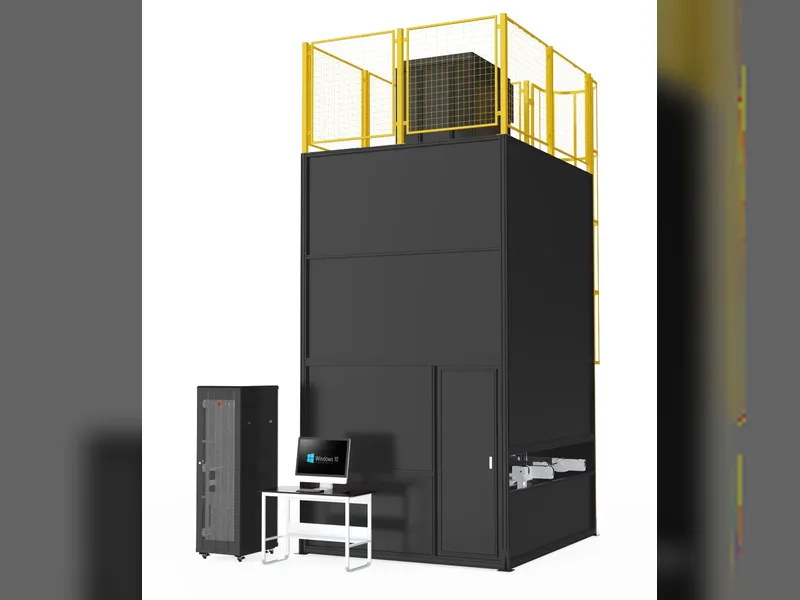
The process barriers are also clear. Copper electroplating requires more production steps, including patterning, coating, plating, cleaning, and wastewater treatment. Equipment investment is higher, there are more process-control points, and production yield can be more difficult to stabilize during the early ramp-up stage.
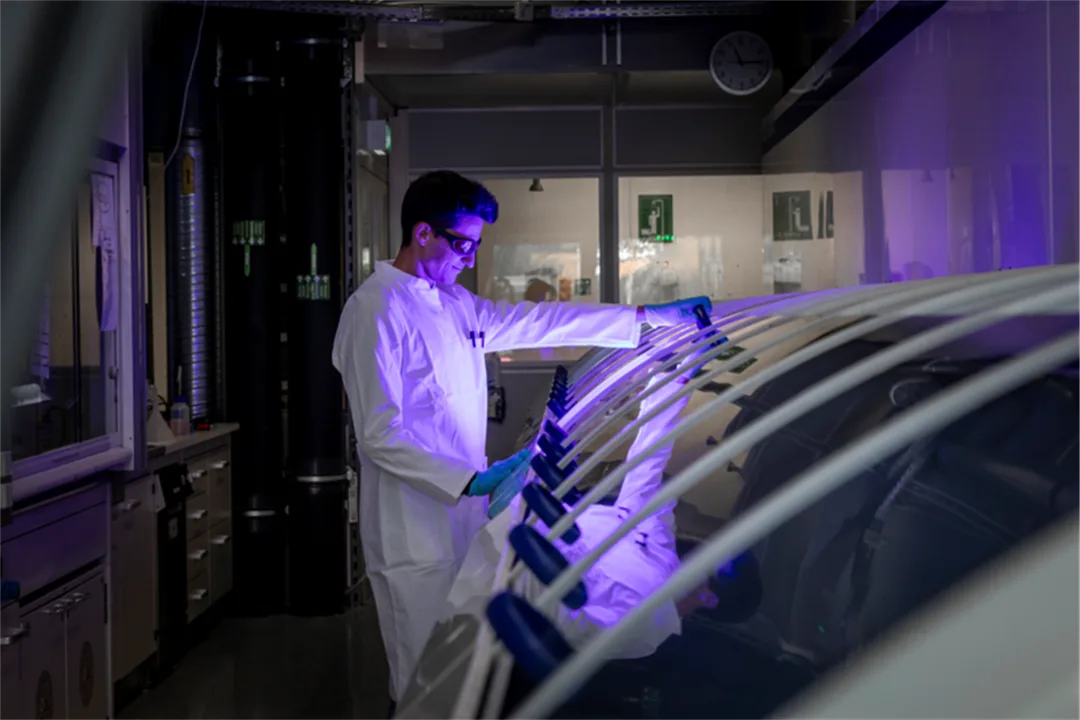
Figure 3. Inline Ni/Cu/Ag electroplating metallization equipment for crystalline-silicon solar cells
According to the publicly disclosed timeline, Aiko announced silver-free metallization coating technology in 2021. Its 6.5 GW ABC project in Zhuhai entered production in the fourth quarter of 2022. The company states that, since 2022, cumulative mass production using silver-free copper interconnection has exceeded 20 GW.
It appears that Aiko started earlier on the path toward silver-free metallization.
For the market, this head start means that Aiko's solution has already gone through equipment investment, process adjustment, and project validation. Whether it can ultimately outperform competing technologies will depend on cost per watt, production-line yield, equipment depreciation, and long-term reliability.
The ability of copper electroplating to continue reducing manufacturing costs matters more than the title of being first. Aiko's contribution to the industry is specific and measurable: copper electroplating has entered gigawatt-scale manufacturing and commercial delivery. The route now has real production data and a practical foundation for further improvement.
Aiko does not use exactly the same metallization solution at every manufacturing base. Available information indicates that the Zhuhai base uses silver-free copper interconnection, while the Yiwu base previously relied mainly on a low-silver solution. The company has not yet achieved complete silver-free coverage across all production scenarios. For utility-scale applications, for example, ABC modules may use finer silver-containing grids to balance metallization design with bifaciality. Available data indicates that the silver-reduced ABC modules produced at the Yiwu base use approximately 70% of the silver required by conventional designs and can reach a bifaciality of 85%.
This also shows that even Aiko's commercially established copper-electroplating technology still has room for optimization. That remaining potential is consistent with the broader cost-reduction and efficiency-improvement possibilities of BC technology.
Process Innovation Around Silver-Free Metallization
Alongside ACM, LONGi introduced 0BB, shingling, conductive backsheet, and hidden-busbar processes, presenting the combined system as a "technology forest."
Taken individually, these processes are not appearing for the first time. One of the main strengths of LONGi's presentation was the way it organized the different process steps around ACM and presented them as a complete system. This helped place greater emphasis on the role of integrated innovation in photovoltaic manufacturing.
Aiko had previously packaged several similar innovations into commercial products rather than presenting them only as technical concepts. Its third-generation ABC "Full-Screen" module, released in 2024, already used precision overlapping interconnection, hidden busbars, and a 0BB design. At SNEC 2026, the company introduced its fourth-generation ABC product, Full-Screen Ultra. By reducing the required creepage distance, the design further reduced non-power-generating area by 20%.
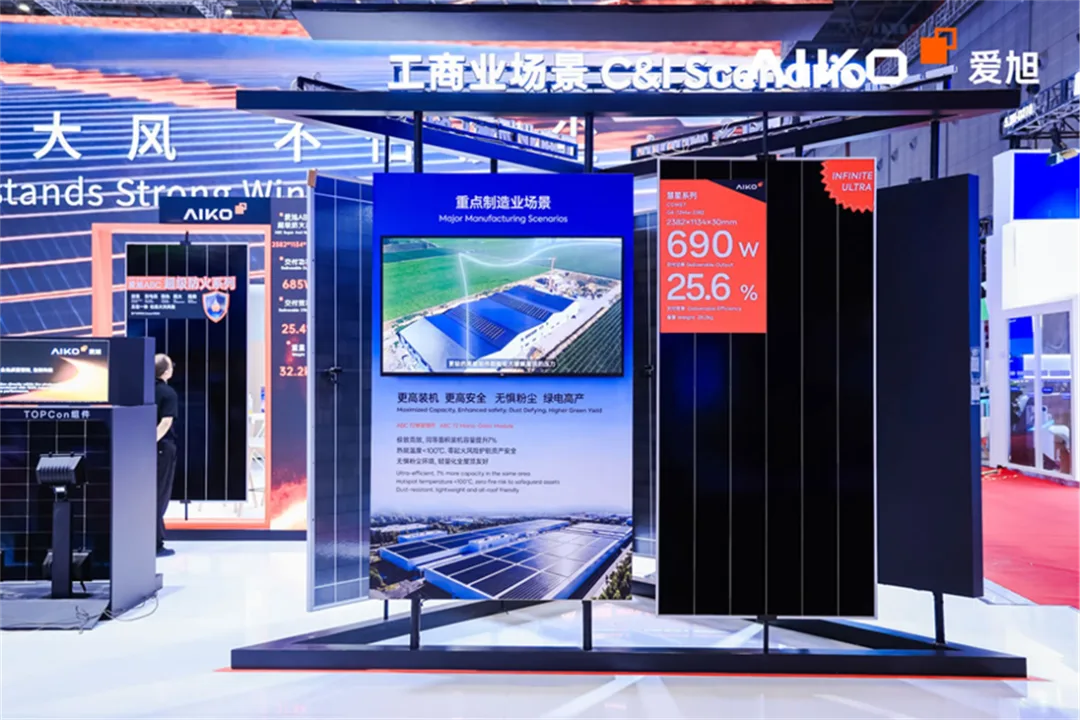
Figure 4. Aiko G4 Full-Screen Ultra module displayed at SNEC 2026
Different technical routes have reached a rare point of agreement on increasing the module's active power-generating area. The next stage of competition will still be decided on the manufacturing floor. The power rating of a test sample can rise quickly when several design improvements are combined. Achieving large-scale production and passing long-term market validation is much harder. Both BC and TOPCon products still have a long road ahead.
The Logic of Innovation Is What Matters
The day after LONGi's launch, Aiko's share price reached its daily trading limit first and helped drive a broader rebound in photovoltaic-equipment stocks. The reaction quickly became a topic of discussion across the industry.
Short-term capital tends to trade themes, expectations, and valuation flexibility, so the two events should not be treated as a direct cause-and-effect relationship. LONGi's launch strengthened market attention on copper metallization, BC technology, and module-process optimization. It was therefore not surprising that Aiko, which had commercialized related technologies earlier and showed greater share-price sensitivity, became a direct market reference.
The deeper reason is that market expectations about the photovoltaic cycle appear to be changing.
On the evening of LONGi's launch, Aiko released its earnings forecast for the first half of 2026. The company expected a net loss attributable to shareholders of RMB 680 million to RMB 790 million. The removal of export tax rebates, exchange-rate fluctuations, and impairment provisions weighed on the half-year figures. The more positive signals came from quarter-on-quarter performance: losses in the second quarter narrowed compared with the first quarter, while ABC module revenue, the overseas sales share, and gross margin all improved.
The market's response suggests that, at least for technology-leading companies, the most difficult stage may have passed. Whether Aiko can move out of the cycle first and help lead a broader industry recovery will still depend on ABC shipment volume, gross margin, capacity utilization, and operating cash flow.
At the same time, policy pressure to eliminate excessive capacity is increasing. The mandatory national standard titled "Minimum Allowable Values of Energy Efficiency and Energy Efficiency Grades for Crystalline Silicon Photovoltaic Modules and Inverters," released in June, and policy changes involving the removal of photovoltaic export tax rebates and the collection of consumption tax are both clear signals that the industry's campaign against destructive internal competition is moving forward.
As the external environment becomes tighter, cost reduction, quality improvement, and efficiency gains are becoming matters of survival. Conservative or aggressive, each route will ultimately face the same test. Only companies that establish a combined advantage in production cost, product quality, and technical innovation will be in a position to define the photovoltaic industry's next stage.
Ooitech's View
The real contest is not simply silver versus copper. It is whether a metallization system can combine low material consumption with stable yield, manageable equipment depreciation, reliable module interconnection, and proven damp-heat performance. Copper paste offers easier production-line compatibility, while electroplating can deliver finer, higher-aspect-ratio grids but demands tighter process and wastewater control. The winning route will be the one that performs consistently at gigawatt scale, not the one with the strongest launch-day claim.
Related: 0BB on back-contact cells: gains and yield limits explains how removing printed busbars changes the silver budget before the paste is changed at all.
Related: 0BB cell technology: what removing the busbar changes compares the other silver reduction routes, which compete for the same paste budget.
Further reading and background data
Public reference material on this topic, published by the organisations that maintain the industry's technology roadmap and market data: