TOPCon’s Environmental Paradox: Lower Silver Use Can
Table of Contents
Quick answer: TOPCon presents an environmental paradox: it beats PERC on almost every impact measure except silver. A study published in Nature Communications found that while TOPCon's lower silver consumption per watt improves its overall footprint, the silver that remains carries a disproportionately large share of the impact — silver mining and refining account for a share of the total that is far above its mass fraction. The figures involved sit in the range of a 6.5% to 15.2% impact contribution from a material that makes up a small part of the cell by weight. This is why reducing silver per cell is treated as both a cost and an environmental lever. The practical implication for a manufacturer is that metallisation design decisions — finger width, busbar count, paste formulation — now carry an environmental argument as well as an efficiency one.
PV Module Manufacturing · by Jerry, Ooitech
Introduction: Why This Study Matters Now
This article is based on the Nature Communications paper published online in February 2026, “Maximising environmental savings from silicon photovoltaics manufacturing to 2035” by Bethany L. Willis et al. The study provides one of the more complete life-cycle comparisons between PERC and TOPCon photovoltaic manufacturing, extending the analysis from today’s production data to 2035 technology and grid scenarios.
By the end of 2023, global installed solar PV capacity had already exceeded 1 TWp. In long-term decarbonization scenarios, that number could reach around 80 TWp by 2050. This growth is essential for the energy transition, but it also creates a manufacturing burden that is often underestimated. Previous estimates suggested that PV manufacturing itself could consume up to 11% of the remaining global carbon budget under a 1.5 °C pathway.
The timing is important because the mainstream crystalline silicon industry is moving rapidly from PERC to TOPCon. TOPCon offers higher efficiency, but its cell structure, dopants, passivation layers, and metallization differ significantly from PERC. The key question is simple but difficult: does higher efficiency reduce environmental impact, or does the extra material and process complexity offset the gain?
The study uses a cradle-to-gate life-cycle assessment, covering the chain from quartz mining to wafer, cell, module manufacturing, and shipment to Central Europe. The functional unit is 1 Wp, and the impact assessment follows the EU EF v3.1 method across 16 categories. Technology development assumptions are based on the ITRPV 2024 roadmap, while electricity decarbonization follows the EIA 2023 low zero-carbon technology cost scenario. Manufacturing regions include China, India, the United States, and Europe, with Monte Carlo analysis used to test uncertainty.
PERC vs TOPCon: Better in 15 Categories, Worse in One
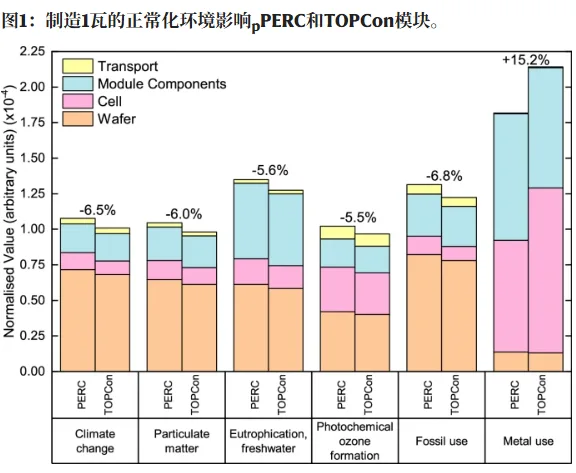
Under the 2023 baseline scenario of Chinese manufacturing and delivery to Central Europe, TOPCon performs better than PERC in 15 out of 16 environmental impact categories on a per-Wp basis. The only category where TOPCon performs worse is metal and mineral resource use.
| Impact Category | TOPCon vs PERC per Wp |
|---|---|
| Climate change | -6.5% |
| Particulate matter | Lower |
| Freshwater eutrophication | Lower |
| Photochemical ozone formation | Lower |
| Fossil resource depletion | Lower |
| Metal and mineral resource depletion | +15.2% |
Fig.1 | Normalized comparison of six major impact categories between PERC and TOPCon, with percentage differences.
The +15.2% increase in metal resource impact is largely linked to silver. In PERC cells, rear-side metallization uses a combination of silver and aluminum. In TOPCon cells, both front and rear metallization rely more heavily on silver paste. As a result, even though TOPCon produces more power per area, its silver demand per Wp remains a critical environmental concern.
This is the first layer of the paradox: TOPCon is cleaner in most life-cycle categories, but its metal footprint can be worse because of silver-intensive metallization.
Hotspot Analysis: Electricity Dominates Carbon, Silver Dominates Metal Use
The study breaks TOPCon module manufacturing into four major stages: wafer production, cell production, module assembly, and transport to Central Europe. The results show that different environmental categories are controlled by very different hotspots.
Wafer production is the largest carbon hotspot
The wafer stage dominates 12 of the 16 impact categories. In the six key categories highlighted by the paper, wafer-related electricity use contributes heavily to:
| Category | Share from Wafer Electricity Use |
|---|---|
| Fossil resource depletion | 88.2% |
| Climate change | 89.9% |
| Particulate matter | 93.5% |
More than 85% of wafer electricity demand comes from polysilicon reduction and Czochralski crystal pulling. In practical terms, the carbon footprint of a solar module is strongly shaped by the electricity mix used upstream in polysilicon and ingot production.
Cell production is the metal-use hotspot
The cell stage is the only stage where metal resource use becomes dominant. Silver paste metallization accounts for 53.0% of total module metal use and 98.3% of metal use within the cell stage. Other cell-stage hotspots include silane for poly-Si deposition and PECVD, annealing electricity, and NMVOC emissions from solvent cleaning.
Module assembly is driven by glass, copper, and tin
The module stage contributes strongly to human toxicity and land use. Key materials include front glass, soda ash, heavy oil used in glass production, copper, and tin. Tin is used in relatively small quantities, but its contribution to metal-use indicators is still noticeable.
Transport is dominated by shipping, but sea freight is still relatively efficient
For China-to-Europe delivery, transport impacts are dominated by ocean shipping in absolute terms. However, per tonne-kilometer, sea freight remains much cleaner than road transport. Transport contributes especially to photochemical ozone formation because of hydrocarbon fuels and logistics infrastructure.
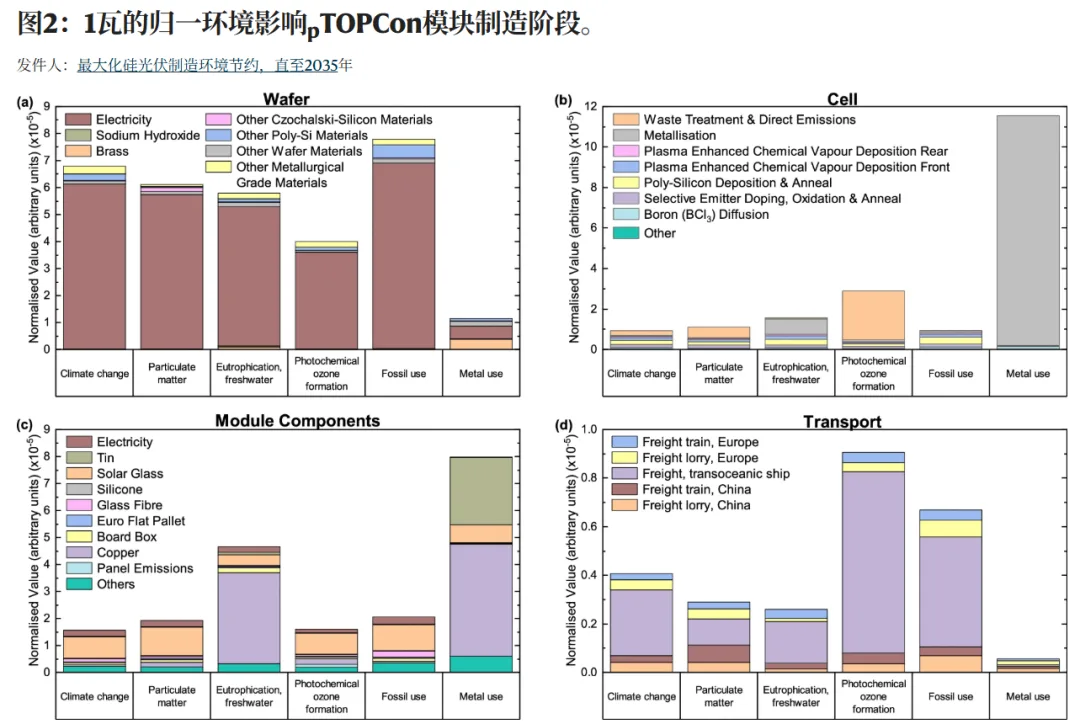
Fig.2 | Hotspot contribution of wafer, cell, module, and transport stages across six major impact categories.
Manufacturing Region and Time Projection: Europe Leads, But 2035 Brings a Twist
The paper then models TOPCon manufacturing in China, India, the United States, and Europe from 2023 to 2035. It considers both current electricity mixes and future decarbonized grid scenarios. Technology parameters such as efficiency, silver use, polysilicon consumption, and wafer thickness improve year by year according to ITRPV assumptions.
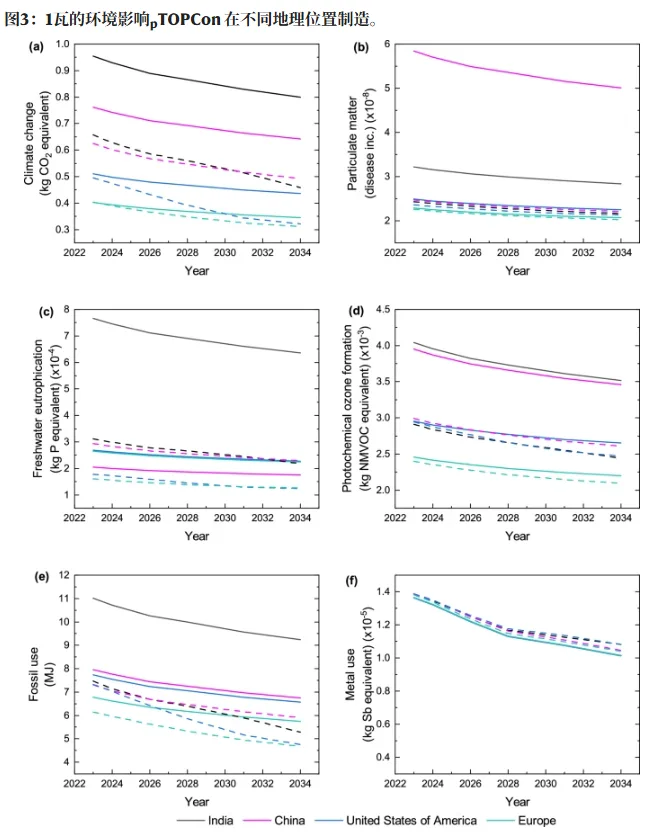
Fig.3 | Six major impact categories by manufacturing region from 2023 to 2035. Solid lines represent current grids; dashed lines represent future decarbonized grids.
Several findings stand out.
| Finding | Details |
|---|---|
| Highest 2023 GWP | India, about 0.95 kg CO₂eq/Wp |
| Lowest 2023 GWP | Europe, about 0.40 kg CO₂eq/Wp |
| Technology-only improvement | Average GWP reduction of about 0.10 kg CO₂eq/Wp by 2035 if grids do not change |
| China particulate matter result | China can show higher particulate impact than India due to coal mining self-use electricity and particulate emissions in the grid inventory |
| Metal-use paradox | Future low-carbon grids may slightly increase metal-use impacts because renewable energy infrastructure itself requires more critical minerals |
The most counterintuitive result is the metal-use paradox. A cleaner electricity system reduces carbon emissions, but renewable power infrastructure can require more scarce metals. In EF v3.1, scarce metals such as silver and rare earth elements carry high characterization factors. Under future grid assumptions, the United States becomes the highest metal-use case by 2035, while Europe remains the lowest because its grid scenario has a relatively smaller PV share.
In other words, decarbonization improves the climate account but can worsen the mineral resource account if the system relies on metal-intensive clean energy infrastructure.
Global Deployment to 2035: Up to 8.2 Gt CO₂eq Can Be Avoided
Using ITRPV shipment projections, the study assumes PERC exits the market by 2034 while TOPCon becomes the dominant successor. It then calculates cumulative global manufacturing impacts under different regional manufacturing and grid scenarios.
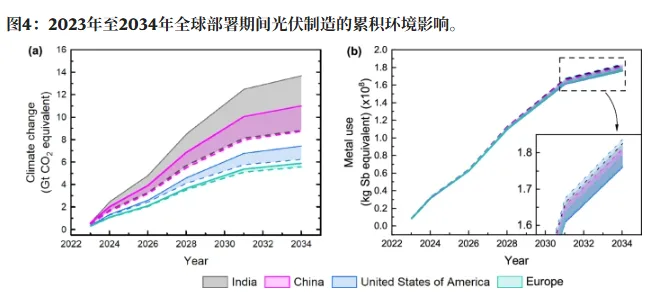
Fig.4 | Cumulative climate change and metal-use impacts for global PERC and TOPCon deployment. Shaded regions indicate the difference between current and future grid scenarios.
Key results include:
Cumulative PERC and TOPCon manufacturing emissions before 2035 could reach an upper limit of about 13.8 Gt CO₂eq.
Optimizing manufacturing location and decarbonizing electricity could reduce this by up to 8.2 Gt CO₂eq.
That saving is equivalent to around 13.9% of global anthropogenic net greenhouse gas emissions in 2019.
Moving manufacturing from China to Europe under the assumed EIA future scenario could reduce cumulative GWP by another 49.5%.
Metal-use impact increases as grids decarbonize, with Europe performing best and the United States worst under future assumptions.
The energy benefit remains very strong. Modules manufactured from 2023 to 2035 are expected to generate around 94,602 TWh over the first 12 years of their assumed 30-year lifetime. Their manufacturing emissions are estimated at around 2.26 Gt CO₂eq. Producing the same electricity with future regional grids would emit between 27 and 67 Gt CO₂eq. Even under conservative assumptions, the avoided emissions exceed 25 Gt CO₂eq.
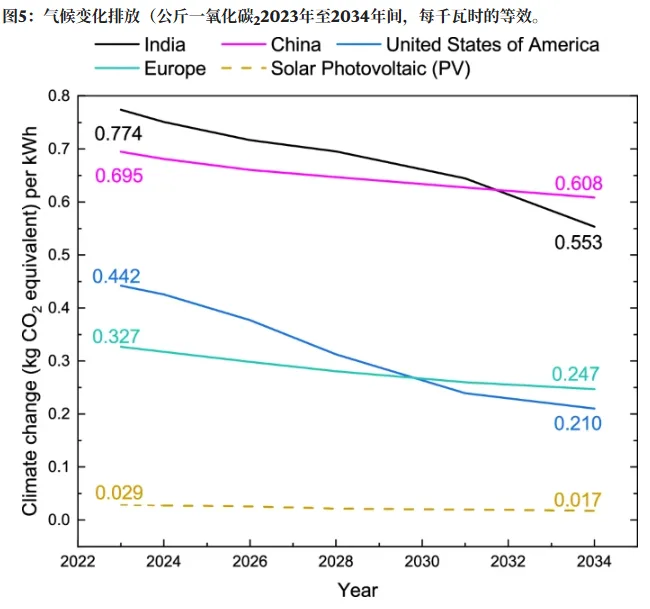
Fig.5 | Solar PV life-cycle carbon intensity compared with future regional grid electricity intensity.
Sensitivity Analysis: Grid Mix and Technology Choices Change the Result
The study performs several sensitivity tests to identify which levers matter most.
Sub-grid carbon intensity matters more than country labels
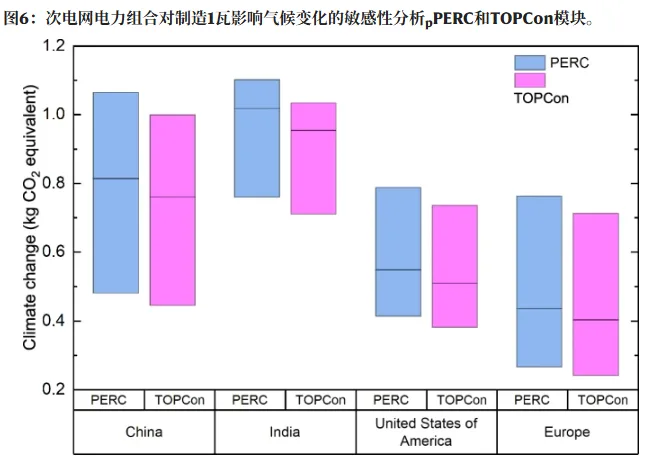
Fig.6 | GWP ranges across sub-grids in four regions. Black lines show the average-grid reference used in the main model.
China has the widest sub-grid range, from about 0.32 to 0.58 kg CO₂eq/Wp. The lowest-carbon Chinese sub-grid is close to the European reference case. This means that the label “made in China” or “made in Europe” is too broad for serious carbon accounting. The actual grid connection, local power purchase agreement, and direct renewable electricity access can decide whether a module meets low-carbon thresholds such as EPEAT Climate+.
Coal is the most sensitive fossil fuel input
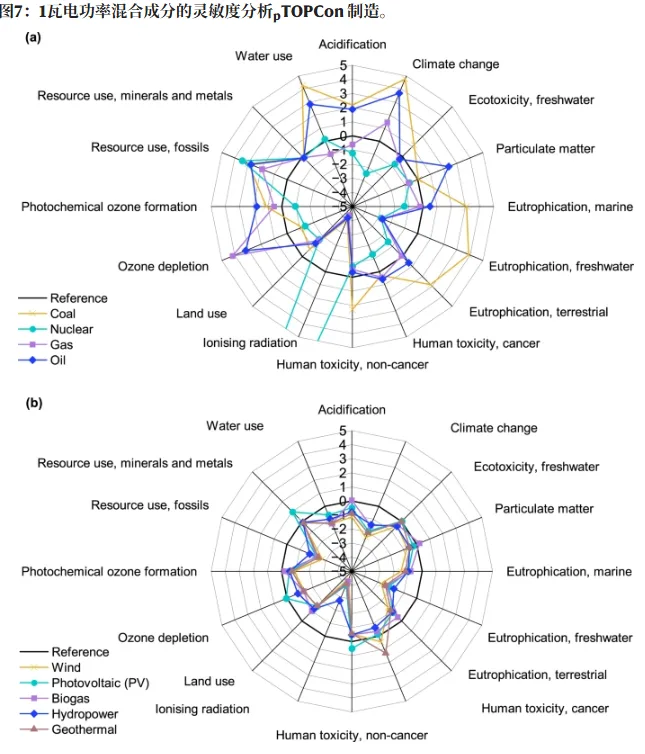
Fig.7 | Impact of ±5% changes in individual fuel shares across 16 environmental categories.
A ±5% change in coal share has the strongest effect across nine categories, including a +4.8% change in GWP. Nuclear power strongly affects ionizing radiation indicators but has smaller effects elsewhere. Hydropower is the only renewable source that reduces all 16 categories in this sensitivity test, suggesting that PV manufacturing powered by hydropower can be particularly favorable from an LCA perspective.
Four technical levers define the next stage of PV sustainability
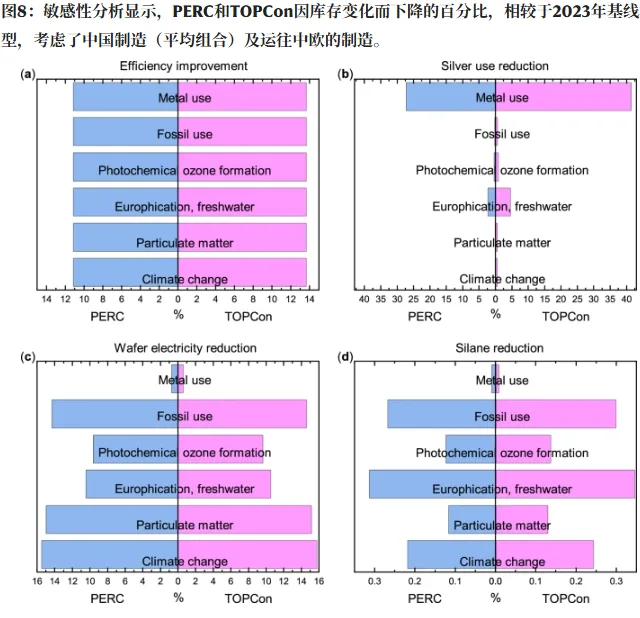
Fig.8 | Sensitivity of efficiency improvement, silver reduction to 5 mg/W, wafer electricity reduction, and silane reduction.
| Lever | PERC Impact | TOPCon Impact | Main Effect |
|---|---|---|---|
| Efficiency improvement | +12.6% | +15.9% | Reduces all categories proportionally per Wp |
| Silver reduced to 5 mg/W | -66.5% silver-related potential | -78.0% silver-related potential | Cuts metal-use impact by more than 41%; little effect on other categories |
| Wafer electricity reduced by 26% | Strong reduction | Strong reduction | Reduces GWP, particulate matter, freshwater eutrophication, and fossil depletion by more than 10% |
| Silane reduced by 14.4% | Small reduction | Small reduction | Broad but modest environmental benefit |
The silver target of 5 mg/W comes from the multi-terawatt sustainability threshold discussed by Haegel et al. in Science 2023. Achieving it would cut metal-use impact sharply, but it does not solve carbon, particulate, or fossil-energy impacts. That is why the headline reduction in silver use is not the full environmental story.
Monte Carlo uncertainty check confirms the main conclusion
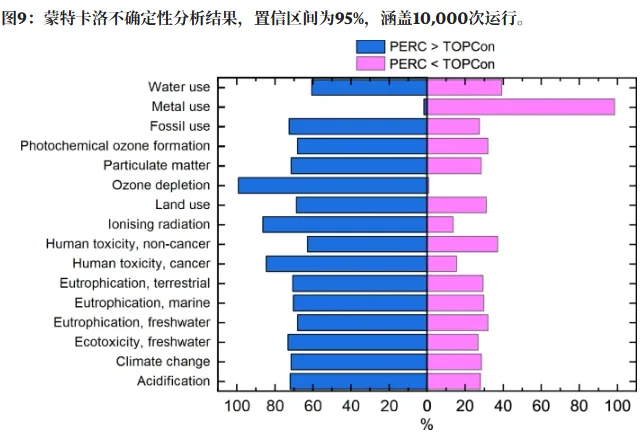
Fig.9 | Monte Carlo confidence results across 16 environmental impact categories.
After 10,000 Monte Carlo runs, PERC shows a higher impact than TOPCon in more than 70% of simulations for 11 of the 16 categories. For climate change, the confidence level is 71.5%. For ozone depletion, it reaches 98.7%. Metal use moves in the opposite direction with 95.8% confidence, confirming that TOPCon is very likely to consume more metal resources under the baseline assumptions.
Industry Implications: The TOPCon Transition Is Positive, But Not Automatically Sustainable
The findings lead to several practical conclusions for the solar manufacturing industry.
TOPCon replacing PERC is environmentally positive overall, but silver becomes a life-cycle issue, not just a cost issue. Copper plating and Ni/Cu/Ag stack technologies are therefore not only cost-reduction options; they are also important for reducing metal resource indicators.
Wafer electricity is the largest climate hotspot. Polysilicon reduction and crystal pulling are the core processes to watch. For carbon-footprint compliance, manufacturing location should be assessed at the sub-grid level, not simply by country.
Low-carbon electricity can create a mineral trade-off. A decarbonized grid lowers GWP, but if the grid expansion depends heavily on metal-intensive renewable systems, metal-use indicators may rise.
Efficiency improvement is the cleanest all-category lever. Higher module efficiency reduces area, material, and energy demand per Wp across the whole value chain. TOPCon has stronger efficiency leverage than PERC, but that benefit must be protected by reducing silver consumption.
Ooitech's View
As an equipment supplier working closely with solar module manufacturing lines, we see the TOPCon transition as a reminder that higher cell efficiency alone is not enough to define a truly sustainable production route. The most important factory-level decisions will be silver-reduction process readiness, wafer-side electricity sourcing, and stable process control that can convert efficiency gains into real per-Wp material savings. For future module lines, especially those designed for TOPCon or next-generation n-type products, environmental performance will increasingly depend on how well equipment, materials, and factory energy strategy are engineered together.