How One Laser Step Forced
Table of Contents
Quick answer: Before 2024, nearly all TOPCon front silver paste was aluminium-doped, because the aluminium helped the paste burn through the anti-reflective coating during firing and form a contact. One laser step changed that requirement. When a laser is used to open the contact regions before metallisation, the paste no longer has to penetrate the coating itself, so the aluminium doping that made burn-through work is no longer needed and becomes a liability, because aluminium in the emitter increases recombination. The firing temperatures involved sat around 650 °C to 700 °C. The shift that followed is a good example of how a single process addition resets the specification for every material upstream of it, and why paste formulations change together with the metallisation route rather than independently.
PV Module Manufacturing · by Jerry, Ooitech
Introduction
Before 2024, TOPCon front silver paste was pretty much all aluminum-doped. Aluminum helped burn through the dielectric layers, helped push down contact resistance, and everyone was using it just fine. Then LECO showed up and the whole picture flipped. Aluminum-free silver paste took the lead almost overnight, and aluminum-doped paste dropped to a supporting role. After that, everybody went deep on the aluminum-free direction, grinding on paste formulas, molecular design, and process synergy.
So why can one laser process shake up the silver paste formula so hard? On the line, a lot of people know that it happened, but not why. Understand this, and you actually understand TOPCon front sintering.
TOPCon front metallization is moving from "material dominates contact" to "material, laser, emitter and fingers sharing the work."
Start From The Front Structure
Take a typical TOPCon structure. The front side is usually a multi-layer dielectric film stack, for example SiOx, SiNx, AlOx. Some processes also bring in functional layers like SiOxNy, and the exact stack differs by manufacturer. Below all that sits the boron-diffused emitter, with a typical junction depth of only 0.8 to 1 micron.
The glass frit in the silver paste has to "eat" through these dielectric films one layer at a time in the few seconds of sintering, so it can take root on the emitter surface. Multiple films, multiple gates. Each layer has a different composition, thickness and density. To the glass frit these are several different dishes, and each needs its own heat. That is the structural reason the TOPCon front sintering window is naturally narrow: you are not sintering one film, you are sintering many.
Aluminum-Doped Era: Aluminum Is A Double-Edged Sword
How does silver paste actually connect with silicon? Roughly like this. The glass frit melts and etches the dielectric films open layer by layer. Past 650°C, silver starts dissolving into the molten glass. Back in 2016 NREL and SLAC filmed it live with in-situ X-ray: at 700°C, in just 10 seconds, 70% of the silver dissolved into the glass phase. The dissolved silver ions follow the glass toward the emitter surface, react with silicon in an oxidation-reduction reaction, and precipitate out again as metallic silver, growing into rows of "silver spikes." On cooling, silver crystallites a few nanometers in size precipitate inside the glass, forming conductive channels that carry the current out.
Put simply: front sintering is letting silver take a walk through the glass, and take root inside the emitter.
In this process, aluminum's job is very real. It helps burn through the dielectric layers, and it presses down contact resistance. But aluminum also plants landmines. The boron emitter junction depth is only 0.8 to 1 micron. The silver spikes need to go deep enough to form a low-resistance contact, but must not punch through the p-n junction. Aluminum changes the glass phase reaction, the interface etching, and the metal precipitation behavior. Under certain process systems, too much aluminum involvement can raise the risk of contact over-firing and emitter damage. And aluminum's bad debt is not just this one passivation account. Under high-temperature sintering, the metal fingers slump and spread out. After firing the fingers get wider and shorter, shading area grows, and optical loss goes up with it. In the aluminum-doped era, these are two bad ledgers: the interface is hurt by aluminum, and the fingers are burned by fire.
One line: the aluminum-doped era traded aluminum's brute force for contact, and paid the bill with passivation and optics.
Once LECO Came In, The Sky Changed
LECO (Laser Enhanced Contact Optimizing) was first proposed in 2016 by Cell Engineering. It entered TOPCon mass production in 2023-2024, and it is now a standard industry configuration. Its meaning is not "one more laser step." Its meaning is that it redistributes the mechanism of front contact formation. For the first time, the initiative of contact formation is partly taken out of the paste's hands and given to the laser, which does precise local processing at the contact interface to "activate" the contact. The work aluminum used to do, the laser can do too, and it does it more precisely, without hurting passivation.
Take the aluminum out, and the biggest front-side hazard, aluminum punch-through destroying the boron emitter passivation, disappears at the source. This is what the industry calls the "big jump": straight from aluminum-doped silver paste to aluminum-free silver paste, with almost no transition state in between.
Here is the point line people most easily misread: aluminum-free silver paste is not simply "delete the aluminum." Delete the aluminum, and the job of burning through the dielectric layers falls entirely on the glass frit, while contact formation falls on LECO. The glass formula, silver powder morphology, and sintering temperature window of the aluminum-free paste all have to be redesigned. Removing aluminum splits one old problem into two new problems, then solves them one by one.
After Aluminum-Free, The Fight Is Over "Inner Skill"
Aluminum-free silver paste is not the finish line, it is the start line. Over the past two years, everyone has been refining in the aluminum-free direction, grinding on the paste's own "inner skill." This August, the Ye Jichun team at the Ningbo Institute of Materials, together with JA Solar and Zhejiang Guangda Electronics, published a 26.31% front metallization work in Matter. That is the latest showpiece of this wave of inner skill.
26.31%-efficiency TOPCon solar cells enabled by synergistic metallization with reduced optical shading and contact resistance losses, https://doi.org/10.1016/j.matt.2026.102965
Unpack it, and it did two things nobody in the aluminum era would dare even think about.
First, it made the silver paste "conformal." Starting from the reversible breakdown and rebuild mechanism of the polymer thixotropic network in the paste, they redesigned the molecular configuration of the polymer network and the intermolecular hydrogen bond network, so the paste "stands up" after it is printed. The printed finger aspect ratio reached 55%, so the fingers are tall and narrow. Don't underrate that number. What high-temperature sintering fears most is finger slumping and spreading. A 55% aspect ratio means shading drops sharply, and a big chunk of optical loss is saved. This is the "clever force" at the paste level, not aluminum's brute force, but rheology design.
Second, it made the contact "point-located." Their customized LECO process applies a reverse bias to the cell while a single-frequency laser continuously scans the front fingers. Carrier injection triggers local Joule heat, forming a hemispherical Pb-Ag/Si alloy contact at the shoulder of the pyramid. Note three keywords: low penetration, low resistance, discrete sites. The metal-semiconductor contact reaction is confined to tiny points, instead of the whole surface being "burned" across like in traditional sintering. The aluminum-induced lattice damage is gone, and metal-induced recombination loss drops a lot.
The Ningbo Institute result: 26.31% third-party certified efficiency, short-circuit current density 41.98 mA/cm², setting a certified record for Jsc of large-area TOPCon cells. This Jsc gain is essentially not from stronger sintering "burning" the contact out, but from "saving" the loss on both ends at once, finger shading and interface recombination.
The Front Side Is Not The Paste's Battlefield Alone
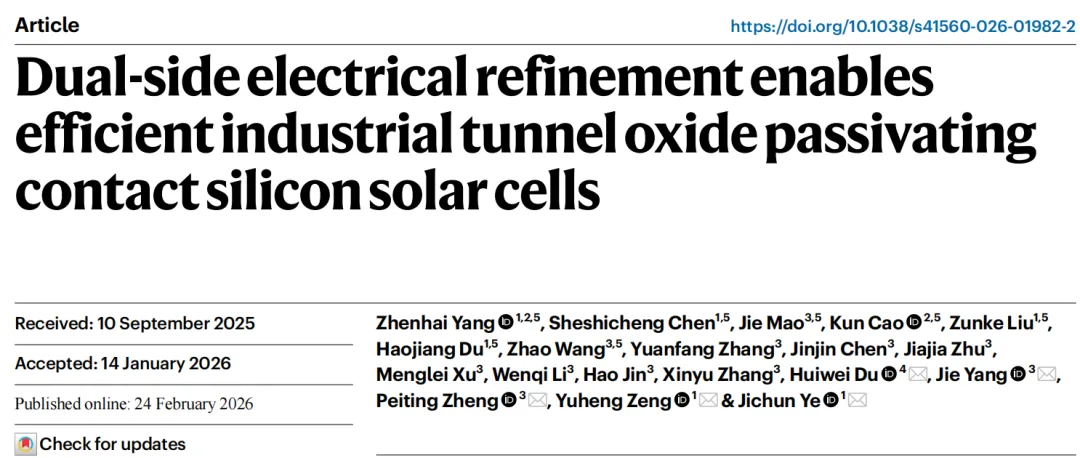
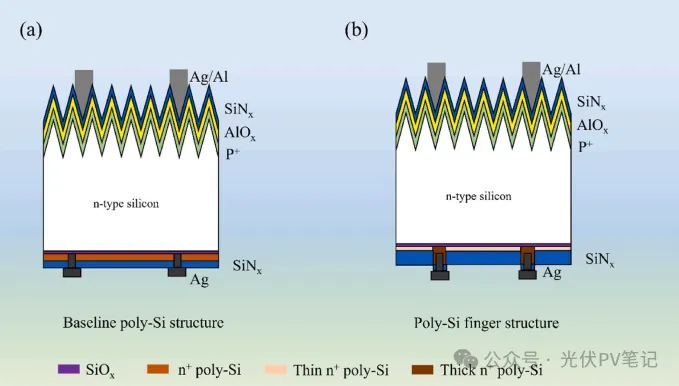
Take that Nature Energy 26.66% work out again. A lot of people only stare at the double-layer poly-Si on its back, but its front side is also under the knife, and the logic is the same as the Matter work.
On the front, the boron emitter sheet resistance is raised from the usual 215 Ω/sq to 430 Ω/sq. Higher sheet resistance means better passivation (minority carrier lifetime up from 0.70 ms to 1.12 ms, dark saturation current density down from 9 to 5 fA/cm²), but the contact gets harder to make. The solution walks on two legs. The fingers are narrowed from 20 μm to 10 μm, and the pitch tightened from 1120 μm to 825 μm, using denser and finer fingers to compensate the lateral transport loss of high sheet resistance, and cutting silver use per unit area by about a third along the way. The other leg leans on the contact activation process to backstop it, solving the high-sheet-resistance contact problem in the metallization step.
What is more interesting is putting the two works side by side. Same team. Nature Energy "blocks silver" on the back, Matter "removes aluminum" on the front. One front, one back, both are "subtraction in metallization." The aluminum-era playbook of "trade brute force for contact, pay with passivation" is being systematically retired, replaced by: clever paste, point-located laser, fine fingers, thick passivation.
The Next Fight: Use Even Less Silver
Aluminum-free solved the "passivation damage" problem, but the next step in cost-down and efficiency-up is "reduce silver content."
If aluminum-free silver paste solves "how to make contact without hurting passivation," then silver-coated copper, low-silver paste, and even pure copper metallization are solving the next problem: how to use less silver.
DK Electronic has developed a copper-based low-silver metallization solution, and worked with leading customers to be the first to reach mass production on TOPCon cells. JinkoSolar is tackling pure copper paste and nickel paste and other base-metal conductive pastes. LONGi's ACM metallization solution is already placed on the board.
In 2026, going silver-free has shifted from a "research direction" to an "industrialization race."
Aluminum-free silver paste solved "how not to hurt passivation," high-copper / pure-copper paste has to solve "how to use less silver." The next fight has already started.
Three Lines To Take Back To The Line
First, aluminum-free is not about saving effort, it is about changing the play. From "aluminum burns through for you" to "formula plus laser synergy." Understand this, and you know why the process window is still that narrow, because now burn-through and contact are two independent mechanisms at work, needing tighter coordination.
Second, before you tune the front sintering window, first figure out how many films are in front of you and what each one is. The "eat-through" times of different stacks add up. Don't just stare at the peak of the furnace curve, watch the temperature band and reaction time matched to each film.
Third, the three ledgers of front efficiency are now counted separately. Fingers handle shading (aspect ratio is key), paste plus LECO handle contact, sheet resistance plus passivation films handle recombination. Whichever ledger doesn't balance is where efficiency gets stuck. In the future, a fourth item will be added to this ledger: silver content.
Ooitech's View
What strikes us watching this shift is that the front-side game is no longer about one hero material carrying the whole contact. LECO, finer fingers, higher sheet resistance and thicker passivation now split the job, and that changes how a module line has to think about upstream cell inputs and downstream stringing. On our side building turnkey module production lines, aspect ratio and finger width like the 10 μm and 55% numbers here directly touch how tabber-stringer and interconnection are set up, so cell metallization trends are not just a cell-maker's concern. Curious to hear from line engineers what actually breaks first when you push these windows. If you want more hands-on solar factory content, our YouTube channel www.youtube.com/ooitech is worth a follow.