Dual-Side Electrical Refinement Pushes Industrial M10 TOPCon to 26.66%
Table of Contents
Product Introduction
"Can TOPCon really squeeze out another 0.5%? The Auger limit is basically in our faces already."
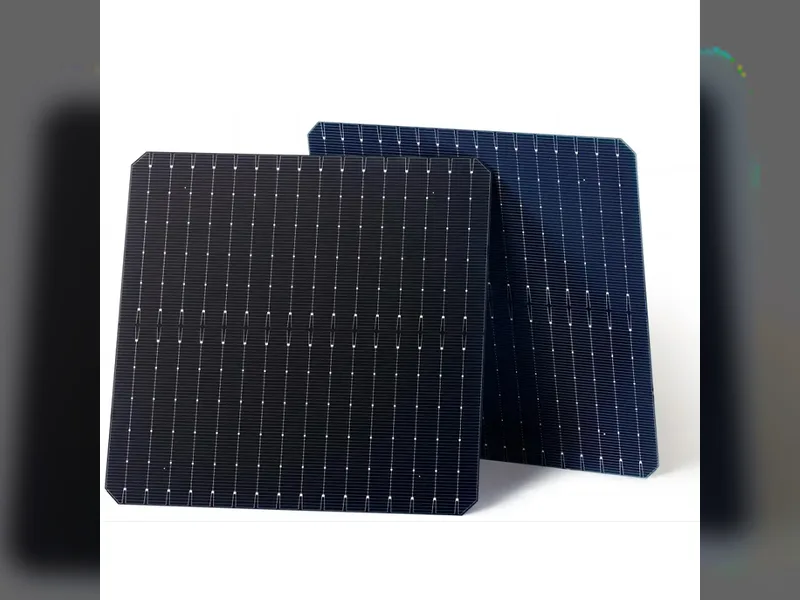
That break-room line pretty much sums up the shared anxiety of everyone running an n-TOPCon line these past two years. M10 full-size cells, mass-production efficiency stuck somewhere between 25.5% and 26%, and every extra 0.1% means grinding against recombination, contact, and silver paste. Then Jinko, together with the Ningbo Institute of Materials, drops this Nature Energy paper and pushes certified industrial M10 TOPCon efficiency straight to 26.66%, and casually pulls bifaciality up to 88.3% along the way. One sentence version: fix both electrical sides at once, instead of only chasing passivation or only chasing gridlines.
Yang, Z. et al. Dual-side electrical refinement enables efficient industrial tunnel oxide passivating contact silicon solar cells. Nat. Energy 11, 699-709 (2026). doi:10.1038/s41560-026-01982-2
26.66%, Where Did This New Step Come From
TOPCon "efficiency news" over the past year has honestly gotten a bit tiring to look at. 26.1%, 26.35%, mostly laser selective modification or minor boron emitter tweaks. This time Jinko's line cuts on both sides at once:
Front surface: high-sheet-resistance boron emitter plus gridline pattern optimization, pushing down recombination and transport loss.
Rear surface: double-layer poly-Si/SiOx structure, blocking silver diffusion, high-crystallinity inner layer, low inactive phosphorus in the substrate, and local thinning.
Certification platform: M10 industrial full-size cells, not lab-scale coupons.
That 88.3% bifaciality is actually more eye-catching than the absolute efficiency in the n-TOPCon world, and I'll explain why later.
Front Surface: High-Sheet-Resistance Boron Emitter, Dare to Push It
The old i-TOPCon front-surface contradiction: boron diffusion too heavy and Auger plus concentration recombination blows up; too light and the emitter lateral resistance gets big, the current under the fine fingers can't be collected, and you're back to forcing contact with LECO.
What this paper does (see the Figure 2 series):
Actively push the boron emitter sheet resistance up, once the passivation quality is there and the blue response is kept.
Re-run the busbar/finger pattern so the lateral transport loss gets eaten back at the gridline step.
On the metallization side, use a nano Joule-heating type approach (their same team's groundwork in Zhou et al., Small 2025 is in the references) to press down the Ag-Si contact resistance.
Figure 2's IQE/PL comparison shows it: the front-surface recombination current density j0 of the high-resistance emitter group clearly drops, and the fill factor doesn't collapse, which means the gridline plus local contact optimization really did patch the transport side back.
Gut reaction from a line engineer: the biggest trap with a high-resistance boron emitter isn't the electrical performance, it's the print firing-through window and compatibility with the LECO process. This is a team out of Jinko's own line (authors like Mao Jie and Wang Zhao are from Haining Jinko), which means this boron-diffusion-plus-gridline combo has most likely already run its DOE on the M10 line, it's not a pure lab recipe.
Rear Surface: Double Poly-Si Is the Real Heavy Lifting
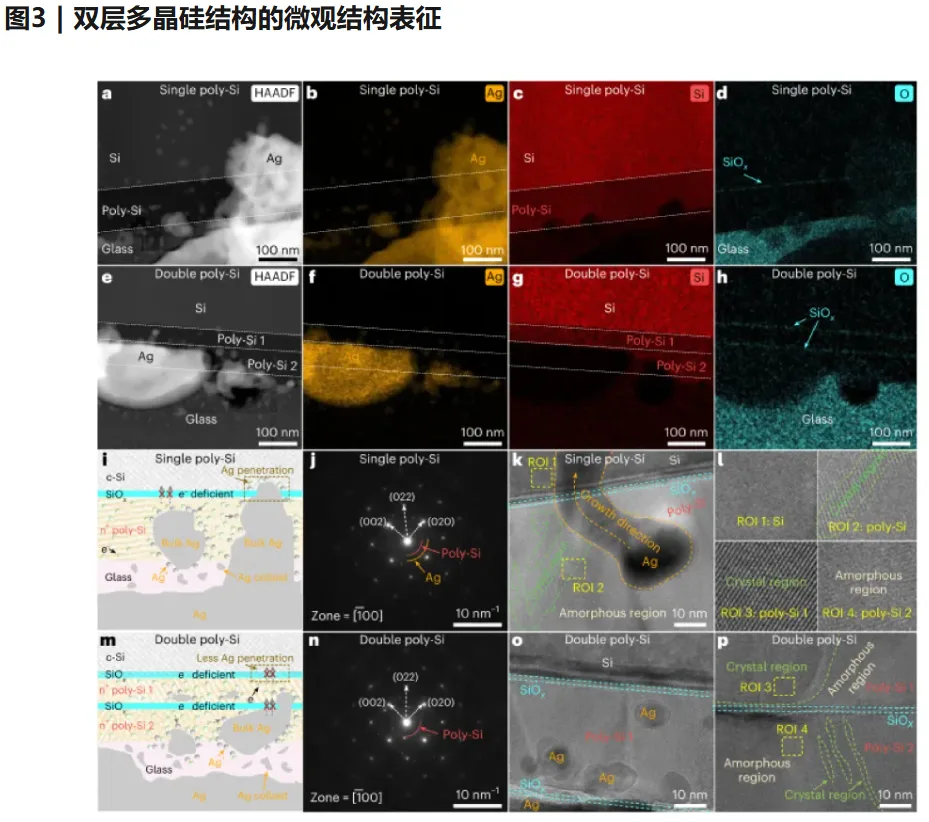
The rear-surface section is the most engineer-facing part of the whole paper (Figures 3 and 4).
Everyone knows the traps the traditional n+-poly / SiOx structure has stepped in:
During silver paste firing-through, Ag drills down toward the substrate along the grain boundaries, inducing interface states, and light-induced plus dark degradation blow up together.
Poly layer too thick and rear parasitic absorption eats the bifaciality; too thin and passivation plus contact can't stay stable.
The fix here is a rear-side double-layer tunnel oxide poly-Si (Figure 3 TEM makes the crystallinity and doping distribution difference between the two layers clear):
Outer layer leans "defensive": block silver diffusion, keep the interface passivation from being wrecked by metallization.
Inner layer leans "offensive": high crystallinity plus suppressed inactive P concentration on the substrate side, so passivation quality goes up (Figure 4's iVoc and j0 data back this up).
Locally thinned poly layer (likely LCO or laser-opened window regions): rear transmission goes up, bifaciality hits 88.3%.
In Figure 4's comparison curves, the double-poly group relative to the single-poly baseline:
Voc stays put (thanks to the high-crystallinity inner layer plus low inactive phosphorus).
FF isn't sacrificed (silver diffusion is stopped by the outer layer, contact resistivity doesn't blow up).
Bifaciality goes from a conventional TOPCon ~80% up to 88.3%, and this matters more for BOS cost than the 0.3% on the efficiency sheet.
Product Application
Drop the "Nature paper, must be expensive" reflex. For anyone actually running an n-TOPCon line, there are three things here you can basically copy straight:
Stop clinging to the old 80-100 ohm/sq menu for the boron emitter. Push it higher, recompute the gridlines, retune the LECO window, and 0.2-0.3% abs on the front surface is genuinely up for grabs.
Switch the rear poly from single layer to double. The outer layer isn't necessarily expensive, it's just one more CVD layer, but silver diffusion as a hidden failure mode is real money over a bifacial module's 25-year life.
Trade local poly thinning for bifaciality. It's a better deal than only optimizing glass and encapsulant. 88% bifaciality with a tracker, and the kWh cost math at the plant end speaks for itself.
Of course there are traps: the thermal budget of double-layer poly, the throughput and uniformity of laser local thinning, and how big the retrofit is versus an existing inline setup. The paper won't spell these out, but Jinko dared to hang a certified efficiency out there, which says at least the M10 pilot line is already running smoothly.
Open question: within the current TOPCon thermal budget of 1300+ high-temperature boron diffusion plus LECO, should you stack another laser selective modification layer on top (like the UV-ps route in Wang Q's 26.35% paper)? Or has the rear double poly already eaten the passivation-contact-bifaciality triangle trade-off to its limit, meaning the next step up should be switching to a BC structure rather than keeping on squeezing TOPCon?
Ooitech's View
What's quietly interesting here is that both of these levers, the high-sheet-resistance boron emitter and the rear double poly, live almost entirely on the cell side, yet the payoff shows up at the module level through that 88.3% bifaciality. On a module line, higher bifaciality changes how you think about layup, backsheet or glass choice, and stringer tension for thinner, more brittle cells, so the process window on the module side has to move with it. As turnkey module line builders working across formats from M10 to shingled and TOPCon, we watch these cell-level shifts closely, because they set the pace for what the downstream line has to handle. If you want to see how a modern module production line actually runs, the Ooitech YouTube channel at www.youtube.com/ooitech is worth a subscribe.