TOPCon Cell UVID Study: Non-Contact IV Testing Tracks Passivation Degradation and 6.72% Efficiency Loss
Table of Contents
TOPCon Cell UVID and Non-Contact IV Testing
TOPCon solar cells have gained a leading position in the photovoltaic market due to their strong surface passivation and carrier-selective contacts. Outdoor operation, however, exposes them to ultraviolet-induced degradation, or UVID. In this study, conversion efficiency fell by 6.72% after UV60 exposure.
Earlier work often linked UVID mainly to high-energy photons breaking Si–H bonds and releasing mobile hydrogen. The solar ultraviolet spectrum covers a much broader photon-energy range of 3.1–4.43 eV, so its interaction with front-surface materials cannot be explained by Si–H bond breaking alone. The front Al₂O₃/SiNₓ stack also shows much weaker UV resistance than the rear-side structure.
The Millennial Solar non-contact IV tester provides non-destructive testing with no consumables and millisecond-level measurement speed. It is compatible with back-contact and busbarless cell designs and can obtain multidimensional IV, EQE and PL parameters in one test sequence.
This study used time-of-flight secondary ion mass spectrometry, or ToF-SIMS, together with depth-profile X-ray photoelectron spectroscopy, or XPS, to track elemental distribution and chemical-bond changes in the Al₂O₃/SiNₓ layers before and after UV60 exposure. The results show that N–H bond breaking acts as a second hydrogen source in addition to Si–H bond breaking. UV exposure also damages Al–O bonds in amorphous Al₂O₃, creating large numbers of oxygen vacancies. The combined hydrogen and oxygen mechanisms increase surface recombination and provide a clearer basis for improving passivation-layer reliability.
Experimental Method
Millennial Solar
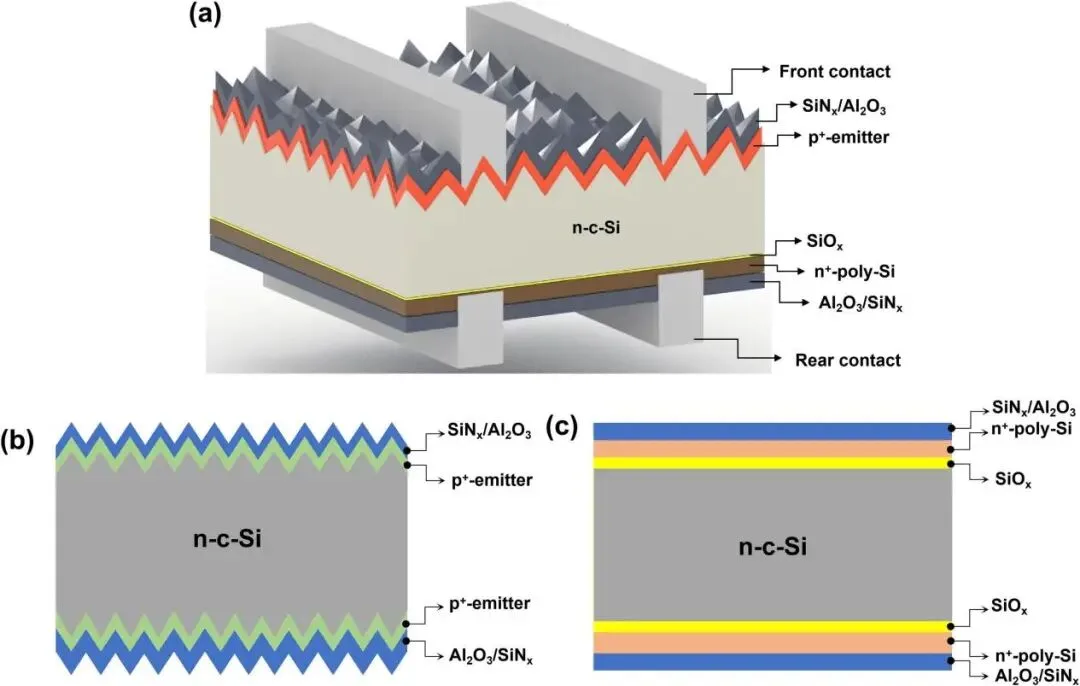
(a) Schematic structure of the TOPCon solar cell; (b) symmetric front-structure sample; (c) symmetric rear-structure sample.
Two symmetric sample structures were prepared. The front structure was SiNₓ/Al₂O₃/n-Si/Al₂O₃/SiNₓ. The rear structure included SiOₓ/n⁺-poly-Si layers. UV aging was carried out at module level using a light source dominated by UV-A with approximately 11% UV-B. The test conditions were 60°C and 30% relative humidity.
| Test item | Condition or configuration |
|---|---|
| Front symmetric sample | SiNₓ/Al₂O₃/n-Si/Al₂O₃/SiNₓ |
| Rear symmetric sample | Structure containing SiOₓ/n⁺-poly-Si layers |
| UV source | Mainly UV-A, with approximately 11% UV-B |
| Test temperature | 60°C |
| Relative humidity | 30% |
| Maximum reported UV dose | 60 kWh·m⁻², identified as UV60 |
| Main analysis methods | ToF-SIMS and depth-profile XPS |
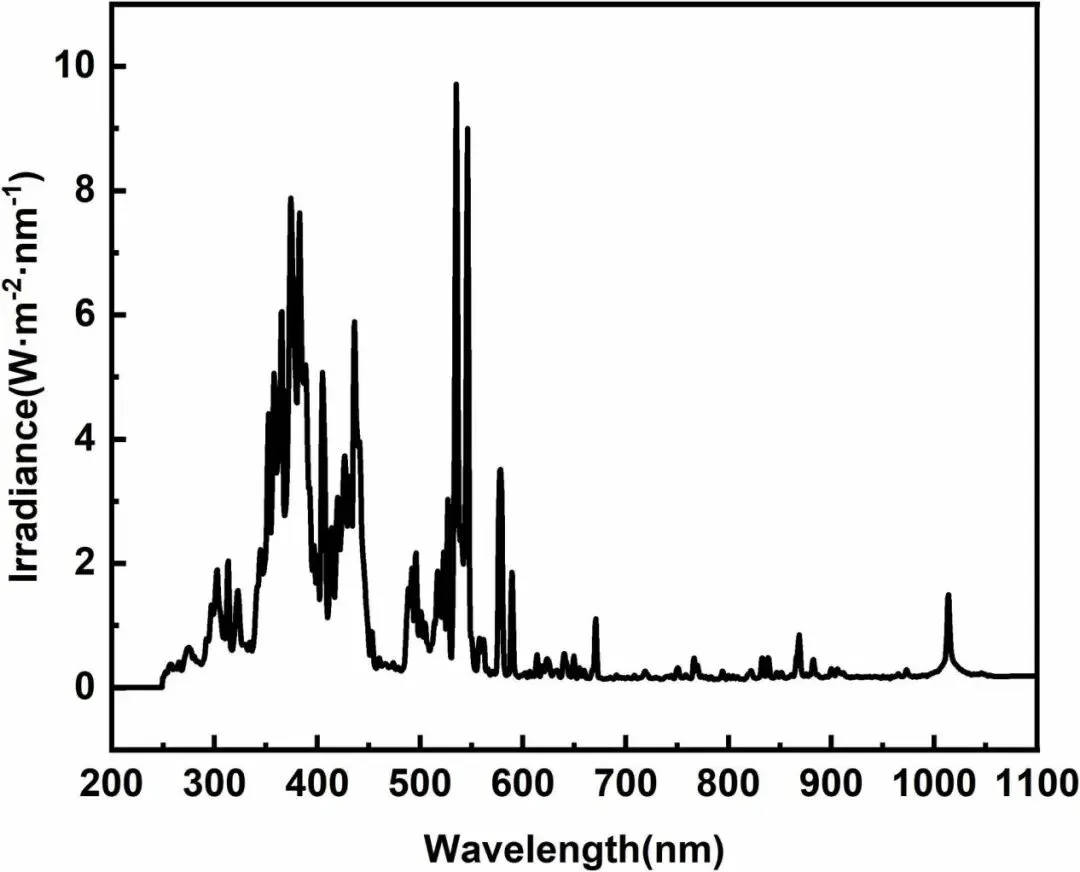
Spectral irradiance of the ultraviolet light source.
UV Resistance of Front and Rear Structures
Millennial Solar
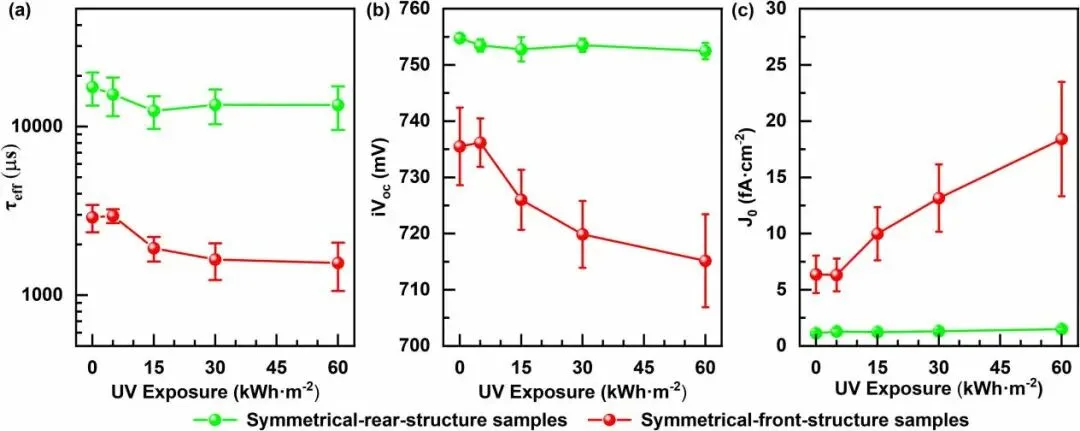
Changes in the symmetric front- and rear-structure samples during UV exposure: (a) effective carrier lifetime, τeff, at an injected carrier concentration of 1 × 10¹⁵ cm⁻³; (b) implied open-circuit voltage, iVoc; and (c) single-side saturation current density, J₀.
The symmetric rear structure showed only minor degradation after 60 kWh·m⁻² of UV exposure. Its 120 nm poly-Si layer absorbed nearly all incident UV radiation and provided effective protection to the underlying interface.
The symmetric front structure degraded much more severely:
Effective carrier lifetime, τeff, fell from 2,895.6 μs to 1,552.8 μs.
Implied open-circuit voltage, iVoc, decreased from 735.5 mV to 715.2 mV.
Single-side J₀ increased to 18.4 fA·cm⁻², approximately three times its initial value.
The Al₂O₃/SiNₓ passivation performance deteriorated substantially.
These results confirm that the front SiNₓ/Al₂O₃ stack is considerably more vulnerable to ultraviolet exposure than the rear SiOₓ/poly-Si structure.
Evolution of Chemical Composition
Millennial Solar
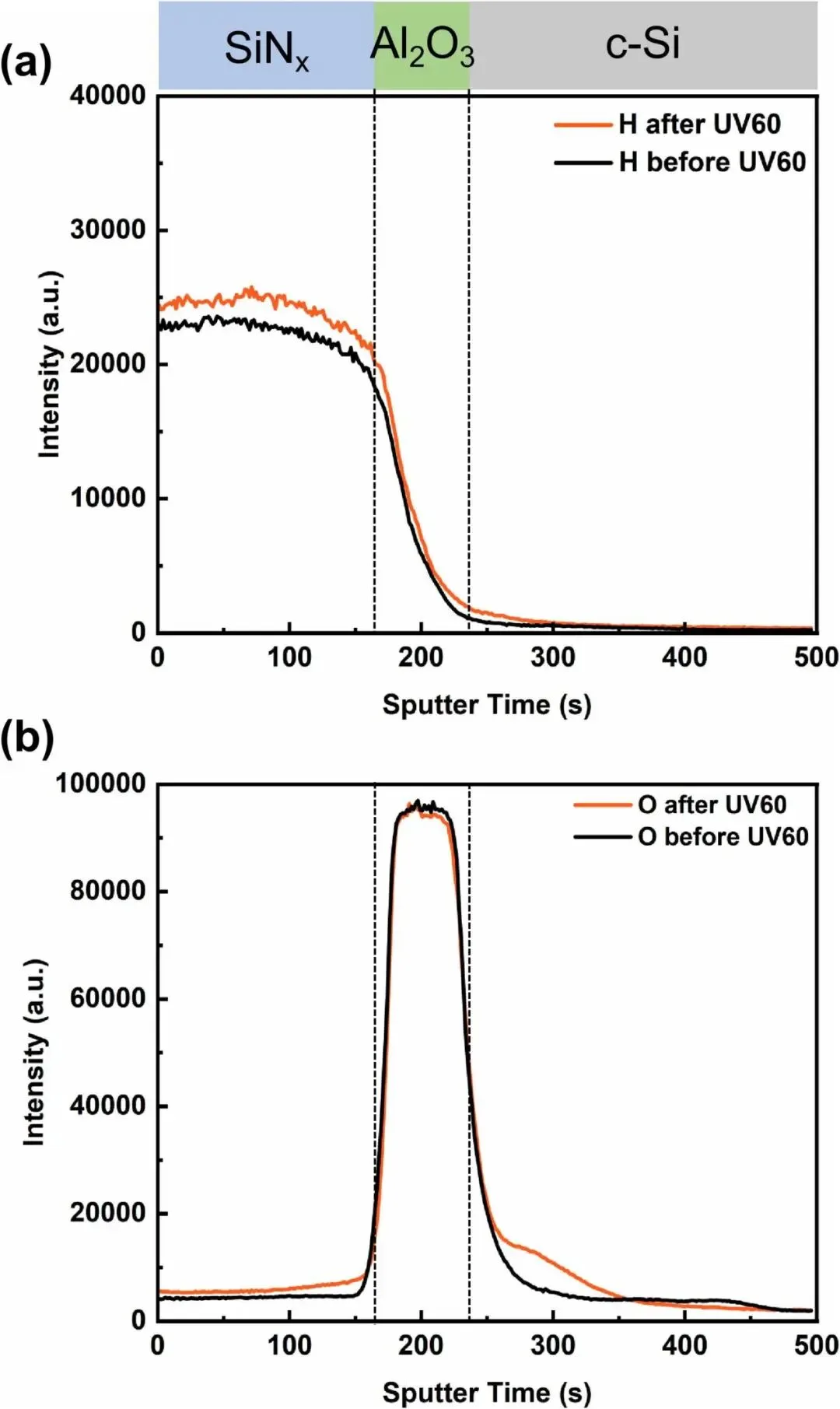
ToF-SIMS depth profiles of (a) hydrogen and (b) oxygen intensity in polished symmetric front-structure samples before and after UV60 exposure.
ToF-SIMS showed a clear rise in hydrogen concentration after ultraviolet exposure, especially inside the SiNₓ layer. Depth-profile analysis of the N 1s XPS signal found that the proportion of N–H bonds at the SiNₓ/Al₂O₃ interface decreased from 9.64% to 5.97%. This confirms that N–H bond breaking is another important hydrogen source alongside Si–H bond dissociation.
Some of the released hydrogen diffused toward the SiNₓ surface and bonded again with silicon. This explains why the local N–H proportion close to the surface increased rather than continuing to fall.
Oxygen evolution was also critical. The oxygen concentration inside the Al₂O₃ layer decreased slightly, while it increased at both the SiNₓ/Al₂O₃ and Al₂O₃/Si interfaces. This distribution indicates that oxygen released by Al–O bond breaking diffused outward from the Al₂O₃ film.
The Al–O bond energy in an ideal crystal is about 5.3 eV. Amorphous Al₂O₃ is different. Under-coordinated aluminum ions and negatively charged oxygen vacancies can lower the activation energy for breaking adjacent Al–O bonds to around 2.4 eV. A 400 nm ultraviolet photon carries about 3.1 eV, which is already sufficient to trigger this process.
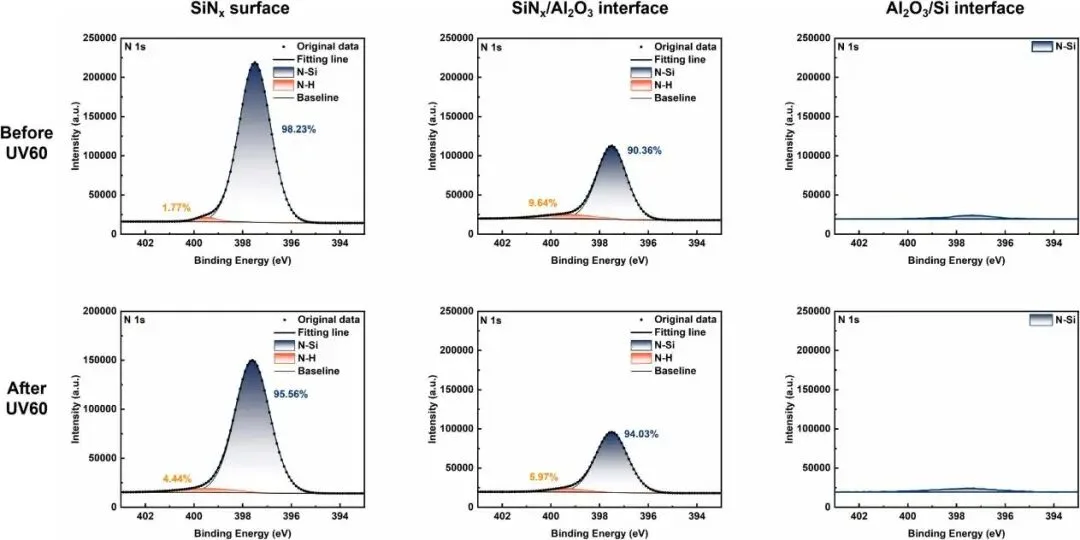
N 1s depth-profile XPS spectra at different Al₂O₃/SiNₓ interfaces before and after UV60 exposure, including fitted N–Si bonds at 397.5 eV and N–H bonds at 399.5 eV.
The O 1s XPS results showed a conversion from lattice oxygen, identified as OI, toward oxygen-vacancy-related components, identified as OII. In the Al 2p spectra, the Al₂O₃ proportion fell from 69.99% to 60.36%, while Al–OH increased from 30.01% to 39.64%.
The Si 2p spectra also showed an increase in Si²⁺ and a decrease in higher silicon oxidation states. Electrons released during oxygen-vacancy formation reduced silicon from higher oxidation states. These coordinated changes in oxygen, aluminum and silicon bonding indicate broad damage to the Al₂O₃ film rather than a single isolated bond-breaking reaction.
Electrical Performance Degradation
Millennial Solar
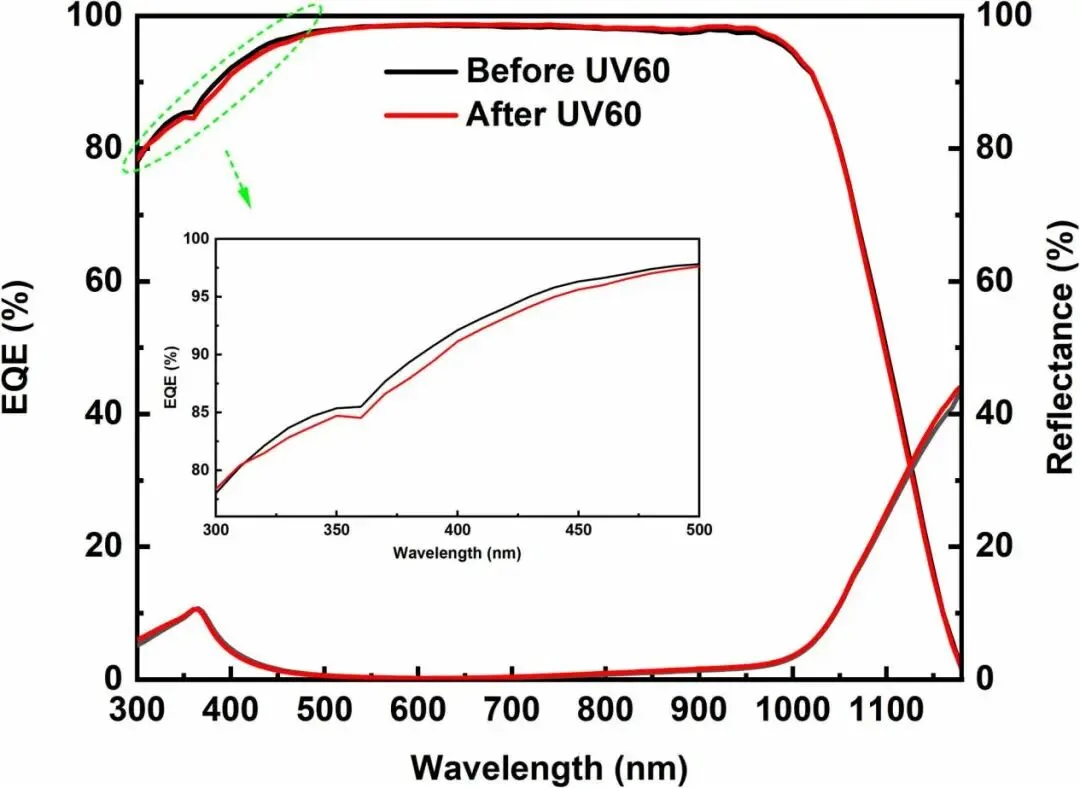
EQE and reflectance curves of the TOPCon solar cell before and after UV60 exposure.
Reflectance remained nearly unchanged after UV60 exposure. EQE showed a moderate decline in the short-wavelength region below 500 nm, which corresponds to stronger recombination at the front surface.
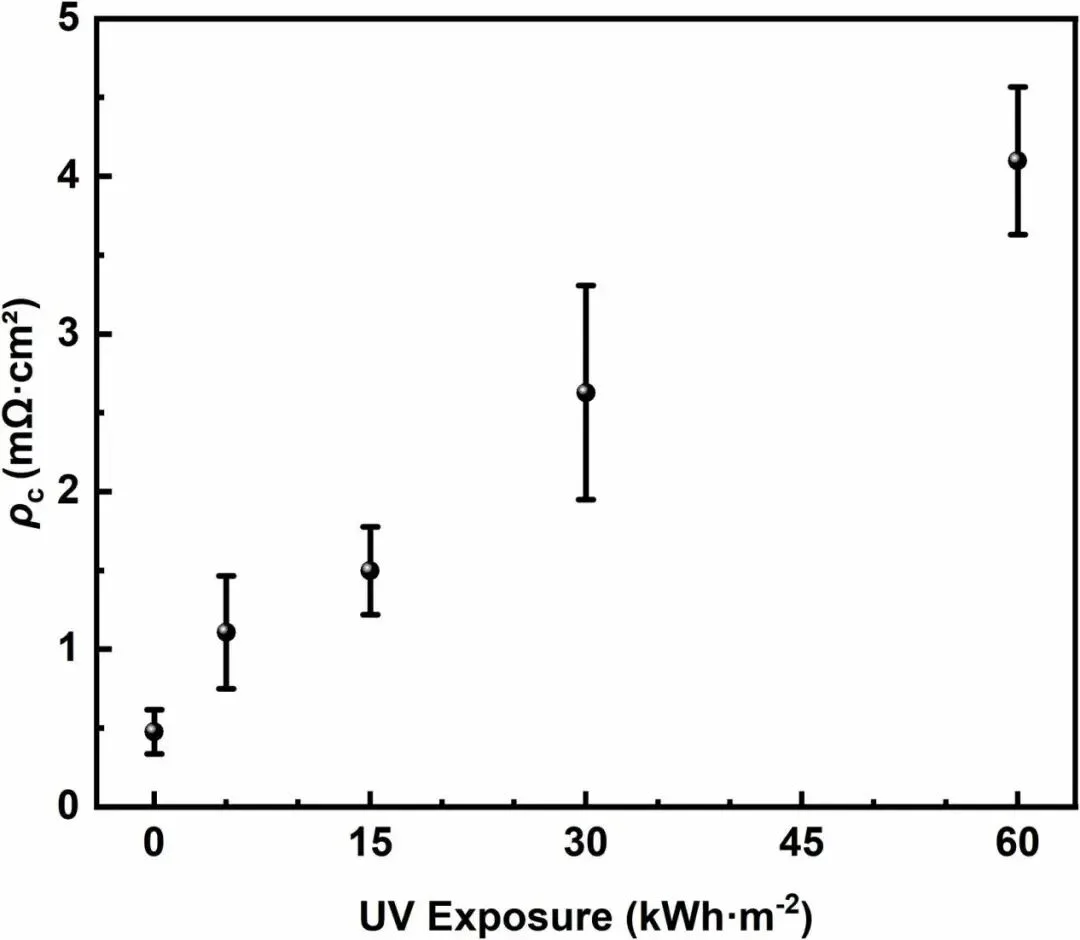
Change in front contact resistivity of the TOPCon solar cell during UV60 exposure.
Front contact resistivity increased almost linearly with UV dose, reaching 4.1 mΩ·cm², about 8.6 times its initial value. The proposed mechanism is linked to mobile hydrogen and oxygen generated inside the passivation layers. These species diffuse toward the electrode interface and participate in oxidation-reduction reactions.
UV radiation can also convert water molecules on the silver surface into hydroxyl radicals. Together, these reactions promote corrosion of the metal electrode and raise contact resistance.
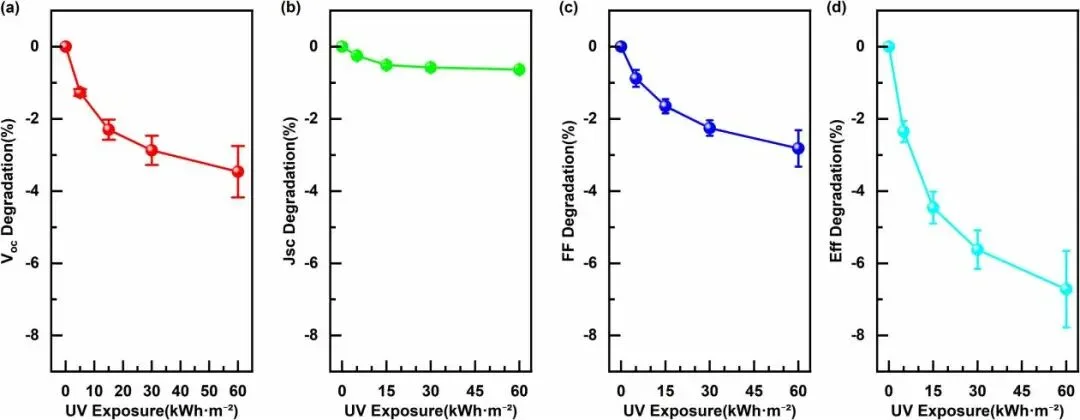
Electrical performance degradation of the TOPCon solar cell during UV60 exposure: (a) Voc; (b) Jsc; (c) FF; and (d) efficiency.
The final electrical losses were distributed across several parameters:
Voc decreased by 3.46%, mainly due to front-surface passivation degradation and the increase in J₀.
FF decreased by 2.82%, mainly because of the sharp rise in front contact resistivity.
Jsc decreased by only 0.64%, as the EQE loss was limited mainly to the short-wavelength region.
Conversion efficiency decreased by 6.72% after UV60 exposure.
The front SiNₓ/Al₂O₃ structure of the TOPCon solar cell therefore has much lower ultraviolet resistance than the rear structure. Under UV exposure, Si–H and N–H bonds break and release mobile hydrogen. Al–O bonds in amorphous Al₂O₃ are also damaged, releasing oxygen and generating a high density of oxygen vacancies. At the same time, Al₂O₃ shifts toward Al–OH and the silicon oxidation-state distribution changes.
The hydrogen- and oxygen-related degradation mechanisms work together to intensify surface recombination. The accompanying increase in front contact resistivity adds a separate electrical loss, leading to the measured 6.72% efficiency degradation. These findings offer a useful reference for understanding TOPCon UVID and improving the long-term reliability of front-side passivation stacks.
Ooitech's View
The key point is that TOPCon UVID cannot be treated as a simple Si–H bond problem. Passivation chemistry, oxygen-vacancy control and metallization stability need to be evaluated together, especially when qualifying module production processes for long outdoor service. Non-contact IV, EQE and PL tracking can help identify these losses earlier without adding mechanical contact damage to increasingly delicate cell designs.